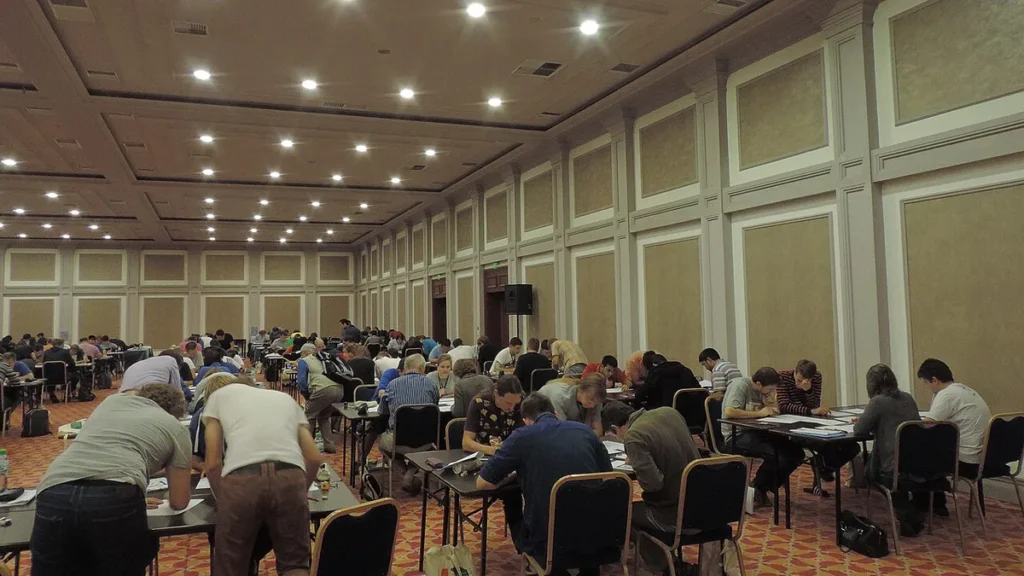
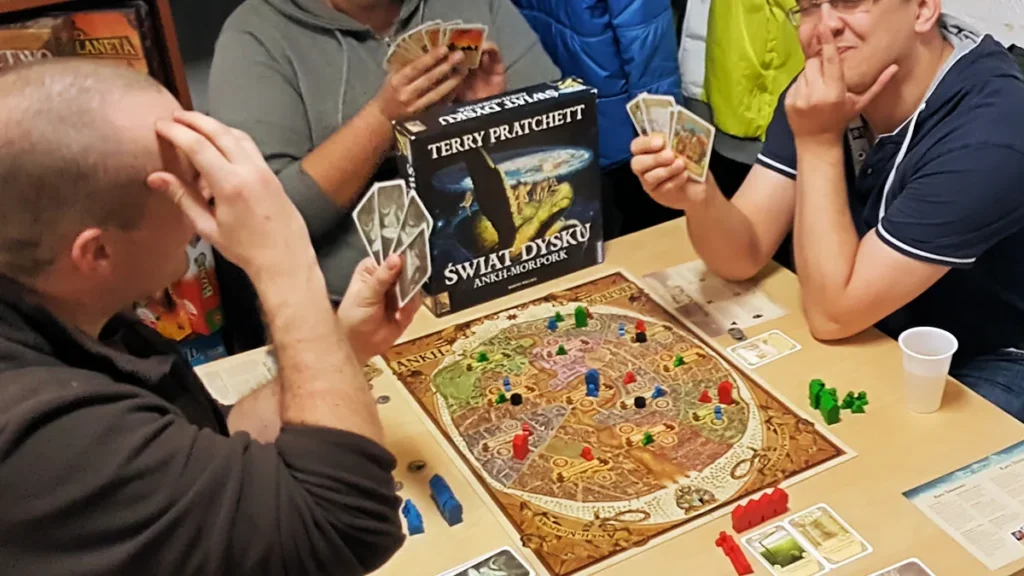
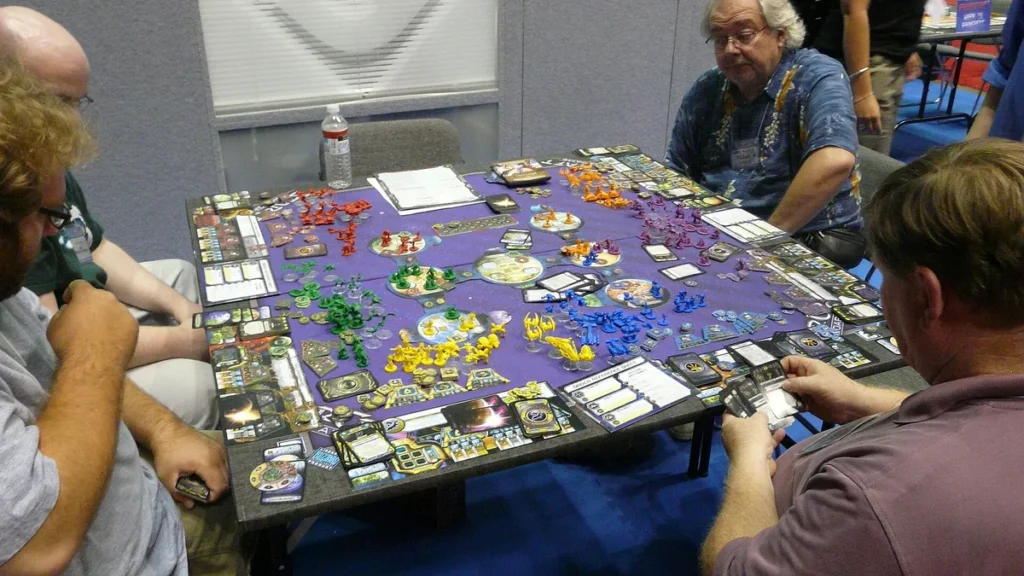
Finding the best board games for 188 players is a different challenge from choosing a game for a family night. No single board game seats 188 people around one table, and no honest list should pretend otherwise. The best board games for 188 players are the games that work brilliantly in parallel: the same game running at twenty or thirty tables at once, with a shared scoreboard, a shared schedule, and a format that keeps every player involved from the first round to the last.
That is exactly how large game nights, school events, company socials, church gatherings, and community festivals already work. Organisers split 188 players into tables of six to ten, run the same game or a small set of games at every table, and rotate players between rounds. The winners from each table advance, or every table contributes points to a team total. When the format is right, a crowd of 188 feels like one big event rather than thirty separate games happening in the same room.
This guide explains that format in full, then reviews the games that suit it best. Every game below was chosen because it is quick to teach, quick to play, easy to run at many tables at once, and fun for mixed groups of adults, teenagers, and families. You will also find a comparison table, a step-by-step organising plan, a checklist, and answers to the questions organisers ask most often before a night this size.
Key takeaways
- Split 188 players into tables of six to ten and run the same game at every table at the same time.
- Choose games that take 15 to 45 minutes, teach in under five minutes, and need little setup.
- Use a shared scoreboard so every table contributes to one event result.
- Rotate players between rounds so nobody is stuck at a slow or quiet table all night.
- Bring spare copies, spare pens, and a clear schedule, because a crowd this size has no room for delays.

How Board Games Work for 188 Players
The first decision is the format, and it matters more than any single game. With 188 players, you are not running one game. You are running a tournament, a festival, or a rotation. The simplest format is the parallel table format: divide the room into tables, put the same game on every table, and play three or four rounds in one evening. Each round lasts 20 to 30 minutes, and each table produces a winner or a set of points.
A second format works well when your group includes very different ages and tastes. Set up stations instead of one game. One corner runs a party game, another runs a word game, another runs a trivia game, and another runs a strategy game. Players move from station to station in groups, collecting points at each one. This suits community events because nobody has to play a game they dislike all night, and it keeps queues short because the crowd is spread across the room.
The third format is the team league. Split 188 players into teams of eight to ten, give each team a table, and let teams compete across several different games. Add up the points at the end of the night and crown one winning team. This is the best choice for company events and school competitions because it builds team spirit, gives quieter players a supportive group, and makes the final result easy to announce.
Best Board Games for 188 Players Compared
The table below compares the strongest choices for a crowd of 188. Player counts are per table, because that is how these games are actually played at a large event. Times are for one round at one table. Use the table to shortlist games, then read the reviews below for the detail that matters when you are buying twenty copies of the same game.
| Game | Players per table | Time per round | Best for | Setup |
|---|---|---|---|---|
| Codenames | 4 to 8 | 15 minutes | Team word play | Very easy |
| Telestrations | 4 to 8 | 20 minutes | Drawing and laughter | Very easy |
| Wavelength | 2 to 12 | 20 to 40 minutes | Discussion and debate | Easy |
| One Night Ultimate Werewolf | 3 to 10 | 10 minutes | Fast social deduction | Easy |
| Two Rooms and a Boom | 6 to 30 | 15 minutes | Very large groups | Moderate |
| Ticket to Ride | 2 to 5 | 30 to 60 minutes | Relaxed strategy | Easy |
| Catan | 3 to 4 | 60 to 120 minutes | Trading and strategy | Moderate |
| Azul | 2 to 4 | 30 to 45 minutes | Quiet, clever play | Easy |
| Sushi Go Party | 2 to 8 | 20 minutes | Quick card drafting | Very easy |
| Just One | 3 to 7 | 20 minutes | Cooperative word guessing | Very easy |
| Monopoly | 2 to 6 | 60 to 180 minutes | Classic long games | Easy |
| Trivial Pursuit | 2 to 6 | 45 to 90 minutes | Trivia teams | Easy |
Short rounds keep the whole event moving together, so favour games that finish in under 45 minutes for the main tournament.
The Best Board Games for 188 Players
Codenames
Codenames is the single best choice for a 188-player event. Two teams compete to find their secret words on a grid of twenty-five cards, guided only by one-word clues from their spymaster. A round takes about fifteen minutes, the rules take two minutes to explain, and the game rewards clever thinking rather than fast reflexes or deep game knowledge. That balance makes it fair for mixed groups where some players are experienced gamers and others have never played a modern board game. At scale, it is almost unbeatable: one inexpensive copy per table, tables running at the same pace, and a proper tournament where winners play winners. If your budget only stretches to one game repeated across the room, make it Codenames. The same parallel-table format works in our guide to the best board games for 186 players, and it transfers directly to a group of 188.
Telestrations
Telestrations is the drawing game that turns a room full of strangers into a laughing crowd within minutes. Each player draws a word, passes the sketchbook on, and the next player guesses what the drawing shows. The results get stranger and funnier with every pass, and the final reveal at each table is always the highlight of the round. Nobody needs to be good at drawing. In fact, bad drawings make the game better. For 188 players, it works because it feels non-competitive even though points are kept. Shy players relax quickly, children and adults can play together, and every table finishes at roughly the same time. Buy the party pack where you can, because it supports up to twelve players per table, and keep spare dry-erase markers on hand.
Wavelength
Wavelength is a discussion game built around a single dial. One player gives a clue that places a hidden target somewhere on a scale between two opposites, such as hot and cold, or brave and cautious. The rest of the team debates where the target sits, then places the dial. The conversation is the game, and the best rounds are the ones where a simple clue sparks five minutes of friendly argument. This game suits a 188-player event because it works with up to twelve players at a table and needs almost no pieces. It also gets better when the players at a table know each other well, which makes it a strong choice for company teams and family gatherings. Keep the rounds moving with a timer, because a lively table can happily debate one clue for ten minutes.
One Night Ultimate Werewolf
One Night Ultimate Werewolf packs a whole social deduction game into a single ten-minute round. Each player gets a secret role, most players are villagers, and one or two are werewolves hiding among them. After a short night phase, the table debates, accuses, and votes. The game ends quickly, the roles change every round, and nobody is eliminated early and left watching from the sidelines. Speed is what makes this game valuable at scale. You can run four or five rounds in an hour, rotate players between tables between rounds, and keep the energy high all evening. The free companion app handles the night phase with spoken instructions, so every table can run the game without a trained host.
Two Rooms and a Boom
Two Rooms and a Boom is the only game on this list designed from the start for very large groups. It supports six to thirty players in a single game, with the group split between two rooms. One team tries to protect its president, the other tries to find the bomber, and players swap rooms between rounds, sharing what they have learned. It is part game, part social experiment, and it creates the kind of shared stories people talk about for weeks. For 188 players, run six or seven separate games at once, each with about thirty players, or use it as the grand finale after an evening of smaller table games. It needs two rooms per game and a confident host for each group, so it takes more planning than a table game.
Ticket to Ride
Ticket to Ride is the calm, friendly strategy game that anchors many large events. Players collect coloured train cards and claim railway routes across a map, scoring points for completed journeys. The rules are simple enough to teach in five minutes, the turns are quick, and the game never feels aggressive. New players can compete with experienced ones from their very first game. At a 188-player event, it works best as a station rather than the main event. It seats only two to five players per copy, and a full game can run for an hour. Place it in a quiet corner and let it be the relaxed option for players who want a break from the noise.
Just One
Just One is a cooperative word game where everyone except one player writes a one-word clue to help that player guess a mystery word. The catch is that identical clues cancel each other out, so the table must think differently from each other while still being helpful. It is gentle, funny, and completely free of the tension that competitive games can create. This game deserves a place at a 188-player event because it welcomes players who do not enjoy competition. A round takes twenty minutes, the rules take one minute to explain, and you only need one copy and a set of pens per table.
Trivial Pursuit
Trivial Pursuit is the trivia classic, and in team form it is a strong fit for a crowd of 188. Split each table into two teams, ask the questions aloud, and let teams confer before answering. The six categories, geography, entertainment, history, art and literature, science and nature, and sports and leisure, give every player a chance to shine on a question in their own area. Team trivia turns a game for six players into a game for a whole table, and a good host can run the same questions for every table at once. Our guide to the best trivia games for 186 players explains how to run team trivia at scale, including scoring and tie-breakers. Keep a tie-breaker question ready, because a room this size will almost always produce a tie at the top.
How to Organise 188 Players on the Night
Good organisation is what separates a great 188-player night from a chaotic one. Start with the room. You need roughly twenty-five tables for 188 players at tables of seven or eight, plus space for a scoreboard, a welcome table, and a spare-games table. Arrange tables in rows with wide aisles so hosts can walk between them, and put the scoreboard where every table can see it. Test the lighting and the sound before anyone arrives, because a host who cannot be heard cannot run a timed event.
Next, plan the schedule and print it. A simple evening runs like this: thirty minutes for arrival and a warm-up game, then three rounds of thirty minutes each, with ten-minute breaks between rounds for rotation and scoring. Announce the round start and end times clearly, use a bell or a whistle rather than shouting, and keep a visible countdown timer on a screen if you can. Players forgive a game they lose, but they do not forgive an event that runs an hour late.
Scoring That Everyone Understands
Keep scoring simple enough to explain in one sentence. The easiest system is three points for a table win, one point for taking part, and a bonus point for the best team spirit as judged by the table host. Record scores on paper at each table and collect the sheets at the end of every round. Appoint one scorekeeper at the welcome table to enter the results, and update the visible scoreboard during each break so players can see where they stand.
Hosts and Helpers
You cannot run 188 players alone. Recruit one host per four or five tables, and give each host a printed sheet with the game rules, the round timings, and the scoring system. Hosts answer questions, settle disputes, keep tables on time, and collect score sheets. Brief them before the event, not during it, and give them a way to reach you quickly, such as a group chat. A calm, prepared host team is worth more than any single game on the shelf. For the livelier side of the evening, party games deserve their own space, and the planning in our guide to the best party games for 186 players covers room layout and rotation for exactly that kind of high-energy group.
Checklist for a 188-Player Board Game Night
- Book a hall with at least twenty-five tables, chairs for 188 players, and clear aisles between rows.
- Buy or borrow enough copies of each game so every table can play at the same time, plus two spare copies.
- Print the schedule, the rules summaries, the table numbers, and the score sheets before the event.
- Recruit and brief one host for every four or five tables, and give each host a printed rules sheet.
- Set up a visible scoreboard, a timer, and a bell or whistle for starting and ending rounds.
- Pack spare pens, pencils, dice, timers, batteries, and dry-erase markers, and test the sound system on arrival.
Frequently Asked Questions
Can one board game really seat 188 players?
No single board game seats 188 players around one table. The honest answer is to run the same game at many tables at once, with twenty-five or more tables playing in parallel and a shared scoreboard joining the results together. Two Rooms and a Boom comes closest to a single large game, supporting up to thirty players, but even that needs several parallel games for a crowd of 188.
How many copies of a game do I need for 188 players?
Divide 188 by the number of players each copy supports. For a game that seats eight, you need about twenty-four copies, plus two spares. For a game that seats four, you need about forty-seven copies, which is why short games with high player counts are the practical choice. Borrowing from a board game club or a library is often cheaper than buying every copy yourself.
How long should a board game night for 188 players last?
Plan for about three hours, including arrival, three rounds of play, and a short prize ceremony. Thirty minutes for arrival and warm-up, three thirty-minute rounds with ten-minute breaks, and fifteen minutes for results and prizes adds up to just over three hours. Longer events tire players out and make the hall booking much more expensive.
What is the best game for a mixed group of adults and children?
Telestrations and Sushi Go Party are the safest choices for mixed ages, because neither needs reading speed, general knowledge, or competitive experience. Just One is also excellent, since the whole table works together. Avoid games with long rules, heavy reading, or player elimination when children are playing, because a child who is eliminated in the first ten minutes will not enjoy the rest of the night.
How do I keep 188 players on the same schedule?
Use short rounds, a visible timer, and a loud signal to start and end each round. Announce the time remaining at ten minutes and at five minutes, and have hosts collect score sheets the moment a round ends. Never wait for the slowest table to finish before starting the next round, or the whole event will drift later with every round.
What prizes work best for a 188-player event?
Small prizes work better than one large prize. Give a small board game, a puzzle, or a gift voucher to the winning team, and give fun prizes for best team name, best sportsmanship, and best comeback. Prizes for several categories mean more players go home happy, and the ceremony takes five minutes instead of dragging on.
Bottom Line
The best board games for 188 players are the games that scale: short, simple, social games that run at twenty-five tables at once and join together on one scoreboard. Codenames is the strongest all-round choice, Telestrations brings the laughter, Wavelength starts the best conversations, and One Night Ultimate Werewolf keeps the pace fast. Build your night around those games, add a quieter station such as Ticket to Ride for players who want a break, and finish with a clear, simple scoring system that everyone can follow. Plan the room, brief your hosts, print your schedule, and bring spares of everything. Do that, and 188 players will feel like one great game night, not a crowd waiting for a turn.