Finding the best puzzle games for 193 players sounds like an impossible brief at first. Most puzzle games are built for one person on a couch, a pair at a kitchen table, or a small team in an escape room. A group of 193 people needs something different: games that split cleanly into teams, keep every player busy at the same time, and still feel like one shared event rather than a hundred separate tables doing their own thing. The best puzzle games for 193 players do exactly that, turning a huge crowd into a lively, competitive puzzle night where nobody sits idle.
The trick is structure. With 193 players, you need games that split cleanly into teams, keep every player busy at the same time, and still feel like one shared event. The games on this list do exactly that: team jigsaw races, puzzle hunts with stations, logic challenges in rounds, and digital games that let dozens of teams submit answers at once.
This guide ranks ten puzzle games that handle a crowd of 193, explains how to set each one up, and gives you a practical plan for running the night, whether you are organising a school event, a company social, a community fundraiser, or a very large family gathering.
Key takeaways
- Split 193 players into teams of 6 to 10 and run puzzle stations in rounds, so everyone plays at the same time.
- Jigsaw races, puzzle hunts, and logic quizzes scale best, because they need little equipment per team and no waiting turns.
- Pick games with clear rules you can explain in under two minutes, since a large crowd will not sit through a long briefing.
- Mix physical puzzles with pen-and-paper and digital rounds to keep energy high across a two-hour event.
- Score teams on speed and accuracy together, and keep a live leaderboard visible so every team stays in the race.

What Makes a Puzzle Game Work for 193 Players
A puzzle game that works for a handful of friends can fall apart completely with 193 players. The first test is whether everyone can play at once. Games built around taking turns are a poor fit, because 190 people waiting for their turn is not a game night, it is a queue. The strongest large-group puzzle games let every team work on the same challenge simultaneously, so the room hums with activity from the first minute.
The second test is clarity. With a crowd this size, you cannot walk around explaining rules to each table one by one. The best puzzle games for 193 players have rules that fit on a single card or a single slide, and they can be demonstrated in a minute or two. If a game needs a ten-minute tutorial, it will lose half the room before it starts. Simple rules also make the event fair, because every team starts with the same understanding of what to do.
The third test is scoring. A puzzle night for 193 players needs a way to compare teams that feels honest and exciting. The simplest approach combines speed and accuracy: points for finished puzzles, bonus points for finishing first, and small penalties for wrong answers in quiz-style rounds. A visible leaderboard, updated between rounds, keeps the competition alive and gives teams at the back something to chase.
How We Ranked the Best Puzzle Games for 193 Players
We ranked these games on five factors that matter most at large-group scale. First, scalability: how easily the game splits across 20 or more teams without extra staff or expensive equipment. Second, engagement: whether every player has something meaningful to do in every round. Third, simplicity: how quickly the rules can be explained to a mixed crowd.
Fourth, we looked at variety and replay value, since a puzzle night usually runs for two hours and a single type of challenge will feel repetitive. Fifth, we considered cost and setup time, because an organiser planning for 193 players needs formats that are affordable and can be set up by a small team in under an hour.
We also gave extra credit to games that work in different venues, from school halls and community centres to office floors and outdoor spaces. A game that only works in one specific setting is less useful for an organiser who has to work with whatever space is available. For a closer look at how a slightly smaller crowd is handled, see our guide to the best puzzle games for 190 players, which uses the same team-and-station format.
Best Puzzle Games for 193 Players at a Glance
| Game | Best for | Team size | Time per round | Setup |
|---|---|---|---|---|
| Team Jigsaw Race | Classic puzzle fun | 6 to 8 | 30 minutes | Low |
| Puzzle Hunt | Active large groups | 6 to 10 | 45 minutes | Medium |
| Logic Puzzle Quiz | Thinkers and quizzers | 6 to 10 | 20 minutes | Low |
| Escape Room in a Box | Drama and teamwork | 6 to 8 | 30 minutes | Medium |
| Word Puzzle Relay | Fast, noisy rounds | 8 to 10 | 15 minutes | Low |
| Cryptic Crossword Challenge | Word lovers | 6 to 8 | 25 minutes | Low |
| Digital Puzzle Tournament | Tech-friendly crowds | 6 to 10 | 20 minutes | Medium |
| Picture Puzzle Rounds | All ages | 6 to 10 | 15 minutes | Low |
| Maths Puzzle Sprint | Numbers people | 6 to 8 | 15 minutes | Low |
| Build and Solve Challenge | Hands-on players | 8 to 10 | 30 minutes | Medium |
The 10 Best Puzzle Games for 193 Players
1. Team Jigsaw Race
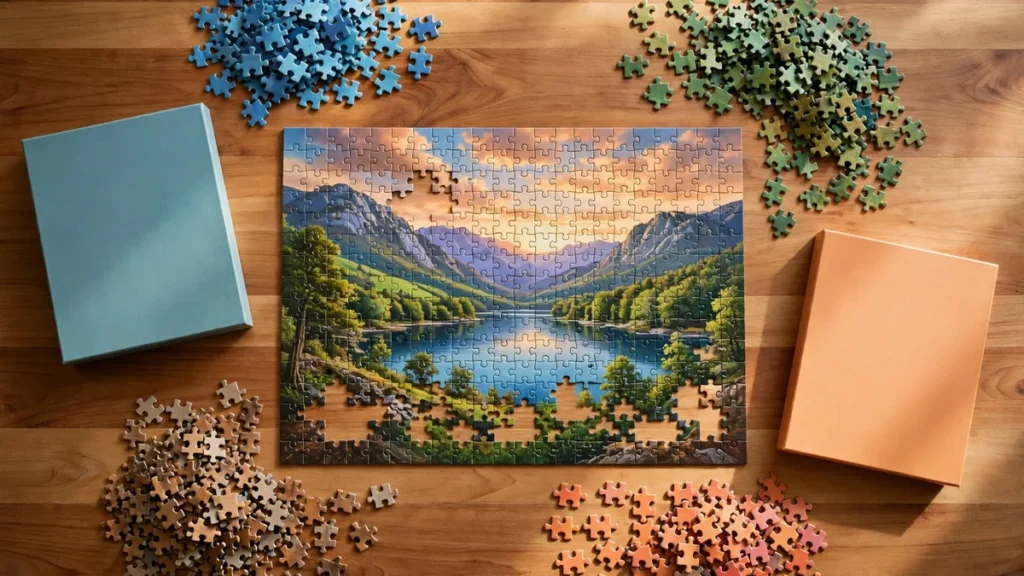
The team jigsaw race is the simplest large-group puzzle game, and often the most satisfying. Each team gets an identical jigsaw puzzle, usually 500 pieces, and races to finish it first. With 193 players, you will have around 25 teams, so you need 25 identical puzzles and 25 tables or table sections. The format works because every player can work on the puzzle at the same time, sorting edge pieces, building colour blocks, and filling in the middle.
Choose a puzzle with a clear, colourful image and distinct regions, so teams can split the work naturally, and avoid large areas of plain sky or sea. A 500-piece puzzle takes most teams 30 to 45 minutes. Award full points to the first three finishers and partial points to every team that finishes in time.
2. Puzzle Hunt
A puzzle hunt turns your venue into a game board. Teams move between stations, and at each station they find a puzzle to solve: a riddle, a code to crack, a pattern to complete, or a hidden object to find. Each solved puzzle earns a clue or a stamp, and the first team to collect them all wins. This format suits 193 players beautifully because the crowd spreads out across the space instead of crowding one area.
Plan eight to ten stations and stagger the starting points so teams do not bunch up at the first stop. Keep each station puzzle solvable in three to five minutes, with one volunteer per station to offer a small hint. Puzzle hunts also work outdoors in a park or around a campus, which suits summer events and fundraisers.
3. Logic Puzzle Quiz
The logic puzzle quiz is the easiest format to run for a very large group, because it needs almost no equipment. The host reads out or projects a logic puzzle, teams discuss it at their tables, and they write down their answer. Classic formats include grid logic puzzles, sequence puzzles, and short deduction problems where teams must work out who did what from a set of clues.
4. Escape Room in a Box
Escape room games in a box bring the excitement of an escape room to a hall full of teams. Each team gets a box containing a series of puzzles: locked compartments, coded messages, hidden compartments, and clues that lead from one puzzle to the next. Teams work against the clock to open the final compartment, usually within 30 minutes.
For 193 players you will need one box per team, which is the main cost of this format, but many kits are reusable and reset in a few minutes. Choose kits with a clear storyline and puzzles that need several people working in parallel, so no single player can solve the whole box alone.
5. Word Puzzle Relay
The word puzzle relay is fast, noisy, and perfect for lifting energy in the middle of the evening. Teams line up and send one player at a time to a puzzle board, where they must solve a word puzzle, such as an anagram, a word ladder, or a missing-letter puzzle, before tagging the next player. Each correct answer scores a point, and the team with the most points when time runs out wins the round.
6. Cryptic Crossword Challenge
A cryptic crossword challenge sounds like a quiet, expert-only activity, but run as a team race it becomes surprisingly lively. Give each team the same crossword grid and set of clues, and let them work together to fill it in. Teams naturally divide the work, with some players tackling the quick definitions and others wrestling with the cryptic wordplay.
For a mixed crowd, use a crossword designed for beginners, with straightforward clues and a few gentle cryptic ones. Score by the number of correct answers after 25 minutes, with a bonus for a fully completed grid.
7. Digital Puzzle Tournament
A digital puzzle tournament uses phones or tablets to run puzzle rounds that would be hard to manage on paper. Teams log into a quiz app or a shared puzzle platform, and the host sends out rounds of puzzles: picture puzzles, pattern sequences, memory challenges, and quick-fire brain teasers. Answers are submitted digitally and scored instantly, so the leaderboard updates in real time.
8. Picture Puzzle Rounds
Picture puzzle rounds are the most accessible format on this list, because they need no reading and no specialist knowledge. Teams are shown an image and asked a question about it: spot the difference, identify the odd one out, name the place, or work out what happens next in a sequence of pictures. These rounds are quick, visual, and fun for every age group.
Project the images onto a large screen so every team can see them clearly, and keep each question to one minute. Picture rounds suit family events where young children play alongside adults, because a child who cannot solve a logic grid can still spot a hidden object in a picture.
9. Maths Puzzle Sprint
The maths puzzle sprint is a short, sharp round built around number puzzles: sequences, magic squares, missing-number problems, and quick mental arithmetic challenges. Teams get a sheet of ten puzzles and fifteen minutes to solve as many as they can. The sprint format creates a burst of focused energy, and it rewards teams that split the sheet and work on different problems at the same time.
Keep the puzzles varied and the difficulty mixed, so teams with different strengths all contribute. Maths sprints pair well with a word round, since the two formats reward different skills. A similar team format appears in our guide to the best puzzle games for 189 players, which mixes number and word rounds in the same evening.
10. Build and Solve Challenge
The build and solve challenge is the most hands-on game on this list. Teams are given a set of building materials, such as blocks, interlocking bricks, or wooden pieces, plus a puzzle to solve that determines what they must build. For example, teams might solve a series of clues to discover a structure, then race to build it correctly before the other teams.
How to Run a Puzzle Game Night for 193 Players
Start by dividing 193 players into teams of 6 to 10, which gives you roughly 20 to 30 teams. Let people form their own teams where possible, then fill gaps so no team is too small. Give each team a name and a table number, and print a simple score sheet for every team.
Plan the evening in rounds of 15 to 30 minutes, with a short break between rounds for scoring. A typical two-hour programme might open with a picture puzzle round, move into a jigsaw race, follow with a logic quiz, and close with a relay or build challenge. Keep the host on a microphone throughout, announcing scores and the time remaining.
Recruit enough volunteers to keep the night running smoothly. You will need one scorekeeper, one person managing the leaderboard, and one helper per five or six teams for the hands-on rounds. For the physical games, such as jigsaws and escape boxes, set up the tables before players arrive so the first round can start on time. If you want more ideas for large-group table games, our guide to the best board games for 190 players covers formats that pair well with a puzzle night.
Choosing the Right Puzzle Game for Your Group
The right puzzle game depends on your players, your space, and your budget. For a school event with mixed ages, lean on picture rounds, word relays, and jigsaw races, which everyone can join without specialist knowledge. For a company social where colleagues want a challenge, add logic quizzes, cryptic crosswords, and escape room boxes to test teamwork under pressure.
Space matters too. A puzzle hunt needs room to move, so it suits a large hall, a campus, or an outdoor area. A logic quiz or digital tournament needs very little space, so it works in a smaller room or a venue with fixed seating. Budget matters as well: pen-and-paper rounds cost almost nothing, while escape room boxes and identical jigsaw sets need a real investment, though both can be reused for future events.
Your Puzzle Night Checklist
- Split 193 players into teams of 6 to 10 and print a team list with table numbers before the night begins.
- Prepare all puzzles, answer sheets, and score sheets in advance, with spares for every round.
- Test the venue sound system, projector, and Wi-Fi, and keep a paper backup for any digital round.
- Brief your volunteers on the rules and scoring for each round so they can answer questions at the tables.
- Set up tables, puzzles, and materials before players arrive so the first round starts on time.
- Keep a live leaderboard visible all evening and announce scores between rounds to hold the excitement.
Frequently Asked Questions
Can 193 people really play puzzle games together?
Yes, if you split the crowd into teams and run the games in rounds. No puzzle game seats 193 people at one table, but team formats, stations, and quiz rounds let every player take part at the same time. The key is choosing games that work in parallel rather than games that need players to take turns one by one.
How many teams should 193 players form?
Aim for 20 to 30 teams of 6 to 10 players each. Teams of this size are large enough to split puzzle tasks between members but small enough that everyone stays involved. If you have an uneven number, keep team sizes as close as possible so no team has a big advantage.
What is the best puzzle game for a mixed-age group of 193?
The team jigsaw race and picture puzzle rounds work best for mixed ages, because they need no specialist knowledge and let younger players contribute alongside adults. Add a word relay for energy and a logic quiz for the adults who want a harder challenge, and the evening will suit everyone.
How long should a puzzle night for 193 players last?
Two hours is a good length, with four or five rounds of 15 to 30 minutes and short breaks in between. Shorter events feel rushed with a crowd this size, while longer events tire people out, especially if some rounds are quiet and seated. Plan a clear finish time and stick to it.
Do puzzle games for 193 players cost a lot to organise?
It depends on the formats you choose. Pen-and-paper rounds, logic quizzes, and picture rounds cost very little beyond printing. Jigsaw races and escape room boxes cost more, but the puzzles and boxes can be reused for future events. A full evening can be run on a modest budget if you mix one or two bought formats with several low-cost rounds.
What prizes work well for a large puzzle night?
Small team prizes work best, such as a trophy for the winning team, medals for the top three teams, or a fun prize like a puzzle book for each member of the winning team. Avoid a single large prize that only one person can enjoy, and consider a small prize for the best team name or the most creative solution to keep the mood light.
The Bottom Line
The best puzzle games for 193 players are the ones that turn a huge crowd into a room full of small, busy teams. Team jigsaw races, puzzle hunts, logic quizzes, and escape room boxes all scale well because they let everyone play at once, use rules that take a minute to explain, and reward different strengths across the evening. Mix physical, paper, and digital rounds, keep the scoring visible, and give every team a round where it can shine.
Plan the night around teams of 6 to 10, prepare everything in advance, and keep the pace moving with a confident host and a live leaderboard. Do that, and 193 players will not feel like a logistical problem. They will feel like the best puzzle night you have ever run.


