Finding the best card games for 149 players starts with an honest fact: no single card game seats 149 people at one table. A standard deck has 52 cards, a large table holds about eight players comfortably, and even the biggest party card games top out at twenty players. That does not mean a 149-player card night is impossible. It means the night has to be organised differently, with many tables playing at the same time, shared rules, and a format that keeps every player involved from the first deal to the final round.
Card games for 149 players work best when you stop thinking of one game and start thinking of one event. You need enough decks, enough tables, a clear rotation plan, and games that are quick to learn so that nobody spends the evening waiting for an explanation. The games in this guide were chosen because they are simple, fast, and easy to run in parallel. They suit school events, company gatherings, community halls, family reunions, and youth groups, and they work for mixed ages and mixed experience levels.
This guide explains the three formats that make a 149-player night work, compares eight card games that scale well, and gives you a practical setup plan, a sample schedule, and a checklist you can follow on the day. You will not need special equipment beyond decks of cards, tables, chairs, score sheets, and a little planning. With the right structure, 149 players can enjoy a lively, fair, and genuinely social card night.
Key takeaways
- No single card game seats 149 players, so plan for multiple tables, team play, or a tournament format.
- Choose fast, simple games such as Uno, Rummy, Hearts, Spoons, Crazy Eights, and War.
- Use at least 25 tables for 149 players, with six players per table, plus a few spare tables.
- Keep rounds short, use a shared scoreboard, and rotate players between tables.
- Prepare at least 30 decks of cards, printed score sheets, timers, and clear written rules for every table.
Card Games for 149 Players at a Glance
The table below compares the six games in this guide. It shows how many players each game suits at one table, how long a round usually takes, and how well it works when many tables play at once. Use it to pick a mix of games for your event, rather than running the same game everywhere.
| Game | Players per table | Round length | Best for | Scales to 149 players |
|---|---|---|---|---|
| Uno | 2 to 10 | 15 to 30 minutes | Families and mixed ages | Excellent |
| Rummy | 2 to 6 | 20 to 40 minutes | Classic card players | Excellent |
| Hearts | 3 to 6 | 20 to 30 minutes | Quiet, focused tables | Very good |
| Spoons | 3 to 13 | 5 to 15 minutes | Fast, noisy fun | Excellent |
| Crazy Eights | 2 to 7 | 15 to 25 minutes | Beginners and children | Excellent |
| War | 2 | 10 to 20 minutes | Tournaments and relays | Good |
Why No Single Card Game Seats 149 Players
A card game is limited by its deck, its table, and its turn structure. A standard 52-card deck gives each player only a handful of cards once you pass ten players, and turns become so long that most players spend their time waiting. A game that works for four to eight people becomes slow and confusing at twenty, and unplayable at 149. The cards run out, the table runs out of space, and the players at the far end cannot see the play.
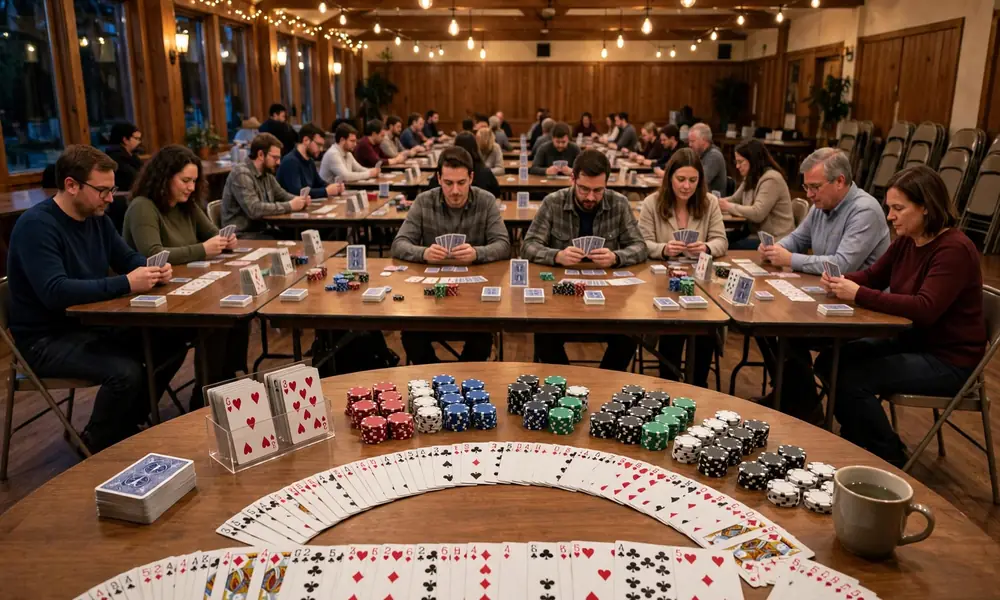
Large-group card nights solve this by splitting the group. Instead of one game for 149 players, you run twenty-five games for six players each, all at the same time. Every table uses its own deck, every player gets a full hand, and every round finishes in a reasonable time. The shared event comes from the common scoreboard, the rotation between tables, and the final rounds that bring the best players together.
How Card Games for 149 Players Actually Work
There are three proven formats for a group of 149 players. You can use one of them for the whole night, or combine them: start with multiple tables, move into team play, and finish with a tournament. The best choice depends on your venue, your players, and how much time you have. If you are planning a similar event with one fewer player, the ideas in our guide to the best card games for 148 players show how the same formats adapt to a slightly smaller group.
Multiple Tables, One Shared Scoreboard
The simplest format is also the most reliable. Set up 25 tables with six players each, leaving one spare seat for a floater or a late arrival. Every table plays the same game for a fixed round, usually 20 to 30 minutes, and records its scores on a shared sheet. At the end of each round, players rotate to new tables so they meet different opponents. After three or four rounds, the players with the highest total scores move to the final tables.
This format works because it is easy to explain and easy to run. Each table needs only one person who knows the rules, and the host can announce round changes over a speaker or with a bell. It also keeps the room lively, because every table is playing at the same time and nobody is sitting out. The shared scoreboard gives the night a sense of progress, and players can check their standing between rounds.
Team Play Across the Room
Team play divides 149 players into teams of about six, with each team spread across several tables. Team members earn points for their team whenever they win a hand or finish near the top of their table. The team with the most points at the end wins, which means every player matters, even if they never win a whole table outright. This format suits school events and company nights, where people already belong to a class, a department, or a house.
Team play also solves the problem of mixed skill levels. A beginner who finishes third at a strong table still earns points for the team, so they stay motivated. Strong players cannot carry a team alone, because points come from many tables at once. Give each team a colour, a name, and a captain who collects scores, and the room quickly fills with friendly rivalry. Keep the scoring simple, such as three points for first place, two for second, and one for third, so that nobody needs a calculator.
Tournament and Relay Formats
A tournament format works well for the second half of the night. After two warm-up rounds at mixed tables, the top players from each table move forward to quarter-final tables, then semi-finals, then a final table. The remaining players keep playing at social tables, so nobody is eliminated and sent home early. This gives competitive players something to aim for while keeping the event welcoming for everyone else.
A relay format is a good alternative when you want constant movement. In a relay, each table plays a short game, and the winner moves up a table while the lowest scorer moves down. After several rounds, the strongest players have climbed to the top tables and the newest players have found tables at their level. Relay play keeps every round meaningful, because a single win changes where you sit next. It also mixes the group naturally, which suits events where many players do not know each other yet.
The Best Card Games for 149 Players
The six games below were chosen for three reasons: they are quick to learn, they finish in under 45 minutes, and they work when many tables play them at once. Each one suits a different mood, so you can run two or three different games across the room and let players choose the table that appeals to them. All of them use a standard deck of cards, except Uno, which uses its own deck.
Uno
Uno is the easiest game in this guide to run at scale, because almost everyone already knows it and a round takes only 15 to 30 minutes. Each table needs one Uno deck, and players race to get rid of their cards by matching colours and numbers, using action cards to skip, reverse, and force other players to draw. The rules are simple enough for children and fast enough for adults, which makes Uno a natural choice for mixed-age events.
For 149 players, Uno works best in the multiple-table format. Put an Uno deck on every table, set a 25-minute round timer, and award points to the first three players to finish at each table. You will need about 25 Uno decks for a full room, so buy or borrow them in advance and check that every deck is complete. Keep a spare deck at the host table for any table that loses a card during play.
Rummy
Rummy is a classic choice for players who enjoy building sets and runs. Each player aims to form matching groups of cards, drawing and discarding in turn until they can lay down their whole hand. A round for six players takes 20 to 40 minutes, which fits well into a schedule of three rounds plus a final. Rummy rewards patience and planning, so it suits tables where players want a quieter, more thoughtful game.
Hearts
Hearts is a trick-taking game for three to six players in which the aim is to avoid winning tricks that contain hearts or the queen of spades. It is easy to learn but hard to master, because players must watch every card and plan several moves ahead. A round takes 20 to 30 minutes, which makes Hearts a good fit for a standard rotation schedule. It works well at quieter tables, away from the noise of faster games.
Spoons
Spoons is the loudest and fastest game in this guide, and it is perfect for breaking the ice at the start of the night. Players pass cards around the table, trying to collect four of a kind, and then grab a spoon from the centre. There is always one fewer spoon than there are players, so the slowest player loses the round. A round takes only 5 to 15 minutes, which means you can play several rounds in the time it takes to finish one game of Rummy.
Spoons works brilliantly for 149 players because it creates energy. Set up several Spoons tables in the middle of the room, use plastic spoons to avoid breakage, and keep the rounds short so that players can join in without a long commitment. Spoons is also a good warm-up game: play two quick rounds of Spoons, then move players to their main tables for the longer games. Make sure there is enough space around each Spoons table, because players reach quickly and chairs can slide.
Crazy Eights
Crazy Eights is one of the simplest card games ever made, and that simplicity is its strength at a large event. Players match the card on the discard pile by number or suit, and eights are wild, so they can be played at any time. A round takes 15 to 25 minutes, and the rules can be explained in under a minute. Crazy Eights suits beginners, children, and anyone who has never played cards before.
War
War is a two-player game of pure chance, which makes it perfect for tournaments and relays. Each player turns over a card, the higher card wins both, and tied cards trigger a war, where extra cards decide the winner. A match takes 10 to 20 minutes, and no skill is needed, so War is fair for players of every age and ability. Its simplicity also means it needs no explanation beyond the first minute.
What You Need to Set Up 149 Players
Good preparation makes the difference between a smooth card night and a chaotic one. Start with the room: you need at least 25 tables and 150 chairs, arranged with enough space between tables for players to move during rotation. A community hall, school hall, or large function room works well. Leave a clear area near the entrance for registration, and a host table near the centre where the scoreboard is visible to everyone.
For cards, bring at least 30 standard decks and 25 Uno decks, plus a few spares. Check every deck before the event, remove jokers unless the game needs them, and keep decks in their boxes until they are handed out. You will also need printed score sheets, pens, timers, table numbers, and a bell or speaker for announcements. If you are also planning board games for the same crowd, our guide to the best board games for 149 players covers the extra tables, space, and timing that board games need at this scale.
People matter as much as equipment. You need one host to run the night, one scorer to manage the scoreboard, and at least one helper for every five tables. Helpers hand out decks, answer rule questions, collect score sheets, and guide rotation. Brief every helper before the event, give each one a printed copy of the rules and the schedule, and make sure they know where the spare decks and score sheets are kept.
A Sample Schedule for a 149-Player Card Night
A three-hour schedule works well for 149 players. Allow 30 minutes for arrival and registration, during which players can join a quick game of Spoons or Crazy Eights. Then run three main rounds of 30 minutes each, with a 10-minute break between rounds for rotation and score updates. Finish with a 30-minute final round for the top players, while the rest of the room plays social games. Leave 15 minutes at the end for results, prizes, and a group photo. For a broader party plan that mixes cards with other activities, see our guide to the best party games for 148 players.
Your 149-Player Checklist
Use this checklist in the week before your event, and again on the day itself. Tick each item off as you complete it, and keep a copy at the host table so that helpers can check it too.
- Book a hall with at least 25 tables and 150 chairs, plus space for rotation.
- Buy or borrow 30 standard decks and 25 Uno decks, and check every deck is complete.
- Print score sheets, rules cards, table numbers, and the schedule for every table.
- Recruit one host, one scorer, and at least five helpers, and brief them before the event.
- Set up a visible scoreboard and a timer, bell, or speaker for round changes.
- Plan prizes for the top players and the top team, and bring a camera for the final photo.
Frequently Asked Questions
Can 149 people really play card games together?
Yes, but not at one table. A 149-player card night works as many small games played at the same time, linked by a shared scoreboard, rotation, and final rounds. Every player gets a full hand and a real game, while the event as a whole feels like one shared night.
How many tables do I need for 149 players?
You need 25 tables for six players each, which seats 150 people. That leaves one spare seat for a floater, a helper, or a late arrival. Add two or three spare tables if you have the space, so that any table with a problem can move without disrupting the room.
How many decks of cards should I bring?
Bring at least 30 standard decks and 25 Uno decks, plus spares. Each table needs its own deck, and a few decks will always go missing or lose a card during a busy night. Check every deck before the event and keep the spares at the host table.
What is the best card game for 149 players?
Uno is the best all-round choice, because it is fast, simple, and suits mixed ages. Rummy is the best choice for classic card players, and Spoons is the best choice for energy and fun. Most successful nights run two or three different games across the room, rather than one game everywhere.
How long should a 149-player card night last?
Plan for about three hours, including arrival, three main rounds, a final round, and results. Shorter nights feel rushed, because rotation and scoring take time, while longer nights tire players out. A three-hour schedule with clear breaks keeps energy high from start to finish.
Do I need prizes for a 149-player card night?
Prizes help, but they do not need to be expensive. Small prizes for the top three players, the top team, and the best newcomer are enough to add excitement. You can also give a fun prize for the friendliest table, which rewards good spirit as well as good cards.
The Bottom Line
The best card games for 149 players are not played at one giant table. They are played at 25 small tables, at the same time, with shared rules, short rounds, and a scoreboard that brings the whole room together. Uno, Rummy, Hearts, Spoons, Crazy Eights, and War all scale well, because they are fast to learn, quick to finish, and fun for players of every age. With enough decks, enough tables, and a clear schedule, 149 players can enjoy a card night that is organised, fair, and full of life. Plan the room, brief your helpers, keep the rounds moving, and let the cards do the rest.