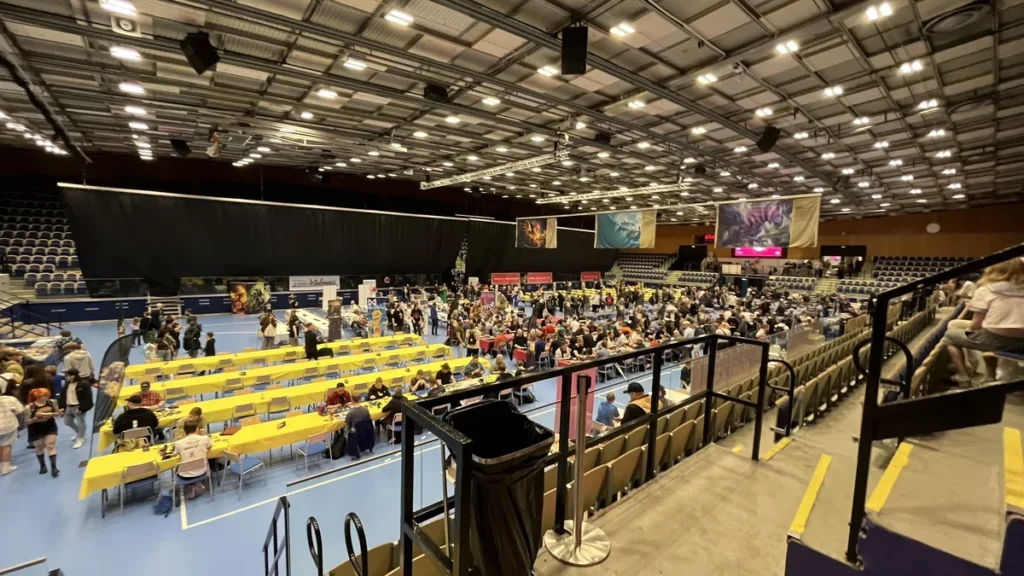
Word games for 413 players sound impossible until you watch a hall full of people play them. Four hundred and thirteen players cannot gather around one board, shout answers at one host, or wait in a single line for a turn. Yet word games are among the few kinds of play that genuinely scale to a crowd this size: they need almost no equipment, suit every age, and reward teamwork rather than one star player. Every member of a team can contribute something different, whether that is spotting a pattern, remembering a spelling, or keeping the team on time.
The secret is to stop thinking of 413 players as one giant group and start thinking of them as 59 small teams. Split the crowd into teams of seven, set up nine game stations around the hall, and let every team play the same nine games at the same time. Nobody waits, nobody watches from the sidelines, and each ten-minute game keeps the hall loud from the first round to the last. With 59 teams of seven, the maths works out exactly, so nobody is left without a team.
Here are nine word games built for exactly that format. Each one uses the same materials for every team, produces a clear score, and works for mixed ages. Play them in any order, keep the pace brisk, and finish with a shared final round on stage.
Key takeaways
- Split 413 players into 59 teams of seven, which uses every player with nobody left over.
- Run nine ten-minute word games at stations, with every team playing at once.
- No game needs more than paper, pencils, printed sheets, letter tiles, and a timer.
- Score one point per correct answer, keep one visible leaderboard, and settle ties with one question on stage.
- Every game works for mixed ages, because spelling, memory, and quick thinking come from different kinds of experience.

Why Word Games Work for 413 Players
Word games scale better than almost any other kind of party game because they need so little equipment. A board game built for four players breaks down when forty people want to join, but a word game only needs a printed sheet, a pencil, and a timer. The host prepares one set of word lists, prints them in bulk, and every team gets exactly the same challenge. There is no expensive kit to buy, no screen to wire up, and no single piece of equipment that the whole hall has to share.
Word games also suit mixed groups better than most alternatives. A hall of 413 players will include quick spellers, quiet thinkers, and people who simply enjoy a laugh with friends. Because most word games reward teamwork rather than one star player, every team member can contribute something different: one person spots the pattern, another remembers the spelling, and a third keeps the team on time. The format used for word games for 411 players shows the same team and station system working at nearly the same scale, and it transfers neatly to a crowd of 413.
There is another advantage that only shows up at this size. With 413 players in the room, every round produces dozens of different answers, and reading the best ones aloud becomes part of the entertainment. The games below are chosen to produce those moments: they all have open answers, so teams surprise each other instead of simply racing through a fixed list.
Teams and Stations: The System That Holds 413 Players Together
Teams of seven work well for 413 players because seven divides the crowd exactly: 59 teams of seven gives you 413 players, with no one left over. A team of seven is large enough for a good mix of skills and small enough that everyone still gets a say. It can split into pairs for a fast round, vote quickly on an answer, and still hear every member. Larger teams start to lose quiet players, and smaller teams struggle when one member is away from the table.
Give every team a captain before the first game starts. The captain collects the answer sheets, hands them to the score table, and settles small disagreements inside the team. Captains also move their teams at each rotation, so nobody has to be herded one by one. The station system that works for word games for 409 players scales neatly to a crowd of 413, because the only thing that changes is the number of teams.
Stations are the second half of the system: nine stations around the room, one for each game, with teams rotating in a fixed order. Each station needs a volunteer host with the word lists, a timer, and a scoring sheet. Print the same materials for every team: answer sheets, pencils, and any word lists the game needs. Keep a central score table where captains hand in sheets at the end of every rotation, and one leaderboard the whole room can see. Announce the next game while scores are being collected, so the hall never goes quiet.
The 9 Word Games for 413 Players
Each game below runs in about ten minutes, uses the same materials for every team, and produces a clear score. Play them in any order, and keep the pace brisk.
1. Anagram Relay Race
Anagram Relay Race turns a pile of jumbled letters into a team sprint. The host gives each team a sheet with ten scrambled words, such as listen, stressed, and dusty, and teams must unscramble as many as they can in five minutes. Listen becomes silent, stressed becomes desserts, and dusty becomes study. Every team gets the same sheet, so the race is fair from the first second.
Score one point per correct unscrambled word, with a bonus of three points for the team that finishes the whole sheet first. Run a second, harder round if the first finishes quickly, using longer words such as conversation and astronomer.
2. Homophone Hunt
Homophone Hunt hands each team a list of words that sound the same but mean different things, and the race is to find both spellings. The host reads out a clue such as a flower and a baking ingredient, and teams must write down flour and flower. Other pairs include peace and piece, right and write, and their, there, and they are. Give each team twelve clues per round, from everyday pairs to ones that need real thought.
Every pair counts only if both words are spelled correctly, so teams have to slow down just enough to check each other. Score one point per correct pair, with a bonus point for any team that gets all twelve right.
3. Word Bingo Battle
Word Bingo Battle gives every team a bingo card filled with words instead of numbers. The host calls out definitions, such as a place where books are kept, and teams must find the matching word, library, on their card. The first team to complete a row, a column, or a full house shouts bingo and has its card checked. Give every team a different card, printed from the same word bank, so no two teams are hunting the same squares.
Score three points for a completed row, five for a column, and ten for a full house, with the round ending as soon as the first full house is checked. If two teams call at once, the team whose card checks out first takes the points.
4. Team Spelling Bee Relay
Team Spelling Bee Relay takes the familiar spelling bee and turns it into a team event. The host reads out a word, and one member of each team steps forward to spell it aloud, letter by letter. If the speller gets it right, the team scores and the next member takes the next word. If the speller gets it wrong, the team can spend one lifeline per round to let another member try the same word.
Use ten words per round, starting with everyday words such as neighbour and rhythm, then moving to harder ones such as embarrass and occurrence. Score one point per correct spelling, with a bonus point for any team that spells all ten without using a lifeline.
5. Hidden Word Search Sprint
Hidden Word Search Sprint gives each team the same word search grid and a list of twelve words to find. The words run across, down, and diagonally, and teams must circle each one they find. The list might include words such as castle, lantern, harbour, and whisper, hidden among random letters. Every team works from an identical grid, so the fastest eyes win rather than the luckiest draw.
Score one point per word found, with a bonus of three points for the team that finds all twelve first. Print the grids large enough to share across a table of seven, and give each team a different coloured pen so the station host can check the circles at a glance. If your teams enjoy unscrambling letters, the word scramble solver is a handy warm-up to try before the round begins.
6. Definition Match Dash
Definition Match Dash asks teams to match ten words with their correct definitions as fast as they can. The host gives each team two columns: one with words such as candid, fragile, and vivid, and one with definitions in a shuffled order. Teams draw lines between the words and the meanings they think belong together. Some pairs are straightforward, while others are close enough to cause a friendly argument.
Score one point per correct match, with a bonus point for any team that matches all ten correctly. The station host checks answers against a short answer key prepared in advance, so scoring stays quick even with 59 teams.
7. Syllable Count Challenge
Syllable Count Challenge hands each team a list of words and asks a simple question: how many syllables does each word have? The host reads out words such as elephant, banana, and university, and teams must write down the number of beats in each one. Some are easy, like cat with one, but the round soon moves to harder ones: hippopotamus has five, and Worcestershire catches out almost everyone.
Give each team twelve words per round, from everyday words to ones that need real thought. Every team gets the same list, and every answer is either right or wrong, so scoring stays simple. Score one point per correct count, with a bonus point for any team that gets all twelve right.
8. Draw the Word Relay
Draw the Word Relay gives each team a word to draw while the rest of the team guesses what it is. One player draws for thirty seconds, then the pen passes to the next player, who continues the same drawing. The team has two minutes to guess the word, and nobody is allowed to write letters or numbers in the picture. Words such as lighthouse, snowman, and bicycle work well, because they are easy to start and hard to finish.
Score two points per word guessed correctly, with a bonus point if the team guesses it in the first thirty seconds. Use three words per team per round, and keep the drawing pads and pens at the station so nothing goes missing between rotations.
9. Alphabet Order Race
Alphabet Order Race asks teams to put a list of words into alphabetical order as fast as they can. The host gives each team twelve words, such as zebra, apple, mango, banana, and cherry, and teams must write them out in the order they would appear in a dictionary. The first words are easy, but the list soon includes words that share their first letters, such as carpet, carton, and castle, where the second and third letters decide the order.
Score one point per word in its correct place, with a bonus of three points for the team that orders the whole list perfectly. Run a second round with longer words if the first finishes quickly. The game needs nothing but printed sheets and pencils, and it is a calm, focused way to finish the circuit before the final round on stage.

Word Games for 413 Players Compared
Use this table to pick the right mix for your crowd. Every game runs in about ten minutes, but they ask for different skills, so a good evening includes a quiet puzzle, a loud race, and at least one game that gets people drawing or clapping.
| Game | Main skill | Best for | Equipment |
|---|---|---|---|
| Anagram Relay Race | Unscrambling letters | Fast starters | Printed sheets, pencils |
| Homophone Hunt | Spelling pairs | Mixed ages | Printed sheets, pencils |
| Word Bingo Battle | Matching definitions | High energy | Bingo cards, pens |
| Team Spelling Bee Relay | Spelling aloud | Confident speakers | Word cards, timer |
| Hidden Word Search Sprint | Spotting words | Quiet focus | Printed grids, pens |
| Definition Match Dash | Vocabulary | Word lovers | Printed sheets, pencils |
| Syllable Count Challenge | Counting beats | Noisy fun | Printed sheets, pencils |
| Draw the Word Relay | Drawing and guessing | Big laughs | Drawing pads, pens |
| Alphabet Order Race | Ordering words | Calm finish | Printed sheets, pencils |
Running the Night: Timing and Scoring
Plan for about two and a half hours from the welcome to the final round. Allow thirty minutes for arrival, team sorting, and a short rules briefing, then ninety minutes for the nine ten-minute stations, and thirty minutes for the final round, the leaderboard, and the prizes. Captains should know the rotation order before the first game starts, so teams move without being herded.
Keep scoring simple enough that a volunteer can do it in seconds. One point per correct answer works for almost every game, with a small bonus for a perfect round or the fastest finish. Keep one visible leaderboard that the whole room can see, and update it after every rotation rather than saving it all for the end. If two teams finish level, settle the tie with one question on stage, such as naming a word that begins and ends with the same letter, and let the crowd judge the answer.
Setup Checklist for 413 Players
- Print 59 answer packs, one per team, with every game sheet, a pencil, and a team number.
- Recruit nine station hosts, one scorekeeper, and two timekeepers before the night begins.
- Set up nine stations around the hall with a table, chairs, a timer, and the game materials.
- Prepare one visible leaderboard and a central score table near the stage.
- Brief every team captain on the rotation order, the scoring rules, and where to hand in sheets.
- Keep spare pencils, printed sheets, and a dictionary at every station for disputes.
Frequently Asked Questions
Can word games really work for 413 players?
Yes, because word games split neatly into small teams playing at the same time. With 59 teams of seven and nine stations, every player is playing in every round, and no one waits for a turn. The system matters more than any single game.
How many teams should 413 players form?
Form 59 teams of seven, which uses every player exactly. Teams of seven are large enough for a good mix of skills and small enough that everyone still gets a say, and they can split into pairs for a fast round.
What is the best word game for a huge group with no equipment?
Anagram Relay Race is the best choice when you have almost nothing to work with. It needs only printed sheets and pencils, every team gets the same list, and the race is fair from the first second. Syllable Count Challenge is a close second, because it needs no equipment at all beyond the word list.
How long should a 413-player word game event last?
Plan for about two and a half hours. That covers a thirty-minute welcome and briefing, ninety minutes for the nine ten-minute stations, and thirty minutes for the final round, the leaderboard, and the prizes.
How do you score word games fairly with so many teams?
Give every team the same word lists, score one point per correct answer, and keep one visible leaderboard. A small bonus for a perfect round or the fastest finish keeps things exciting without making the scoring complicated, and one question on stage settles any tie.
Can children and adults play in the same 413-player event?
Yes. Word games suit mixed ages because different games reward different strengths: younger players are often fastest at spotting patterns and unscrambling letters, while older players remember spellings and definitions. Mixed teams of seven usually do better than teams of one age.
The Bottom Line
Word games for 413 players work when you stop trying to run one giant game and start running 59 small ones at the same time. Split the crowd into teams of seven, set up nine stations, keep the scoring simple, and let the teams surprise each other. Pick three or four games from the list above, print the packs, brief your captains, and the hall will take care of the rest.