
Finding the best board games for 99 players starts with an honest fact: no single board game seats 99 people around one table. The largest party games top out at around 20 to 30 players, and even those need a big room and a confident host. A 99-player game night is therefore not about one box and one table. It is about a format — many tables running the same game at once, teams competing across the room, or one whole-room game that turns the entire crowd into the playing field.
That is good news, because it means a group of 99 can have a genuinely great board game night. With the right mix of games and a little planning, everyone plays at the same time, nobody waits on the sidelines, and the energy of a huge group becomes the best part of the evening. The games in this guide were chosen because they scale: they work in parallel across many tables, they split neatly into teams, or they are built for very large groups from the start.
This guide covers ten games that work for 99 players, the three formats that make a crowd that size playable, a comparison table to help you choose, and a practical checklist for running the night. Every game here is a real, widely available title, and every suggestion has been tested against one question: can 99 people actually play it together, tonight, without chaos?
Key takeaways
- No board game seats 99 players at one table, so plan for multiple tables, teams, or a whole-room format instead of searching for a single giant game.
- Team games like Codenames and Wavelength scale best, because each table becomes one team in a room-wide competition.
- Social deduction games such as Werewolf and The Resistance are built for large groups and keep every player involved in every round.
- Run the same game at every table with a shared timer and a shared scoreboard to keep 99 players in sync.
- Pick games with simple rules, short rounds, and almost no downtime, so new players can join in within minutes.
How 99 Players Actually Play Board Games Together
Before choosing games, choose a format. The format decides whether your night feels like a party or a queue.
The Multi-Table Model
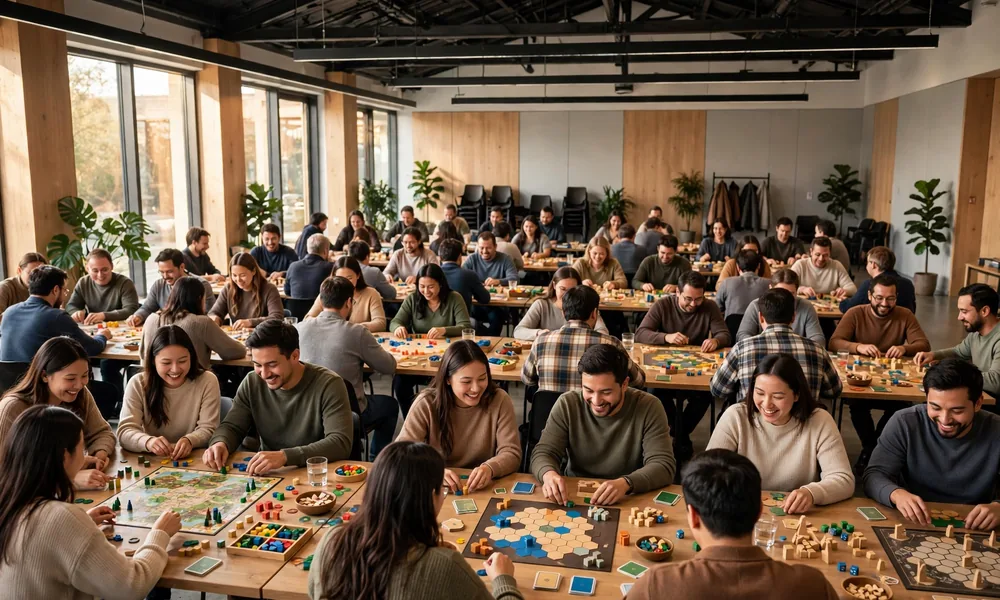
The multi-table model is the simplest way to host 99 players. Set up twelve to fifteen tables, put the same game on every table, and run all the tables at the same time. Each table plays its own game, and the winners from each table advance to a final round or earn points for a room-wide leaderboard. This works beautifully with games like Ticket to Ride, Catan, and Dixit, which are designed for three to six players per table but become a tournament when run in parallel.
The key is synchronisation. Start every table at the same time, use a visible timer for each round, and collect scores centrally after every game. If you want ideas for scaling down slightly, the best board games for 97 players use the same multi-table approach and adapt easily to a group of 99.
Team Play and Relay Formats
Team play turns a small game into a big one. Split the room into teams of six to ten, give each team its own table, and let teams compete against each other. Codenames is the classic example: one spymaster per team, the rest of the team guessing together, and a room full of teams racing to crack the same set of words. Wavelength and Pictionary work the same way, with each table acting as a single team in a larger contest.
Relay formats add movement. In a relay, teams rotate between tables every fifteen minutes, trying a different game at each stop. This keeps the night fresh, lets everyone sample several games, and stops any single table from going stale. Relays suit mixed groups especially well, because players who dislike one game know the next table is only a few minutes away.
Whole-Room Games
Whole-room games need no tables at all, or only a few. Everyone plays at once, usually standing or sitting in a large circle, with one host guiding the game. Two Rooms and a Boom, large-group Werewolf, and big-team trivia-style board games all work this way. These games are ideal for opening the night, because they warm up the whole crowd together and give everyone a shared experience before splitting into tables.
Whole-room games need a strong host and a clear set of rules explained in under two minutes. Keep the first round short, let people learn by playing, and save the detailed rules for later.
Best Board Games for 99 Players at a Glance
Use this table to compare the ten games in this guide. The format column shows how each game reaches 99 players, and the players-per-table column shows the group size each copy of the game handles.
| Game | Format for 99 players | Players per table | Best for |
|---|---|---|---|
| Codenames | Multi-table teams | 4 to 8 | Word lovers and mixed groups |
| Two Rooms and a Boom | Whole room | Up to 30 per game | High-energy opening game |
| One Night Ultimate Werewolf | Whole room or multi-table | 3 to 10 | Social deduction fans |
| The Resistance | Multi-table teams | 5 to 10 | Bluffing and debate |
| Wavelength | Multi-table teams | 2 to 12 | Quick, funny team debates |
| Telestrations | Multi-table | 4 to 8 | Creative groups and families |
| Dixit | Multi-table tournament | 3 to 6 | Imaginative, relaxed play |
| Ticket to Ride | Multi-table tournament | 2 to 5 | Strategy fans |
| Catan | Multi-table tournament | 3 to 4 | Classic strategy night |
| Pictionary | Multi-table teams | 4 to 16 | Big laughs, all ages |
Codenames
Codenames is the single best board game for a group of 99, because it was practically built for team play. Each team has a spymaster who gives one-word clues, and the rest of the team debates which words on the grid those clues point to. With teams of six to eight, twelve or thirteen tables cover the whole room, and every team plays the same word grid at the same time.
The room-wide version is simple to run. One host reads out the shared grid or projects it on a screen, each table’s spymaster gives clues in turn, and teams score points for correct guesses. Because the game is turn-based and quiet, neighbouring tables never disturb each other, and the debate inside each team is where the fun lives.
Two Rooms and a Boom
Two Rooms and a Boom is the only game here that can genuinely involve dozens of players in a single game. Players are split between two rooms, each with a secret role, and they have five minutes per round to trade players between rooms and work out who is on their team. The President must end up in the same room as the Bomber for the red team to win, or apart from the Bomber for the blue team to win.
For 99 players, run three parallel games of about 33 players each, or use it as a whole-room opener with a large hall divided into two sides. The game needs almost no equipment beyond the role cards, and rounds last only fifteen minutes including setup. It is loud, fast, and gloriously chaotic in the best way, which makes it a perfect icebreaker before the quieter table games begin.
One Night Ultimate Werewolf
One Night Ultimate Werewolf compresses the classic social deduction game into a single ten-minute round, which makes it ideal for a huge group. Each player gets a secret role, the village wakes up, and everyone debates who the werewolves are. With the companion app handling the night phase, even a table of ten plays smoothly.
For 99 players, run ten tables of ten at the same time. Each table plays its own game, and the app’s narration keeps every table in sync if you play the audio over speakers. Between rounds, players can switch tables, which keeps the social mix fresh and stops anyone from being stuck with the same group all night.
The Resistance
The Resistance is a game of hidden traitors and failed missions, and it scales to 99 players through the multi-table model. Each table of five to ten players runs its own game, with spies secretly sabotaging missions while loyal players try to spot them. Rounds take about fifteen to thirty minutes, and the debate between rounds is the heart of the game.
What makes The Resistance special for large groups is that every player matters in every round. There is no elimination, so nobody sits out, and even a quiet player can change the game with one well-timed vote. That matters with 99 people, because the worst outcome at a big game night is a player who feels like a spectator.
Wavelength
Wavelength is a party game about guessing where a hidden target sits on a spectrum, from hot to cold, or boring to exciting. One player gives a clue, and their team debates where the target lies. It is simple, funny, and endlessly replayable, and it works brilliantly in teams.
For 99 players, set up ten to twelve tables with one copy of the game each, or project a single target on a screen and let every table guess at once. The team version is the better choice: each table debates together, scores points, and competes against the other tables. A round takes only a few minutes, so the pace stays quick and nobody waits long for a turn.
Telestrations
Telestrations is the telephone game in board game form: draw a word, pass the sketch on, guess what it shows, and watch the meaning drift into comedy. Each table of four to eight players needs one copy, so twelve to fifteen copies cover a room of 99, and every table produces its own chain of hilarious misunderstandings.
The game needs no strategy and no prior knowledge, which makes it one of the most inclusive choices on this list. Bad drawings are the point, so nobody feels judged, and the reveal at the end of each round gets the whole table laughing. For family groups and mixed-age crowds, Telestrations is often the most popular game of the night.
Dixit
Dixit is a beautiful game of storytelling and guesswork. Each player holds illustrated cards, and on their turn they describe one card with a word, a phrase, or a sound. The other players choose a card from their own hand that matches the clue, and everyone guesses which card was the storyteller’s. It is gentle, imaginative, and completely different from the competitive games on this list.
For 99 players, run Dixit as a multi-table tournament. Tables of three to six play short games, winners advance, and the final table decides the champion. Because turns are quick and the game is calm, neighbouring tables never disturb each other, and the artwork on the cards gives players something lovely to look at all evening.
Ticket to Ride
Ticket to Ride is a classic route-building game: collect coloured train cards, claim routes across the map, and complete destination tickets for points. It is easy to learn, satisfying to play, and one of the best tournament games ever made, which is exactly what a 99-player night needs.
Run it as a multi-table tournament with twenty tables of five players. Every table plays the same map, games last thirty to forty-five minutes, and the top scorers from each table advance to a final. Use a shared timer and a central scoreboard, and award small prizes for the best route or the longest train to keep every table motivated.
Catan
Catan is the game that introduced millions of people to modern board games, and it remains a superb tournament game. Players settle an island, trade resources, and build roads and cities, racing to ten victory points. Tables of three or four play in about an hour, so a multi-table tournament with twenty-five tables covers 99 players comfortably.
The trading and negotiation are what make Catan shine at scale. Every table develops its own rivalries and alliances, and the room buzzes with the sound of deals being struck. A shared leaderboard adds a competitive edge, and the final table, made up of the winners from each group, is a genuinely exciting climax to the night.
Pictionary
Pictionary is the original big-group drawing game, and it scales to 99 players with almost no effort. Split the room into teams, give each team a board and a stack of cards, and let teams race to guess their own artist’s drawings. With teams of eight to ten, ten teams cover the whole room, and a room-wide scoreboard keeps the competition alive.
For a party atmosphere, run Pictionary as a relay: one artist draws on a big whiteboard at the front while every team guesses at once, with points for the fastest correct answer. This whole-room version is perfect for the final game of the night, because it brings everyone together and ends the evening on a high. The best party games for 96 players offer more whole-room ideas in the same spirit if you want to extend the night further.
Choosing the Right Setup for Your Group
The best game for your group depends on who is coming and how much time you have. For a mixed crowd of friends, family, and colleagues, start with a whole-room game like Two Rooms and a Boom, move to team games like Codenames and Wavelength, and finish with Pictionary.
Think about timing too. A three-hour evening fits one whole-room game, two rounds of team games, and a closing game, with breaks between each. A full-day event can run a proper tournament with heats and a final. Whatever you choose, test the setup with a small group first if you can, and keep the rules explanation under two minutes per game. Groups of this size reward simple plans executed well, and the best board games for 75 players follow the same planning principles if your numbers change.
Checklist: Running a 99-Player Board Game Night
Use this checklist in the week before your event, and tick each item off as you complete it.
- Count your players and confirm the number a week ahead, so you know exactly how many tables and game copies you need.
- Choose one format per part of the evening, such as a whole-room opener, team games in the middle, and a closing game for everyone.
- Buy or borrow enough copies of each game so that every table can play at the same time, and check every box has all its pieces.
- Arrange twelve to fifteen tables with good lighting, enough chairs, and space for players to move between tables.
- Appoint a host and a scorekeeper, prepare a shared timer and a visible scoreboard, and rehearse the rules explanation for each game.
- Plan the flow of the night in advance, including breaks, snacks, and a clear ending, so 99 players always know what happens next.
Frequently Asked Questions
Is there a board game that seats 99 players at one table?
No. No board game is designed for 99 players around a single table, and no honest guide should claim otherwise. The largest party games support around 20 to 30 players, and even those need a big room and a strong host. For 99 players, use multiple tables, teams, or a whole-room format instead.
How many copies of a game do I need for 99 players?
It depends on the game. For a game that seats six per table, you need about seventeen copies for 99 players. For a game that seats ten per table, you need about ten copies.
What is the best game to start a 99-player night with?
Two Rooms and a Boom is the best opener, because it involves the whole room at once and gets everyone talking within minutes. If you prefer something calmer, start with Wavelength in teams, which is easy to teach and gets every table debating straight away.
How long should a 99-player board game night last?
Three hours works well for an evening event: thirty minutes for a whole-room opener, ninety minutes for team and table games, and thirty minutes for a closing game and prizes.
Can children join a 99-player board game night?
Yes, if you choose the right games. Telestrations, Dixit, and Pictionary work well for mixed ages, and children enjoy team games where they play alongside adults. Avoid long strategy games like Catan for younger children, and keep rounds short so nobody loses interest.
What should I do if some players have never played a board game?
Seat newcomers with experienced players, choose games with rules that take under two minutes to explain, and start with a practice round that does not count. Games like Wavelength and Telestrations are ideal first games, because the rules are simple and the fun starts immediately.
The Bottom Line
The best board games for 99 players are not the biggest games, but the games that scale best: Codenames for team wordplay, Two Rooms and a Boom for a whole-room opener, One Night Ultimate Werewolf and The Resistance for social deduction, and Ticket to Ride and Catan for a proper tournament. Pick your format first, match the games to your group, and keep the rules short and the rounds moving. Do that, and 99 players will not feel like a crowd to manage. They will feel like the best game night you have ever hosted.