
Finding the best board games for 75 players starts with an honest fact: no single board game box on the shelf seats 75 people around one table. The largest party games top out at 20 or 30 players, and most classic board games are built for two to six. That does not mean a 75-player game night is impossible. It means the format has to change, and once it does, a group of 75 can have a better night than a group of six ever could.
A group of 75 players is a crowd, not a table. It is a school hall, a company offsite, a wedding weekend, a church social, or a community fundraiser. At that scale, the best board games for 75 players are the ones that split naturally into teams, run in parallel across several tables, or put one confident host in charge of the whole room. The games in this guide were chosen because they work in one of those three formats, and every recommendation below explains exactly how to run it for 75 people rather than pretending the box alone will do the job.
This guide covers the team games that turn 75 strangers into rival squads, the multi-table tournament format that lets classic board games shine at scale, and the moderator-led games where a single host can hold a whole hall. You will also find a comparison table, a setup checklist, and answers to the questions every large-group host asks first. The logistics here build on the lessons from the best board games for 74 players, because adding one more player changes almost nothing about the setup, only the headcount on the scoreboard.
Key Takeaways
- No single board game seats 75 players, so the best board games for 75 players use team play, multiple tables, or a tournament format.
- Team games such as Codenames, Wavelength, and Monikers scale best because extra players simply join a team instead of waiting for a turn.
- Moderator-led games such as Werewolf and Two Rooms and a Boom can hold a whole hall with one host and a clear set of rules.
- Classic games such as Catan and Ticket to Ride work for 75 players only as a multi-table tournament with shared scoring across tables.
- Plan for at least three copies of every team game, one host per eight to ten players, and a simple scoring system everyone can see.
Why 75 Players Changes Everything About Board Games
Most board games are designed around a simple assumption: everyone at the table can see the board, hear the other players, and take a turn within a minute or two. With 75 players, every part of that assumption breaks. Nobody can see one small board from the back of a hall, nobody can hear a quiet player three tables away, and a game where each person takes a 30-second turn would need more than half an hour just to complete a single round.
The fix is to stop thinking of 75 players as one game and start thinking of them as one event. A good large-group event has a clear structure, a visible scoreboard, and a rhythm that keeps everyone involved at the same time. When all 75 people are playing at once, even in different teams or at different tables, the energy in the room stays high. When half the room is watching and waiting, the energy drains away within minutes, no matter how good the game is.
The Three Formats That Actually Work for 75 Players
Every successful 75-player game night uses one of three formats, and most great nights use all three across the evening. The first format is team play. The group splits into teams of five to ten, and each team plays the same game at the same time. Codenames, Wavelength, and Monikers all work this way, because the game is really a conversation inside the team, and adding more players to a team only adds more voices to that conversation.
The second format is the multi-table tournament. Classic board games run in parallel at eight to twelve tables, each table plays the same game, and the scores are combined into one leaderboard. A tournament turns Catan, Ticket to Ride, and Azul into 75-player games without changing a single rule. It needs more copies of the game and more table hosts, but it lets serious board gamers play the games they actually love.
Team Play
Team play is the simplest format to run and the easiest for new players to join. Split the room into teams of seven or eight, hand each team the same game, and let the teams compete for the highest score. Because every team plays at the same time, nobody waits, and because the team shares the decisions, shy players can contribute without standing in front of the whole room. Team play works best with word games, guessing games, and drawing games, where the fun comes from the discussion inside the team.
Multi-Table Tournaments
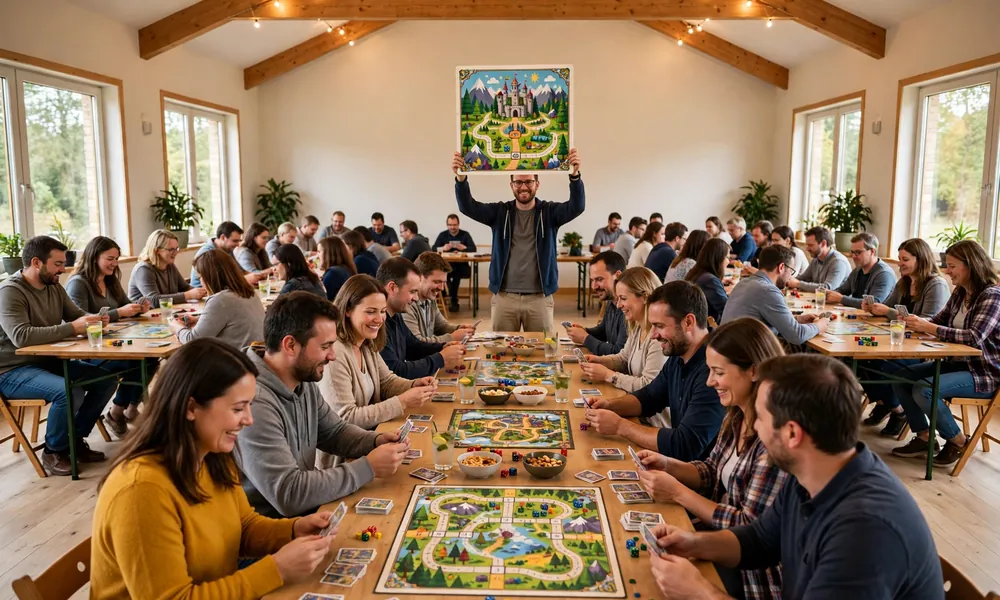
A multi-table tournament is the format for groups that want real board games rather than party games. Set up ten tables of six to eight players, run the same game at every table, and give each table a host who knows the rules. After each round, players rotate to new tables and the scores carry forward. With 75 players, you need about ten tables, ten hosts, and at least ten copies of the game, which sounds like a lot until you remember that a single hall and a borrowed game collection can cover it.
Whole-Room Host-Led Games
The third format puts one confident host in charge of the entire room. Werewolf, Two Rooms and a Boom, and large-group trivia all work this way, because the host controls the pace and every player has a role in every round. Host-led games are the best choice for the opening and closing of the night, when you want the whole room laughing together instead of scattered across tables. They need a strong host, a microphone, and a clear set of rules, but they need almost no equipment.
Best Team Board Games for 75 Players
Team games are the backbone of a 75-player night because they scale by adding teams rather than by adding waiting time. The games below were chosen because they play in 20 to 30 minutes, they are easy to teach, and they get better, not worse, when more people join the team.
Codenames
Codenames is the single best team board game for a group of 75. Each team picks a spymaster who gives one-word clues, and the rest of the team debates which words on the grid match the clue. With 75 players, split the room into eight or nine teams of eight or nine, and run the same word grid at every table with a large printed copy or a projected grid. The debate inside each team is where the fun lives, and clever clues matter more than fast reflexes.
Wavelength
Wavelength asks teams to place a hidden target on a spectrum between two opposites, such as hot and cold or good and bad. One player gives a clue, the team argues about where the target sits, and the other team tries to steal the point. The argument is the game, and a team of nine will argue far more entertainingly than a team of three.
Monikers
Monikers is a guessing game played in three rounds with the same set of cards: first with full descriptions, then with a single word, then with silent gestures. Each team needs only one deck, and the second and third rounds turn into running jokes that the whole team shares.
Telestrations
Telestrations mixes drawing and guessing in a chain where each player draws a word, the next player guesses it, and the guesses get stranger with every link. It is not a traditional board game, but it belongs on this list because it handles a crowd better than almost any game on the market. Run tables of eight and display the funniest chains on a screen between rounds.
Best Whole-Room Board Games for 75 Players
Whole-room games are the ones that make a 75-player night feel like one shared event instead of ten separate tables. They need a host, a microphone, and a room where everyone can see the front, but they repay that setup with the loudest moments of the night.
Werewolf
Werewolf is the classic large-group social deduction game, and it is one of the few games that genuinely seats 75 players in a single game. Every player gets a secret role, the village debates by day, and the werewolves strike by night. With 75 players, use several werewolves, add roles such as the seer and the doctor, and keep the rounds tight.
Two Rooms and a Boom
Two Rooms and a Boom splits the room into two teams in two separate spaces, with players trading rooms over several timed rounds. It is built for large groups, and 75 players is comfortably inside its range. Each player has a secret role, and the game ends with a single dramatic reveal.
Large-Group Trivia and Quiz Games
A well-run trivia night is one of the easiest whole-room games for 75 players, and it is also one of the most flexible. Teams of five to eight answer the same questions, the host reads them aloud, and the scoreboard updates after every round. Mix general knowledge with questions about the group itself, and the room will stay engaged for hours. If you want ready-made ideas for the quiz rounds, the best trivia games for 74 players use the same team sizes and scoring that work here.
Best Classic Board Games for a 75-Player Tournament
Classic board games do not scale by adding players to one table, but they scale perfectly as a tournament. The trick is to stop asking one box to hold 75 people and instead run the same game at ten tables at once, with a shared leaderboard tying the tables together.
Catan
Catan is the most popular tournament game for a large group because almost everyone has played it or heard of it. Run ten tables of six to eight players with standard rules, and award points for wins, settlements, and longest road across the tables. After two rounds, reseed the tables so the leaders play each other. You will need ten copies, so borrow from the group or ask a local game shop about rentals.
Ticket to Ride
Ticket to Ride is the easiest classic game to teach to a mixed group, which makes it ideal for a 75-player tournament where many players are new to board games. The rules take five minutes to explain, the game plays in under an hour, and the tension of claiming routes builds naturally at every table. Score each table the same way, with a small bonus for the longest continuous route.
Azul and Splendor
Azul and Splendor are the best choices when the group wants a quieter, more thoughtful tournament. Both games play in 30 to 45 minutes, both are easy to learn and hard to master, and both work well at tables of four, which means more tables and more winners across the night. Run them as a two-round tournament with a short break between rounds.
Best Board Games for 75 Players Compared
The table below compares the leading games for a 75-player night across the three formats. Use it to pick the right mix for your group: one team game, one whole-room game, and one tournament game usually covers an entire evening.
| Game | Format | Players Per Table | Time | Best For |
|---|---|---|---|---|
| Codenames | Team play | 6 to 10 | 20 minutes | Word lovers and mixed ages |
| Wavelength | Team play | 6 to 10 | 30 minutes | Debate and laughter |
| Monikers | Team play | 6 to 10 | 30 minutes | Energetic groups |
| Telestrations | Team play | 6 to 8 | 30 minutes | Creative players |
| Werewolf | Whole room | Up to 75 | 45 minutes | Drama and deduction |
| Two Rooms and a Boom | Whole room | Up to 75 | 30 minutes | A big finale |
| Catan | Tournament | 4 to 6 | 60 minutes | Serious gamers |
| Ticket to Ride | Tournament | 4 to 5 | 45 minutes | New players |
| Azul | Tournament | 4 | 40 minutes | Quiet strategy |
How to Run a 75-Player Board Game Night
Choosing the games is only half the job. The other half is running the night so that 75 people all know where to go, what to play, and when to move. The plan below has been used for groups of this size many times, and it works because it keeps the structure simple and visible.
Plan the Room First
Book a hall with ten tables of six to eight seats, a clear space at the front for the host, and a wall or screen for the scoreboard. Arrive an hour early, lay out the games, and put a numbered sign on every table. Players find their table by number, not by wandering, and the host can call out table numbers instead of names when it is time to rotate. Keep a large open space in the middle of the hall for whole-room games.
Recruit One Host Per Table
A 75-player night needs about ten table hosts plus one main host for the whole room. The table host explains the rules, keeps the game moving, and records the score. Recruit them in advance, give each one the game they will run, and let them practise once before the night. A host who knows the rules is worth more than an extra copy of the game.
Keep Scoring Simple and Visible
The scoring system should fit on one sheet of paper and be readable from the back of the hall. Award ten points for a table win, seven for second place, five for third, and three for everyone else, then add the points up on a large scoreboard or a projected spreadsheet. Simple scoring keeps the competition friendly and lets players check their own standing between rounds. If you are mixing party games into the night as well, the best party games for 74 players use the same team sizes, so the same scoring sheet works for both.
Run a Tight Schedule
A good schedule for 75 players is a short welcome and a whole-room icebreaker, two team-game rounds of 30 minutes each, a break with snacks, one tournament round of 60 minutes, and a whole-room finale of 30 minutes. Announce the schedule at the start, keep a visible timer, and start every round on time even if one table is still finishing.
Setup Checklist for 75 Players
- Book a hall with at least ten tables, 75 chairs, and a front area for the host and scoreboard.
- Borrow or buy three copies of each team game and ten copies of the tournament game.
- Recruit one main host and ten table hosts, and brief every host on the rules in advance.
- Print a simple scoreboard, table numbers, and one rules summary sheet per table.
- Test the microphone, projector, and timer before the first player arrives.
- Plan snacks, drinks, and a break halfway through so the energy stays high to the end.
Frequently Asked Questions
Can one board game really seat 75 players?
No single boxed board game seats 75 players around one table. The largest party games support 20 to 30 players, and most classic games support two to six. A 75-player night works by splitting the group into teams, running the same game at several tables, or playing a whole-room game with one host.
How many copies of each game do I need for 75 players?
Plan for at least three copies of every team game and about ten copies of a tournament game, which is one copy per table. Borrow copies from the players, ask a local game shop about rentals, or buy a few extra copies and treat them as part of the event budget.
What is the best game to start a 75-player night?
Start with a whole-room game such as Werewolf or a short trivia round. It gets the entire hall laughing together, it needs no table setup, and it gives the host a chance to explain the schedule while everyone is already paying attention.
How long should a 75-player board game night last?
Three to four hours is the right length. That covers a welcome and icebreaker, two team-game rounds, a break, one tournament round, and a finale, with time for players to chat between rounds. Longer nights tire the room out, and shorter nights feel rushed.
Do I need a microphone for 75 players?
Yes. A host cannot be heard clearly by 75 people in a hall without one, and the night will fall apart if half the room cannot hear the instructions. A simple portable speaker and microphone is enough, and it is worth testing before the event starts.
What if some players have never played board games before?
Choose games that take under five minutes to explain, such as Ticket to Ride, Codenames, and Wavelength, and seat new players with an experienced table host. Team games are the friendliest choice for beginners because the team makes decisions together, so no single player feels put on the spot.
Bottom Line
The best board games for 75 players are not the games with the biggest player counts on the box. They are the games that split cleanly into teams, run in parallel across many tables, or put one great host in charge of the whole room. Pick one team game such as Codenames, one whole-room game such as Werewolf, and one tournament game such as Ticket to Ride, recruit a host for every table, and keep the scoring simple and visible. Do that, and 75 players will feel like one big game night instead of ten small ones happening in the same hall.


