Finding the best board games for 146 players starts with an honest fact: no single board game seats 146 people at one table. The largest party games top out at around twenty players, and most classic board games are built for two to six. A group of 146 is a whole school year, a company all-hands, or a wedding-sized crowd, and it needs a different kind of plan than a family game night.
That does not mean board games are the wrong choice for a crowd this big. It means the games become the centrepiece of a format, not the whole event. With team play, multiple tables running the same game at once, and a tournament or relay structure that brings everyone back together, 146 players can all play, compete, and cheer in the same room on the same night. The secret is picking games that scale, explain in under five minutes, and keep every team busy at the same time.
This guide covers the board games for 146 players that actually work at that scale, the three formats that make a giant group playable, and a practical plan for running the night without chaos. Every game here was chosen because it is easy to learn, plays fast, works in teams, or runs well in parallel across many tables. If you follow the setup below, nobody sits out, nobody waits an hour for a turn, and the final round feels like a real contest.
Key takeaways
- No single board game seats 146 players, so plan team play, multiple tables, or a tournament instead of one giant table.
- Pick games that explain in under five minutes and finish in under thirty, so every table stays in step.
- Run the same game at many tables at once, then bring the table winners together for a shared final.
- Use team captains, a visible scoreboard, and a strict round timer to keep 146 players moving together.
- Mix word games, drawing games, and strategy games so every kind of player has a round they can win.
Why 146 Players Changes Everything About Game Night
A normal game night has one table, one game, and everyone watching the same board. At 146 players, that model breaks in three ways. First, nobody can see or reach a single board. Second, turns take so long that most players spend the night waiting instead of playing. Third, one rules explanation to 146 people at once is almost impossible to hear, let alone follow. The games that work at this scale solve all three problems by splitting the crowd into small, active groups.
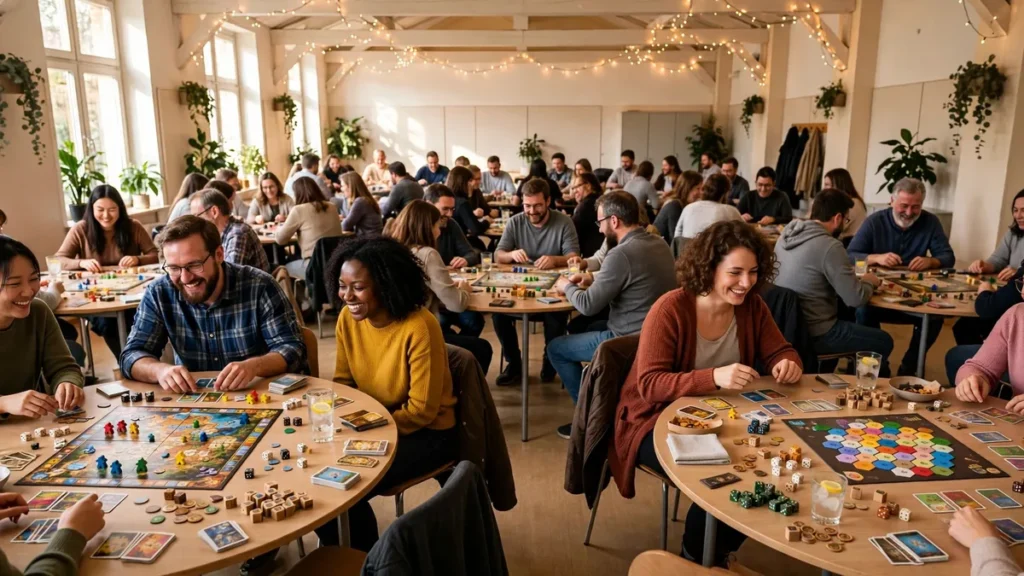
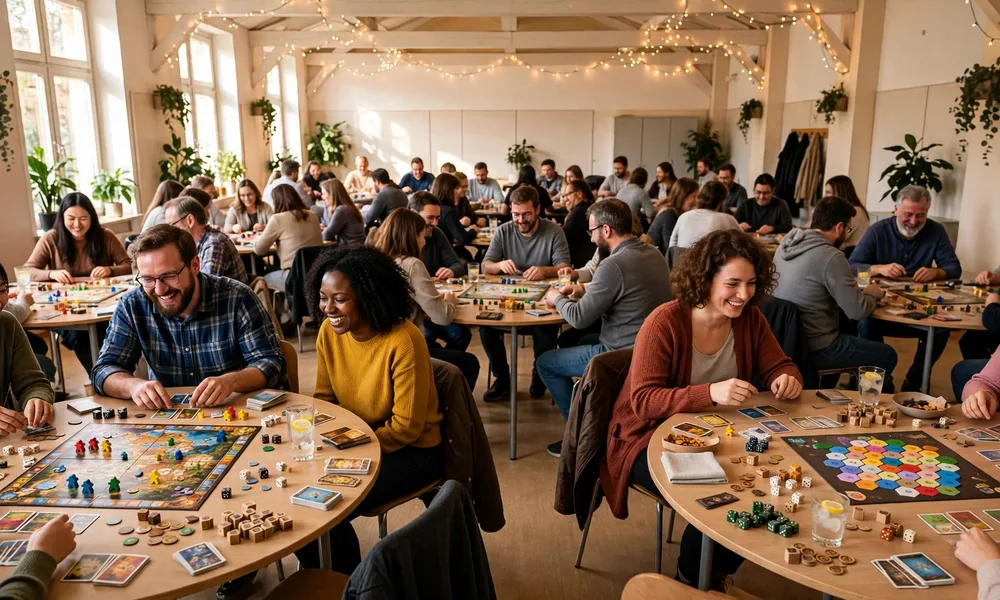
The maths is simple and reassuring. Split 146 players into teams of six and you have about 24 teams. Put two teams at a table and you need roughly 12 tables. Give each table the same game, the same start time, and the same round length, and suddenly you are not running one impossible game for 146 people. You are running twelve normal games at once, and that is a job any good host can handle with a few helpers.
That is why the best board games for 146 players are not the biggest games on the shelf. They are the games with the shortest rules, the fastest turns, and the clearest scoring. A game that takes two minutes to teach and twenty minutes to play beats a grand strategy epic every time when you have 146 people, a fixed evening, and a room full of players who may never have met.
The Three Formats That Make 146 Players Work
Every successful giant game night uses one of three formats, and the best nights mix two of them. Each format suits different games, different rooms, and different crowds, so choose the one that fits your space and your players before you buy a single box.
Format One: Team Play at Shared Tables
In team play, each table holds one game, and the players at that table split into two teams. Teammates discuss every move together, so even quiet players contribute, and a table of eight or ten people stays engaged because every turn is a group decision. Games like Codenames and Wavelength were practically built for this: one clue, one guess, and a whole team leaning in to debate it.
Team play works best when the game has hidden information, a shared puzzle, or a guessing element. Word games shine here, because a team can argue about a clue without needing to touch the board. If your crowd loves language and quick thinking, start with the best word games for adults and pick the ones that play well in teams of five or six.
Keep teams to five or six players each. Smaller teams mean more voices get heard, and larger teams mean some players drift to their phones. Give each team a name, a captain, and a coloured scorecard. The captain reads the rules aloud at the table, keeps the score, and reports the result to the scoreboard. That one role removes most of the host’s workload.
Format Two: Multiple Tables Running the Same Game
In the parallel format, every table plays the same game at the same time. Twelve tables of Codenames, for example, all start together, all finish within a few minutes of each other, and the table winners advance to a final. The room feels electric because everyone is playing the same puzzle, and the chatter between tables becomes part of the fun.
This format needs several copies of the same game, which is its main cost. Borrow copies from friends, ask players to bring their own, or choose a game cheap enough to buy in bulk. Drawing games such as Telestrations and guessing games such as Wits and Wagers are affordable, quick to reset, and easy to run in parallel. You do not need identical editions, just the same rules at every table.
Synchronise the tables with a visible timer and a clear signal for the start and end of each round. A simple air horn, a bell, or a projected countdown on a screen works well. When time is called, every table stops, records its score, and resets for the next round. That shared rhythm is what turns twelve separate games into one event.
Format Three: Tournament and Relay Play
In a tournament, tables play short rounds and winners move up while other teams rotate to new games. A relay adds a twist: each team sends one player to a central table for a quick challenge, then tags the next teammate in. Both formats keep the energy high because every round has a winner, and nobody is stuck at a losing table all night.
Tournaments suit a crowd that likes competition and a clear champion at the end. Keep each round to fifteen or twenty minutes, post the bracket where everyone can see it, and announce the advancing teams by name. The announcement itself becomes a moment, and teams that are out of the running still enjoy watching the final.
Relay play suits mixed-age and mixed-ability crowds, because each player only needs to handle one short turn. A relay built around quick party games, such as Herd Mentality or Green Team Wins, lets a team of six each take one question, one vote, or one guess. The whole team wins or loses together, and nobody carries the result alone.
Best Board Games for 146 Players Compared
The table below compares the games that work best at this scale. None of them seats 146 players in one copy, and that is the point: each one works in teams, in parallel across many tables, or in a tournament. The table shows how each game scales, how long a round takes, and which format suits it best.
| Game | Best format | Players per copy | Round length | Why it works for 146 |
|---|---|---|---|---|
| Codenames | Teams, parallel, tournament | 4 to 8+ | 15 minutes | One-word clues spark whole-team debate |
| Wavelength | Teams, parallel | 2 to 12 | 20 minutes | Simple target guessing, huge table energy |
| Telestrations | Parallel, relay | 4 to 8 | 20 minutes | Drawing and guessing, no skill needed |
| Monikers | Teams, tournament | 4 to 16 | 30 minutes | Three rounds of clues build running jokes |
| Wits and Wagers | Parallel, tournament | 3 to 7 | 25 minutes | Everyone bets, everyone stays involved |
| Herd Mentality | Relay, parallel | 4 to 20 | 20 minutes | Match the herd, laugh at the odd one out |
| Two Rooms and a Boom | Whole room | 6 to 30 | 15 minutes | Two rooms, hidden roles, real suspense |
| Dixit | Teams, parallel | 3 to 6 | 30 minutes | Beautiful cards, creative clue giving |
| Green Team Wins | Relay, parallel | 3 to 12 | 20 minutes | Quick questions, instant team votes |
| Escape room games | Parallel, tournament | 2 to 6 | 60 minutes | Timed puzzles, strong team bonding |
Codenames: The Safest Choice for a Giant Group
Codenames is the most reliable game for 146 players because it is almost impossible to run badly. One spymaster gives a one-word clue, the team debates which words it points to, and the whole table leans in. With teams of five or six, every player has a voice, and a round finishes in about fifteen minutes. Buy or borrow one copy per table, run the same word grid everywhere, and compare scores across the room.
Wavelength and Wits and Wagers: Fast Rounds, Big Reactions
Wavelength asks a team to guess where a hidden target sits on a scale between two opposites, such as hot and cold, or boring and exciting. The debate is the game, and the reveal always gets a reaction. Wits and Wagers asks numerical questions, such as how many jelly beans fit in a jar, and lets every player bet on the closest answer. Both games keep everyone involved on every turn, because there is no waiting for a single player to finish a long move.
Telestrations and Dixit: Games for Players Who Hate Rules
Some guests will not read a rulebook, and that is fine. Telestrations is a drawing and guessing chain: draw a word, pass the book, guess the drawing, and laugh at how far the meaning drifts. Dixit gives each player a hand of dreamlike picture cards and asks them to describe one with a word or phrase, while the others try to spot it. Both games need almost no explanation, and both reward creativity over experience.
Two Rooms and a Boom: The Whole-Room Showpiece
Two Rooms and a Boom is the closest thing to a single game for a giant group, and it still does not seat 146 at one table. It splits the players into two rooms, gives everyone a secret role, and asks them to find their leader and protect them. It plays in fifteen minutes, it needs almost no equipment, and it turns a whole hall into a game board.
Use it once, as the centrepiece of the evening, not as the whole night. Split the 146 players into two rooms of about 73, run two copies of the game in parallel, and bring everyone together for the reveal. The reveal is the payoff, so build it up: gather the room, count down, and announce the result. It is the moment people will remember.
Escape Room Games: The Timed Team Challenge
Escape room board games give each team a box of puzzles and sixty minutes to solve them. They are the most intense option here, and the most rewarding for teams that love to cooperate under pressure. If your crowd enjoys puzzles and mystery, the escape room board games on this site will help you pick a box that suits your group, and the timed format fits a tournament perfectly.
Run escape room games as a single timed round, not a repeating rotation, because each box takes an hour and can only be solved once. Give each table a different box so teams cannot copy answers from neighbours, start all the clocks together, and announce the finishing times as teams escape. The team that escapes fastest wins, and the teams still working when the clock runs out get a shared photo and a round of applause.
How to Run a Board Game Night for 146 Players
A great giant game night is mostly planning, and the plan fits on one page. Start by confirming the room: you need about twelve tables, a chair for every player, a screen or whiteboard for the scoreboard, and a sound system or loud voice for announcements. Visit the room beforehand, count the tables, and mark where each team will sit. A room that feels full is better than a room that feels empty, so seat teams close together.
Next, recruit helpers. You need one host, one scorekeeper, and one helper for every three or four tables. Helpers hand out games, answer rules questions, and report scores. They do not need to know every game deeply; they need to know the start time, the round length, and where the spare pieces are. A short briefing the day before is enough.
On the night, open with a five-minute welcome, not a lecture. Explain the format, the round timer, and the scoreboard, then demonstrate one round of the first game on the big screen. Start the clock, and let the tables play. Walk the room, fix small problems, and keep the energy up with short announcements between rounds. The host’s job is timing and mood, not rules.
Plan the evening in blocks: a warm-up game, two competitive rounds, a relaxed middle game, and a final, with ten minutes between blocks for scoring and refreshments. A night that runs from seven to ten gives 146 players a full evening without exhaustion. End on time, announce the winners, and hand out a small prize for the winning team to share.
Checklist: Your 146-Player Game Night in Six Steps
- Count the room first: confirm twelve or more tables, 146 chairs, and a visible scoreboard before choosing any game.
- Pick three games that teach in under five minutes and finish in under thirty, with one word game, one drawing game, and one guessing game.
- Split 146 players into teams of five or six, give each team a captain, a name, and a coloured scorecard.
- Borrow or buy one copy of the main game per table, plus two spares, pens, timers, and extra scorecards.
- Run rounds on a shared timer, post scores where everyone can see them, and announce advancing teams by name.
- Finish with a shared final, announce the winners, and end on time so players leave wanting another night.
Frequently Asked Questions
Can one board game really seat 146 players?
No. No board game on the market seats 146 players at a single table, and any claim otherwise is a misunderstanding. The honest way to play board games with 146 people is team play, multiple tables running the same game, or a tournament with a shared final. Those formats let everyone play at once, and they are how every successful giant game night actually works.
How many copies of a game do I need for 146 players?
Plan on one copy per table, which usually means ten to twelve copies of your main game. Borrow copies from friends and players, ask a local game shop about bulk hire, or choose a game cheap enough to buy several copies of. Add two spare copies for damaged or missing pieces, and keep a simple backup game, such as a word game you can run from a screen, in case a box goes missing.
What is the best first game for a group this big?
Codenames is the safest first game because it teaches in two minutes, plays in fifteen, and works in teams of any size. If your crowd prefers drawing, start with Telestrations. If they prefer trivia and guessing, start with Wits and Wagers. The best first game is the one your host can explain confidently in under five minutes.
How long should a game night for 146 players last?
Three hours is the sweet spot, including breaks. Plan four game blocks of about thirty minutes each, with ten minutes between blocks for scoring and moving. A shorter night feels rushed, and a longer night loses players to tiredness. If you are running escape room games, allow a full hour for that block and shorten the others.
What if some players have never played a board game?
That is normal at a group this size, and the format handles it. Team play means a new player learns by watching teammates, and games such as Herd Mentality and Green Team Wins need no experience at all. Put new players on teams with a confident captain, choose games with almost no rules for the opening round, and never make a new player take a solo turn in front of the room.
Can I mix board games with digital games for 146 players?
Yes, and it often helps. A digital quiz or puzzle round on a shared screen gives the host a break, resets the energy, and includes players who prefer screens to boards. If you want a digital option for the warm-up or the break, the puzzle apps for adults on this site include games that work well as a whole-room round between board game blocks.
The Bottom Line
The best board games for 146 players are the ones that respect the size of the crowd: short rules, fast rounds, team play, and a format that keeps everyone busy at once. Codenames for the opener, Wavelength or Wits and Wagers for the competition, Telestrations or Dixit for the relaxed middle, and Two Rooms and a Boom for the whole-room finale will give 146 players a night that feels like one shared event, not twelve separate tables. Split into teams, run the clock, keep the scoreboard visible, and let the games do the work.