The verdict up front
Puzzles do teenagers real good, but not in the way the box promises. A teenager who spends half an hour on a puzzle is practising focus, patience and calm in a way that scrolling never teaches, and that practice shows up in homework, revision and everyday moods. What puzzles will not do is turn a teenager into a genius, fix exam anxiety on their own, or compete with a phone for attention without a fight. The honest verdict is this: puzzles are a genuinely useful habit for a teenager who picks the right kind, at the right difficulty, for the right reasons. They are a waste of money and shelf space when they are chosen like a toy for a much younger child. The difference between those two outcomes is almost entirely about the choice, not the puzzle itself.
Teenagers live in a strange middle ground. They are old enough for hard problems and long books, yet most of the puzzles aimed at their age group are either dressed up for small children or aimed at adults who want a quiet evening with a thousand-piece landscape. That gap is why so many teenagers say puzzles are boring before they have ever tried a good one. This piece looks at what puzzles actually do for a teenager, where they fall short, why the image problem matters so much at this age, and how to pick the ones a teenager will come back to.
What a puzzle asks a teenager to do
A puzzle makes one demand that almost nothing else in a teenager’s day makes: stay with a single problem until it gives way. Schoolwork is chopped into lessons and deadlines. Phones are built to interrupt. Even television is cut into scenes that change every few seconds. A crossword, a logic grid or a half-finished jigsaw asks for the opposite. It sits there, unchanged, until the person working on it figures out the next move.
That kind of attention is a skill, and like any skill it improves with use. A teenager who works on puzzles regularly gets better at reading a question twice before answering, at holding several clues in mind at once, and at resisting the urge to give up at the first dead end. None of that is dramatic. It shows up quietly: a maths problem worked through instead of abandoned, a revision sheet read to the end, an essay planned before it is written. Teachers notice it before teenagers do.
Patience works the same way. Puzzles teach a teenager that being stuck is a normal stage of solving something, not a sign that the task is impossible. A Sudoku grid that refuses to yield for ten minutes eventually cracks, and the teenager who waited it out has learned something no pep talk can teach: the feeling of a hard thing becoming possible. That feeling carries into subjects a teenager finds difficult, because the pattern is the same. Sit with it, try a different angle, and the answer arrives.
Focus, homework and the wandering mind
Homework is where most teenagers first notice their own attention slipping. They sit down with good intentions, and twenty minutes later they are three apps deep and cannot remember what the assignment was. Puzzles help here in a practical, unglamorous way: they are training for the exact moment when the mind wants to wander and the work is not finished.
A short puzzle before homework can act like a warm-up. Ten minutes on a logic puzzle or a crossword gets the brain into the habit of concentrating before the real work starts, in the same way a runner stretches before a run. It also gives the teenager a small win before the harder task begins, which matters more than it sounds. Starting homework after a small success feels different from starting it cold.
A real break from screens
Teenagers spend most of their waking hours looking at screens, and the problem is not only the time. It is the pace. Feeds, videos and games are designed to deliver something new every few seconds, and a brain trained on that pace finds ordinary life dull by comparison. A paper puzzle is the opposite of that. Nothing flashes, nothing beeps, nothing new arrives unless the teenager creates it by solving something.
That slowness is the point. A puzzle gives the eyes and the mind a different kind of work, and after twenty minutes the teenager often feels calmer than when they started. It is not the same as rest, and it is not the same as sleep, but it is a genuine change of gear. Parents who watch a teenager swap a phone for a puzzle book for half an hour usually notice the difference in mood afterwards: less edgy, less snappy, more present.

Stress, exams and the calm half-hour
Exam season is when puzzles earn their keep. Revision is stressful because it is both boring and frightening at the same time: the same notes, read again and again, with a deadline that keeps getting closer. A puzzle breaks that loop. It gives the brain a problem that is hard enough to absorb attention and easy enough to finish, and finishing something small is exactly what a stressed teenager needs in the middle of a long revision day.
The best time for a puzzle during exams is between study sessions, not instead of them. Fifteen minutes on a crossword after an hour of revision lets the mind reset without falling into a scrolling session that lasts until bedtime. The puzzle ends naturally when it is finished, which is something a feed never does. That clean ending is what makes it a break rather than a distraction.
Puzzle nights with friends
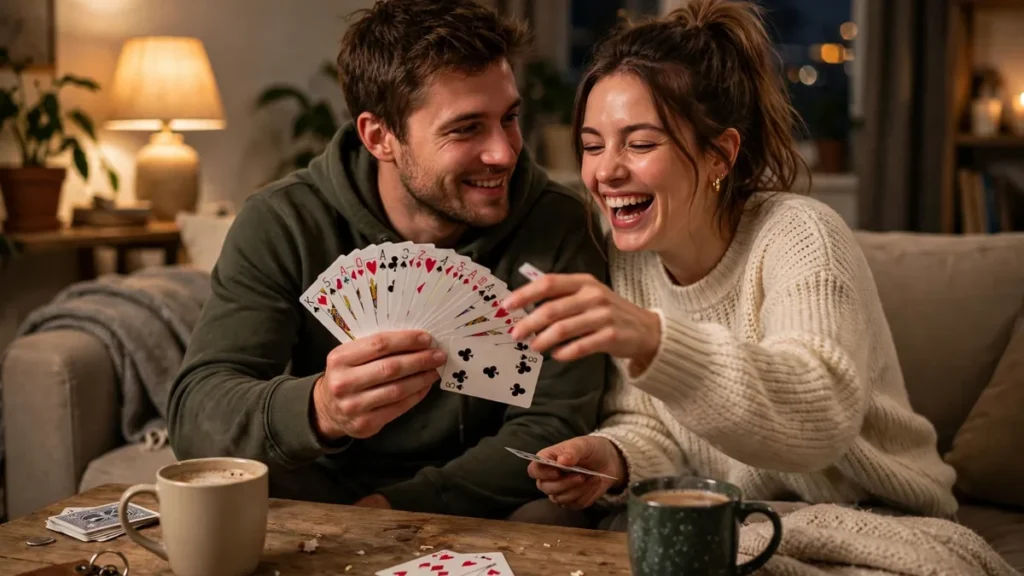
The strongest case for puzzles for teenagers is not the solo one. It is the social one. A puzzle night gives a group of friends something to do together that is not staring at separate phones in the same room. A jigsaw on the table, a riddle round, a logic puzzle raced in teams: these give teenagers a shared problem, and a shared problem is one of the fastest ways to make a group feel like a group.
Puzzle nights also teach something teenagers rarely get taught directly: how to work on a problem with other people without arguing about it. Someone has a wrong answer and has to let it go. Someone else sees the solution and has to explain it instead of just announcing it. These are small skills, but they are the same skills group projects at school are supposed to teach, and a puzzle night teaches them without anyone calling it a lesson. If the idea appeals, our guide to hosting a riddle night for teens shows how to set one up so that everyone actually enjoys it.
When puzzles feel babyish
Here is the honest problem, and it is the reason this question gets asked at all. Many teenagers think puzzles are for younger children, and they are not entirely wrong. A lot of what is sold as a puzzle for teenagers is a children’s puzzle with a different cover. Cartoon animals, huge pieces, clues written for a nine-year-old: a fourteen-year-old handed one of those will feel talked down to, and they will be right.
What counts as teen-credible is surprisingly specific. Escape-room style puzzle books, murder-mystery logic grids, strategy-heavy board puzzles, competitive word games and genuinely difficult crosswords all pass the test, because they are hard in a way that feels grown-up. A thousand-piece jigsaw of a city skyline or a film poster passes too, because the finished picture is something a teenager would actually want on a wall. A puzzle with a timer, a score or a rival to beat passes fastest of all, because teenagers love a contest. Our round-up of the top puzzle games for teens leans heavily on exactly these kinds of puzzles, and it is a good place to start if the teenager in question has already decided that puzzles are not for them.
How to pick one a teenager will finish
Picking the right puzzle is a matter of matching the puzzle to the teenager, not the other way round. A teenager who loves stories will do better with a mystery puzzle or an escape-room book than with a blank grid of numbers. A teenager who likes competition will do better with a timed challenge or a head-to-head word game than with a solitary jigsaw. A teenager who is visual will do better with a picture puzzle than with a page of clues. The puzzle that gets finished is the one that fits the person holding it.
Difficulty matters more than format. A puzzle that is too easy feels like an insult, and a puzzle that is too hard feels like a trap. The right level is one where the teenager has to think hard on a good share of the clues, yet still makes steady headway instead of stalling on the first page. If the teenager finishes it in five minutes without thinking, it was too easy. If they are still stuck on the first page after half an hour, it was too hard. Either way, the answer is to change the puzzle, not to blame the teenager.
Let the teenager choose. A puzzle picked by a parent and handed over like homework will be treated like homework. A puzzle the teenager picks themselves, from a shelf or a list, has a far better chance of being finished. That is one reason a good collection of puzzle books for teens is worth browsing together rather than buying blind: the teenager can judge the cover, the difficulty and the subject, and the choice becomes theirs.
Where puzzles fall short
That is the case in favour. Now the case against, because a fair answer has to include it. Puzzles are not a shortcut to better grades. A teenager who does crosswords every day will get better at crosswords, and the focus and patience will help with schoolwork, but no puzzle will teach algebra or write an essay. Anyone who claims otherwise is selling something.
Puzzles can also become a way of avoiding the work that actually needs doing. A teenager who spends three hours on a jigsaw the night before an exam is not relaxing. They are putting off revision, and the puzzle is the excuse. The test is simple: does the teenager feel calmer and more ready afterwards, or just later than they were before? If it is the second, the puzzle has stopped being a break and started being a hiding place.
The verdict
So, are puzzles good for teens? Yes, in the specific ways that matter to a teenager’s actual life. They train focus and patience, they offer a genuine break from screens, they give a stressed teenager a calm half-hour during exams, and they give friend groups something real to do together. They do all of that cheaply, quietly and without needing anyone’s permission.
They are not magic, and they are not for everyone. They will not raise grades on their own, they will not fix serious stress, and they will be ignored completely if they look like a toy for a younger child. But a teenager with the right puzzle, at the right difficulty, chosen by themselves, has a habit that makes ordinary days slightly better. That is a modest claim, and it is the honest one. Puzzles are good for teens when the puzzle is good enough for the teen.
Frequently asked questions
How much time should a teenager spend on puzzles each day?
Twenty to thirty minutes is plenty. Short, regular sessions build the habit far better than a long session once in a while, and they leave time for everything else a teenager needs to do.
What if my teenager says puzzles are boring?
They are probably right about the puzzles they have been offered. Try a different kind: an escape-room book, a mystery logic puzzle, a timed challenge or a competitive word game. The boring verdict usually belongs to the puzzle, not to puzzles in general.
Are puzzle apps as good as paper puzzles for teens?
Apps are convenient and they can adjust the difficulty, but they come with notifications and the temptation to switch to something else. Paper puzzles end cleanly and keep the phone out of the picture, which is half the point of the break.
Can puzzles help with exam revision?
They help as a break between study sessions, not as a replacement for studying. A short puzzle resets focus and lowers stress, so the next revision session goes better. It will not teach the material itself.