Most adults have not played a scavenger hunt since school, and that is exactly why one works so well at a grown-up gathering. Put a group of friends, colleagues, or neighbours in front of a clever clue and something shifts: the polite small talk stops, people start scheming in whispers, and the quietest person at the table suddenly becomes the one everyone is listening to. The secret is not the hiding places. It is the theme. A hunt built around something your group already loves, whether that is old buildings, second-hand bookshops, or terrible jokes, turns a simple game into an afternoon people remember. Below are twelve hunt themes made for adults, each one a complete idea you can run as it stands, with notes on who it suits and how to make it sing.
Before you pick one, think about your group for a minute. A hunt that asks strangers to perform in public will fall flat, while the same hunt with old friends will have everyone in tears of laughter. A walking-heavy hunt suits a fit group on a dry day and punishes everyone else. And a hunt that leans on one person’s specialist knowledge will leave the rest of the team watching. The best themes below spread the work around, so every player gets a moment to shine. If you need the practical side as well, our guide on planning a scavenger hunt for adults covers timings, team sizes, and clue writing in full. A theme is not a plan, though. It is the flavour of the day, the thing that decides whether your group groans or grins when the first clue lands, so it is worth choosing with care rather than grabbing the first idea that comes to mind.
1. The Historic Landmarks Hunt
Send teams around your town to find the stories hiding in plain sight: the oldest doorway on the high street, the plaque nobody has ever read, the statue with the missing sword, the building that used to be something else entirely. Clues work best as half-riddles, such as asking for the year carved above a doorway or the name on a war memorial. This theme suits visitors and locals alike, because locals are always shocked by how much they have walked past for years without noticing. Keep the route to about a mile, give every team a map, and finish somewhere with seats and cake. The prize can be a small guidebook to the town, which feels exactly right.
2. The Museum and Gallery Hunt
A museum is a scavenger hunt waiting to happen, because every room is already full of things to find. Give teams a list of details to track down: a painting with a dog in it, a sculpture made from something unexpected, the oldest object in one gallery, a portrait of someone wearing a hat indoors. Add one creative task, such as recreating a famous painting with the team as the models, photographed on a phone. This theme suits rainy days, thoughtful groups, and anyone who likes a slower pace. Check the museum’s photography rules first, keep voices down in quiet galleries, and pick a museum with a café, because the hunt always ends better over coffee and a debrief.
3. The Charity Shop Treasure Hunt
Give every team a small budget, perhaps five pounds each, and a list of wonderfully specific things to find in charity shops: the ugliest ornament in the shop, a book with a previous owner’s inscription, a shirt in a colour nobody would choose, a board game with a missing piece. Teams photograph their finds rather than buying everything, though the best find of the day usually does get bought. This theme is cheap, funny, and endlessly surprising, and it suits groups who enjoy browsing. Set a firm time limit and a meeting point, agree that nothing fragile leaves the shop, and award bonus points for the strangest genuine find.
4. The Bookshop and Library Hunt
For readers, there is no better hunting ground than shelves full of books. Clues can point at a novel with a colour in the title, a cookbook from a country nobody on the team has visited, a book published in the year the oldest player was born, or a spine with a misprint. One lovely task is to build a poem from the titles of five books found in order. This theme suits quiet groups, book clubs, and rainy afternoons, and it works beautifully in a library, where everything is free. Ask staff before you start, keep the noise down, and remind teams that reshelving is part of the game.
5. The Music and Playlist Hunt
Build the whole hunt around songs. Each clue is a lyric, a song title, or a band name, and the answer is a place, an object, or the next clue’s hiding spot. Teams might have to find a street named in a famous song, photograph something that matches a chorus, or hum a tune for the other teams to guess. A brilliant finishing task is for each team to build a five-song playlist that tells the story of the day, then play it at the finish. This theme suits music lovers of every age and works indoors or out. Keep the songs recognisable, mix decades so no generation dominates, and have a speaker ready for the finale.
6. The Comedy and Improv Hunt
This one is for groups who are not afraid of looking silly. Every stop comes with a performance task: deliver a weather forecast in the style of a sports commentator, stage a dramatic reunion with a garden gnome, give a guided tour of a bus stop as if it were a palace, or act out a film scene using only three words. Teams film each task, and the funniest clip wins a bonus prize. This theme suits close friends, work teams who already trust each other, and anyone who would rather laugh than compete. Keep tasks short, never force anyone to perform alone, and make the scoring about effort and nerve rather than talent.
7. The Nature Trail Hunt
Take the hunt into woods, a country park, or along a river path, and let the landscape supply the clues. Teams look for a tree with bark that peels, a bird they can identify by its song, a leaf with five points, a stone with a hole through it, or the best view on the whole trail. Add a quiet challenge, such as the best photograph of something tiny, which slows everyone down and makes them look properly. This theme suits walkers, families with older children, and anyone who wants fresh air without a race. Plan for mud, bring a simple first-aid kit, and finish at a café or a picnic spot.
8. The Office Team-Building Hunt
A workplace hunt works when it gets people talking to colleagues they rarely meet. Clues hide around the office, the building, or the streets nearby, and each one needs a different skill: one is a riddle, one is a maths puzzle, one needs someone who knows the company history, and one needs the person who can draw. Mix the teams across departments so nobody plays only with their own desk neighbours. This theme suits away days, new-starter socials, and end-of-project celebrations. Keep it inside working hours, keep the tasks respectful, and make the prize something the whole winning team can share, such as a team lunch.
9. The Couples Date-Night Hunt
A hunt for two is a different creature from a hunt for twenty, and it can be wonderfully romantic. One partner hides a trail of clues around the house, the neighbourhood, or a favourite part of town, and each clue recalls a shared memory: the café where you first met, the bench where a big question was asked, the shop where a disastrous gift was bought. The final clue leads to dinner, a picnic, or a small gift. This theme suits anniversaries, Valentine’s Day, and anyone who wants a date with a little more imagination than a restaurant booking. Keep the clues gentle, keep the walk short, and let the memories do the heavy lifting.
10. The Back Garden Games Hunt
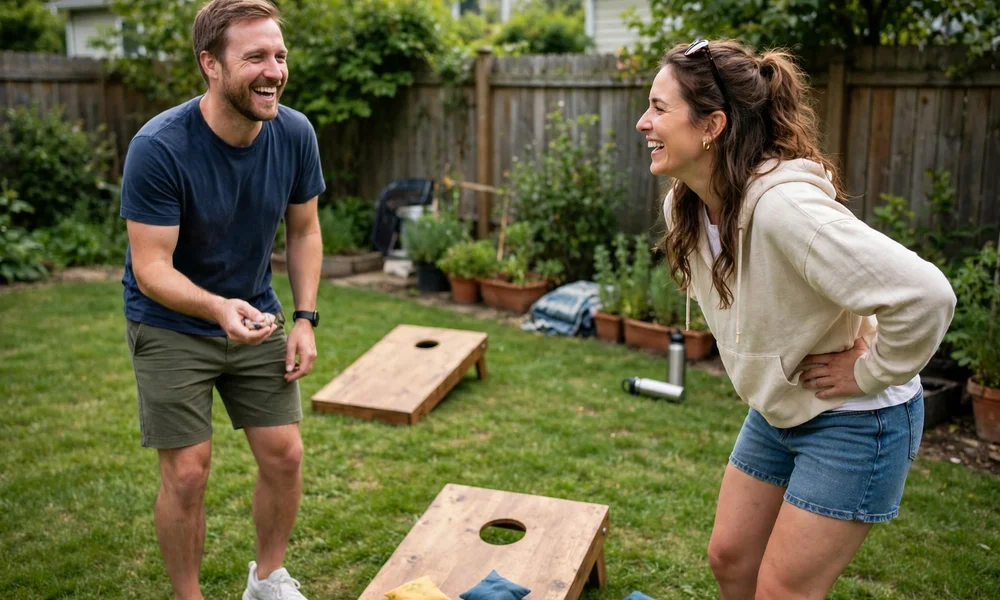
Some of the best adult hunts never leave the garden. Set up a circuit of short challenges and let teams rotate between them: a beanbag toss, a ring toss, a timed puzzle, a blindfolded tasting, a round of giant Jenga, a quiz question pinned to the fence. Each station earns points, and the team with the most points at the end wins, which means nobody is ever stuck on a single impossible clue. This theme suits garden parties, barbecues, and groups with mixed ages or mixed fitness, because every station offers a different way to score. Keep the games simple, keep a scoreboard everyone can see, and have a shaded spot for the teams waiting their turn.
11. The Art and Street Mural Hunt
Street art turns a neighbourhood into an open-air gallery, and a hunt is the perfect excuse to look at it properly. Teams search for a mural with an animal in it, a piece of art on a shuttered shop, a mosaic on a wall, a statue wearing something it should not be wearing, or the most colourful doorway on the street. Add a creative task: sketch a mural in thirty seconds, or photograph a team member copying the pose of a painted figure. This theme suits creative groups, photographers, and anyone exploring a new city. Stay on public pavements, respect private property, and finish at a café where teams can compare their sketches.
12. The Science and Discovery Hunt
For the curious, a science-themed hunt is pure joy. Clues lead to things that demonstrate how the world works: a sundial, a compass reading, a plant that closes when touched, a puddle that shows a rainbow in oil, a building that casts a surprising shadow at a certain hour. Add simple experiments as tasks, such as making a paper plane fly the furthest or building the tallest tower from newspaper. This theme suits science centres, school reunion groups, and anyone who likes to understand things. If you want the puzzle side to carry more of the weight, our guide on how to make a puzzle hunt shows how to chain clues together so each answer unlocks the next. Keep the science simple, keep it hands-on, and let the wonder do the work.
How to Pick the Right One
Start with the people, not the place. A group of old friends will love the comedy hunt and forgive a long walk, while a work group will do better with the office hunt or the garden games, where nobody is put on the spot. A rainy weekend calls for the museum, the bookshop, or the library, while a sunny one belongs outdoors on a nature trail or a landmarks walk. If your group spans a wide age range, look at the teen version too: our guide on planning a scavenger hunt for teenagers has team and clue ideas that translate well when younger players join an adult hunt. Whichever theme you choose, keep the teams small, keep the clues fair, and test the route yourself before the day. The theme gets people excited; the planning is what makes the day work.
The best adult scavenger hunt is the one your group is still talking about weeks later, and that rarely has anything to do with who won. It is the moment someone spotted a plaque they had passed for twenty years, or the team photo that still makes everyone laugh, or the clue that took four people arguing happily to solve. Pick a theme that fits your people, give them a reason to look at the world a little more closely, and let the hunt do the rest. If one theme on this list made you smile as you read it, trust that instinct, because it is the same smile your players will be wearing at the finish line. Your next great afternoon out is already hiding in plain sight, waiting for someone to write the first clue.