There is a box on the shelf in our hallway that has been opened more times than any other object I own. The corners are soft now, and the lid has a small tear where somebody once pulled it too hard. Inside are a thousand cardboard pieces and a picture I have built four times. I do not need another jigsaw. I have three more in the cupboard beside it, two of them still sealed. And yet, on an ordinary evening when the day has finally run out of demands, it is that box I reach for.
I have been trying to work out why. It is not the picture. I could look at the picture on the lid any time I liked, and looking at it would take ten seconds. It is not the challenge, either, at least not in the way people usually mean. Nobody is keeping score. There is no opponent, no clock, no prize. A puzzle game asks almost nothing of you and gives back something I have never found anywhere else: an evening that feels used rather than spent.
That is the strange thing about puzzle games. They look like the least exciting thing in the house: a box of cut-up cardboard, a wooden box with a hidden drawer, a phone screen full of coloured blocks. None of them shouts for your attention. They sit quietly on shelves, waiting. And when you finally sit down with one, you understand why they have outlasted every new entertainment that was supposed to replace them.
A Game You Can Pick Up
The first thing I love about puzzle games is how little they demand before they start giving back. There is no long introduction to sit through, no character to create, no tutorial that lasts half an hour. You open the box, you tip the pieces out, and you are playing. A child can do it. A grandparent can do it. Someone who has never played a game of any kind in their life can do it, because the whole idea is visible on the table in front of them: here is a mess, and somewhere inside the mess is a picture.
That simplicity is not an accident. A puzzle game is built around a single clear job, and the job never changes while you are doing it. Find the piece that fits. Slide the tile into the gap. Turn the box until the hidden catch gives way. If you want a fuller picture of the shape these games take, our guide to what counts as a puzzle game walks through the different kinds, from jigsaws to puzzle boxes to the ones that live on a screen. They all share the same honest deal: the task is obvious, and the only question is how you will go about it.
I think that is why puzzle games are so easy to return to after a long break. You do not have to remember a storyline, or where you left off, or which buttons do what. You sit down, you look at the table, and within a minute your hands remember what to do.
There is also something reassuring about a game that cannot be lost in the ordinary sense. You cannot be knocked out of a jigsaw. You cannot run out of lives while sorting pieces by colour. The worst thing that can happen is that you get stuck, and getting stuck is not a punishment. It is just a pause. You walk away, you make a cup of tea, you come back, and the piece you were holding suddenly belongs somewhere you had not considered.
The Rules Fit in Your Hands
What makes a puzzle game different from almost every other kind of game is that the rules live in the object itself, not in a booklet you have to memorise. You learn a jigsaw by touching it. The edge pieces feel different. The corners announce themselves. After ten minutes your fingers know things your eyes have not caught up with yet: this piece is too smooth for that gap, that one has the wrong shade of blue, this one turns a fraction and suddenly sits flush.
Puzzle boxes work the same way, only smaller and more secretive. There is no sheet telling you how to open one. You hold it, you turn it over, you press a panel and feel it shift a millimetre, and that tiny movement is the game talking back to you. Every catch and sliding panel was put there by a maker who wanted you to find it eventually. The pleasure is not in beating the box. It is in learning its manners.
Video puzzle games keep the same promise in a different shape. The rules might be stranger — gravity that runs sideways, blocks that fall in patterns, rooms where every object is a clue — but they are still learned by doing, not by reading. You press a button, something happens, and your understanding grows by one small step.
The learning never really stops, either. The first hundred pieces teach you how to sort. The next hundred teach you how to see. By the end you are spotting a shape in the pile before you have consciously registered its colour. Nobody taught you that. The game did, quietly, while you thought you were just passing the time.
One More Level, One More Piece
Ask anyone who plays puzzle games why they find it hard to stop, and they will give you the same answer in different words: just one more. One more piece. One more level. One more try at the box that nearly opened. The pull is gentle, but it is real. It works because the next step is always small and always visible: one piece, one move, one level that takes three minutes. And when that step is done, the next one is sitting right there, obvious and inviting.
That is also why the satisfaction lasts. Each piece you place is a finished thing. It clicks, it stays, and the picture is one piece more complete than it was a moment ago. You can see your progress spread across the table in a way that is rare in ordinary life, where most of the work we do disappears the moment it is done.
The variety helps, too. Some evenings I want a thousand-piece landscape that will take a week. Other evenings I want something I can finish before bed. The shelf holds both, and everything in between, and choosing between them is half the pleasure. If you are looking for somewhere to start, our roundup of the top puzzle games for adults covers the ones that hold up best when the evening is yours and the kettle is on.
Company Without a Performance
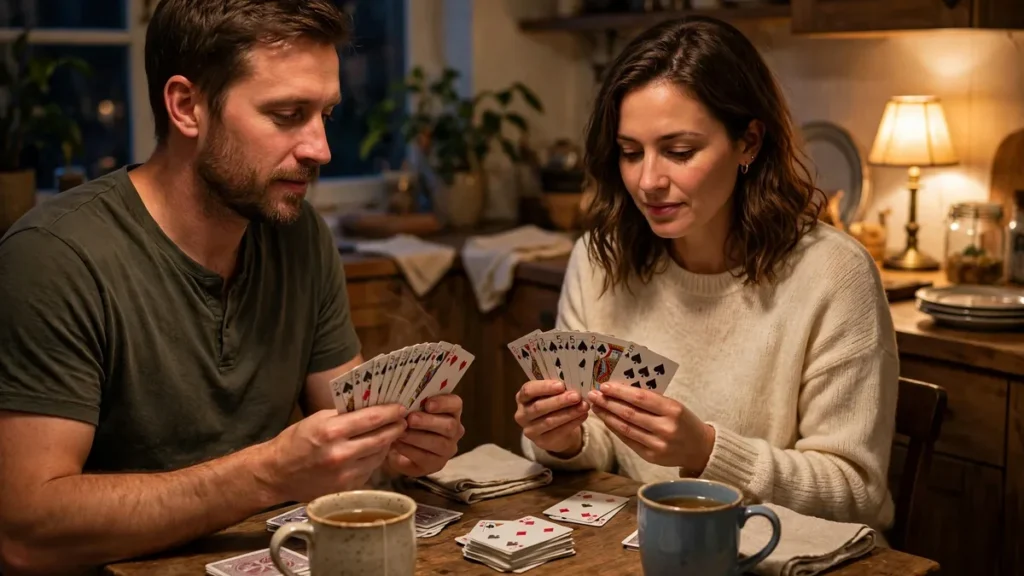
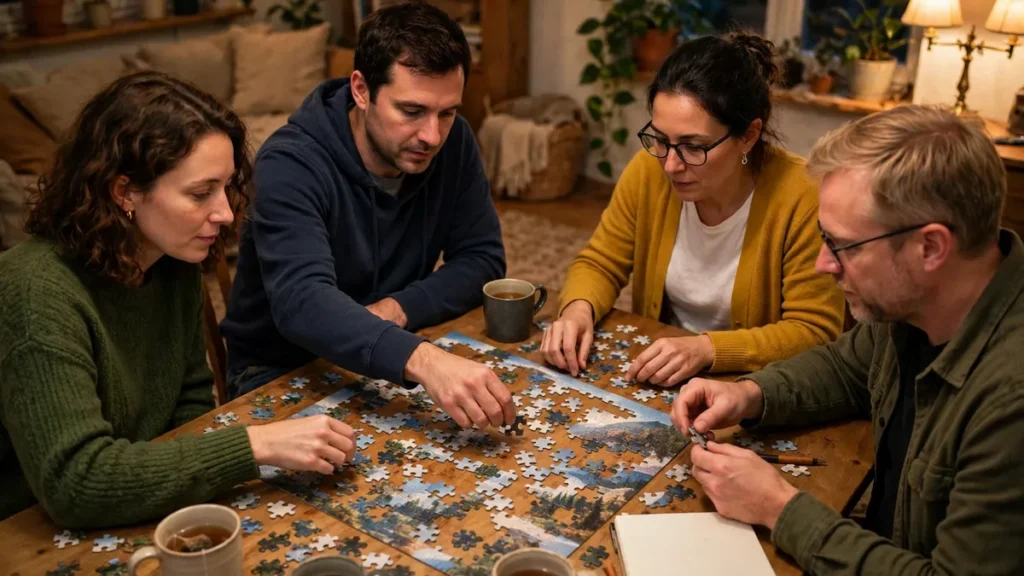
Some of my favourite evenings with puzzle games have involved almost no talking at all. Two people at a table, a pile of pieces between them, the occasional murmur when somebody finds a corner. Nobody is performing. Nobody is trying to be interesting. The game gives everyone something to do with their hands, and the conversation, when it comes, arrives on its own, in the gaps between pieces.
That is a rarer thing than it sounds. Most ways of spending time together ask somebody to carry the evening: to tell a story, to suggest a film, to keep the talk going. A puzzle game carries the evening itself. The silence is comfortable because it is full. You can sit beside someone you love for an hour, say very little, and still feel as though you spent the evening together rather than merely in the same room.
I have watched shy guests come alive at a puzzle table in a way they never do at a dinner table. The game gives them a role that does not depend on being witty or confident. They can contribute without speaking, and their contribution is visible: a section of the picture that would not exist without them. If you fancy turning an evening like that into a proper occasion, our guide on how to host a puzzle night has the practical side covered, from choosing the right games to setting up the table so nobody has to perch on the arm of a chair.
The Shelf of Unfinished Games
Here is a confession: I have never finished every puzzle game I own. There is a wooden puzzle box on my shelf that has defeated me for two years. The lid moves a fraction and then stops, and I have no idea what I am missing. There is a jigsaw in the cupboard with a missing piece — not lost by me, I should add; it arrived that way — and a phone game I abandoned on a level that I am convinced is impossible, even though I know it is not.
I used to feel guilty about the unfinished ones. Then I realised they are doing a different job from the finished ones. The finished games are trophies. The unfinished ones are invitations. Every time I look at that puzzle box, I think about it for a moment. What if I press the side panel first? What if the trick is the order, not the force? The game is still working on me, quietly, even when I am not playing it.
That is one of the kindest things about puzzle games: they do not punish you for leaving. A half-built jigsaw can sit on the table for a week, and when you come back, it is exactly where you left it. A level you abandoned three months ago will still be there, waiting, with no lecture about your absence. The game does not keep score against you. It simply keeps your place.
These days the unfinished shelf reads to me like a library of future evenings. On a rainy Sunday, or a holiday, or a night when sleep will not come, there they are: a box that still has a secret in it, a picture that still has a hole in it, a level that still needs one good idea. The pleasure is not only in finishing. It is in knowing that there is always something left to come back to.

The Smallest Wins, Properly Earned
There is a particular feeling that belongs to puzzle games and almost nothing else. It arrives in the half-second when a piece you have been carrying around the table for ten minutes suddenly fits. There is a small sound — a soft click, or a sigh of cardboard settling — and the picture changes. Not dramatically. Just one piece more complete. And yet the feeling is out of all proportion to the size of the event. It is a whole small victory, delivered in a single quiet moment.
I think the feeling is so strong because the win is entirely yours. Nobody handed it to you. Nobody hinted at it, unless you count the box lid, which has been hinting at it all along. You looked, you tried, you were wrong several times, and then you were right. The game did not congratulate you. It did not need to. The piece sitting flush in its place is the congratulation.
That is a useful feeling to have practised, I think. Most of life does not hand out small clear victories. Work stretches on. Problems stay half-solved. A puzzle game is a place where effort and result still line up neatly, where trying something and seeing it work are separated by seconds rather than months.
And the wins add up. The first piece is luck. The tenth is judgement. By the hundredth, you are not guessing any more; you are reading the table. The game has taught you to notice the difference between two nearly identical shades of green, to trust the small hunch that says this one belongs over there. Those are not grand skills. But they are real ones, and they stay with you after the box is closed.
Why the Box Keeps Getting Opened
So why do I keep opening that box in the hallway, when there are a hundred easier ways to spend an evening? It is not one reason. It is a handful of small ones, stacked up like pieces in a pile: the game asks little and gives back steadily; the rules are learned by touch rather than by study; the next step is always small enough to take; the company it offers asks nothing of anyone; the unfinished ones wait without complaint; and every small win is honestly earned.
That is why the box is worn at the corners and torn at the lid. Not because it is the most exciting thing in the house, but because it is the most reliable. On the evenings when the day has taken more than it gave, I do not want a spectacle. I want a table, a pile of pieces, and an hour in which the only question is where this one goes. The box is always there. The table is always free. And somewhere in the pile, the next piece is waiting.