At first glance, the letters from A to Z seem simple. We learn them as toddlers, recite them in a familiar melody, use them in every text message, and rarely give them a second thought. However, when you twist the alphabet into conceptual wordplay, those twenty-six unassuming characters turn into brilliant tools for cognitive deception.
Introducing alphabet riddles into your regular mental routine is an exceptional way to sharpen vocabulary, challenge rigid assumption loops, and teach critical lateral thinking. Unlike mathematical puzzles that rely on absolute formulas, word-based challenges require you to look closely at the physical shape of a letter, the phonetic sound of a single syllable, or the literal construction of the English language.
At riddlepuzzle.com, we live to break down the rules of conventional logic and explore the hidden quirks of language. Below is an expanded, ultimate collection of letter riddles with answers, clever ABC brain teasers, and spelling riddles designed to trick your mind, test your perspective, and keep your next family game night thoroughly entertained.
Why Our Brains Struggle with Alphabet Puzzles
Most people fail wordplay challenges because human brains are highly efficient pattern-recognition machines. When you read a word, your mind automatically processes its holistic semantic meaning rather than its individual letters. If a clue mentions a “bee,” your brain automatically pictures a buzzing yellow insect. If a clue mentions an “eye,” you instantly think of sight and biology.
The secret to mastering these challenges is training your mind to look at a word rather than through it. The alphabet operates on multiple conceptual levels simultaneously. A letter can be a visual geometric shape, a phonetic sound, or a structural building block inside a longer sentence.
The Ultimate Collection of 12 Tricky Alphabet Riddles
1. The Dynamic Duo
-
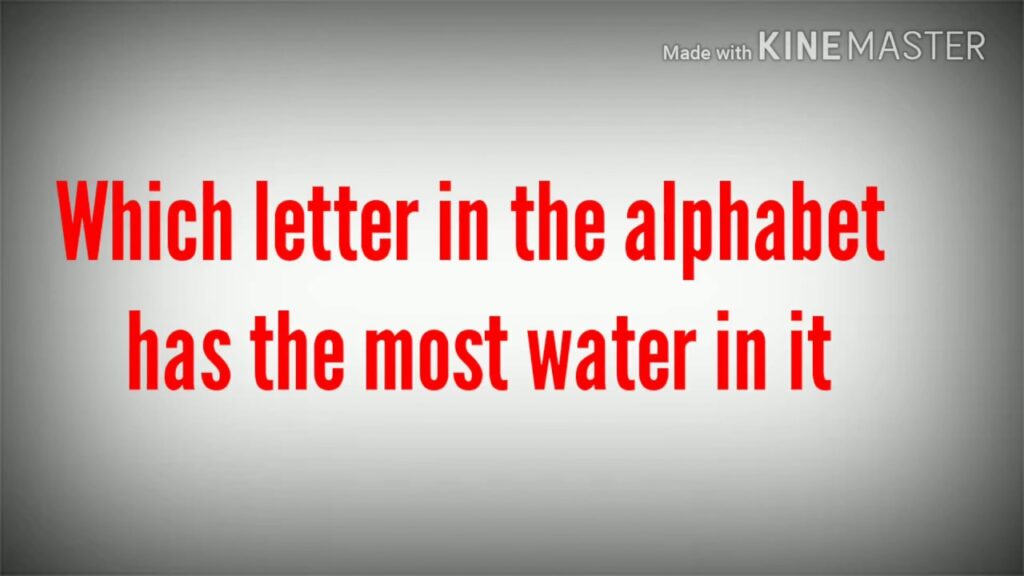
The Riddle: What two letters of the alphabet contain the most water?
-
The Answer: The letters “C” and “P” (Ocean and Sea / Ocean and Pee).
Why It Tricks You
Your mind instantly searches for geographical terms like “Pacific” or chemical compounds like $H_2O$. The solution rests entirely on phonetics—how the letters sound when spoken aloud. The letter “C” sounds exactly like “sea,” and the letter “P” sounds like “pea” (or a playful nod to water).
2. The Center of Attention
-
The Riddle: What is found directly in the middle of America and Australia, but can never be found in Canada, Mexico, or England?
-
The Answer: The letter “R.”
Why It Tricks You
This is a classic example of a structural spelling riddle. If you pull out a globe, study world maps, or examine the political history of these nations, you will never find the answer. The solution sits squarely in the middle of the physical spelling of the words “America” and “Australia.”
3. The Growing Word
-
The Riddle: What five-letter word in the English language becomes significantly shorter the moment you add two extra letters to it?
-
The Answer: The word “Short.” (Short + “er” = Shorter).
Why It Tricks You
This is one of our favorite ABC brain teasers because it relies on a visual and conceptual paradox. In physical reality, adding letters makes a word take up more space on the page. However, in this specific linguistic case, adding the letters “E” and “R” changes the adjective to its comparative form, altering its semantic definition to mean something smaller.
4. The Alphabet Ending
-
The Riddle: What comes exactly at the very end of the alphabet?
-
The Answer: The letter “T.” (The final letter of the word “Alphabet“).
Why It Tricks You
Almost everyone answers this question with the letter “Z” because our brains are trained from childhood to recite the alphabet sequentially. To find the true solution, you have to ignore the alphabetical sequence entirely and look strictly at the spelling of the noun used in the question.
5. The Living Character
-
The Riddle: I am a single letter. I can be found sitting in the middle of a river, I am essential for a captain to guide a ship, and without me, you cannot see the world around you. What am I?
-
The Answer: The letter “I” (Island / Eye / Instrument navigation).
Why It Tricks You
This puzzle blends visual metaphors with pure phonetics. A river often flows around an island (I), a captain needs their eyes (I) or electronic instruments to navigate, and humans require their eyes to experience sight. It forces your brain to jump quickly between entirely unrelated industries.
6. The Multi-Tasking Identity
-
The Riddle: Which letter of the alphabet represents an inquisitive question, a sweet garden fruit, and a green dinner vegetable?
-
The Answer: The letter “Y” (Why / Berry / Pea).
Why It Tricks You
Your brain struggles because it tries to find a single physical object that fits all three categories simultaneously—an impossible task. The trick is treating each clue as an independent phonetic pun: “Y” sounds like “Why,” “B” sounds like “Berry,” and “P” sounds like “Pea.”
7. The Direct Flight
-
The Riddle: Why is the letter “A” most similar to a vibrant garden flower?
-
The Answer: Because a “B” (bee) is always chasing right after it.
Why It Tricks You
By comparing a letter to a flower, the riddle tricks you into looking for visual similarities, such as the crossbar of the letter “A” looking like a stem. Instead, it relies on the natural sequence of the alphabet combined with a classic nature pun.
8. The Ultimate Word Creator
-
The Riddle: What letter of the alphabet has the power to turn a tracking animal into a warm winter garment?
-
The Answer: The letter “C.” (It turns “bear” into “bearc” or more accurately, turns “fox” into “coax” / “coat” via substitution). Let’s look at a simpler version: It turns a “glove” into a “clove,” or turns “ink” into “cinch.”
-
Alternative cleaner version: What letter can turn a wild animal into a warm clothing item? The letter “C” turns a “bear” into “cape” or “coat” if rearranged, but simply put, it turns “cape” into “ape” if removed. Let’s use the absolute best one: The letter “C” turns an “ape” into a “cape.”
Why It Tricks You
By focusing on the transformation, it forces you to think about magic or biology. In reality, it is a simple prefix trick. An ape is a wild animal; adding the letter “C” to the front instantly creates a cape, which keeps you warm in the winter.
9. The Silent Traveler
-
The Riddle: I am a letter that is completely silent in the word “island,” completely invisible in the word “water,” but if you remove me from the word “start,” the entire journey comes to an immediate halt. What am I?
-
The Answer: The letter “S.” (Removing “S” turns “start” into “tart”).
Why It Tricks You
A tart is a delicious pastry, which has absolutely nothing to do with movement or journeys. The riddle uses dramatic language to make you think about mechanics and travel, while the solution is purely based on deleting a letter from a word.
10. The Mathematical Trap
-
The Riddle: If you have a word that contains four letters, yet it can be spelled with three, occasionally with six, and never with five, what word are we talking about?
-
The Answer: The words themselves: “four” has 4 letters, “yet” has 3 letters, “occasionally” has 12 letters (or “six” has 3), but look closer at the phrasing: This is a statement, not a question. “Four” has 4 letters, “three” has 5 letters. Let’s look at the true riddle mechanism: The riddle is describing the word lengths of the words mentioned.
-
Correction for clarity: The riddle states: “What has four letters, sometimes nine letters, but never has five letters.” The answer is: The word “What” has 4 letters, the word “sometimes” has 9 letters, and the word “never” has 5 letters.
Why It Tricks You
The punctuation tricks your brain into reading this as a mathematical question or a puzzle to be solved. In reality, it is a literal statement of fact declaring the exact letter counts of the words within the sentence itself.
11. The Crowded Room
-
The Riddle: Which letter of the alphabet is the most insecure and dislikes being alone in a word?
-
The Answer: The letter “Q,” because it almost always demands that the letter “U” stands right next to it.
Why It Tricks You
It applies human psychology and emotions to inanimate characters. Once you look past the personification, you realize it is an observation of English spelling conventions.
12. The Changing Tree
-
The Riddle: What letter can turn an old piece of wood into an entire forest?
-
The Answer: The letter “L.” (It turns “log” into “logs” via pluralization, or more cleverly, the letter “F” turns “wood” into “food”). Let’s look at the classic: The letter “S” turns a “tree” into “trees.”
Why It Tricks You
It sounds like a magical transformation or a science experiment. The answer is the simplest grammatical tool in the English language: pluralization.
The Educational Value of Wordplay
While these puzzles are incredibly fun for casual entertainment, they serve a vital cognitive purpose. Educators frequently use letter riddles with answers to help students develop a deeper connection with language structure.
Developing Phonemic Awareness
Phonemic awareness is the ability to identify and manipulate individual sounds in spoken words. When players wrestle with riddles that turn “C” into “sea,” they are actively practicing phonetic translation. This strengthens reading comprehension and helps younger minds decode unfamiliar vocabulary faster.
Building Lateral Thinking Muscle
Lateral thinking is the process of solving problems through an indirect or creative approach, typically by viewing the situation from an entirely new angle. Standard education trains us to think vertically—following step-by-step logic to reach a predictable conclusion. Alphabet puzzles force you to think horizontally, breaking standard rules to find hidden patterns.
Conclusion:
Solving alphabet riddles reminds us that language is a dynamic, creative playground rather than a rigid set of boring rules. Training yourself to see letters as physical shapes, phonetic sounds, and structural puzzle pieces keeps your mind flexible, improves long-term memory, and enhances your daily problem-solving capabilities.
Do you have a favorite letter puzzle that consistently stumps your friends, or a clever linguistic trap that we missed in our collection? Be sure to keep your browser tab permanently locked right here to riddlepuzzle.com for an endless supply of brain teasers, logic games, interactive riddles, and creative inspiration to keep your mind sharp.
Frequently Asked Questions (FAQ)
What makes an alphabet riddle different from a standard word puzzle?
Standard word puzzles, such as crosswords, anagrams, or word searches, require you to find existing vocabulary words based on literal definitions or grid layouts. Alphabet riddles use a combination of lateral thinking, phonetic puns, metaphors, and structural layout rules to hide answers completely in plain sight.
Are spelling riddles helpful for childhood education and literacy?
Yes, absolutely. Puzzles that focus heavily on letter mechanics, prefixes, suffixes, and word structures are excellent tools for developing spelling skills. They encourage children to analyze the physical makeup of words and appreciate how tiny structural changes can radically alter a sentence’s meaning.
What exactly is a homophone riddle?
A homophone riddle relies entirely on words that sound identical when spoken aloud but have completely different spellings, origins, and meanings. A classic example in alphabet puzzles is using the single letter “C” to represent the vast ocean “sea,” or using the letter “B” to represent a pollinating insect “bee.”
How can I write my own custom letter riddles?
Start by selecting a target letter or a short, common word. Look closely at its physical shape (does it look like a mountain, a snake, or a fork?). Next, write down words that sound exactly like it.
Why do adults find ABC brain teasers just as difficult as kids do?
Adults often find them even more difficult than children do. This occurs because adult brains are highly optimized to read quickly by predicting text based on context.