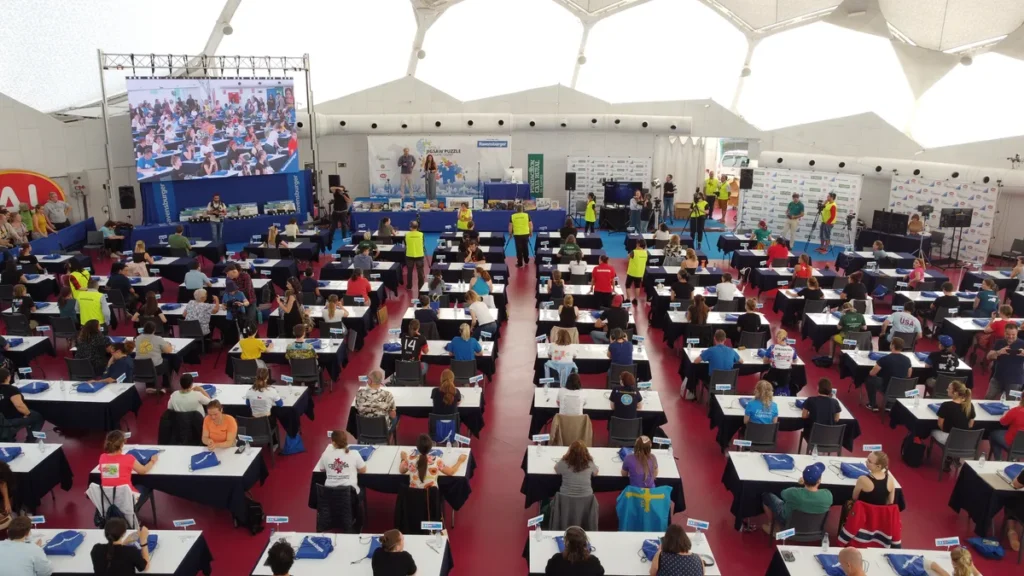
Four hundred and ninety-eight players on one building site sounds like a shift change at a tower block until the first whistle blows. Then the noise settles into a steady rhythm: hammers tapping, tape measures snapping back, and teams calling out numbers across the yard. This plan turns that crowd into 33 teams, each moving through nine construction stations in turn, with every team working on a puzzle that can be checked and scored before the next round.
The building site theme is the reason a group this large can play together without long queues or idle players. Nobody waits for a turn, and no single expert can carry a whole team. Each station gives every player a small job at the same time, so a team of 15 or 16 can spread around a long workbench and all be busy from the first minute.
This guide gives you the full day in order: the nine races, the timing, the kit list, and the scoring system. If you want a smaller warm-up first, try the plan for 497 players before you scale up to 498. The one extra player joins as a sixteenth member on one of the smaller teams, and nothing else in the plan needs to change.
Key takeaways
- Split 498 players into 33 teams: 30 teams of 15 and three teams of 16.
- Run nine construction stations at 25 minutes each, with five minutes to move, reset, and check the work.
- Give every station a printed briefing card, a worked sample, and a scoring sheet.
- Score finished work, accuracy, and teamwork together, not speed alone.
- Keep one host, nine station leaders, and a spare kit table so a missing card never stops a round.

The Nine Races at a Glance
| Race | What teams do | Round length | Kit per station |
|---|---|---|---|
| Roof Tile Overlap Race | Overlap tiles in the right pattern | 25 minutes | Tile sets, roof boards, chalk |
| Blueprint Symbol Race | Read symbols on a site drawing | 25 minutes | Blueprints, symbol keys, rulers |
| Crane Load Swing Race | Swing a load to the right bay | 25 minutes | Model crane, load boxes, bay cards |
| Scaffold Board Fit Race | Fit boards into a frame | 25 minutes | Boards, frames, wedges, mallets |
| Tool Belt Sort Race | Sort tools into belt pockets | 25 minutes | Tool sets, belts, pocket charts |
| Concrete Pour Level Race | Pour and level a slab section | 25 minutes | Trays, mix, floats, level gauges |
| Steel Beam Measure Race | Measure beams to a cut list | 25 minutes | Beam lengths, tapes, cut lists |
| Rivet Pattern Count Race | Count rivets in a plate pattern | 25 minutes | Rivet plates, counters, tally sheets |
| Wheelbarrow Load Race | Load a barrow to the right weight | 25 minutes | Barrows, load bags, scales |
The Nine Construction Races
Each race below follows the same shape: a short demo, a timed round, and a check against a sample. Station leaders read the same script at every station, so every team gets the same fair start. Keep the briefing cards face down until the bell, and keep the worked sample covered until the check.
1. Roof Tile Overlap Race
Roof Tile Overlap Race gives each team a small roof board marked with rows and a box of tile pieces in three colours. The team must lay the tiles row by row, overlapping each tile over the one below it, and matching the colour pattern shown on the sample card. One player reads the pattern aloud, one places the tiles, and the rest check each row.
Score the round by checking each row against the answer key, giving one point per row with the overlap and the colour pattern both correct. A row with the right colours but the wrong overlap still loses the point for that row. Keep spare tiles in a separate tray, because a cracked tile cannot be laid in the time left.
2. Blueprint Symbol Race
Blueprint Symbol Race starts with a large site drawing covered in small symbols for doors, windows, pipes, and power points, plus a symbol key that explains what each mark means. Each team must find every symbol on the drawing, write down what it stands for, and mark its position on a blank grid. The team needs one reader, one writer, and two checkers who read the grid back aloud before the bell.
Score the finished grid by counting the symbols in the right places, then checking the meanings against the answer key. A symbol in the right place but with the wrong meaning still loses the point for that symbol. Keep spare symbol keys handy, because a torn key cannot be read in the time left.
3. Crane Load Swing Race
Crane Load Swing Race hands each team a small model crane with a swinging hook, a set of load boxes of different weights, and a row of bay cards marked with weight limits. The team must swing each load to the bay that can take its weight, then stack the loads in the order shown on the bay card. The hook swings further than most players expect, so the best teams move it in short, gentle pulls and count to three before each drop.
Score one point per load in the right bay, with a bonus for a full row stacked without a second swing. Keep the load boxes in a shallow crate, because a spilled crate will scatter across two tables. One player should work the crane while another reads the bay cards aloud, and a third should hold the weight list so no limit is missed.
4. Scaffold Board Fit Race
Scaffold Board Fit Race gives each team a wooden frame with slots of different lengths and a pile of boards, wedges, and mallets. The team must fit every board into the slot that matches its length, tap the wedges in to hold the boards firm, and leave no board sticking out past the frame. The team needs one measurer, one fitter, and one checker who tests each board with a gentle push before the bell.
Score the finished frame by checking each board against the answer key: one point per board in the right slot, with a bonus if every wedge sits tight and no board moves when pushed. A board in the wrong slot loses the point, even if it fits snugly. Keep spare wedges in a small tin, because a split wedge cannot be used again.
5. Tool Belt Sort Race
Tool Belt Sort Race starts with a jumbled box of hand tools and a set of belts, each with pockets marked for a different trade. Each team must sort every tool into the pocket where it belongs, following the pocket chart that shows which tool goes where. The best teams lay the tools out in a line and count them before sorting. A hammer in the measuring pocket, or a level in the cutting pocket, costs the team that point.
Give each team a numbered answer sheet and a pencil, and let one player act as the reader who calls the pockets in order. The rest find the tool, check it against the chart, and place it down. Score one point per tool in the right pocket, with a bonus for a full belt sorted without a change. Keep spare tools in a separate box, so a team cannot swap a tool after the bell.
6. Concrete Pour Level Race
Concrete Pour Level Race gives each team a shallow tray marked with a level line, a bucket of thick mix, and a float for smoothing the surface. The team must pour the mix into the tray, spread it evenly, and smooth it flat so the top sits exactly on the level line all the way across. The mix sets quickly, so the team needs one pourer, one spreader, and one checker with the level gauge who calls out the high and low spots while there is still time to fix them.
Score the finished tray by running the gauge across the surface: one point per section that sits on the level line, with a bonus for a smooth finish with no ridges or dips. A section poured too high loses the point, even if the rest of the tray is perfect. Keep spare floats at the station, because a float caked in mix cannot smooth the surface.
7. Steel Beam Measure Race
Steel Beam Measure Race hands each team a rack of steel beam lengths, a set of tape measures, and a cut list showing the exact length each beam must be. The team must measure every beam, match it to the right line on the cut list, and mark the cutting point with chalk. The beams sit close in length, so measuring by eye alone will send a beam that is too short to the cutting bench while a longer one waits unused. One player should read the cut list aloud while another measures, and a third should hold the chalk and mark each beam as it is checked.
Score the round by checking each mark against the answer key: one point per beam marked at the right length, with a bonus if every beam on the list is matched without a second measure. A mark in the wrong place loses the point, even if it sits next to the right one. Keep spare tapes handy, because a stretched tape cannot be trusted in the time left.
8. Rivet Pattern Count Race
Rivet Pattern Count Race starts with a set of steel plates, each stamped with a pattern of small rivets in rows and rings, plus a tally sheet for the count. Each team must count the rivets on every plate, working row by row, and write the total for each plate on the tally sheet. The rivets are small and the patterns repeat, so the team needs one counter, one marker who dots each rivet as it is counted, and one checker who recounts the busiest plate before the bell.
Score the finished sheet by comparing it with the answer key: one point per plate with the right total, with a bonus for a full set counted without a correction. A plate with the right pattern but the wrong total still loses the point for that plate. Keep spare tally sheets in a folder, because a stained sheet cannot be read in the time left.
9. Wheelbarrow Load Race
Wheelbarrow Load Race gives each team a wheelbarrow, a pile of load bags of different weights, and a set of order cards showing the exact weight each barrow must carry. The team must load the bags into the barrow, check the total on the scales, and swap bags until the weight matches the order card. The bags look alike at a glance, and two of them differ by only a small amount, so the team has to read the weight tags instead of guessing from the size alone.
Score the round by weighing each barrow against the order card: one point per barrow at the right weight, with a bonus for a load balanced so nothing tips when the barrow is lifted. A barrow at the wrong weight loses the point, even if it looks full. One player should read the order cards aloud while another loads, and the rest check the scales before the bell.
How the Day Runs
Start at nine with a ten-minute welcome, a walk around the stations, and a clear reading of the scoring rules. Teams draw their starting station from a box. The first bell starts the first round at half past nine, and each round runs for 25 minutes, with five minutes to move and reset. After three rounds, take a 20-minute break, then run three more rounds, take lunch, and finish with the last three.
The timing follows the same station rhythm as the 496-player plan, with short rounds and a clear reset between them. That reset is the part most hosts undervalue: five minutes is enough to clear the workbench, count the kit, top up the card sets, and lay out fresh answer sheets, but only if the station leader has a checklist in hand. If a station falls behind, the host holds the bell for two minutes and lets the next round run two minutes short.
Finish with a 30-minute closing ceremony. Bring the best board from each station to the front table, read out the top three teams, and let the winning team choose one finished board to keep.
Setup Checklist
Work through this list the day before, not on the morning of the event. For a smaller hall, the 495-player plan shows how the same stations fit into tighter rooms. The kit below is counted for 33 teams, with spares for the stations that use the most material.
- Count 33 team tables, nine station kits, and one spare kit table with extra tile sets, blueprints, load boxes, boards, tool sets, trays, beam lengths, rivet plates, and load bags.
- Print 33 sets of briefing cards, answer sheets, and scoring sheets, and put each set in a labelled folder.
- Brief the nine station leaders together, with a live demo of each race and a copy of the same script.
- Set out the trays, token boxes, and card sets early, and check the level gauges and the spare supplies before the first team arrives.
- Mark the team tables clearly, lay out the display wall, and test the bell from the far end of the hall.
- Pack a repair box with spare cards, markers, pencils, timers, tape, and batteries, and keep it at the host table.
Frequently Asked Questions
How do 498 players fit into teams?
Make 33 teams: 30 teams of 15 and three teams of 16, which adds up to 498 players. The kit is counted for 15, so the leader should give the three larger teams a second set of the smallest tools.
How long does the whole day take?
Plan for five hours of play, plus a welcome, two breaks, lunch, and a closing ceremony, which brings the day to about seven hours. The nine rounds take four and a half hours with the five-minute moves included.
Do we need a big hall?
You need a hall with room for 33 tables and nine station areas, plus a clear path for teams to move between rounds. A school hall or a community centre with a flat floor works well, as long as the tray and barrow stations sit near a firm surface with room to turn.
What if a team has never played anything like this before?
That is the normal starting point, and the plan is built for it. Each station starts with a two-minute demo, a worked sample to copy, and a briefing card that shows every step. New players take the reading and checking jobs first, then try the harder steps in the later rounds.
Can younger or older players take part?
Yes, with a small change at the stations that need quick hands. Younger players work with a teammate at the crane and the barrow loading, and older players can sit for the blueprint, the rivet counting, and the tool sorting stations.
What should we do if a kit breaks during a round?
Stop the clock for that station only, swap in the spare from the kit table, and add the lost minutes to the end of that round. The leader notes the break on the scoring sheet, so the team is not blamed for the delay.
The Bottom Line
Running puzzle games for 498 players works when the work is real, the rules fit on one card, and every player has a job from the first minute. Nine construction stations, 33 teams, and a steady bell give a huge crowd the feel of a small building site, and the finished boards on the display wall show the day better than any score sheet.
Start with the checklist, print the briefing cards, and book the hall early. The teams will bring the noise and the friendly rivalry. Your job is to give them a fair start, a clear finish, and a day where 498 people all built something worth keeping.