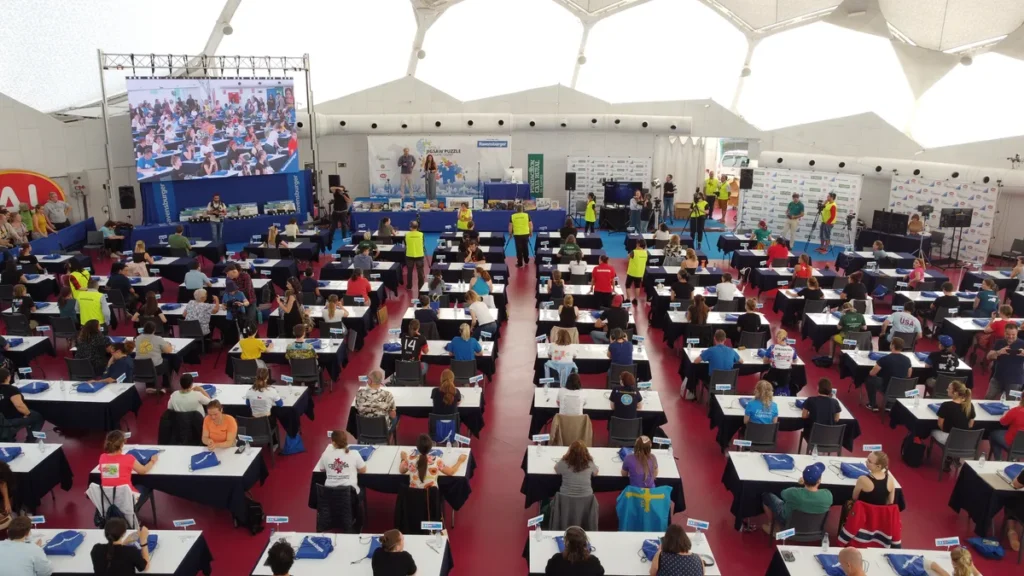
Four hundred and ninety-six players is not a party. It is a small festival, and it only works when the day is built around stations instead of a single crowd doing one thing at the same time. Split the group into thirty-one teams of sixteen, set up nine stations across a field or a large hall, and rotate every team through every station on a fixed timetable. Nobody waits in a line that never moves.
The nine games below were chosen for exactly that shape of day. Each one works with sixteen players at a time, needs only simple and cheap equipment, and can be scored in about twenty minutes so the rotation stays on schedule. They mix balance, rolling, tossing, music, folding, shaking, scattering, and spitting contests. If you are still sizing the crowd, our guide to party games for 494 players shows how a slightly smaller gathering runs on the same station system, and the timetable there transfers directly to this plan.
What matters most is not the size of the prizes or the fanciness of the equipment. It is the flow. Give every team a colour, a captain, and a printed rotation card, and put a volunteer with a whistle at every station. Start and end every round together, and keep the gaps between rounds short. Do that, and 496 players feel like thirty-one small parties instead of one enormous crowd.
Key takeaways
- Split 496 players into thirty-one teams of sixteen and rotate them through nine stations on a twenty-minute timetable.
- Every game below works for sixteen players at once, uses cheap and simple equipment, and can be scored in a single round.
- Mix physical, musical, craft, and silly games so every kind of player gets a station where they can shine.
- One volunteer with a whistle at each station keeps the whole day on schedule and stops queues from forming.
- Score every station the same way, add the points up at the end, and crown one winning team at the closing ceremony.

How to Run a 496-Player Party Day
Start with the ground. You need enough space for nine stations with a clear walking lane between them, plus a central meeting point where teams gather at the start and the end of the day. A school field, a large park lawn, or a community sports ground all work well. Mark every station with a coloured flag and a simple sign showing the game name, the rules in three short lines, and how points are scored.
Next, build the timetable. Nine stations at twenty minutes each give three hours of play, with five-minute changeovers adding forty-five minutes between rounds. Add thirty minutes at the start for welcome and team photos, and thirty minutes at the end for the final scores and the closing ceremony, and the whole day runs to about four hours and forty-five minutes. Keep water stations along the walking lanes, and a shaded rest area near the central meeting point.
Scoring should be simple enough for a volunteer to run with a clipboard. Award ten points to the best team at a station, eight to the second, six to the third, and four to every other team that completes the station fairly. Ties share the points. Announce the running totals after the fifth station, but keep the final result secret until the closing ceremony. Finally, check the ground for holes and slippery patches, keep a first-aid kit at the central meeting point, and have a covered hall as a backup if rain is possible.
The 9 Best Party Games for 496 Players at a Glance
| Game | Players per Round | Time | What You Need |
|---|---|---|---|
| Giant Seesaw Balance Rally | 16 | 20 minutes | Long seesaw, sandbags, stopwatch |
| Mega Acorn Roll Race | 16 | 20 minutes | Acorns, ramps, tape lanes |
| Human Sundial Pose Challenge | 16 | 20 minutes | Chalk circle, numbered markers |
| Giant Pinecone Toss Tournament | 16 | 20 minutes | Pinecones, buckets, tape line |
| Mega Harmonica Hoot Rally | 16 | 20 minutes | Harmonicas, song cards |
| Giant Picnic Blanket Fold Race | 16 | 20 minutes | Picnic blankets, stopwatch |
| Mega Snow Globe Shake Challenge | 16 | 20 minutes | Snow globes, timers |
| Mega Birdseed Scatter Relay | 16 | 20 minutes | Birdseed, cups, marked plots |
| Giant Watermelon Seed Spitting Contest | 16 | 20 minutes | Watermelon slices, tape measure |
The 9 Best Party Games for 496 Players
1. Giant Seesaw Balance Rally
The seesaw is the oldest balance game in the world, and at party scale it becomes a team event. Set a long, sturdy seesaw on a flat patch of grass, and mark a balance line across the middle with bright tape. Each team of sixteen splits into two groups of eight, one group on each end, and the aim is to hold the seesaw level for as long as possible. Players may shuffle their feet, crouch, or lean, but nobody may step off once the round has started. The volunteer starts the stopwatch the moment both ends leave the ground, and the clock stops the moment either end touches down.
The fun of this game is that strength does not win it. Balance wins it, and balance is a team skill. The players on the heavy side need to slide gently toward the centre, while the players on the light side need to edge outward a little at a time. Teams that appoint a single caller and follow that caller calmly will always outlast teams where everybody shouts at once. Score the game by time, keep the seesaw low, and put soft mats underneath each end.
2. Mega Acorn Roll Race
Acorns are small, round, and gloriously unpredictable, which is exactly what makes them perfect for a rolling race. Build four short ramps from plywood or sturdy cardboard, each about two metres long, and mark four lanes on the ground with tape. Each team sends four players to the ramps, and each player rolls one acorn down their ramp and watches it travel across the lane. The acorn that rolls the farthest without leaving its lane wins the heat. Four heats make a full round, so every member of the sixteen-player team gets a turn at the ramp.
The skill is in the release. Roll too hard and the acorn bounces out of the lane. Roll too gently and it stops halfway down the ramp. The best players give it a smooth, steady push and let the slope do the work. Keep spare acorns in a bucket, because a few will always roll away into the grass, and award points by total distance across the four heats. This station is quiet and oddly tense, a lovely change of pace after the seesaw.
3. Human Sundial Pose Challenge
A sundial tells the time with a shadow, and in this game the players are the shadow. Draw a large circle on the ground with chalk, mark the hours around its edge like a clock face, and place a tall pole at the centre. The station volunteer calls out a time, such as half past three, and the team has thirty seconds to arrange themselves in a line from the centre pole to the correct hour mark, forming a living shadow hand. The line must be straight, every player must be part of it, and the team must hold the pose until the volunteer has checked it.
This game rewards quick thinking and clear communication more than speed. Someone must work out where the hour hand should point, someone else must guide the line into place, and everyone else must move without getting in each other’s way. Play five rounds with five different times, with a bonus point for the straightest line. It works best in sunshine, when real shadows stretch across the circle.
4. Giant Pinecone Toss Tournament
Pinecones are free, plentiful, and satisfying to throw, which makes them ideal for a tossing tournament. Set three buckets at three distances from a throwing line: the nearest bucket is worth one point per pinecone, the middle bucket is worth three points, and the far bucket is worth five. Each player gets three pinecones, and the team total is the sum of every player’s score. Sixteen players, forty-eight pinecones, and one very busy volunteer counting buckets at the end of the round.
The choice each player faces is the heart of the game. Play it safe and aim for the near bucket, or risk everything on the far bucket for five points. Most teams split the difference, sending their steadiest throwers at the far bucket and letting everyone else collect safe points. Count the pinecones in front of the team so the score is never in doubt. The same station system also powers our party games for 492 players, which uses the same rotation timing and the same scoring scale, so a team that has played this format before will settle in quickly.
5. Mega Harmonica Hoot Rally
The harmonica is the friendliest instrument at a party, because anyone can make a sound with it in seconds. Hand every player a clean harmonica, place a set of song cards on a table, and let the team draw one card per round. Each card names a well-known tune, and the team has two minutes to work out how to play it together before performing it for the volunteer. The performance does not need to be perfect. It needs to be recognisable, it needs to involve everyone, and it needs to finish together on the same note.
This station turns a group of strangers into a band in two minutes. Someone takes the melody, someone else keeps a steady rhythm, and someone always ends up conducting with wild arm movements. The volunteer scores three things: whether the tune could be recognised, whether every player took part, and whether the team finished together. Buy cheap harmonicas in bulk and let every player keep theirs as a souvenir.
6. Giant Picnic Blanket Fold Race
Folding a picnic blanket sounds easy until sixteen people have to do it together against the clock. Spread a large blanket on the ground, and on the whistle the team must fold it into a neat square, with straight edges and no corners sticking out, and carry it to a marked finish line. The catch is that every player must hold an edge of the blanket for the whole fold, so the team has to move as one unit, stepping in together, lifting together, and turning together. Drop an edge, and the team must start that fold again.
This is a game about coordination, not strength. The teams that win are the ones that talk in short, clear words: lift, step, turn, fold. Three folds make a full round, and the volunteer times each fold and checks the finished square. A square with a corner sticking out costs a five-second penalty. It suits players who prefer a calm, careful challenge to a fast, noisy one.
7. Mega Snow Globe Shake Challenge
A snow globe holds a tiny winter scene, and shaking it fills the water with glitter. In this game, the aim is the opposite of what you might expect: shake the globe, start the timer, and watch the glitter settle. The team that predicts the settling time most accurately wins the round. Each player gets one globe and one guess, written on a card before the shaking begins. The volunteer shakes all sixteen globes at once, sets them down in a row, and the team watches the glitter drift down together in silence.
The waiting is the game. Sixteen people standing quietly around a row of snow globes, watching glitter fall, is one of the strangest sights of the whole day. Play three rounds with three different globes, because every globe settles at a different speed. Choose sturdy globes with thick glass and tight seals, and keep them on a flat table. This calm station makes a perfect rest stop between the livelier games.
8. Mega Birdseed Scatter Relay
Birdseed is light, cheap, and easy to scatter, and this game turns scattering it into a test of accuracy. Mark sixteen small plots on the ground, one for each player, each about the size of a dinner plate. Each player carries a cup of birdseed from a start line to their plot, scatters it as evenly as they can across the plot, and runs back to tag the next player. The volunteer then scores each plot on how evenly the seed is spread, with full coverage earning the most points and bare patches losing points.
Running fast and scattering well pull in opposite directions. Sprint to the plot and the seed flies everywhere. Walk carefully and the scatter is beautiful but the time is slow. The best teams split the difference. Keep the seed in sealed buckets at the start line, and sweep the plots clear between rounds so every team starts from the same clean ground. The birds will enjoy the scattered seed once the party is over.
9. Giant Watermelon Seed Spitting Contest
Spitting watermelon seeds is a classic summer pastime, and at party scale it becomes a proper contest with a tape measure and a cheering crowd. Each player eats a slice of watermelon, keeps one seed, steps up to the line, and spits it as far as they can down a marked lane. The lane is swept clean before every round, the landing spot is marked with a small flag, and the distance is measured from the line to the flag. Sixteen players, sixteen flags, and one very long tape measure.
Technique matters more than lung power. The best spitters take a breath, aim slightly upward, and let the seed fly in a smooth arc. Players who blow too hard send the seed straight into the ground a metre from the line. Award points by total distance across the whole team. Keep napkins and a water tap nearby, and keep the lanes well away from the food tables. If your guest list shrinks, our party games for 490 players keep the same nine-station layout, so the plan scales down without any redesign.
Party Day Checklist
- Confirm the venue, the backup hall, and the water supply at least a week before the day.
- Print thirty-one rotation cards, one per team, and pack a whistle and a clipboard for every station volunteer.
- Buy, borrow, or build all nine stations of equipment and test every game once before the players arrive.
- Mark the stations, the walking lanes, and the central meeting point with flags, tape, and clear signs.
- Pack a first-aid kit, sun cream, drinking water, and a shaded rest area near the meeting point.
- Prepare the score sheets, the closing ceremony script, and the prizes for the winning team.
Frequently Asked Questions
Can 496 players really play the same nine games?
Yes, because nobody plays all at once. Thirty-one teams of sixteen rotate through nine stations, so only sixteen players are at any one station at any time. The station system is what makes a crowd of this size playable, and it is the same system used by large school events and community festivals every summer.
What is the best team size for 496 players?
Teams of sixteen work best for these nine games. Sixteen is large enough to feel like a real team and small enough that every player gets a turn at every station. Smaller teams mean more teams and longer queues, while larger teams mean some players spend too long watching instead of playing.
How much space do we need for 496 players?
A full sports field or a large park lawn is ideal, with room for nine stations, walking lanes, and a central meeting point. Allow at least a hundred metres by sixty metres of open ground. If space is tight, move the four calmest stations indoors.
How long does a full day of nine games take?
About four hours and forty-five minutes, including welcome, changeovers, and the closing ceremony. Nine stations at twenty minutes each give three hours of play, five-minute changeovers add forty-five minutes, and the welcome and closing take an hour.
What equipment should we buy first?
Start with the items that are hardest to borrow: a sturdy seesaw, sixteen harmonicas per station rotation, and a set of snow globes. Pinecones, acorns, birdseed, blankets, and watermelon are cheap and easy to find locally. Buy the whistles, clipboards, tape, and flags early, because small items are the ones most often forgotten.
What if our guest list is smaller than 496 players?
Keep the nine stations and shrink the teams instead of cutting games. Teams of twelve work well for a smaller crowd, and teams of eight work for a much smaller one. The timetable, the scoring, and the rotation all stay the same, so the plan scales down cleanly without any redesign.
The Bottom Line
A 496-player party succeeds when the day is organised like a festival and played like a game. Thirty-one teams, nine stations, one clear timetable, and a volunteer at every whistle will carry a crowd of this size through a full day without queues, confusion, or anyone standing around with nothing to do. The nine games above give every player a balance test, a rolling race, a shadow puzzle, a toss, a tune, a fold, a shake, a scatter, and a spit.
Start with the seesaw, end with the watermelon seeds, and let the points add up in between. Hand out the harmonicas as souvenirs, and announce the winners at a closing ceremony where every team gets a cheer. Do that, and 496 players will leave asking when the next one is.