Four hundred and forty players is not a party crowd. It is a whole school, a company campus, or a small town gathered in one place for a day of play. Most party games were made for a living room, and they fall apart at this size because one set of equipment cannot serve eighty-eight teams, one voice cannot reach a whole field, and one slow round can drain the energy from hundreds of people at once. The answer is not to shout louder or to buy a bigger speaker. It is to choose games that split cleanly into teams, run at many stations at the same time, and score in minutes rather than hours.
The nine games in this guide were chosen because they work at exactly that scale. Each one uses simple rules that can be explained in under two minutes, equipment that is cheap to buy in bulk or easy to borrow, and a format that keeps every team playing instead of watching. Some are quiet and careful, some are wet and loud, and some reward steady hands more than fast legs. The plan below works for a school festival, a company family day, a community fundraiser, or a very large birthday celebration.
Split 440 players into 88 teams of five, give every team a colour, a name, and a captain, and run the games in heats and parallel stations so nobody waits long for a turn. A team of five is small enough that everyone has a job in every game, and large enough that one shy player never has to carry a round alone. Keep each heat short, post the scores where everyone can see them, and bring all 88 teams back together for a shared final. That rhythm, small teams inside one big crowd, is what turns 440 strangers into one party.
Key takeaways
- Split 440 players into 88 teams of five, each with a colour, a name, and a captain.
- Run every game in heats at parallel stations so all 88 teams play and nobody waits long.
- Mix calm games with active games so energy rises and falls across the day instead of peaking early.
- Use simple scoring, one point table, and a visible leaderboard that every team can trust.
- Plan for shade, water, and rest between heats, because a crowd this size tires faster than it looks.

How 440 Players Actually Play Together
No single game seats 440 people at once, and no sensible host would try to make one do it. Party games for 440 players are never really one game. They are nine games, played in waves, in zones, and in heats, by teams that all feel part of one shared day.
Start with zones rather than games. A flat field holds the throwing and tossing games, a shaded area holds the table games, and a hall or marquee holds anything that needs dry paper or a still surface. Put four to six stations in each zone and rotate teams through them on a fixed clock, fifteen minutes of play and five minutes to move. If you are short of space, the same structure works in a smaller venue, as the guide to party games for 438 players shows with its own zone and heat plan for a crowd almost exactly this size.
Scoring needs to be simple enough for a tired volunteer to run at speed. Give every team a scorecard, award points from ten down to one in each heat, and add the totals on one central board. When the score is visible, teams trust it, and when teams trust it, they keep playing hard all day.
The 9 Best Party Games for 440 Players
The table below gives a quick view of all nine games, so you can plan the day at a glance. Each game lists what it suits best, how many players take part in one heat, and how long a heat takes. Read the full section for each game before you buy equipment, because the setup notes explain how many stations you need to keep 88 teams moving.
| Game | Best For | Players per Heat | Time per Heat |
|---|---|---|---|
| Giant Paper Plane Distance Championship | Calm focus and friendly rivalry | 10 | 15 minutes |
| Giant Cup Stacking Speed Race | Fast hands and steady nerves | 10 | 10 minutes |
| Giant Hula Hoop Chain Pass | Teamwork and laughter | 10 | 10 minutes |
| Giant Water Balloon Toss Tournament | Hot days and big laughs | 10 | 15 minutes |
| Giant Cornhole Accuracy Tournament | All ages and all abilities | 10 | 15 minutes |
| Giant Balloon Pop Stomp Battle | High energy and noise | 10 | 10 minutes |
| Giant Sardines Hide-and-Seek Festival | Exploration and quiet suspense | 20 | 20 minutes |
| Giant Jigsaw Puzzle Race | Calm teamwork indoors | 10 | 20 minutes |
| Giant Paper Chain Building Race | Creativity and fast fingers | 10 | 15 minutes |
1. Giant Paper Plane Distance Championship
Give every team the same stack of paper, the same two minutes to fold, and the same throwing line, and you have a game that costs almost nothing and still fills a field with noise. Each team picks two throwers per heat, and each thrower gets three planes. The longest single flight wins the heat, with a bonus point for the best-looking plane as judged by the crowd. Because folding is part of the game, quiet players who never win a race can still win here with a clever fold and a steady arm.
Set up five throwing lanes side by side, each marked with distance lines every five metres, and run two teams per lane in each heat. Use plain A4 paper for every team, ban tape and staples, and turn the lanes across the wind if it picks up.
2. Giant Cup Stacking Speed Race
Cup stacking looks simple until the clock starts. Each team gets twelve plastic cups and a flat table, and the task is to build a pyramid, take it down into a single stack, and slap the table to stop the clock. The fastest clean run wins the heat, and any cup that falls off the table adds five seconds to the time. It is a game of fast hands and calm breathing, and it works indoors, under a marquee, or on a shaded patio when the sun is too strong for the field.
Run ten tables in a row, one team per table, with a starter who calls the start and a timer at each table. Give every team one practice run first, use cups of the same size for every team, and keep spares close by.
3. Giant Hula Hoop Chain Pass
Link hands in a circle, hang a hula hoop on one joined pair of arms, and pass the hoop around the whole circle without letting go of each other. That is the whole game, and it is much harder than it sounds. Players have to duck, step, and twist through the hoop while holding on, and the team that gets the hoop all the way around fastest wins. It needs no running, no throwing, and no special skill, which makes it one of the kindest games in this guide for mixed ages and mixed fitness.
Use large, light hoops that slide easily over arms and shoulders, and mark a clear circle on the ground so teams do not drift into each other. Run four circles at once, with a timer at each circle. If a team lets go, they pause for five seconds and rejoin hands before continuing.
4. Giant Water Balloon Toss Tournament
Two players stand facing each other, toss a water balloon back and forth, and step one pace further apart after every successful catch. The pair that stays dry longest wins the heat, and the crowd always gathers for this one because every throw could end in a splash. It is the best game in this guide for a hot day, and it needs almost no equipment: balloons, water, buckets, and a patch of grass where a little water will not hurt anyone.
Fill balloons to the size of a small orange, not a grapefruit, so they are easy to catch and less likely to burst on a gentle toss. Run pairs in rows of ten, award points by successful catches before the burst, and keep spare balloons ready in buckets of water.
5. Giant Cornhole Accuracy Tournament
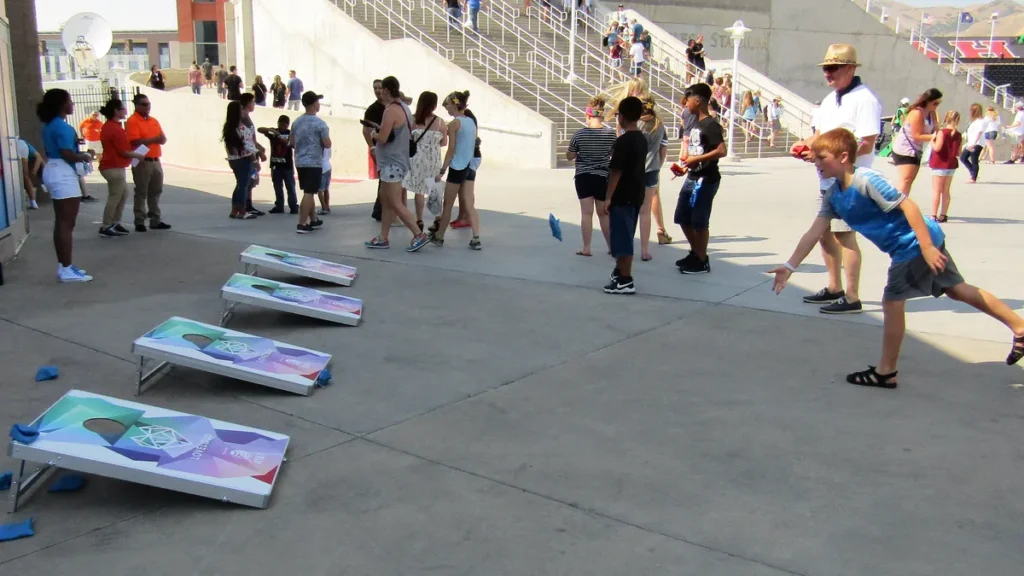
Cornhole is a quiet star at large parties because anyone can play it, it needs very little space per board, and the score is obvious from where the bags land. Each team sends two throwers per heat, and each thrower tosses four bean bags at a board with a single hole. A bag through the hole scores three points, a bag that stays on the board scores one, and a bag that misses scores nothing. The team with the most points after four rounds wins the heat, and ties are settled with one extra bag each.
Set up at least ten boards in two rows, with a clear throwing line eight metres from each board and a waiting area behind the line so the next team is ready. Use bags in team colours and keep a volunteer at each board to call the score out loud. For a crowd this size, the format in the guide to party games for 436 players is a useful comparison, because it shows how a similar throwing game can be run in heats without long queues.
6. Giant Balloon Pop Stomp Battle
Tie a balloon to each player’s ankle, blow a whistle, and try to pop other teams’ balloons while protecting your own. The last team with a balloon still whole wins the heat, and the noise alone makes this the loudest ten minutes of the day. It is fast, silly, and very physical, so it works best on soft grass with clear boundaries and a referee in each corner. Players love it because the rules fit in one sentence and the result is visible the moment the last balloon pops.
Use balloons of the same size and thickness for every team, and tie them with a short string so they bounce just above the ground. Keep each playing area about the size of a badminton court, run four heats at once, ban hard studs and grabbing, and stop the heat if a player falls.
7. Giant Sardines Hide-and-Seek Festival
Sardines turns hide-and-seek upside down: one person hides, and everyone who finds them squeezes into the same hiding place until the last seeker is left looking alone. At a festival it becomes a gentle, funny game of patience, because the hiding crowd grows quietly while the seekers wander past. It suits a site with trees, tents, marquees, and corners to explore, and it gives tired players a calm game between the louder heats of the day.
Mark a clear boundary for the game area and a time limit of twenty minutes per round, with a whistle to call everyone back. Set simple rules: no hiding in toilets, kitchens, or anywhere a volunteer cannot reach quickly. Run two rounds at once in different zones. Score by the order in which seekers find the group, with early finders earning more points.
8. Giant Jigsaw Puzzle Race
Give every team the same 100-piece puzzle, the same table, and the same twenty minutes, and the room goes quiet in the best possible way. Teams sort edges first, then colours, then shapes, and the first team to finish wins the heat. A puzzle race rewards patience and clear talking more than speed, and it is the best indoor game in this guide for a rainy spell or a hot afternoon when the field is too warm for running games.
Use puzzles with the same piece count and a similar picture difficulty for every team, and keep the box lid visible so teams can check the picture without arguing about it. Run ten tables in a hall or marquee, with a timer calling five-minute warnings. Store each puzzle in its own labelled bag between heats so pieces do not mix.
9. Giant Paper Chain Building Race
Paper chains are the simplest craft in this guide, and at festival scale they become a surprisingly tense race. Each team gets coloured paper strips, glue sticks, and ten minutes to link the longest chain they can. The chain must hold together when lifted by one end, and any link that falls apart does not count. Teams have to decide quickly whether to make long, loose links or short, tight ones, and that small choice is where the game is won or lost.
Set up long tables in a marquee or hall, with paper strips already cut to the same size so no team wastes time cutting. Give each team the same number of strips, measure each chain with a tape measure, and have two volunteers check the count together. A similar building game appears in the guide to party games for 434 players, where the building challenge uses a different material and a different test, which shows how much variety a simple building idea can hold.
How to Run the Day in Four Waves
Divide the day into four waves of about ninety minutes each, with a short break between waves for water, shade, and score updates. In the first wave, run the calm games, paper planes, cup stacking, and the puzzle race, so teams warm up without tiring themselves out. In the second wave, run the active games, hula hoop, cornhole, and the paper chain race, while energy is still high. After lunch, run sardines and the water balloon toss, when the crowd needs a slower pace and a cool splash. Save the balloon pop battle for the last wave, because it is the loudest game and it sends everyone into the final with a cheer.
Staff each zone with at least two hosts: one to run the game and one to record scores and move teams on. Give every host and captain a printed sheet with the rules, scoring, and rotation. Keep a central scoreboard updated after every wave, and read the top ten teams out loud before the final. If rain arrives, move the paper, cup, puzzle, and chain games indoors first.
Your 440-Player Party Checklist
- Count 440 players into 88 teams of five before the day starts, and print the team list twice.
- Mark zones, stations, throwing lines, and waiting areas with rope, cones, and clear signs.
- Pack spare paper, cups, balloons, bean bags, puzzles, and glue sticks for every station.
- Set up shade, drinking water, first aid, and a lost-property table near the centre of the site.
- Test the loudspeaker, the whistle, and the scoreboard before the first team arrives.
- Brief every host on the rules, the scoring, and the rotation so the day runs without long pauses.
Frequently Asked Questions
Can 440 players really play the same game at once?
Not in one circle, and they do not need to. Every game here runs in heats at parallel stations, so ten or twenty players play at once while the other teams play the same game at nearby stations. All 88 teams can finish a game inside one wave, and the shared scoreboard keeps it feeling like one event.
What is the best team size for 440 players?
Teams of five work best, giving you 88 teams. Five is small enough that everyone has a job, large enough that one quiet player is never alone, and easy to split across stations that take ten players per heat.
How much space do we need for 440 players?
A full-size sports field plus a hall or marquee is ideal, because the throwing games need open grass and the table games need dry shade. As a rough guide, allow one station per ten players in each wave, with a waiting area behind every station.
How long does a full day of nine games take?
About six hours of play, plus lunch and breaks. Each heat takes ten to twenty minutes, and four waves of ninety minutes cover all nine games with time to move between stations. You can shorten the day to four hours by picking five games instead of nine.
What equipment should we buy first?
Start with the items every game needs: paper, cups, balloons, bean bags, puzzles, glue sticks, hula hoops, and a loudspeaker. Buy in bulk and keep spares, because a crowd of 440 will use more paper and balloons than you expect. Test every station the day before so a broken cup or a flat balloon does not slow the first heat.
What if our guest list is smaller than 440 players?
Nothing in this guide breaks with a smaller crowd. Keep the teams at five players, run fewer stations, and let teams play more heats instead of waiting. The scoring stays fair as long as every team plays the same number of heats.
The Bottom Line
Four hundred and forty players sounds like a problem until you plan it as 88 teams of five, nine simple games, and four clear waves. Pick games that split cleanly, score visibly, and mix calm with noise, and the crowd will look after itself. Start with the paper planes, end with the balloon pops, keep the scoreboard honest, and your 440-player party will feel like one big game that everyone played together.