Puzzle games for 400 players sound impossible until you stop picturing one table. Nobody expects 400 people to crowd around a single jigsaw, pass pieces hand to hand, and finish before lunch. The trick is scale: you split the crowd into teams, you spread the work across stations, and you run the whole thing like a tournament. When the structure is right, a group that big does not feel chaotic at all. It feels like a festival, with every table busy, every team chasing the same finish line, and a room full of people who all have something useful to do.
The number 400 is not a magic limit. It is a way of thinking about the range from 3 players to 400 players, and the games that carry a puzzle event across that whole range. A family of three can play a puzzle game at the kitchen table. The puzzle does not change. Only the organisation around it grows.
This guide lists nine puzzle games that work for 400 players, explains how to set each one up, and shows how to combine them into a day that keeps a huge crowd playing happily for hours. Pick three or four games for a short session, or run all nine across a full day. Every game below can be set up in identical copies, finished in a fixed time, and scored without a judge watching every move, which is exactly what a crowd of 400 demands.
Key takeaways
- Think in the 3-to-400 range: the puzzle stays the same, and teams, stations, and tournaments are what scale it up.
- Split 400 players into teams of four to six, and give every team its own table, puzzle, and job list.
- Mix fast jigsaw builds with slower logic games so every kind of player has a game they enjoy.
- Plan one station for every 12 to 18 players, and keep each round short enough that nobody waits long.
- Score by puzzles finished and pieces placed, not by speed alone, so careful teams stay in the race.

Why Puzzle Games Work for 400 Players
Puzzle games suit very large groups because they need no stage, star performer, or silence. A quiz needs everyone to hear the same question at once, which is a sound problem at 400 players. A puzzle only needs a table, a set of pieces, and a clear goal, and you simply run many copies at once.
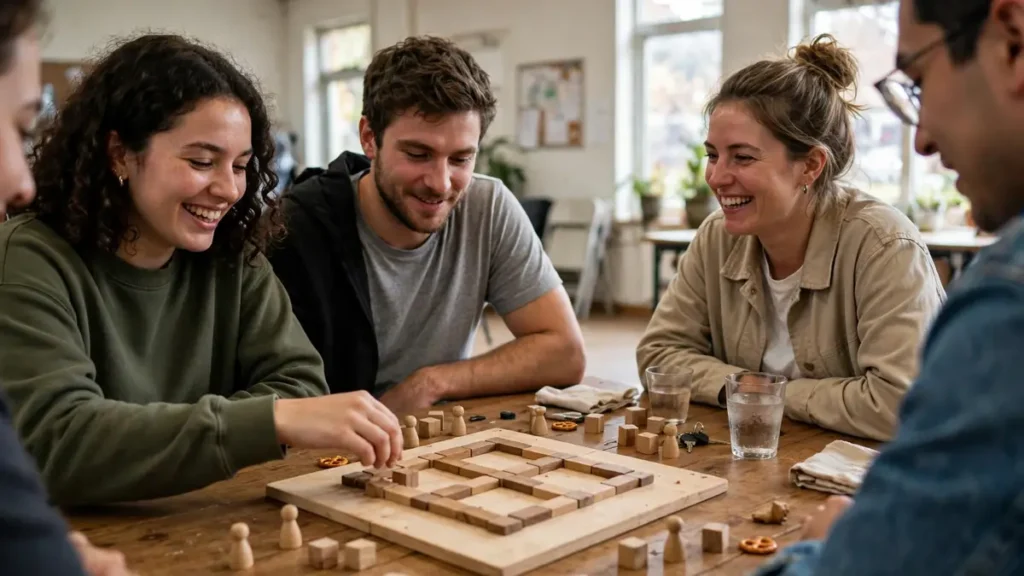
There is also a social reason puzzle games work at this size. In a group of 400 strangers, most people will not speak outside their own table unless the format gives them a reason to. A shared puzzle gives them that reason within seconds: someone spots an edge piece, someone else remembers a pattern, and suddenly six strangers are a team. The puzzle does the icebreaking for you,
Scale also makes puzzle games cheaper than most large-group entertainment. Printed grids, card sets, dominoes, and second-hand jigsaws cost very little per player, and the same sets can be reused round after round. For a near-identical field, the guide to running puzzle games for 399 players shows the same team-and-station thinking in action, one player short of a round 400.
The 3-to-400 Range
Every plan here is built around the 3-to-400 range, the honest way to think about an event this size. At the small end, three players sit at one table and solve a single puzzle together. At the large end, 400 players fill a hall. The bridge is the team: divide 400 into teams of five and you get 80 teams, each just a small group around a table. The event is big, but nobody experiences it as big.
This thinking also protects you from the most common planning mistake: designing for 400 as if it were one group. A single puzzle with 400 people touching it is a queue, not a game. But 80 teams each solving their own puzzle is a real competition, run with ordinary tables and a realistic number of volunteers.
Three players can finish a 300-piece puzzle in an evening, talking as they go. Thirty players need five or six teams and a little structure. Ninety-six players need stations and a rotation plan. At 400 players, you need all of it: teams, stations, a timetable, and a few helpers who do nothing but keep the flow moving. The same logic carries the puzzle games for 397 players plan, where teams of six leave a single spare player to float between tables.
Teams, Stations, and Tournaments
Three scaling methods carry almost every large puzzle event, and most successful events combine at least two of them. Teams are the first method: they turn 400 individuals into 80 units that can be scheduled, scored, and moved around a room. Give every team a name, a number, and a colour.
Stations are the second method: instead of one puzzle for everyone, you set up eight to twelve different puzzle stations around the hall, and teams rotate from one to the next on a timer. A team spends 12 to 15 minutes at a station, scores what it finishes, and moves on when the bell rings.
Tournaments are the third method: heats, semifinals, and a final let you narrow a huge field down to a dramatic finish without asking every team to play every round. The simplest format is a points leaderboard, where every station awards points and the highest total after the final rotation wins. For a more dramatic finish, take the top eight or sixteen teams into a knockout final, such as a single large jigsaw race on stage or a head-to-head crossword sprint.
The 9 Best Puzzle Games for 400 Players
The nine games below cover the full range of puzzle play, from hands-on jigsaw building to quiet logic challenges. Each one is written for a crowd of 400, with a setup that scales and a scoring rule that keeps the result fair. Run them as stations so every team meets every game, or as heats so the fastest teams advance to a final.
1. Mosaic Jigsaw Build
In a mosaic jigsaw build, every team assembles one small puzzle, and all the finished puzzles slot together into one giant picture on the wall. Each team gets a 100-piece puzzle that is one tile of a much larger image, such as a landscape, a city skyline, or a famous painting.
Buy 80 identical sets of tiles in bulk, one per team, and number the back of each tile so the wall crew knows exactly where it belongs. Set a 30-minute build limit, and score teams by finished tiles first, then by pieces placed. The mosaic build is the flagship game for a crowd this size because it turns 80 separate efforts into one shared achievement, and the finished wall makes a perfect photo at the end of the day.
2. Crossword Relay
A crossword relay gives every team the same large grid, and players take turns filling in one answer before passing the pen on. Instead of one quiet person solving alone, five or six people argue, check, and correct each other under a twelve-minute timer.
Score by counting correct answers, with a bonus for a completed grid. Rushing teams score worse than careful ones, which teaches the room that accuracy beats speed.
3. Sudoku Showdown
A Sudoku showdown runs as a series of short timed rounds, with every team tackling the same grid at the same time. Each round uses a fresh puzzle at a set difficulty, and teams score points for correct rows, columns, and boxes, with a bonus for a fully solved grid. Because every team faces the same grid, the result is honest, and the live leaderboard after each round keeps the room buzzing.
Print the grids on large sheets so the whole team can see the numbers, and give each team a different coloured pen for corrections. Run four rounds of eight minutes each, with a two-minute break between rounds for scoring. The showdown format works because the timer is objective, the puzzle is identical for everyone, and a team that is slow in round one can still win the day in rounds three and four.

4. Logic Grid Tournament
A logic grid tournament asks teams to solve who-did-what puzzles, where a set of clues narrows down one correct answer. Each team gets the same printed grid and clue list, such as matching five friends to five pets and five hobbies, and fifteen minutes to work through it.
Score by correct matches, with a bonus for a fully solved grid and a small time bonus for early finishers. Run the tournament in two heats, with the top teams from each heat meeting in a final round on a harder grid.
5. Rebus Relay
A rebus relay turns pictures and wordplay into a race. Each team gets a sheet of rebus puzzles, where a picture plus a few letters stands for a common phrase, such as a drawing of a man plus the word over to make man overboard. Players take turns solving one rebus before passing the sheet on, so the team must think ahead together and nobody can dominate the round.
Print rebuses of the same length and difficulty, and set a ten-minute limit. Score by correct answers, with a bonus for a completed sheet. Rebus puzzles suit mixed groups because they reward lateral thinking rather than vocabulary or arithmetic, and the moment a team cracks a tricky one is usually loud enough for the neighbouring tables to hear.
6. Memory Match Marathon
A memory match marathon lays out a grid of face-down cards, and teams take turns flipping two cards to find matching pairs. Each team gets its own identical set of cards, so every team faces the same layout, and the team that finds the most pairs in ten minutes takes the points. The twist is that teams play in relay: only two players flip cards at a time, while the rest watch, remember, and call out suggestions.
Use picture cards rather than numbers so the game works for every age, and shuffle each set the same way so the layouts match. Score by pairs found, with a bonus for finishing the whole grid. The marathon is fast, visual, and surprisingly tense, because a single lucky flip can swing the score.
7. Domino Pattern Challenge
A domino pattern challenge gives each team a full set of dominoes and a pattern to build, such as a square, a star, or a winding snake, with every domino touching the next. The first team to complete the pattern exactly wins, and the pattern changes each round so teams cannot memorise a layout. Dominoes are silent and visual, and they work for every age because no reading or arithmetic is involved.
Buy identical sets in bulk so no team gains from worn pieces, and run five-minute rounds with a new pattern each time. Early finishers can attempt a harder bonus pattern for extra points.
8. Nonogram Team Sprint
A nonogram sprint, also called a picture logic puzzle, gives teams a grid where numbered clues reveal a hidden picture one row at a time. Each team gets the same grid, the same clues, and ten minutes to uncover the image. The format is quiet and absorbing, and it rewards teams that split the work: one player reads the row clues, another the column clues, and a third fills in the squares.
Print the grids large enough for the whole team to see, and choose pictures that are recognisable once half the grid is filled, such as an animal, a house, or a star. Score by correct squares, with a bonus for naming the finished picture.
9. Word Search Sprint
A word search sprint gives every team the same large word grid and a list of words to find, hidden across, down, and diagonally. Teams race to circle every word before the whistle, and the team with the most correct circles in eight minutes takes the points.
Score by words found, with a bonus for a completed grid and a penalty for circled words that are not on the list. Word searches are the fastest station to set up and the easiest to explain, which makes them a perfect opener or closer for the day.
How the 9 Games Compare
Not every game suits every crowd, so use this table to pick the right mix for your event.
| Game | Time per round | Players per team | Equipment needed | Best for |
|---|---|---|---|---|
| Mosaic Jigsaw Build | 30 minutes | 4 to 6 | One 100-piece tile puzzle per team | A shared finale and a great photo |
| Crossword Relay | 12 minutes | 4 to 6 | Printed grids and pens | Word lovers and mixed ages |
| Sudoku Showdown | 8 minutes per round | 4 to 6 | Printed grids and coloured pens | Fair scoring and a live leaderboard |
| Logic Grid Tournament | 15 minutes | 4 to 6 | Printed grids and clue sheets | Careful thinkers and debate |
| Rebus Relay | 10 minutes | 4 to 6 | Printed rebus sheets | Lateral thinking and loud moments |
| Memory Match Marathon | 10 minutes | 4 to 6 | One set of picture cards per team | Fast finishes and big reactions |
| Domino Pattern Challenge | 5 minutes per round | 4 to 6 | One domino set per team | Hands-on play and spatial thinking |
| Nonogram Team Sprint | 10 minutes | 4 to 6 | Printed grids and pencils | Quiet focus and steady progress |
| Word Search Sprint | 8 minutes | 4 to 6 | Printed poster-size grids | A quick opener or closer |
Planning Checklist for 400 Players
Use this checklist in the weeks before your event, and tick each item off as you finish it.
- Book a hall with at least 80 tables and space for 8 to 12 stations, plus a clear area for the leaderboard and the final.
- Buy or print 80 identical copies of every puzzle set, and test each one yourself before the day.
- Recruit one volunteer per two stations, and rehearse the rotation once with them before any player arrives.
- Prepare a live leaderboard, scorecards for every team, and a bell or whistle for rotation changes.
- Print a clear instruction card for every station, in three short steps, so volunteers spend their time scoring, not teaching.
- Plan the final in advance: a knockout round, a mosaic wall reveal, or a single large jigsaw race on stage.
Frequently Asked Questions
How many teams do 400 players make?
Teams of five give you exactly 80 teams, which is the cleanest split for 400 players. Teams of four give you 100 teams, and teams of six give you 66 teams with four players spare to act as floaters or judges.
How long does a full puzzle games day take?
A full circuit of nine stations at 12 to 15 minutes each takes about two hours, plus a break and a final. A short session with three or four games fits comfortably into ninety minutes.
What if some teams finish much faster than others?
Give early finishers a bonus puzzle at each station, such as a harder grid or an extra pattern, so nobody sits idle while the clock runs down.
Do we need identical puzzles for every team?
Yes, for any game that is scored. If one team gets an easier picture or a worn set of dominoes, the result is not fair and the room will notice. Buy puzzles in bulk, check that every box is the same edition, and test one set from each batch yourself before the event.
Can children and adults play together?
Yes, and puzzle games are one of the best formats for mixed-age teams. Word searches, domino patterns, and memory matching need no special knowledge, while crosswords and logic grids reward the adults.
What is the cheapest way to run puzzle games for 400 players?
Print your own grids, rebuses, and word searches, buy second-hand jigsaws and domino sets in bulk, and reuse everything next year. The puzzle games for 394 players guide uses the same low-cost approach, with one puzzle set per station rather than one per player.
The Bottom Line
Puzzle games for 400 players work when you stop treating 400 as a crowd and start treating it as 80 small teams, nine short stations, and one clear clock. Give every team its own table and puzzle, keep the rounds short, score fairly, and finish with something the whole room can share, like a mosaic wall or a final on stage. Do that, and a number that sounds impossible becomes one of the easiest large events you will ever run.