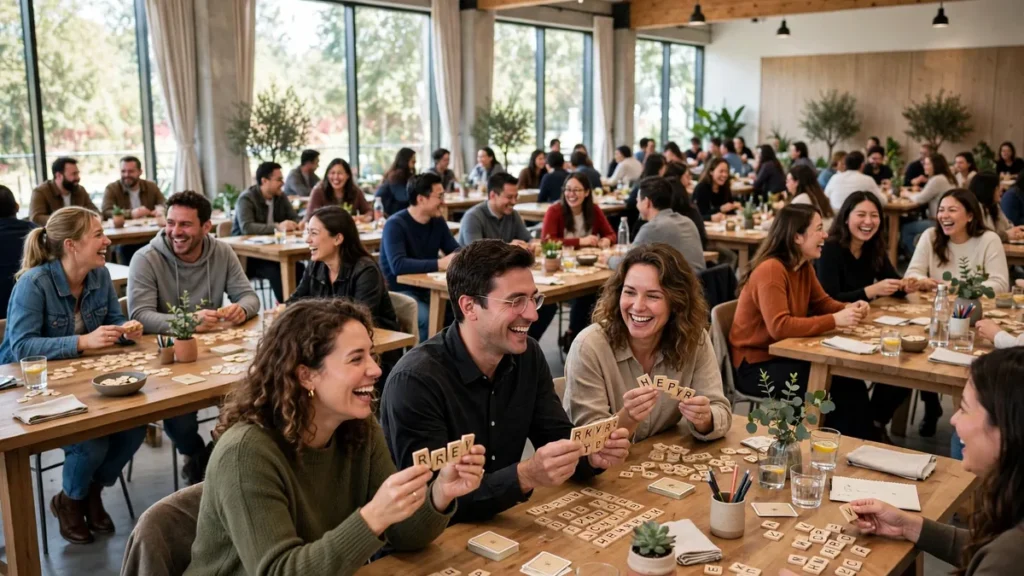
The best dice games for 311 players turn an impossible headcount into a brilliant party. Three hundred and eleven people is not a game night around one table; it is a school hall, a wedding reception, a company celebration, or a community festival that happens to have dice. Most dice games were designed for four to eight players, so the usual advice simply does not scale, and handing one set of dice to three hundred people would leave almost everyone watching instead of playing.
The secret is to stop thinking of one game and start thinking of one system. The best dice games for 311 players use small tables, team captains, heats, and one shared leaderboard, so every player rolls, scores, and cheers within minutes of sitting down. Players compete in groups of six to eight while the whole room shares the same schedule, the same scoreboard, and the same big finish, which means the size of the crowd becomes the entertainment instead of the problem.
This guide gives you ten games that genuinely work at this scale, with exact player counts, dice needs, timing, and setup notes for each one. Every game below can be run with ordinary six-sided dice, printed score sheets, dice cups, and a handful of volunteers. Pick one as your main event, add two or three as side stations, and you will have a full evening that keeps 311 players busy, laughing, and rolling.
Key Takeaways
- Split 311 players into small tables of six to eight, then link the tables with one shared leaderboard so everyone plays at once.
- Choose games with rules anyone can learn in two minutes and rounds that last under fifteen minutes.
- Use heats and rotations so nobody waits more than a few minutes between turns.
- Appoint one captain per table to roll, score, and report results to the central score desk.
- End with a short final round for the top tables instead of trying to crown a winner from 311 individual scores.

Why Dice Games Work for 311 Players
Dice games have three advantages that almost no other party game can match at this scale. First, the equipment is cheap. A bag of dice costs very little, and you can equip more than forty tables for less than the price of one hired entertainer. Second, the rules are visual. Players can watch a roll, see the result, and understand what happened without reading a long rulebook or listening to a ten-minute explanation.
Third, dice create instant drama. A single roll can rescue a losing team or ruin a perfect score, and a whole room reacts to that moment at once. That shared reaction is exactly what a huge event needs, because it turns forty separate tables into one audience. Even players who are shy, young, or completely new to games can join in, because rolling dice needs no skill, no vocabulary, and no prior experience.
How to Run Dice Games for 311 Players
Start by dividing the room into tables of six to eight players. With 311 players, that means about forty tables, which sounds like a lot until you realise that each table only needs five or six dice, a cup, a pencil, and a score sheet. Arrange the tables in rows with a clear aisle down the middle so captains can walk to the score desk without squeezing past chairs. Number every table and give each table a matching number on its score sheets.
For scoring, keep it simple and visible. Award table points rather than trying to rank all 311 individuals after every game. The top two players at each table earn points for their table, or the whole table shares one team score. Either way, the leaderboard shows about forty table names, not three hundred individual names, and everyone can follow it. A similar table-and-leaderboard system keeps the action moving in our guide to the best dice games for 308 players, where the same forty-table layout works for a crowd of almost the same size.
The 10 Best Dice Games for 311 Players at a Glance
| Game | Players per table | Dice needed | Round length | Best for |
|---|---|---|---|---|
| Shut the Box Relay | 6 to 8 | 2 dice | 10 minutes | Quick thinking |
| Cee-Lo Clash | 6 to 8 | 3 dice | 10 minutes | High drama |
| Zombie Dice Horde | 6 to 8 | 13 dice | 12 minutes | Risk taking |
| Qwixx Roll-and-Write Relay | 6 to 8 | 6 dice | 15 minutes | Quiet focus |
| Pass the Pigs Parade | 6 to 8 | 2 pig dice | 10 minutes | Big laughs |
| Dice Poker Showdown | 6 to 8 | 5 dice | 12 minutes | Bluffing |
| Fifty Race | 6 to 8 | 2 dice | 8 minutes | Fast finish |
| Chicago Dice Derby | 6 to 8 | 2 dice | 12 minutes | Steady play |
| Snake Eyes Sprint | 6 to 8 | 2 dice | 8 minutes | Warm-up |
| Threes Showdown | 6 to 8 | 5 dice | 12 minutes | Low-score twist |
The 10 Games in Detail
1. Shut the Box Relay
Shut the Box is a classic pub game that fits a relay format perfectly. Each table gets a Shut the Box board, or a printed number strip from one to nine, plus two dice and a set of markers. Players take turns rolling the dice and flipping down the tiles that match the total, or two tiles that add up to it. The turn ends when no combination matches, and the player scores the sum of the tiles left standing. Lowest score wins the table.
Run it as a relay by giving every player one turn per round and adding the table total across three rounds. The game is quiet enough for conversation, quick enough to keep energy up, and simple enough that a new player understands it after watching a single turn. Captains love it because scoring is obvious: fewer points left standing is better, and nobody needs a calculator.
2. Cee-Lo Clash
Cee-Lo is a fast three-dice game with a built-in pecking order that creates instant cheers. Each player rolls three dice and looks for a pair plus a third die, which becomes their score, or for triples, which beat almost everything. A four, five, six in any order is an automatic win, while a one, two, three is an automatic loss. Those two combinations alone produce gasps from the whole table every few minutes.
3. Zombie Dice Horde
Zombie Dice turns every player into a zombie hunting for brains, and the push-your-luck tension is perfect for a big room. Each table shares a cup of thirteen special dice in green, yellow, and red. On a turn, a player draws three dice, rolls them, and keeps any brains while setting aside shotguns. They can stop and bank their brains, or keep rolling and risk losing everything to three shotguns.
The horde twist for 311 players is that each table plays as one zombie horde with a shared brain total. Players take turns as the roller while the rest of the table chants for them to stop or keep going, which makes every decision a group event. First table to thirteen brains wins the round. The game is silly, loud, and completely luck-based, so nobody feels outclassed.
4. Qwixx Roll-and-Write Relay
Qwixx is a roll-and-write game where two white dice set a number everyone can use, while four coloured dice offer personal choices. Each player has a score sheet with four coloured rows, and on every turn they cross off numbers in order, trying to fill rows before their rivals. The clever part is that every roll matters to every player, even when it is not their turn, so nobody zones out.
For a 311-player event, run Qwixx as a relay across tables. The host rolls the dice at the front and calls the numbers over the microphone, while every table marks the same roll on their sheets at the same time. This whole-room version is wonderfully calm after a loud game, and it gives quieter players a moment to shine. The shared-roll format also means you only need one set of dice for the entire hall.
5. Pass the Pigs Parade
Pass the Pigs uses two small pig-shaped dice, and the scoring depends entirely on how the pigs land. A pig on its side scores one point, a pig on its back or snout scores more, and two pigs touching noses, known as a snouter, is worth a fortune. Rolling two pigs in the same position doubles the score, while a pig on its back and a pig on its side in the same roll, the dreaded pig out, wipes out the turn.
The parade format sends the pigs around the table like a baton, with each player rolling until they choose to bank their points or lose them. Because the pigs are funny to look at and the results are so visual, this game gets the biggest laughs of the night. It is the ideal side station: set up four or five tables of Pass the Pigs between the main games, and players will drift over during breaks. The same spirit of simple, visual fun drives the best dice games for 309 players, where short, silly rounds keep a huge crowd smiling.
6. Dice Poker Showdown
Dice Poker plays like five-card poker with dice instead of cards, and it brings a welcome dose of bluffing to the evening. Each player rolls five dice, sets aside the ones they like, and re-rolls the rest up to two times, aiming for pairs, three of a kind, straights, full houses, and five of a kind. The best hand at the table takes the round, and ties are broken by the highest single die.
Run the showdown as a short tournament: three hands per round, one point per hand won, and the table champion reports to the score desk. Because everyone knows poker hands, or learns them in two minutes from a printed chart, the game needs almost no teaching. The re-roll decisions give thoughtful players an edge, which balances the luck-heavy games around it and keeps competitive players engaged.
7. Fifty Race
Fifty is one of the simplest dice games ever made, and that simplicity makes it a brilliant filler. Each player rolls two dice and adds the totals together, but only doubles count toward the score. A pair of threes scores six, a pair of sixes scores twelve, and everything else scores nothing. The first player to reach fifty wins, which usually takes about eight minutes of fast, noisy rolling.
For 311 players, run Fifty as a table race with a twist: every player rolls at the same time on the host signal, and the table total is the sum of all doubles rolled in that minute. Tables compete to reach fifty first, and the host calls out the leading tables every thirty seconds. The simultaneous format means nobody waits, and the race is over before anyone gets bored. Use it as a warm-up or a palate cleanser between longer games.
8. Chicago Dice Derby
Chicago, also known as rotation, is a steady two-dice game that rewards patience. Players take turns rolling two dice, aiming for a target total that rises by one each round, from two up to twelve. Rolling the target scores points, and the player with the most points after eleven rounds wins the table. The rising target keeps every round fresh, because the number everyone wants changes constantly.
9. Snake Eyes Sprint
Snake Eyes Sprint is a lightning-fast two-dice game built for warming up a hall. Each player rolls two dice and scores points equal to the total, except that rolling a pair of ones, snake eyes, wipes out the points from that turn. Players can stop at any time and bank their points, or keep rolling to chase a bigger total. First to one hundred points wins the table.
Run it as a sprint by giving every table exactly five minutes on the clock. The short time limit creates a lovely urgency: players roll quickly, bank early, and groan loudly when snake eyes strike at the worst moment. Because the rules fit in one sentence, Snake Eyes Sprint is the best possible first game of the night, played while late arrivals are still finding their tables. A similar quick-start idea opens the best dice games for 307 players, where a fast first round settles a huge room in minutes.
10. Threes Showdown
Threes flips normal dice scoring upside down, because the lowest total wins. Each player rolls five dice and sets aside the lowest die, then re-rolls the rest, repeating until all five dice are kept. Threes count as zero, which makes them the most valuable roll in the game, and the player with the lowest final total takes the round. The twist delights players who are tired of high-score games.
Checklist for Game Night
- Count the dice before the event and pack spares: at least one set for every four players, plus extra cups, pencils, and printed score sheets.
- Number every table, print matching score sheets, and brief one captain per table on the rules and the route to the score desk.
- Set up a large visible leaderboard at the front of the room and update it after every round so the whole hall can follow the race.
- Test the microphone, the timer, and the lighting before the first guest arrives, and keep a printed schedule at the host table.
- Prepare a simple tie-breaker in advance, such as a single highest-die roll-off between tied table captains.
- Keep a quiet corner with a calm game ready for players who need a break, and a small prize table for the winning tables.
Frequently Asked Questions
How many dice do I need for 311 players?
Plan on at least one set of five dice for every table of six to eight players, which means about two hundred dice in total, plus spares. Shared-roll games like Qwixx need far fewer, because the host rolls once for the whole room, so the exact number depends on your game list. Buy dice in bulk bags, count them into labelled table kits the night before, and keep a spare bag at the score desk for losses.
Can children and older players play together?
Yes, and dice games are one of the best formats for mixed ages. Games like Fifty Race, Snake Eyes Sprint, and Pass the Pigs need no reading beyond numbers and no strategy beyond knowing when to stop. Seat families together, let captains help younger players with scoring, and choose the gentler games for tables with small children. Older players often enjoy the slower games, such as Chicago and Shut the Box, just as much.
How long does a 311-player dice event take?
Plan for two to three hours, including arrival, rules, and the final round. Ten games at ten to fifteen minutes each would take too long, so run four or five games in rotation rather than all ten in a row. A typical evening is thirty minutes of setup and welcome, ninety minutes of games in three blocks, and fifteen minutes for the final and prizes. Shorter events work well too if you pick only the fastest games.
What if some tables finish at different speeds?
Different speeds are normal and easy to handle. Give fast tables a quick side game, such as Fifty Race, while slower tables finish, and use a visible timer so every table knows when the round ends. When the timer sounds, tables stop and report their scores as they stand, which keeps the schedule fair. Captains should never feel rushed into finishing a game that is nearly done, but the timer is the final word.
Do I need a stage or a special room?
You need a large flat room with tables and chairs, good lighting, and a microphone, but not a stage. A school hall, community centre, or hotel function room works perfectly. The host needs a visible spot at the front for the leaderboard and the timer, and the score desk needs to sit near the main aisle. If the room has a small raised area, use it for the host, but a table at the front works just as well.
How do I choose a winner fairly?
Crown the winning table rather than a single player, because no individual format is fair across 311 people. Add up table points across the games, then invite the top three tables to a short final round of one quick game, such as Cee-Lo Clash or Snake Eyes Sprint. The final decides the champion, everyone can watch it, and every table that reached the final has already earned its place. Keep a printed tie-breaker ready in case the final itself is tied.
The Bottom Line
The best dice games for 311 players are not the most complicated games, they are the simplest games run with the clearest system. Small tables, short rounds, one shared leaderboard, and a captain at every table turn an overwhelming crowd into forty lively teams sharing one evening. Pick four or five games from this list, rehearse the rules out loud, keep the timer visible, and let the dice do the rest. When the final roll lands and the whole room cheers at once, you will know the size of the crowd was never the problem. It was the point all along.