
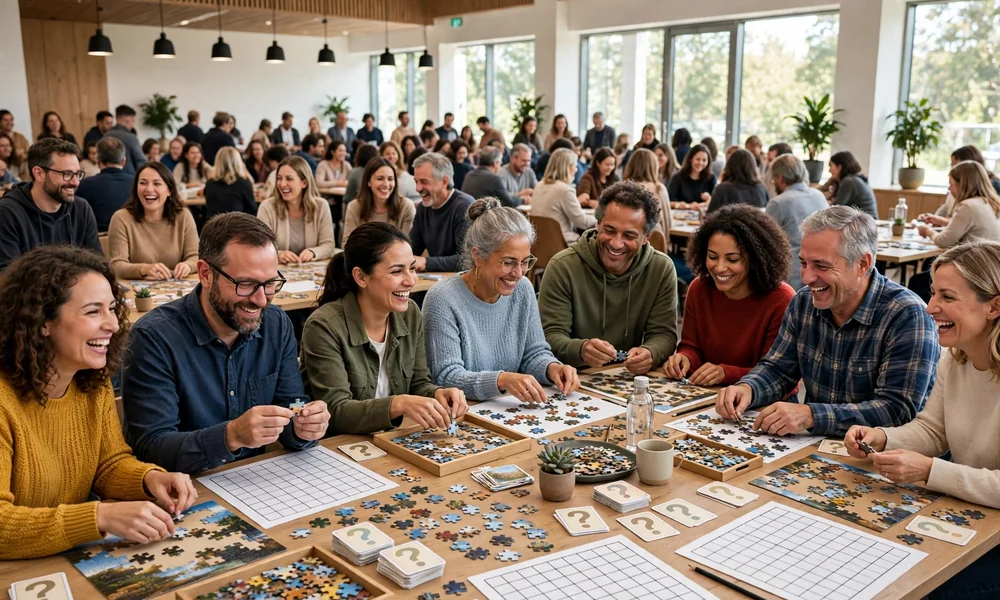
Finding the best puzzle games for 327 players is a very different challenge from choosing a game for a family evening or a small classroom. With 327 people, you are not looking for a single board on a single table. You are planning an event, a tournament, a school day, a company gathering, or a community festival where hundreds of people need to play at the same time, stay engaged, and feel that their contribution matters. The games that work at this scale are the ones that split easily into teams, use simple rules that can be explained in two minutes, and keep every player busy rather than watching a few confident people solve everything.
The best puzzle games for 327 players share three qualities that smaller games often lack. First, they scale without losing their shape: a jigsaw relay, a crossword race, or a logic puzzle league works just as well with 30 teams as it does with three. Second, they balance speed and thinking, so quick players cannot finish everything before careful players have had a chance to contribute. Third, they create clear results. Everyone should know the score, the next round, and what their team needs to do next. When those three qualities are present, a very large group stops feeling chaotic and starts feeling like a proper competition.
This guide explains how to choose, organise, and run puzzle games for exactly 327 players. It covers the formats that work best, the equipment and space you need, fair scoring systems, and the mistakes that turn large puzzle events into long waits and confused teams. Whether you are a teacher, an event organiser, a team leader, or a parent planning a very large celebration, you will find a practical plan here that you can use without specialist equipment or a large budget.
Key takeaways
- Split 327 players into teams of three to nine people, so every player has a clear role and no one is left watching.
- Choose puzzle formats that run in parallel rounds, such as jigsaw relays, crossword races, and logic puzzle leagues.
- Use simple scoring, visible leaderboards, and fixed time limits to keep a large event moving and fair.
- Mix word, number, visual, and physical puzzles so different strengths are rewarded across the day.
- Test every puzzle in advance, prepare spare copies, and appoint one host and one scorer for every ten teams.
Why 327 Players Changes the Game
A group of 327 players is large enough that ordinary party games break down. A single quiz master cannot hear every answer, a single puzzle cannot be shared by hundreds of hands, and a single winner-takes-all round leaves most people with nothing to do after ten minutes. The solution is not to find a bigger version of a small game. It is to change the structure so that many small games happen at the same time under one shared set of rules, one timetable, and one scoreboard.
The most useful way to think about 327 players is in teams. If you form 109 teams of three, you have a fast, nimble competition with many rounds and quick turnarounds. If you form 47 teams of seven, with one team of six, you have larger teams that can split tasks inside the team, which suits mixed-age groups and workplace events. Teams of nine give you 36 teams of nine plus one team of three, which works well for school houses or company departments. The exact split matters less than the principle: every team should be small enough for every member to speak, and large enough to divide the work.
What Makes a Puzzle Work for a Huge Group
A good large-group puzzle has a clear starting point and a clear finish. Players should be able to tell within thirty seconds whether they are making progress. Jigsaw puzzles, crosswords, word searches, Sudoku grids, and picture puzzles all meet this test because progress is visible: pieces fit, words appear, numbers fall into place, and images emerge. Abstract puzzles with no visible progress are harder to run at scale because teams cannot tell whether they are close to an answer or completely stuck.
The puzzle should also allow parallel work. In a jigsaw relay, one player can sort edge pieces while another works on the sky and a third works on the foreground. In a crossword race, different players can tackle different clues at the same time. In a logic puzzle league, the team can split into pairs and compare answers. If only one person can work on a puzzle at a time, the rest of the team will lose interest, and that is the fastest way to spoil a large event.
How to Organise 327 Players
Organisation is the difference between a memorable puzzle day and a confusing one. Start with the venue. You need enough table space for every team to work without crowding, plus a central area for the host, the scoreboard, and the distribution of puzzle packs. A school hall, a community centre, a large conference room, or an outdoor space with tables and shade can all work, provided teams can hear the host and see the clock. Test the sound system before the day, and place a large visible timer where every team can see it.
Next, prepare identical puzzle packs for every team. Each pack should contain the same puzzles, the same answer sheets, and the same pens or pencils. Identical packs are essential for fairness, and they also make scoring much simpler. Label every pack with a team number, and keep a master list that matches team numbers to team names. If a pack goes missing or a puzzle is damaged, you can replace it quickly without stopping the whole event.
The Best Puzzle Games for 327 Players
The games below are ranked by how well they scale, how easy they are to run, and how much fun they provide for mixed groups. You do not need to use all seven. Most successful events use four or five formats across a day, with a short break between each round. Choose a mix that suits your players: word lovers, number lovers, visual thinkers, and people who prefer hands-on puzzles should all find something they enjoy.
1. Jigsaw Relay
The jigsaw relay is one of the most reliable large-group puzzle games because it is visual, physical, and easy to understand. Each team receives the same jigsaw puzzle, usually with 100 to 300 pieces, and works together to complete it within a fixed time. Points are awarded for the number of pieces correctly placed, with bonus points for a finished puzzle. To keep the relay moving, you can add a rule that only two players may place pieces at a time, while the others sort and search. This keeps everyone involved and prevents one fast player from doing all the work.
2. Crossword Race
A crossword race turns a quiet solo puzzle into a lively team competition. Each team receives the same crossword grid and clue sheet, and the team that completes the most correct answers within the time limit wins the round. Crosswords are ideal for 327 players because they need only paper and pens, they can be printed cheaply, and they can be marked quickly against an answer key. They also suit mixed-age groups, because different players will know different answers.
3. Logic Puzzle League
A logic puzzle league is a series of short logic problems, such as grid puzzles, sequencing puzzles, and deduction challenges, played over several rounds. Each round lasts ten to fifteen minutes, and teams earn points for each correct answer. The league format works well for 327 players because it rewards careful thinking rather than speed alone, and because a team that does badly in one round can recover in the next. It also allows you to include puzzles of different types, so no single skill dominates the whole day.
4. Word Puzzle Tournament
A word puzzle tournament combines several short word games into one competition. Rounds might include anagrams, word ladders, word searches, and missing-letter puzzles. Each round is short, usually five to ten minutes, and teams earn points for every correct answer. The variety keeps energy high, and the short rounds mean that no team is stuck on a single puzzle for too long. Word tournaments are also easy to adapt for different ages and abilities by changing the difficulty of the word lists.
The best word tournaments use familiar words and clear rules. Anagram rounds should use words that most players will recognise, and word searches should have words that are hidden in different directions but not so well hidden that no one can find them. If you want inspiration for related formats, the ideas in Best Puzzle Games for 325 Players show how similar word and puzzle formats can be adapted for another very large group.
5. Sudoku and Number Puzzle Rounds
Sudoku and number puzzles are excellent for large groups because they are silent, fair, and easy to mark. Each team receives the same Sudoku grid or number puzzle, and points are awarded for correct rows, columns, and completed grids. You can run several difficulty levels in the same round, with easier grids worth fewer points and harder grids worth more. This allows teams to choose their own level of challenge, which is useful when players have very different experience levels.
6. Picture and Visual Puzzle Hunt
Picture puzzles, spot-the-difference challenges, and visual logic games are ideal for players who think in images rather than words. In a visual puzzle hunt, teams receive a set of images and must find hidden objects, identify the odd one out, or put a sequence of pictures in the correct order. These puzzles are quick to explain, fun to play, and easy to score, which makes them perfect for a large group with limited time.
7. Trivia Puzzle Hybrid
A trivia puzzle hybrid mixes general knowledge questions with puzzle elements, such as solving a word puzzle to reveal the answer to a trivia question, or using trivia answers to complete a crossword grid. This format suits large groups because it rewards both knowledge and puzzle skill, and because it can be adapted to any theme, such as history, science, sport, or music. It also keeps the audience engaged, because even players who are not strong at puzzles can contribute trivia answers.
To keep a trivia hybrid fair, use questions with clear, single answers, and avoid questions that depend on very recent events that some players may not know. You can also allow teams to use a limited number of lifelines, such as asking the host for a hint, which adds strategy to the game. For another large-group example, Best Puzzle Games for 324 Players includes formats that combine trivia and puzzles in a similar way.
Comparison Table: Which Game Suits Your Group
| Game | Best For | Time Per Round | Equipment Needed | Energy Level |
|---|---|---|---|---|
| Jigsaw Relay | Teamwork and visual thinkers | 20 minutes | Jigsaw puzzles, tables | Medium |
| Crossword Race | Word lovers and mixed ages | 15 minutes | Printed grids, pens | Low |
| Logic Puzzle League | Careful thinkers | 15 minutes | Printed puzzles, answer sheets | Low |
| Word Puzzle Tournament | Quick rounds and variety | 10 minutes | Printed word puzzles | Medium |
| Sudoku and Number Rounds | Quiet focus and fairness | 15 minutes | Printed grids, pencils | Low |
| Visual Puzzle Hunt | Visual thinkers and younger players | 10 minutes | Printed images, cards | Medium |
| Trivia Puzzle Hybrid | General knowledge and themes | 20 minutes | Question sheets, answer sheets | Medium |
Scoring That Stays Fair for 327 Players
Fair scoring is essential when 327 players are competing. The simplest system is to award points for each correct answer, with a fixed number of points per round. For example, a crossword might be worth one point per correct word, a jigsaw might be worth one point per ten pieces placed, and a logic puzzle might be worth five points per correct solution. Keep the points simple enough that teams can work out their own score, and publish the scoring rules before the event starts.
Use a visible leaderboard that is updated after every round. A large whiteboard, a projected screen, or a printed sheet on a central wall all work well. Update the leaderboard promptly, and check scores twice before announcing them. If a team disputes a score, listen carefully, check the answer sheet, and explain the decision clearly. A fair and transparent scoring system builds trust, and trust keeps a large competition enjoyable even for teams that are not winning.
Planning Checklist for Your Event
Use this checklist to prepare for your puzzle day. Work through it at least a week before the event, and tick off each item as you complete it.
- Confirm the venue, table layout, sound system, and visible timer, and test them before the day.
- Divide 327 players into teams, assign team numbers, and prepare a master list of team names.
- Choose four or five puzzle formats from this guide and prepare identical packs for every team.
- Print spare puzzles, answer sheets, and instructions, and pack extra pens, pencils, and timers.
- Recruit a host, scorers, and helpers, and brief them on the rules, scoring, and timetable.
- Prepare a simple scoring system, a visible leaderboard, and prizes for the winners and other categories.
Common Mistakes to Avoid
The most common mistake is choosing puzzles that are too hard. A puzzle that only a few experts can solve will leave most teams frustrated, while a puzzle that is too easy will finish too quickly and leave teams with nothing to do. Aim for puzzles where most teams can solve about two-thirds of the content within the time limit. This gives every team a sense of progress while still allowing the best teams to stand out.
Another common mistake is running out of time. With 327 players, every transition takes longer than you expect. Allow at least five minutes between rounds for collecting answer sheets, distributing new packs, and updating the scoreboard. Build extra time into the timetable, and have a short filler puzzle ready in case a round finishes early. A relaxed timetable is far better than a rushed one, because it gives the host time to explain the next round clearly.
Frequently Asked Questions
How do you split 327 players into fair teams?
Divide players into teams of three to nine people, depending on the age and experience of the group. Mix abilities within each team so that every team has word, number, and visual strengths. Use team numbers rather than names for scoring, and keep a master list so you can match scores to teams quickly and accurately.
How long should a puzzle event for 327 players last?
Most events last between two and four hours, including breaks. A two-hour event can include four short rounds, while a four-hour event can include six to eight rounds plus a final. Allow extra time for registration, explanations, and prize giving, and do not try to fit too many rounds into a short session.
What equipment do you need for 327 players?
You need tables and chairs for every team, printed puzzle packs, pens or pencils, answer sheets, timers, and a visible scoreboard. For specific games, you may also need jigsaw puzzles, clue envelopes, locks or boxes, and printed images. Keep equipment simple and identical for every team to ensure fairness.
Can children and adults play together in the same event?
Yes, provided you choose puzzles with a mix of difficulties and allow teams to divide tasks. Children often excel at visual and jigsaw puzzles, while adults may do better at crosswords and logic puzzles. Mixed-age teams work well when every player has a role, and when the scoring rewards teamwork rather than individual knowledge.
How do you keep 327 players engaged for the whole event?
Use short rounds, varied puzzle types, and a visible leaderboard that is updated after every round. Give every team a fresh chance in each round, award bonus points for teamwork, and include at least one active game, such as a scavenger hunt or escape challenge, to break up quieter rounds.
What is the best puzzle game for 327 players if you can only choose one?
If you can only choose one format, choose the jigsaw relay or the crossword race. Both are easy to organise, need little equipment, scale well to hundreds of players, and suit mixed groups. For a broader day, add a logic puzzle league and a visual puzzle hunt, and you will have a balanced event that rewards different strengths. If you want more ideas for large-group board formats, Best Board Games for 324 Players offers related options that pair well with puzzle rounds.
Bottom Line
The best puzzle games for 327 players are the ones that turn a very large crowd into many small, focused teams, each working on the same fair challenge at the same time. Choose a mix of jigsaw, crossword, logic, word, number, visual, and adventure puzzles, organise identical packs and clear scoring, and keep rounds short enough that every team stays engaged. With careful planning, simple rules, and a visible leaderboard, 327 players can enjoy a puzzle event that feels personal, competitive, and fun from the first clue to the final score.


