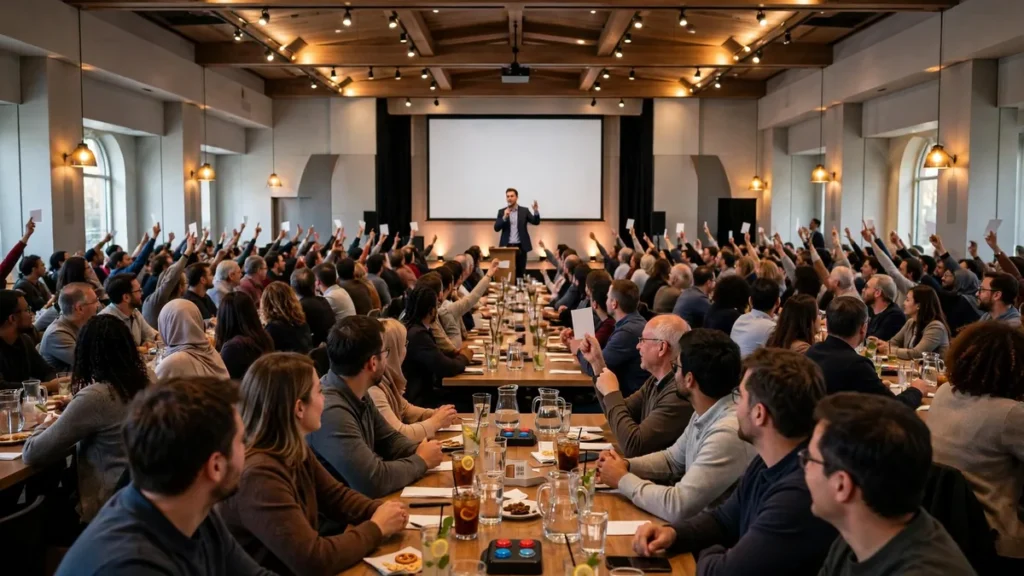
Running a trivia night for 302 players sounds like chaos, but with the right format it becomes the most memorable event of the year. The best trivia games for 302 players are the ones built for scale: clear rules, fast rounds, team-based scoring, and a host who can keep three hundred people moving at the same pace. When the format fits the crowd, nobody waits around, nobody gets lost, and every team feels like it has a real shot at winning.
A group this large changes everything about how trivia works. You cannot hand out paper answer sheets one table at a time and expect to score them before midnight. You need digital answer collection, visible scoreboards, and rounds that work when fifty teams answer at once. The games in this guide were chosen because they handle exactly that kind of pressure, whether your event is a company all-hands, a school fundraiser, a conference social, or a community night at a packed hall.
Below you will find ten games that genuinely work at this scale, a comparison table to help you pick, a setup checklist, and answers to the questions organisers ask most. Each game includes the player setup, the tech you need, and the honest trade-offs, so you can choose with confidence instead of guessing on the night.
Key takeaways
- Team-based trivia is the only format that works smoothly for 302 players; split the room into teams of four to six.
- Digital answer collection with a live scoreboard is essential at this size, because paper scoring is too slow for fifty teams.
- Short rounds of eight to ten questions keep energy high and stop the room from drifting between questions.
- Mix question types across every game, because a single style of question bores half the room within twenty minutes.
- Rehearse the tech and the scoring flow before the night, since a five-minute delay feels like twenty minutes to a crowd of three hundred.

How to Choose a Trivia Game for 302 Players
Choosing well starts with three questions: how will answers be collected, how will scores be shown, and how long will each round take? If a game cannot answer all three clearly, it will struggle at this scale. The best options use phones or tablets for answers, project a live leaderboard, and keep each round under fifteen minutes including scoring.
Room layout matters just as much as the game itself. Teams need to hear the host, see the screen, and talk without shouting across the hall. A long narrow room with one screen at the far end will frustrate the back tables, so plan for at least two large screens, speakers spread through the space, and aisles wide enough for runners and scorekeepers to move freely.
Comparison Table: Best Trivia Games for 302 Players
| Game | Best For | Answer Method | Setup Time | Cost |
|---|---|---|---|---|
| Team Trivia Showdown | Classic pub-quiz feel | Phone app | 30 minutes | Low |
| Live Poll Quiz Battle | Fast, high-energy rounds | Phone browser | 15 minutes | Low |
| Picture Round Challenge | Visual thinkers | Phone app | 20 minutes | Low |
| Music Round Mania | Parties and socials | Buzzers and phones | 25 minutes | Medium |
| General Knowledge Gauntlet | Competitive crowds | Phone app | 30 minutes | Low |
| Speed Round Frenzy | Short attention spans | Phone browser | 10 minutes | Free |
| Themed Trivia Night | Movie, sport or decade fans | Phone app | 40 minutes | Medium |
| Buzzer Beater Quiz | Head-to-head drama | Physical buzzers | 45 minutes | Medium |
| Progressive Jackpot Quiz | Fundraisers | Phone app | 35 minutes | Low |
| Hybrid Remote Trivia | Mixed in-person and online | Phone and laptop | 60 minutes | Medium |
The 10 Best Trivia Games for 302 Players
These ten games cover every kind of crowd, from a quiet corporate audience to a rowdy fundraiser. They are ordered from the most reliable all-rounder to the most specialised, and each one has been judged on the same three tests: can it handle 302 players, can it keep them engaged, and can a single host run it without a team of assistants.
1. Team Trivia Showdown
Team Trivia Showdown is the closest thing to a classic pub quiz that still works for 302 players. Teams of five answer six rounds of ten questions on their phones, and a live leaderboard updates after every round. The host reads each question aloud while it appears on the big screens, which keeps the room together and stops faster teams from racing ahead. It works because it is familiar: everyone understands the format within two minutes, and nobody needs a tutorial.
The scoring is simple and fair. Correct answers earn points, and a bonus point goes to the fastest correct team in each round, which adds tension without punishing slower teams too harshly. The host can drop in a picture round or a music round between the standard rounds to break up the rhythm. For a first-time organiser with a huge room, this is the safest choice on the list, and it is also the easiest to explain to volunteers. Similar large-group formats, like the ones in our guide to trivia games for 301 players, use the same team structure for the same reason.
2. Live Poll Quiz Battle
Live Poll Quiz Battle trades depth for speed. Every question is multiple choice, every team answers within twenty seconds, and the results appear on screen the moment the timer ends. The pace is relentless, which is exactly what a large restless crowd needs after dinner or between conference sessions. Rounds last about ten minutes, so you can run five or six rounds in an hour and still leave time for a final.
The format shines when the audience is mixed, because nobody needs specialist knowledge to enjoy it. A team that knows nothing about history can still guess well and cheer when a lucky answer lands. The trade-off is that serious quizzers may find it too shallow, so pair it with a harder final round to keep the competitive teams invested. It also needs solid Wi-Fi, since three hundred phones submitting at once will expose any weak spot in the network.
3. Picture Round Challenge
Picture Round Challenge is built around images: famous landmarks, cropped logos, celebrity childhood photos, and close-ups of everyday objects. Each team sees the same image on the screen and on their phones, and they type or select their answer before the timer runs out. Visual questions level the playing field, because they reward observation and memory rather than the ability to recall a fact from a textbook.
This game is a strong second round after a text-heavy opener, since it changes the kind of thinking the room is doing. It also photographs well for social media, which matters for fundraisers and corporate events that want shareable moments. The main risk is image quality: a blurry or low-contrast photo on a distant screen will frustrate the back tables, so test every image from the farthest seat before the event starts.
4. Music Round Mania
Music Round Mania plays short clips and asks teams to name the song, the artist, or the year it was released. Ten seconds of a famous intro is enough to fill a hall with shouting, singing, and laughter, and that energy carries into the next round. It works best as a mid-event lift, roughly halfway through the night when attention starts to dip and the room needs a jolt.
Sound quality is everything here. A single small speaker will not reach three hundred people, so use the venue sound system and test the volume from every corner of the room. Keep clips short and vary the decades, because a round made only of recent hits will lose older players and a round made only of classics will lose younger ones. Licensing is worth checking too: some venues already hold the relevant licences, while others need you to arrange one.
5. General Knowledge Gauntlet
General Knowledge Gauntlet is the most demanding game on this list, and the most satisfying for a competitive crowd. Six rounds cover science, history, geography, sport, arts, and current affairs, with ten questions per round and no multiple choice. Teams write or type full answers, which makes guessing harder and rewards genuine knowledge. The difficulty rises each round, so weaker teams stay in the hunt early and stronger teams are separated by the final questions.
This format needs a confident host who can pronounce unusual names and handle disputes about answers gracefully. Build a clear answer key before the night, including acceptable alternative answers, and appoint one person as the final judge so disputes do not eat into playing time. It is the best choice when the audience has asked for a serious quiz rather than a light party game.
6. Speed Round Frenzy
Speed Round Frenzy is pure adrenaline: thirty questions in fifteen minutes, ten seconds per question, no conferring time beyond a shouted suggestion. Teams answer on their phones, and the leaderboard updates in real time so everyone can watch positions change. It is the best filler game on this list, perfect for opening the night, bridging a gap while food is served, or closing with a burst of energy.
The format is also the cheapest to run, since it needs nothing more than a quiz platform and a screen. The danger is burnout: two speed rounds back to back will exhaust the room, so use it once and follow it with something slower. Keep the questions short and unambiguous, because a team cannot parse a long question and answer it in ten seconds. For organisers planning a mixed evening, our roundup of party games for 300 players shows how fast rounds like this sit alongside slower, social games.
7. Themed Trivia Night
Themed Trivia Night takes one subject, such as a decade, a film series, a sport, or a city, and builds the entire evening around it. Every round explores a different corner of the theme, from music and fashion to famous moments and behind-the-scenes facts. For a crowd of 302, a strong theme does something no generic quiz can: it gives strangers an instant shared conversation and turns the event into an experience rather than a test.
The catch is preparation time. Writing fifty good themed questions takes far longer than writing fifty general ones, and a weak theme will expose itself within the first round. Choose a theme with broad appeal and deep material, such as the 1990s or classic films, rather than a narrow topic only a few teams will know. Costumes, themed decorations, and a themed final round all add to the atmosphere and are worth the extra effort for a special occasion.
8. Buzzer Beater Quiz
Buzzer Beater Quiz brings game-show drama to a huge room. Instead of every team answering every question, the host calls two teams to the front for a head-to-head round while the rest of the room watches, cheers, and plays along on their phones for bonus points. The front-of-room contest creates heroes, rivalries, and moments the whole hall remembers, while the audience game keeps everyone else involved.
Logistics are the challenge. You need physical buzzers or a reliable buzzer app, a stage area, and a host who can manage the crowd noise. Rotate the front teams so that every table gets a turn across the evening, and keep each head-to-head under five minutes so the audience does not lose interest. It is the most theatrical option on this list and the best choice when the event is as much a show as a quiz.
9. Progressive Jackpot Quiz
Progressive Jackpot Quiz is designed for fundraisers. Teams buy in, answer rounds as normal, and a jackpot grows with every round as more teams stay in or pay for extra lives. The final round decides the jackpot winner, and the pot can be split between the winning team and the cause. The format creates a natural arc for the evening, because the stakes rise with every round and the room gets louder as the jackpot grows.
Transparency matters more here than in any other game. Show the jackpot total on screen, explain the rules before the first question, and have a clear written record of buy-ins and prizes. Keep the buy-in modest so that cost never stops a team from playing, and consider a small prize for the best team name to keep the atmosphere friendly. When the money side is handled cleanly, this is the most exciting game on the list.
10. Hybrid Remote Trivia
Hybrid Remote Trivia connects an in-person hall of 302 players with remote teams joining by video call, which suits conferences and companies with distributed staff. Everyone answers the same questions through the same platform, and the leaderboard merges both audiences into one competition. The shared scoreboard is what makes it work: remote players stop feeling like spectators and start feeling like rivals.
This is the hardest game on the list to run well. You need a dedicated tech operator watching the remote feed, a host who remembers to address both audiences, and a rehearsal with real remote players before the night. Audio delay is the biggest risk, so keep questions on screen for a few extra seconds and avoid buzzer rounds that depend on split-second timing. When it works, though, it is the only format here that turns a local event into a company-wide one.
Setup Checklist for a 302-Player Trivia Night
- Split 302 players into teams of four to six, giving you roughly fifty to seventy teams to manage.
- Test the venue Wi-Fi with at least fifty devices connected at once before the event.
- Place at least two large screens so the back tables can read every question clearly.
- Prepare a printed answer key with acceptable alternative answers for every question.
- Rehearse the host script, the scoring flow, and the leaderboard display end to end.
- Have a backup plan, such as printed question sheets, in case the platform or the Wi-Fi fails.
Frequently Asked Questions
How many teams should 302 players form?
Aim for teams of four to six players, which gives you roughly fifty to seventy teams. Smaller teams keep everyone involved, while larger teams leave quieter players with nothing to do. If the room has fixed tables of eight, let them play as eights but cap the scoring so no team gains an unfair advantage from extra brains.
How long does a trivia night for 302 players take?
Plan for two to two and a half hours including breaks. That allows for five or six rounds, a picture or music round, scoring time, and a final. Shorter events feel rushed at this scale, because moving three hundred people between rounds and announcing scores simply takes longer than it does for a small group.
Do we need a professional host?
A professional host helps, but a confident volunteer can run the night if they rehearse. The key skills are clear delivery, calm handling of disputes, and the ability to keep energy up between rounds. Whoever hosts should run the full script at least once with the actual tech before the event, because reading questions aloud to three hundred people is harder than it looks.
What if the Wi-Fi fails during the game?
Keep printed question sheets and answer sheets as a backup, and agree in advance that the host will switch to paper scoring if the platform goes down for more than two minutes. Tell the teams about the backup plan at the start of the night so a failure feels like a planned switch rather than a crisis. A mobile hotspot can also cover a short outage while the main network recovers.
How do we keep 302 players engaged for two hours?
Mix the formats: follow a text round with a picture round, then a music round, then a speed round. Announce the leaderboard after every round so teams can see their progress, and add small prizes for the best team name or the funniest wrong answer. Short breaks with food and drinks help too, because a hungry room stops listening no matter how good the questions are.
Can children and adults play together in one trivia night?
Yes, if the questions are balanced. Include rounds that children can enjoy, such as picture rounds and music rounds, alongside rounds aimed at adults. Family teams work best when questions mix general knowledge with visual and audio clues, and a dedicated kids prize keeps younger players motivated even if their team does not win overall. A well-chosen mix of rounds is also what makes the broader format in our guide to trivia games for 300 players work for mixed-age crowds.
The Bottom Line
The best trivia games for 302 players share the same strengths: team play, digital answers, a live leaderboard, and rounds short enough to hold a huge room. Start with Team Trivia Showdown if you want reliability, add a music or picture round for energy, and finish with a speed round or a jackpot final to send the room home buzzing. Get the tech rehearsed, the screens visible, and the scoring fair, and three hundred and two players will feel like one room playing together rather than fifty teams playing apart.


