
The best puzzle games for 326 players turn a crowd that looks impossible to manage into one of the most enjoyable group events you can run. Three hundred and twenty-six people is a huge number for any game night, yet puzzle games are unusually well suited to it, because they split naturally into teams, rounds, and stations, and because every player can contribute something useful whether they are quick with words, good with numbers, or simply great at spotting a pattern everyone else missed.
Planning for a group this size is really about structure rather than the puzzles themselves. When 326 players are divided into teams of six to eight, given clear instructions, and rotated through a series of short challenges, the event feels personal and fast-paced instead of chaotic. The games below are chosen because they scale: they work in a school hall, a conference centre, a community festival, or a company offsite, and they need nothing more exotic than printed sheets, a projector, and a few volunteers to keep score.
This guide covers the formats that work best at this scale, how to organise the room, and how to score fairly across dozens of teams.
Key takeaways
- Split 326 players into teams of six to eight so every player gets a real role and no one is left watching from the sidelines.
- Use short rounds of ten to fifteen minutes, because short rounds keep energy high and let teams recover from a slow start.
- Mix puzzle types across the event, including word puzzles, logic grids, jigsaws, codes, and picture rounds, so different strengths shine.
- Score with simple points per puzzle plus time bonuses, and post a live leaderboard so teams can see where they stand.
- Rehearse the instructions once with your volunteers before the doors open, because clear instructions matter more than clever puzzles at this scale.
Why Puzzle Games Work for 326 Players
Most party games break down once the group passes thirty or forty people, because only a few players can take part at once while everyone else waits. Puzzle games do the opposite. A puzzle is a problem that many minds can attack at the same time, and a team of seven people working on a logic grid will genuinely solve it faster than one person working alone. That makes puzzles one of the few game formats where adding more players makes the event better rather than slower.
Puzzle games are also unusually inclusive. A good puzzle event does not reward the loudest voice or the fastest reflexes. It rewards patience, careful reading, and the willingness to test an idea that might be wrong. In a group of 326 players, you will have teenagers and grandparents, confident talkers and quiet thinkers, and people who love numbers alongside people who love words. A mixed puzzle programme gives every one of them a moment to be the person who cracks the clue.
There is a practical advantage too. Puzzle games are cheap to run at scale. Printed puzzle sheets cost pennies per player, a single projector can display a puzzle to a whole hall, and you do not need expensive equipment or licensed software.
How to Organise 326 Players Into Teams
Organisation is the difference between a memorable puzzle night and a confusing one. With 326 players, you cannot improvise the team structure on the evening itself. Decide it in advance, print it clearly, and brief your volunteers so that every player knows exactly where to sit within five minutes of arriving.
Choose Team Sizes That Give Everyone a Job
Teams of six to eight players work best for puzzle events. With 326 players, teams of seven give you 46 teams of seven plus one team of four, which is a little uneven. A cleaner split is 40 teams of eight, which covers 320 players, plus one team of six, giving you 41 teams in total. Teams of eight are large enough to split a puzzle into parts, yet small enough that everyone can see the puzzle sheet and hear each other talk.
Give every team a simple identity, such as a colour or an animal name, and print it on a table card. Team names make scoring easier and give players something to cheer for.
Assign Roles Inside Each Team
Every team needs a captain who reads the puzzle aloud, a scribe who writes down answers, and a timekeeper who watches the clock. The remaining players can split the puzzle itself: one person works on the word clues, another on the number clues, and another checks the answers before they are submitted. Rotating these roles between rounds keeps the event fair and stops one confident player from taking over every puzzle.
For a group this large, recruit one volunteer per four or five teams. Their job is to hand out puzzle sheets, collect answer slips, and answer simple questions, so the host can focus on running the event. With 41 teams, ten volunteers is about right, plus a host, a scorekeeper, and someone managing the projector.
Set Up the Room for Puzzles, Not Performances
Arrange tables in rows or clusters of eight, with enough space between tables for volunteers to move freely. Each table needs good light, a flat surface for puzzle sheets, and a clear view of the projector screen. If the room has a stage, use it for the host and the leaderboard, not for the puzzles themselves, because puzzle solving happens best at table level.
Test the sound system before the event. A host who cannot be heard by 326 people will lose the room within ten minutes, and no puzzle, however clever, can recover that. A simple handheld microphone and two speakers are enough for most halls, but test them from the back row, not from the front.
The Best Puzzle Games for 326 Players
The games below are ordered from the easiest to set up to the most ambitious. You do not need to run all of them. Pick four or five, mix the types, and leave time between rounds for scoring and a short break. A two-hour event with five rounds of twelve minutes, plus introductions and results, runs comfortably.
1. Giant Crossword Relay
The giant crossword relay is the simplest large-group puzzle and a reliable opener. Each team receives the same crossword grid and the same set of clues, and the first team to complete the grid correctly, or the team with the most correct answers when time runs out, wins the round. Because every team works on the same puzzle, the host can display the answers on the projector and let teams mark their own sheets, which saves an enormous amount of scoring time.
Choose clues that suit your audience. A general-knowledge crossword with a mix of easy and medium clues works for mixed-age crowds, while a themed crossword, perhaps about the town, the school, or the company, adds a personal touch that players remember. Keep the grid to around twenty clues so that most teams finish within twelve minutes. The shared format means the whole room works in silence for a few minutes, then erupts as teams compare answers, which is exactly the atmosphere you want at the start of the night.
2. Logic Grid Challenge
Logic grids are puzzles where players use a set of clues to match people with houses, pets, jobs, or hobbies. They are ideal for large groups because they reward careful teamwork: one player can track the clues while another fills in the grid, and a third checks for contradictions. A well-designed logic grid takes a team of eight about ten minutes, which fits the round structure perfectly.
Print the grid large enough to read at a table of eight, and give each team a fresh copy for every round. Start with an easy grid so that teams learn the method, then raise the difficulty in later rounds. Logic grids also score cleanly, because each correct match earns a point, so the scorekeeper can award partial credit to teams that solved most of the puzzle but ran out of time.
3. Code-Breaking Race
In a code-breaking race, each team receives a short coded message and a set of clues that reveal the cipher. The first teams to decode the message and write down the correct answer win the round. Codes are exciting because they feel like a spy mission, and they work well for a crowd of 326 because the puzzle is identical for every team and the answer is a single sentence that is easy to check.
Use a simple substitution cipher for the first round and a slightly harder one, such as a keyword cipher, for the second. Avoid ciphers that need specialist knowledge, and always test the puzzle with a volunteer before the event.
4. Jigsaw Relay
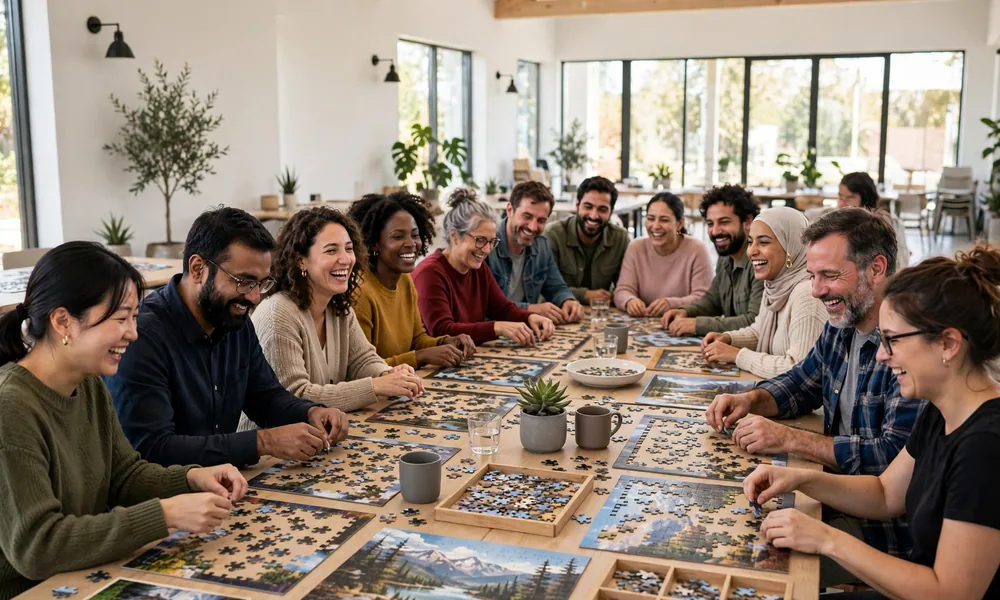
A jigsaw relay brings a physical, hands-on element to the event, which is a welcome change after two rounds of paper puzzles. Each team receives the same small jigsaw, perhaps 100 pieces, and the team that completes it first wins. Jigsaws are noisy, tactile, and wonderfully competitive, and similar team formats appear in the best puzzle games for 325 players, where they scale neatly to a station rotation.
Buying 41 identical jigsaws sounds expensive, but puzzle libraries, schools, and charity shops often lend them, and a 100-piece puzzle is cheap to buy in bulk. Alternatively, run the jigsaw as a station rather than a simultaneous round: teams rotate to the jigsaw tables in groups, which means you only need ten or twelve puzzles.
5. Picture Puzzle Round
A picture round asks teams to identify close-up photographs, spot the difference between two images, or name the object in a cropped picture. Picture puzzles are fast, visual, and a relief for players who find word puzzles tiring. They also work brilliantly on a projector, because the whole room sees the same image at the same time and the host controls the pace.
Prepare ten images per round and give teams thirty seconds per image, with answers written on a single slip. Choose images with a clear theme, such as famous landmarks, animals, or food. Avoid images so obscure that nobody can answer them, because a round where every team scores zero drains the room.
6. Word Ladder Tournament
A word ladder asks players to change one word into another by changing one letter at a time, with every step forming a real word. For example, turning CAT into DOG might pass through COT, COG, and DOG. Word ladders are quick, satisfying, and easy to score, because each correct ladder earns a fixed number of points and partial ladders earn partial credit.
Run the word ladder as a tournament: every team attempts the same five ladders in ten minutes, and the teams with the most correct steps advance to a head-to-head final round on the projector. The final is great entertainment for a large audience, because the whole room can follow the two finalist teams and shout suggestions. Keep the ladders short, four or five steps each, so that the final moves quickly.
7. Escape-Room Style Puzzle Trail
An escape-room style trail is the most ambitious format on this list, and the most memorable. Instead of sitting at tables, teams move between stations around the venue, and at each station they solve a puzzle to earn a clue. The clues combine into a final answer, such as a combination for a locked box. With 326 players, the trail needs careful timing so that teams do not queue at the same station.
The simplest way to manage the flow is to stagger the start: send teams to different first stations and rotate them in a fixed order. Six stations with five minutes at each one gives a thirty-minute trail, and you can run it as the centrepiece of the evening. Each station needs one volunteer to explain the puzzle and check the answer. This format suits venues with several rooms, such as schools and community centres, and it is the closest you can get to a real escape room for a crowd of this size. The best puzzle games for 324 players use a similar station approach, and their layout tips apply directly to a group of 326.
Puzzle Game Comparison at a Glance
Use this table to choose the right mix for your event. Setup time is the time your volunteers need before the round starts, and the player count column shows how many players can take part at once without changing the format.
| Game | Setup time | Round length | Best for |
|---|---|---|---|
| Giant crossword relay | Low | 12 minutes | Opening round, mixed ages |
| Logic grid challenge | Low | 10 minutes | Careful team thinkers |
| Code-breaking race | Medium | 12 minutes | Excitement and drama |
| Jigsaw relay | Medium | 15 minutes | Hands-on fun, photos |
| Picture puzzle round | Low | 5 minutes | Quick energy boost |
| Word ladder tournament | Low | 10 minutes | Word lovers, finals |
| Escape-room trail | High | 30 minutes | Centrepiece event |
Scoring and Timing That Keep Everyone Engaged
Fair, visible scoring is what turns a pleasant evening of puzzles into a competition that people care about. Keep the scoring simple enough that a volunteer can mark an answer slip in under a minute, and transparent enough that teams trust the results. The best puzzle games for 323 players use the same simple points system, and it works just as well for 326 players.
Award one point per correct answer in most rounds, with a small time bonus for the first three teams to finish a round correctly. For example, the first team to submit a fully correct crossword earns five bonus points, the second earns three, and the third earns one. Post the running totals on a projector or a large whiteboard after every round, and announce the top five teams by name, because public recognition is a powerful motivator.
Timing matters as much as scoring. Keep rounds to ten or fifteen minutes, and keep the gaps between rounds to two or three minutes. Plan a ten-minute break halfway through the event, and use it to update the leaderboard and hand out refreshments.
Event Checklist for 326 Players
Use this checklist in the week before your event, and tick each item off as it is done. It covers the practical details that are easy to forget when you are focused on writing puzzles.
- Confirm the venue, the seating plan for 41 teams, and the sound system, and test the projector from the back row.
- Print answer slips, team table cards, and one puzzle sheet per team per round, plus ten percent spares for mistakes.
- Recruit and brief ten volunteers, one host, one scorekeeper, and one person to manage the projector and leaderboard.
- Test every puzzle with a volunteer solver, and check that each round fits inside its time limit.
- Prepare the leaderboard, the scoring sheets, and the prizes for the top three teams and the best team name.
- Pack pens, spare puzzle sheets, a first-aid kit, drinking water for the volunteers, and a backup copy of every puzzle on a USB stick.
Frequently Asked Questions
How many teams should 326 players form?
Forty-one teams is the cleanest split: forty teams of eight players plus one team of six. Teams of six to eight give every player a role and keep the table small enough for everyone to see the puzzle and hear the discussion.
How long should a puzzle event for 326 players last?
Plan for two to two and a half hours, including introductions, five rounds, a ten-minute break, and the results. Shorter events feel rushed at this scale, and longer ones tire players who are sitting and concentrating for most of the evening.
What is the best first puzzle for a large group?
A giant crossword relay is the best opener, because every team works on the same puzzle, the rules are obvious, and the host can display the answers on the projector. It settles the room quickly and gives every team an early success.
Do puzzle games work for mixed-age groups?
Yes, and they are one of the best formats for mixed ages, because different puzzle types reward different strengths. Picture rounds suit younger players, logic grids suit careful older players, and team play lets family members help each other across the age gap.
How much does it cost to run a puzzle event for 326 players?
Printing is the main cost, and it is modest: a few hundred puzzle sheets, answer slips, and table cards. A projector and a sound system are usually available at the venue, and jigsaws can be borrowed, so most events cost very little beyond refreshments and prizes.
Can puzzle games work outdoors for 326 players?
Yes, if the weather is reliable and you have shelter for the paper puzzles. An escape-room style trail works particularly well outdoors, because teams can move between stations in a garden, a park, or a school playground, although you should keep the paper rounds under cover.
Bottom Line
The best puzzle games for 326 players are the ones that give every player a job, keep rounds short, and mix puzzle types so that different strengths get their moment. Split the crowd into 41 teams, run four or five varied rounds with a live leaderboard, and finish with a shared final round that brings the whole room together. Do that, and a group of 326 stops feeling like a crowd and starts feeling like a community solving puzzles together.


