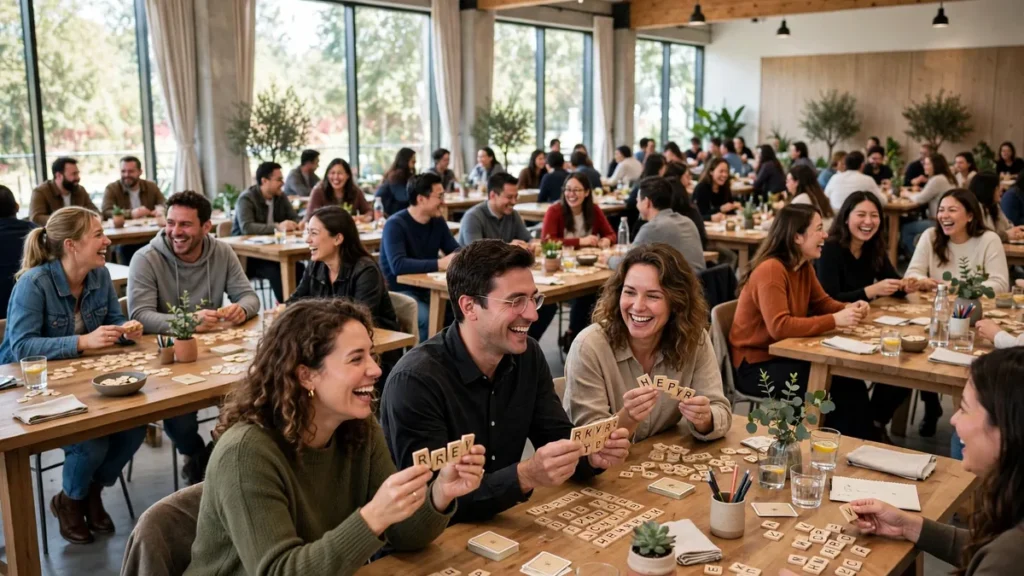
Finding the right dice games for 200 players sounds impossible at first. Two hundred people cannot gather around a single table, share one set of dice, and take turns without the game grinding to a halt. Yet dice games are one of the best choices for a crowd this large, because the rules are simple, the equipment is cheap, and the games scale beautifully when you split the crowd into teams and stations.
The secret is that dice games for 200 players are not really one game at all. They are a format: dozens of small tables or teams playing the same game at the same time, with scores flowing up to a central leaderboard. Everyone rolls, everyone cheers, and nobody waits more than a minute for a turn.
This guide rounds up the best dice games for a group of 200, explains the team and tournament formats that make them work, and gives you a practical plan for dice, tables, scorekeepers, and prizes. Every game here is a family-friendly party game. There is no betting, no wagering, and no casino play — just luck, laughter, and friendly competition.
Key takeaways
- Split 200 players into 20 teams of 10, or 40 tables of 5, so everyone rolls within the first few minutes.
- Use team scoring and a central leaderboard so a huge group still feels like one shared game.
- Choose simple games with rounds under five minutes, such as Bunco, Tenzi, and Dice Bingo.
- Plan on at least 40 dice sets, 200 score sheets, and one scorekeeper per table.
- Rotate teams between stations every 15 minutes so nobody plays the same game all night.

Why Dice Games Work So Well for 200 Players
Dice games have three qualities that make them ideal for a very large group. First, the rules take less than a minute to explain. A new player can watch one round and understand exactly what to do, which matters when you have 200 people and no time for a long tutorial. Second, the equipment costs almost nothing. A bag of dice, some cups, and printed score sheets can serve the entire room for less than the cost of one board game per table.
Third, dice games are naturally fair and fast. Every roll is a fresh chance, so a team that falls behind can catch up in a single lucky round. That keeps energy high across the whole room, even for teams at the bottom of the leaderboard. Nobody is eliminated early, nobody sits out, and the outcome stays uncertain until the last round.
Large-group dice games also solve the biggest problem of big events: keeping everyone busy at once. A quiz or a stage game leaves most of the room watching. Dice games put a cup in every hand, and when 200 people roll at the same moment, the room fills with noise and excitement.
How to Run Dice Games for 200 Players
Running dice games for 200 players is mostly a matter of organization. Pick your format first, then set up the room to match it. The four formats below all work well, and you can combine them across an evening — for example, station rotations for the first hour, then a tournament final for the last half hour.
Team Stations
Set up 10 stations with a different dice game at each one, and assign 20 players to each station. Teams of five play head to head while the other teams at the station watch, cheer, and keep score. After 15 minutes, every team moves to the next station. By the end of the night, every player has tried every game, and the team with the best combined score wins.
Relay Races
Divide the room into long lines of 10 players per team. The first player rolls a target combination, then passes the dice down the line. The team that finishes its relay first wins the round. Relay races are loud, fast, and wonderfully visual, which makes them perfect for opening the evening or for a grand finale. They also need almost no equipment — one dice set per team is enough.
Tournament Brackets
Run a single-elimination or points-based tournament where tables of five compete and the winners advance. With 200 players, you start with 40 tables, and after three rounds you have five finalists for a championship table on stage. Tournaments add drama, but they leave eliminated players with nothing to do, so pair the tournament with open-play stations for anyone who is out.
Whole-Room Simultaneous Play
In this format, everyone plays the same game at the same time, with a host calling the rounds over a microphone. Dice Bingo and large-group Farkle work best this way. Every table rolls on the host’s signal, scores are shouted out, and a leaderboard is updated between rounds. This format creates the most shared excitement, and the planning lessons from dice games for 199 players apply almost exactly here — the team sizes and table counts are nearly identical.
The Best Dice Games for 200 Players
These ten games were chosen because they are simple, quick, and fun at scale. Each one works with teams of five to ten, needs only dice and a score sheet, and keeps every player involved.
1. Team Bunco
Bunco is the classic large-group dice game, and it is the natural first choice for 200 players. Each table of four or five rolls three dice, aiming to roll the number of the current round. Players score points for matching dice, and a Bunco — three of a kind on the round number — scores 21 points. After each round, winners move up a table and losers move down, so players constantly meet new opponents. Bunco nights routinely host 100 or more players, and the format stretches to 200 without any changes. You need three dice and a score sheet per table, plus a bell to signal round changes.
2. Tenzi Team Race
Tenzi is a speed game: each player rolls ten dice as fast as possible, trying to get all ten to show the same number. For a group of 200, run it as a team race. Each team of ten lines up its dice cups, and on the host’s signal everyone rolls at once. The first team with all ten members finished wins the round. Tenzi rounds last two to three minutes, which makes it perfect for quick rotations between stations.
3. Dice Bingo
Dice Bingo turns a familiar game into a whole-room event. Each player gets a bingo card with numbers from 2 to 12, and the host rolls two large dice on stage. Players mark the number rolled, and the first to complete a row, column, or full card shouts bingo. Because everyone plays from the same rolls, a group of 200 can play together with no extra equipment beyond printed cards and markers.
4. Farkle Team Challenge
Farkle is a push-your-luck game where players roll six dice, bank scoring combinations, and decide whether to risk their points on another roll. For a large group, play it as a team challenge: each team of five shares one score, and members take turns rolling for the team. A bad roll — a Farkle with no scoring dice — wipes out the turn’s points, which produces huge cheers and groans across the room. Standard scoring gives 50 points for a single 1, 100 for a single 5, and bigger bonuses for three of a kind and straights.
5. Liar’s Dice Team Showdown
Liar’s Dice is a bluffing game where each player rolls five dice under a cup, looks at them secretly, and bids on how many of a certain number are showing across the whole table. For 200 players, run it as a team showdown: each table of five plays a mini-tournament, and the table winners advance to a final round on stage. The bluffing and calling-out make it one of the liveliest games in this list, and it works best with older children and adults. Each player needs a cup and five dice.
6. Pig Race
Pig is the simplest dice game of all, which makes it ideal when your group includes young children or first-time players. Each player rolls a single die, adding the result to their turn total, and can stop at any time to bank the points — but rolling a 1 wipes out the turn. Run it as a relay: each team member rolls until they choose to stop or roll a 1, then passes the die to the next teammate. The first team to 100 points wins.
7. Yahtzee-Style Team Scoring
Yahtzee’s familiar scorecard — ones through sixes, three of a kind, full house, small and large straights, and Yahtzee itself — adapts easily to team play. Give each team of five a single shared scorecard, and let members take turns rolling for the team, with the team deciding together which box to fill. The group discussion is half the fun, and it means even players who have never played Yahtzee can contribute. A full team game takes about 20 minutes, so use it as a longer station or as a relaxed game for a side room.
8. Sevens Knockout
Sevens is a fast elimination game: players take turns rolling two dice, and anyone who rolls a seven is out for the round. The last player standing wins. For 200 players, run Sevens as a knockout across tables — each table plays until one winner remains, then the 40 table winners gather for a grand final. The rules take ten seconds to explain, and the elimination format builds real tension.
9. Ten Thousand (Zilch) Team Play
Ten Thousand, also known as Zilch, is a six-dice scoring game similar to Farkle but with a target of 10,000 points and a famous twist: rolling no scoring dice wipes out everything, and three failed turns in a row can cost a player their whole score. Played as a team game, each team shares one score and members rotate the roll, which turns every turn into a group decision about whether to push on or bank the points. A team game takes 20 to 30 minutes, so place it at a station for players who want a longer, thinkier game.
10. Dice Relay Challenge
The Dice Relay Challenge is a custom game built for huge groups. Set up a course with five stops, and at each stop a player must roll a specific target — a 6 at stop one, a pair at stop two, a total of 10 at stop three, and so on. Teams of ten race through the course, with each player handling one stop before tagging the next teammate. The relay is physical, noisy, and highly watchable, which makes it a great closing game.
If your crowd is a little smaller on the night, most of these games transfer directly — the same team sizes and station counts work well, as shown in our roundup of dice games for 198 players, which uses the same formats with only two fewer teams.
Comparing the Best Dice Games for 200 Players
Use this table to pick the right mix for your event. A good evening usually combines one whole-room game, three or four station games, and one fast relay or knockout game as a finale.
| Game | Players per team | Round length | Best format | Ages |
|---|---|---|---|---|
| Team Bunco | 4 to 5 | 15 minutes | Stations | 8 and up |
| Tenzi Team Race | 10 | 3 minutes | Whole room | 6 and up |
| Dice Bingo | Individual | 10 minutes | Whole room | 5 and up |
| Farkle Team Challenge | 5 | 10 minutes | Stations | 8 and up |
| Liar’s Dice Showdown | 5 | 15 minutes | Tournament | 12 and up |
| Pig Race | 10 | 10 minutes | Relay | 5 and up |
| Yahtzee Team Scoring | 5 | 20 minutes | Stations | 8 and up |
| Sevens Knockout | 5 | 5 minutes | Tournament | 6 and up |
| Ten Thousand Team Play | 5 | 25 minutes | Stations | 10 and up |
| Dice Relay Challenge | 10 | 10 minutes | Relay | 6 and up |
Planning Checklist for 200 Players
A smooth event comes down to preparation. Work through this checklist in the week before your game night so nothing is left to chance.
- Count the dice: at least 40 full sets of six dice, plus two spare sets per station, and one cup per player at active tables.
- Print 200 score sheets, 200 bingo cards if you are playing Dice Bingo, and a one-page rules sheet for every table.
- Assign one scorekeeper per table and give each scorekeeper a whistle or a bell to signal round changes.
- Set up a visible leaderboard on a whiteboard or projector and update it between rounds so every team can see where they stand.
- Test the sound system before guests arrive, since the host needs to reach all 200 players at once for whole-room games.
- Buy prizes for the top three teams plus a small prize for the best team name, and keep a few spare prizes for tie-breakers.
Planning the wider party matters too. Dice games are the centerpiece, but food, music, and seating shape the evening just as much. For ideas on building the rest of the night around your games, our guide to party games for 198 players covers large-group planning, team formation, and pacing for a crowd of almost exactly the same size.
Tips for Hosting a Smooth Dice Night
Start on time with your easiest game. Dice Bingo or Sevens gets everyone playing within five minutes and builds confidence before the longer games begin. Save the complicated games for the middle of the evening, when players are warmed up and comfortable with the format.
Keep rounds short and signals clear. A bell, a whistle, or a microphone announcement should mark every rotation, and scorekeepers should collect score sheets at the same moment. Long gaps between rounds are what drain energy from a big event, so rehearse the transitions with your helpers before guests arrive.
Mix ages and abilities on each team rather than grouping friends together. Mixed teams play better, talk more, and enjoy the evening more than teams of identical players. If you are assigning teams in advance, spread experienced players evenly so no single team dominates from the first round.
Frequently Asked Questions
How many dice do you need for 200 players?
Plan on at least 40 sets of six dice, which is 240 dice, plus spares. That gives every table of five a full set for games like Farkle, Bunco, and Ten Thousand. Tenzi needs ten dice per player, so if you run Tenzi for the whole room at once, you will need 2,000 dice — in practice, most hosts run Tenzi as a station for 20 players at a time, which needs only 200 dice. Buy dice in bulk bags online, and keep a few extra sets in reserve.
What is the best dice game for a group of 200?
Bunco is the best all-round choice, because it was designed for large groups, uses simple rules, and rotates players between tables so everyone meets new opponents. If you want a single whole-room game instead, Dice Bingo is the best pick, since all 200 players play from the same rolls at the same time. For pure excitement, the Tenzi team race is hard to beat, and it works well as an opening or closing game.
Can children play dice games for 200 players?
Yes. Most of the games in this guide suit children aged six and up, and Dice Bingo, Pig, and Sevens work well even for five-year-olds. For mixed-age events, use team play so younger children are paired with adults who can help with scoring. Avoid Liar’s Dice and Ten Thousand for younger children, since the bluffing and scoring are more complex.
How long does a dice game night for 200 players take?
Plan on two to three hours, including setup and prize-giving. A typical schedule is 15 minutes for welcome and team assignments, 90 minutes of station rotations or tournament rounds, 20 minutes for a whole-room finale game, and 15 minutes for final scores and prizes. Do not try to squeeze more than five or six different games into one evening — players enjoy replaying a favorite game more than rushing through a new one every ten minutes.
How do you keep score with 200 players?
Use one scorekeeper per table and a central leaderboard. Each table’s scorekeeper records the team’s points on a paper score sheet, then hands it to a runner or enters it into a shared spreadsheet at the end of each round. A projector or large whiteboard showing the top ten teams keeps the competition visible and exciting. Keep the scoring simple: points per round, added up across games, with the highest total winning.
Do you need a host for dice games with 200 players?
Yes, a host makes a big difference. The host explains the rules, signals the start and end of each round, updates the leaderboard, and keeps the energy up between games. For a group of 200, the host needs a microphone and a sound system that reaches the whole room. If you do not have a confident host, ask your most outgoing helper to take the role and give them a printed script with the rules and the schedule.
Bottom Line
The best dice games for 200 players are the simple ones: Bunco for team play, Dice Bingo for the whole room, Tenzi for speed, and Farkle for drama. Split the crowd into teams of five to ten, run stations or a tournament, keep one scorekeeper per table, and let the leaderboard do the work of keeping everyone invested. With enough dice, clear signals, and a confident host, 200 players is not a problem to solve — it is the reason the night is so much fun.