Number puzzle games have quietly become one of the most popular ways to pass the time, and it is easy to see why. A good number puzzle asks for nothing more than a few minutes and a little concentration, yet it rewards you with that small rush of satisfaction every time a row clicks into place. Whether you are filling in a Sudoku grid on your morning commute, sliding tiles together in a game of 2048, or working out the logic of a Kakuro, these games turn simple arithmetic and pattern recognition into something genuinely absorbing. They are the rare kind of entertainment that feels productive: you are relaxing, but your brain is working.
What makes number puzzles so enduring is their range. Some are gentle and meditative, perfect for winding down before bed, while others are fiendishly difficult and will keep even the most confident problem-solver busy for hours. Some are pure logic, with a single correct answer waiting to be found, and others are more open-ended, rewarding experimentation and creative thinking. There is a number puzzle for every mood, every skill level, and every amount of free time, from a two-minute daily challenge to a sprawling puzzle hunt that unfolds over weeks.
This guide brings together the best number puzzle games you can play in 2027, from timeless classics to clever modern twists. We look at what makes each one special, who it suits best, and how to pick the right game for the way you like to think. Whether you are a lifelong Sudoku devotee, a parent looking for something smart for the kids, or a complete beginner wondering where to start, there is something here for you.
Key takeaways
- Sudoku remains the most popular number puzzle in the world, and it is the best starting point for beginners because it needs no maths beyond recognising the digits 1 to 9.
- Games like 2048 and Threes reward planning and pattern-spotting rather than arithmetic, making them ideal for players who want a quick, addictive challenge.
- Kakuro, KenKen and Killer Sudoku blend arithmetic with logic, and they are the natural next step once classic Sudoku starts to feel too easy.
- The best number puzzle games offer daily challenges, difficulty levels and hint systems, so the game grows with you instead of going stale.
- Playing a little every day builds number sense, working memory and patience, and it is one of the cheapest hobbies you can have.
What makes a great number puzzle game?
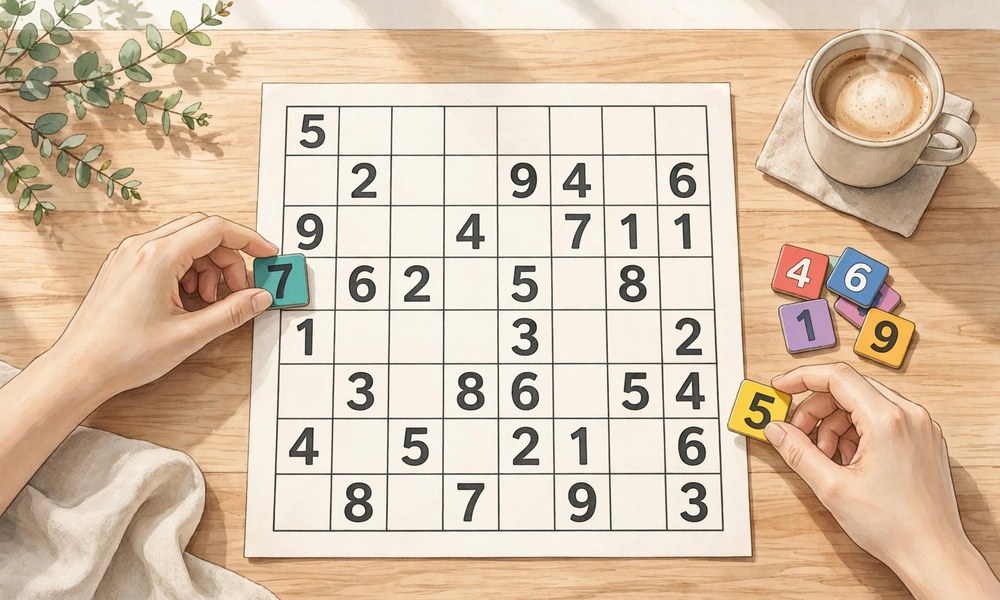
A great number puzzle game starts with a simple rule set. The best puzzles can be explained in a sentence or two, yet they hide surprising depth. Sudoku is the classic example: place the digits 1 to 9 so that every row, column and box contains each digit once. That is the whole rule, and from it springs a lifetime of puzzles. If a game needs a long tutorial before it becomes fun, it has probably overcomplicated things.
Fairness matters just as much. A well-designed number puzzle always has a solution that can be reached by logic alone, with no guessing required. This is what separates a good puzzle from a frustrating one. When you are stuck, the answer should always be findable if you look carefully enough, and the best games give you tools to help, such as pencil marks, error highlighting and gentle hints, without giving the whole game away.
Variety is the third ingredient. The strongest number puzzle games keep things fresh with daily puzzles, multiple difficulty levels, timed modes and new puzzle types to unlock. A game that only offers one puzzle type at one difficulty will wear thin quickly, no matter how good that puzzle is. Look for games that let you grow: easy puzzles for lazy mornings, hard ones for when you want a real test, and something in between for the commute.
The best number puzzle games in 2027
1. Sudoku
Sudoku is the undisputed king of number puzzles, and it has earned the title. The 9 by 9 grid, the digits 1 to 9, the elegant logic: it is a design so clean that it feels inevitable, as though it must always have existed. Sudoku needs no arithmetic at all, only careful observation, which is why it appeals to everyone from schoolchildren to retirees. A beginner can finish an easy puzzle in a few minutes, while an expert puzzle can keep a seasoned solver thinking for an hour.
Modern Sudoku apps have made the classic even better. The best ones offer thousands of puzzles across four or five difficulty levels, a daily challenge, pencil-mark tools, mistake tracking and smart hints that explain the logic rather than just filling in a cell. Some add variants like Killer Sudoku, where cages of cells must add up to a target, or Sudoku X, where the diagonals must also contain each digit once. If you only play one number puzzle game, make it Sudoku, and if you want to find the finest apps for it, our guide to the best Sudoku apps compares the top options in detail.
2. 2048
2048 is the simplest game on this list and one of the most addictive. You slide numbered tiles around a 4 by 4 grid; when two tiles with the same number touch, they merge into one tile worth double. The goal is to create the 2048 tile, and the game ends when the board fills up and no more moves are possible. The rules take ten seconds to learn, but the strategy runs deep: every slide changes the board, and a careless move can undo ten minutes of careful building.
What makes 2048 so compelling is the way it rewards planning. Good players keep their largest tile pinned in one corner, build chains of descending numbers, and think several moves ahead, much like chess players think in patterns rather than single moves. It is a perfect short-session game, with a round lasting anywhere from two to fifteen minutes, and it is ideal for anyone who likes a puzzle that feels more like a reflex test than a maths exam. Variants with bigger boards, different target numbers and special tiles keep the formula fresh.
3. Kakuro
Often described as a crossword with numbers, Kakuro is Sudoku’s cleverer cousin. You fill a grid with digits so that each run of cells adds up to the clue number printed beside it, with no digit repeated inside a single run. It combines the logic of Sudoku with real arithmetic, and the result is a puzzle that feels richer and more textured. A Kakuro grid is a satisfying thing to solve: each clue narrows the possibilities, and the moment you crack a long run, several other cells fall into place at once.
Kakuro suits players who enjoy Sudoku but want something that exercises their mental arithmetic too. It is an excellent workout for addition and number combinations, and regular players find they start recognising useful number pairs automatically, like knowing instantly that 17 in two cells must be 8 and 9. If you enjoy crosswords, you will probably love Kakuro, because it shares the same pleasure of a grid slowly filling in.
4. KenKen
KenKen is a compact grid puzzle that packs a surprising amount of thinking into a small space. A grid, usually 4 by 4 up to 9 by 9, is divided into cages outlined in bold. Each cage has a target number and an operation, and the digits inside the cage must combine using that operation to reach the target. Like Sudoku, no digit can repeat in a row or column, so every cage interacts with every other. The result is a puzzle that is part logic, part arithmetic, and entirely absorbing.
KenKen is particularly popular in classrooms because it builds arithmetic fluency without feeling like a worksheet, and many teachers use it as a warm-up exercise. For adults, it is a neat, self-contained challenge that fits into a coffee break, with smaller grids taking just a few minutes. If you like Sudoku but want your puzzles to include a little more maths, KenKen is the natural next step.
5. Nonogram number puzzles
Nonograms, also known as Picross or Griddlers, turn numbers into pictures. Each row and column carries a set of number clues telling you how many consecutive filled cells it contains, and by working out where the filled cells must go, you gradually reveal a hidden image. The numbers are the whole puzzle, but the reward is visual: a completed grid might show a cat, a lighthouse or a rocket. It is a lovely twist on the number puzzle idea, and it appeals to players who like logic but also want something to show for their effort.
Nonograms scale beautifully. A small 5 by 5 puzzle is a gentle two-minute diversion, while a large 25 by 25 grid is a serious undertaking that can take an hour and demands careful, systematic reasoning. Many nonogram games include hundreds of puzzles organised into themed collections, plus a daily puzzle and colour modes that add extra layers of logic. They are an excellent choice for players who find pure number grids a little dry and want a picture at the end.
6. Number crosswords and arithmetic crosswords
Arithmetic crosswords replace word clues with sums. Each answer is a number, and the clues are calculations, equations or number riddles that you must solve to fill the grid. They are a favourite in puzzle books and newspapers, and they have found a second life in apps that generate fresh grids every day. The format is wonderfully flexible: easy puzzles use simple addition, while harder ones use multiplication, fractions and multi-step problems.
These puzzles are a great bridge between number games and word games, and they work particularly well for families, since different members can tackle different clues. They also make excellent practice for anyone who wants to sharpen their mental arithmetic in a low-pressure setting, because the crossword format means every answer is checked against the crossing answers, so mistakes reveal themselves quickly.
7. Killer Sudoku
Killer Sudoku takes the familiar Sudoku grid and adds cages with sum targets, borrowing the arithmetic twist from Kakuro. Each cage must add up to its target number, with no repeated digit inside the cage, and the usual Sudoku rules still apply. The combination is powerful: the sum clues give you information that ordinary Sudoku lacks, and they open up new solving techniques, such as working out which combinations can make a given total in a given number of cells.
For experienced Sudoku players who have started to find the classic puzzle too routine, Killer Sudoku is the perfect upgrade. It is noticeably harder, so it is best approached after you are comfortable with standard Sudoku, but it rewards the effort with deeper, more satisfying solves. Many Sudoku apps now include Killer mode alongside the classic game, so it is easy to try.
8. Threes and sliding tile puzzles
Threes is the charming original that inspired 2048, and it remains the more thoughtful game of the two. Tiles slide around the board, and you combine 1s and 2s to make 3s, then combine matching numbers from there upward. The board is smaller and the pace is gentler than 2048, which gives the game a calm, almost meditative quality, and its soft design and playful character make it feel more like a toy than a test.
Sliding tile games in general are a lovely entry point for players who are put off by grids full of numbers. They feel tactile and game-like, and they build the same skills as other number puzzles: planning ahead, recognising patterns and thinking about the consequences of each move. They are also some of the most child-friendly number puzzles around.
9. Magic squares
A magic square is a grid in which every row, column and diagonal adds up to the same total, and building one is one of the oldest number puzzles in the world. The classic 3 by 3 magic square uses the digits 1 to 9 and has a magic total of 15, and it has fascinated mathematicians and puzzle lovers for thousands of years. Modern puzzle games turn the idea into a challenge: you are given some numbers and a target total, and you must place the rest so that everything balances.
Magic square puzzles are short, elegant and surprisingly tricky, and they are a wonderful choice for anyone who enjoys a puzzle with a satisfying sense of symmetry. They also make a great introduction to number puzzles for children, because the goal is easy to explain and the moment the square balances feels like a small piece of magic.
10. Daily number challenges and puzzle hunts
Beyond individual puzzle types, the daily challenge format has become a genre of its own. Games built around a single new puzzle each day, sometimes with a shared leaderboard or a streak to protect, turn a solitary hobby into a small daily ritual. Puzzle hunts go further, chaining number puzzles together so that the answer to one unlocks the next, and they are popular at parties, in classrooms and in team-building events.
The daily format works because it removes decision fatigue: you do not choose a puzzle, the day chooses it for you, and everyone solving the same puzzle creates a gentle sense of community. If you struggle to stick with puzzle games, a daily challenge with a streak counter is the single best way to build the habit.
Comparison table
| Game | Maths needed | Best for | Typical session | Difficulty range |
|---|---|---|---|---|
| Sudoku | None, logic only | Everyone, beginners especially | 5 to 30 minutes | Easy to expert |
| 2048 | Doubling, pattern sense | Quick addictive play | 2 to 15 minutes | Easy to hard |
| Kakuro | Addition, combinations | Crossword and Sudoku fans | 10 to 40 minutes | Medium to hard |
| KenKen | Basic arithmetic | Classrooms, coffee breaks | 3 to 20 minutes | Easy to hard |
| Nonogram | Counting, logic | Visual puzzle lovers | 5 to 60 minutes | Easy to expert |
| Arithmetic crosswords | Mixed arithmetic | Families, mental maths | 10 to 30 minutes | Easy to hard |
| Killer Sudoku | Addition, Sudoku logic | Experienced Sudoku players | 15 to 60 minutes | Hard to expert |
| Threes | Simple addition | Relaxed, child-friendly play | 5 to 20 minutes | Easy to medium |
| Magic squares | Addition, symmetry | Short elegant puzzles | 2 to 15 minutes | Easy to medium |
| Daily challenges | Varies | Building a daily habit | 5 to 15 minutes | Varies daily |
How to choose the right number puzzle game
Start with your mood rather than the game. If you want to relax, pick something gentle and visual, like a nonogram or an easy Sudoku, where progress is steady and mistakes are cheap. If you want to feel your brain working, reach for Kakuro, KenKen or Killer Sudoku, where every move demands real thought. And if you only have a few minutes, a sliding tile game like 2048 gives you a complete experience in the time it takes to drink a coffee.
Think about who is playing, too. Younger players do best with games that feel like play rather than homework, and this is where the right game makes all the difference: a child who groans at a worksheet will happily spend half an hour sliding tiles or filling in a magic square. Our guide to the best maths games for kids has plenty of ideas for turning number play into family time, and many of the games there pair naturally with the puzzles in this guide.
Finally, consider the features that keep a game alive after the first week. Daily puzzles, difficulty levels, statistics and streaks all help a good game stay good. A hint system that explains the logic is far more useful than one that simply fills in an answer, and a clean, uncluttered design matters more than you might think when you are staring at a grid for twenty minutes. The best number puzzle games respect your time and your intelligence, and they reward both.
Tips for getting better at number puzzles
Improvement at number puzzles comes from practice, but a few habits make practice much more effective. First, slow down. Most mistakes in number puzzles come from rushing, not from a lack of ability, and a puzzle solved slowly is worth more than three puzzles abandoned halfway. Second, use pencil marks or notes. Writing down the candidates for each cell turns a memory test into a logic puzzle, and it is how every strong solver works. Third, learn one new technique at a time. Sudoku alone has dozens of named techniques, from hidden singles to X-wings, and mastering them one by one is far more satisfying than trying to learn them all at once.
It also helps to play a mix of puzzle types rather than only one. Different games train different skills: Sudoku sharpens pure logic, Kakuro trains addition, nonograms train spatial reasoning, and 2048 trains planning under pressure. Rotating between them keeps your thinking flexible and stops any single game from going stale. If you enjoy this kind of mental training more broadly, our roundup of the best brain training apps covers games that exercise memory, attention and speed alongside number skills.
Checklist: picking your next number puzzle game
- Decide how much time you have: under five minutes points to 2048 or Threes, while a longer session suits Sudoku, Kakuro or a big nonogram.
- Match the maths to your comfort level: Sudoku needs none, KenKen and Kakuro need confident addition, and Killer Sudoku needs both.
- Check for a daily puzzle and difficulty levels, so the game can grow with you instead of going stale after a week.
- Look for a hint system that explains the reasoning, not one that just fills in the answer for you.
- Try the free version first and make sure the design is clean and readable before committing to any paid features.
- Keep a small rotation of two or three different puzzle types, so you train logic, arithmetic and planning in turn.
Frequently asked questions
What is the best number puzzle game for beginners?
Sudoku is the best place to start. It needs no arithmetic, only the ability to recognise the digits 1 to 9, and easy puzzles can be finished in a few minutes. Start on the easiest difficulty, use pencil marks for candidates, and move up a level only when easy puzzles feel routine. Once Sudoku feels comfortable, KenKen is a great second game because it adds gentle arithmetic to the same kind of logic.
Do number puzzle games actually improve your brain?
Regular puzzle play is associated with better working memory, attention and number sense, and it certainly keeps your mind active. The benefits are strongest when you play a variety of puzzle types and gradually increase the difficulty, rather than repeating the same easy puzzle every day. Think of it like exercise: a varied routine with progressive challenge does far more than a single easy walk around the block.
Are number puzzle games good for children?
Yes, and they are one of the best screen-based activities for children because they build number sense, patience and logical thinking. Games like Threes, magic squares and easy Sudoku are suitable for younger children, while older children enjoy KenKen and Kakuro. Keep sessions short, play together when you can, and let the child choose the game so it feels like play rather than homework.
What is the difference between Sudoku and Kakuro?
Sudoku is pure logic: you place digits so that each row, column and box contains 1 to 9 exactly once, and no arithmetic is involved. Kakuro adds addition: each run of cells must add up to a printed clue, with no repeated digit in the run. Kakuro is generally harder and appeals to players who want their puzzles to exercise mental arithmetic as well as logic.
How long should a number puzzle take?
It depends on the game and the difficulty. An easy Sudoku or a quick game of 2048 takes two to five minutes, a medium Kakuro or KenKen takes ten to twenty minutes, and a hard Killer Sudoku or a large nonogram can take an hour or more. There is no right answer: a puzzle that takes longer because you are thinking carefully is time well spent, while a puzzle that takes long because you are stuck and frustrated is a sign to drop down a difficulty level.
Can I play number puzzle games without an app?
Absolutely. Number puzzles predate smartphones by decades, and newspapers, puzzle books and printable grids remain excellent ways to play. A pencil and a printed Sudoku is still one of the most pleasant ways to spend a quiet half hour, and many players prefer paper because it removes distractions. Apps add convenience, hints and daily puzzles, but the puzzle itself is exactly the same.
Bottom line
The best number puzzle game is the one you actually keep coming back to. Sudoku is the classic starting point and the most versatile choice, 2048 is the best quick fix, Kakuro and Killer Sudoku are the richest challenges for experienced players, and nonograms are the most rewarding for anyone who likes a picture at the end. Start with one game, learn it properly, and then branch out: the skills transfer, and each new puzzle type makes you better at the others. A few minutes a day is enough to build a habit that sharpens your thinking and, just as importantly, gives you a genuinely enjoyable way to spend your downtime.
Note: Game descriptions in this guide cover the classic rules and general gameplay of each puzzle type. Features, difficulty levels and availability vary between apps and editions, so check the details of the version you choose before downloading or buying.