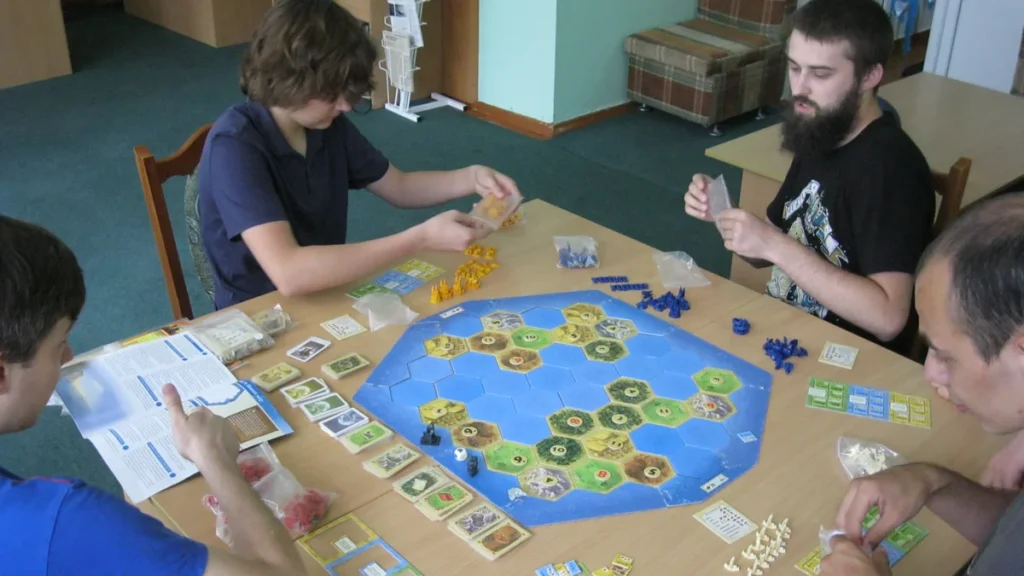
The best word games for 136 players are not games that seat 136 people around one table. No word game does that, and no single board, tile set, or scorecard is built for a crowd that large. The best word games for 136 players work because they turn one very large group into many small teams, all playing the same game at the same time, with one shared scoreboard and one clear winner at the end. When that structure is in place, 136 players stop being a logistical problem and start being the whole point of the evening.
Planning for 136 players means planning for 17 teams of eight, or 34 teams of four, rather than planning for one giant game. Each team needs its own table, its own set of tiles or cards, and its own scorecard, while the host needs a visible scoreboard, a clear rotation plan, and rounds short enough that no team waits long between turns. The games themselves stay familiar and fun; only the format changes.
This guide covers the 10 best word games for 136 players, how to set each one up for a crowd this size, what supplies you need, and how to run the whole event without confusion. Every game here scales cleanly to 17 teams of eight or 34 teams of four and keeps all 136 players involved from the first round to the final score.
Key takeaways
- No single word game seats 136 players, so the best format is many tables playing the same game at once, organised into teams.
- Split 136 players into 17 teams of eight or 34 teams of four, and give every team its own table, tiles, and scorecard.
- Choose games with short, simultaneous rounds so no team sits idle while another team plays.
- Use one visible scoreboard and one host with a microphone to keep every table on the same clock.
- Finish with a short final round between the top teams so the whole room watches one ending together.

How Word Games Work With 136 Players
A word game night for 136 players is really a tournament, even if nobody calls it that. The host runs the room, the teams play at their tables, and the scoreboard ties everything together. Once you accept that shape, almost any good word game can work for a crowd this size.
Split Into Teams First
Teams of eight work well when the game involves discussion, guessing, or building words together, because eight people can talk without shouting and everyone still gets a turn. Teams of four work better for fast tile games, where each player needs hands on the pieces. Either way, the maths is simple: 136 divided by eight is 17 teams, and 136 divided by four is 34 teams. Pick one size, stick to it for the whole night, and print the team list before anyone arrives.
Mix the teams deliberately rather than letting friends cluster together. A team with one strong speller, one fast thinker, and one confident speaker usually beats a team of four strong spellers who all want to lead. Mixing departments or tables also gets people talking to strangers, which is half the fun. For a gentler evening with friends and family, the gentler picks among our favourite word games for adults make a good warm-up round before the tournament starts.
Run Every Table on the Same Clock
The single biggest mistake at a large game night is letting tables run at their own pace. One table finishes in four minutes, another takes fifteen, and the room slowly falls apart. Fix it with a visible timer and a host who calls the start and end of every round. A large screen showing the round number and time remaining keeps everyone honest.
Short rounds are your friend. Ten to fifteen minutes per round is long enough for a real game and short enough that a slow table never holds the room hostage. Between rounds, allow two minutes for scoring and a quick stretch. With six rounds, the whole tournament takes about two hours, including a break in the middle.
One Scoreboard for the Whole Room
Every team needs to see where it stands, or the later rounds lose their tension. A large whiteboard, a projected spreadsheet, or a flip chart at the front of the room all work. Update it after every round, and read out the top five teams so the room knows who is chasing whom. Keep the scoring simple: points for words, a bonus for speed, and a small bonus for the longest word.
Appoint one scorekeeper per table if you can, and give each table a printed scorecard with the team name already filled in. Collect the cards at the end of each round rather than trusting teams to report their own scores from memory. It takes thirty seconds longer and prevents most arguments at the end of the night.
Word Games for 136 Players at a Glance
Use this table to pick the right mix for your room. Short rounds suit restless crowds, while longer rounds suit players who want to think.
| Game | Format | Teams | Round length | Best for |
|---|---|---|---|---|
| Scrabble team tournament | Team board play | 17 of 8 | 20 minutes | Serious word lovers |
| Big Boggle relay | Timed letter grids | 34 of 4 | 10 minutes | Fast, noisy energy |
| Bananagrams team race | Tile race | 34 of 4 | 10 minutes | Quick, hands-on play |
| Codenames multi-table | Team guessing | 17 of 8 | 15 minutes | Talkers and teams |
| Word chain relay | Relay race | 34 of 4 | 10 minutes | Movement and laughs |
| Giant crossword race | Shared puzzle | 17 of 8 | 15 minutes | Quiet, clever teams |
| Anagram hunt | Letter unscrambling | 34 of 4 | 10 minutes | All skill levels |
| Category word game | Timed lists | 17 of 8 | 15 minutes | Big mixed groups |
| Word bingo | Whole-room call-out | All 136 at once | 15 minutes | Warm-ups and finales |
| Taboo-style guessing | Team guessing | 17 of 8 | 15 minutes | Loud, lively rooms |
The 10 Best Word Games for 136 Players
Each game below includes the format that works for 136 players, the team size it suits best, and the supplies you need. Pick three or four for a two-hour night rather than trying to play all ten.
1. Scrabble Team Tournament
Scrabble is the classic word game, and it adapts to a crowd better than most people expect. Each team of eight shares one board, with players taking turns placing words and the whole team discussing each move. The discussion is the point: a quiet player who spots a triple-word square can win the round for a team of talkers. Give each table its own board, tile set, and score pad, and run three twenty-minute rounds with a fresh board each time.
For 136 players, you need 17 boards and 17 tile sets. Borrow sets from players, buy second-hand, or run Scrabble as one station in a rotation rather than the only game. Score tables against each other, so a team on 210 points knows it is chasing a team on 260.
2. Big Boggle Relay
Boggle is built for speed, and speed is exactly what a big room needs. Each team of four gets a letter grid and three minutes to find as many words as they can. When the timer ends, teams swap grids with the next table, so every team faces fresh letters and nobody can coast on one lucky grid. Five grids in a row makes one full round, and the whole round takes about fifteen minutes including scoring.
The relay keeps the room loud in a good way, because every table is calling out words at the same time. Use a large printed grid at each table so all four players can see the letters, and award bonus points for the longest word found.
3. Bananagrams Team Race
Bananagrams is a race to build a crossword grid from your own tiles, and a team version turns it into a sprint. Each team of four shares one pouch of tiles and builds a single grid together, calling out letters and rearranging words as new tiles arrive. The first team to use all its tiles shouts the winning word and stops the round, so every table is racing the clock and each other at the same time.
You need 34 tile pouches for 34 teams, which is the main cost, but the game itself takes almost no explaining. Keep rounds to ten minutes and play best of three. A player who is weak at spelling can still help by sorting tiles and calling out words.
4. Codenames Multi-Table
Codenames is a team word-association game where one player gives a one-word clue that links several secret words on a grid, and the team guesses which words match. With 17 teams of eight, each table plays its own game while the host runs a shared timer, and the team with the most words found after three rounds wins the table trophy. The discussion at each table is the entertainment, and the game needs almost no equipment beyond the word cards.
The clue-giver role rotates each round so everyone gets a turn at the hardest job in the game. Keep the grids identical across all tables for a fair comparison, and share the best clues of the night with the whole room.
5. Word Chain Relay
Word chain is simple: the last letter of one word becomes the first letter of the next, and the chain keeps going until the timer ends. As a relay, one player from each team runs to the front board, writes a word, and tags the next player, who runs up and adds the next link. With 34 teams of four, the relay keeps everyone moving, and the room gets louder with every round as teams cheer their runners on.
This is the best game on the list for breaking the ice, because it rewards quick thinking rather than a large vocabulary. Set a rule that no word can repeat within a round, and use a whiteboard per team if you have no space for runners.
6. Giant Crossword Race
A giant crossword race gives every team the same printed crossword and fifteen minutes to fill in as much as they can. Teams of eight are ideal here, because different players can work on different corners of the grid at the same time, and the team only needs one pencil and one shared sheet. Print the crossword large, at least A3 size, so the whole team can read the clues without crowding.
Write the clues yourself for the best results, and theme them to the event: company words for a work night, family words for a reunion, or general knowledge for a community event. Score one point per correct answer, with a bonus for a fully completed row. If you want a similar team-puzzle feeling with more drama, the cooperative energy of escape room board games is a useful model for how a group cracks a shared puzzle under time pressure.
7. Anagram Hunt
An anagram hunt hands every team a sheet of scrambled words and a ten-minute timer. Each correct unscramble earns a point, and longer words earn more, so teams have to decide whether to chase the easy points or gamble time on the big words. With 34 teams of four, you can run five short sheets in a single hour, and the scoring stays simple enough that a volunteer can tally a whole round in two minutes.
Mix the difficulty on every sheet so beginners and strong players both contribute. Put five easy words, five medium words, and two hard words on each sheet, and make the hard words worth triple points.
8. Category Word Game
The category game, in the style of Scattergories, gives every team a letter and a list of categories, then asks for one answer per category starting with that letter. Teams of eight work well because the group can argue over whether an answer counts, and the arguments are half the entertainment. The twist for a big room is that duplicate answers across tables score nothing, so teams must think of unusual answers rather than obvious ones.
Run three rounds with three different letters and a fresh category list each time. Collect the answer sheets, score them at the front table, and read out the most creative answers while the next round is set up.
9. Word Bingo
Word bingo is the only game on this list that all 136 players can play at the exact same moment, with no teams at all. Every player gets a bingo card filled with words instead of numbers, the host calls out clues or definitions, and players mark the matching word. The first player to complete a row shouts it out, and the room erupts. It works brilliantly as a warm-up before the teams form, or as a finale after the tournament ends.
Print the cards in advance and mix the word positions so no two cards are identical. Call the clues slowly and repeat each one, because a player who misses a clue cannot catch up. For a modern twist, a phone-based round using some of the best puzzle apps for adults can run alongside the paper cards. Keep the prizes small and fun.
10. Taboo-Style Guessing
Taboo-style guessing puts one player in front of their team with a word to describe, and a list of forbidden words they are not allowed to say. The team shouts guesses while the clock runs, and the describer cannot point, spell, or say any part of the word. With 17 teams of eight, every table is noisy at once, and the noise is the point: a room full of people shouting guesses is the loudest, happiest version of a word game night.
Rotate the describer every round so the confident players do not take over. Keep rounds to three minutes so the energy stays high, and subtract a point every time the describer says a forbidden word. It is the best closing game on this list, because it ends the night with laughter.
Your 136-Player Word Game Checklist
Run through this list the day before the event, and again on the morning of the event, so nothing is left to the last minute.
- Teams are set: 17 teams of eight or 34 teams of four, with a printed team list by the door.
- Every table has a full game set, a scorecard, pens, and a visible table number.
- The timer, microphone, and scoreboard are tested and working before players arrive.
- The host has a printed running order with round times, break times, and the finale plan.
- Scorecards are collected after every round and totals are posted before the next round.
- The finale is ready: a short final round between the top teams, watched by the whole room.
Frequently Asked Questions
Can one word game really seat 136 players?
No, and any event that promises one game for 136 people at a single table is not being honest. The games on this list work for 136 players because the group is split into teams, every team plays at the same time, and one scoreboard brings the results together. The format does the heavy lifting, not the game itself.
Is 17 teams of eight better than 34 teams of four?
Teams of eight suit discussion games like Codenames, crosswords, and category games, where more voices make the game better. Teams of four suit fast tile games like Boggle and Bananagrams, where every player needs to touch the pieces. If you are running a mix of games, pick teams of eight, because they handle the widest range of games without rearranging the room.
How many copies of each game do we need?
One copy per table, so 17 copies for teams of eight or 34 copies for teams of four. That is the biggest cost of a large game night, and it is worth borrowing sets from players or buying second-hand. If copies are scarce, rotate games between tables so each game only needs a few copies, or choose games that need only printed sheets, like anagrams, crosswords, and the category game.
How long should a 136-player word game night last?
About two to two and a half hours, including arrival time, a break, and a finale. Six rounds of ten to fifteen minutes each is the right amount of play, and anything longer starts to lose the room. Short rounds with a visible timer keep the pace up, and a break in the middle gives teams time to talk, eat, and reset.
What if some players are much stronger at word games than others?
Mix the teams so strong players are spread evenly, and choose games that reward different skills. Anagram hunts reward pattern spotting, word bingo rewards listening, relays reward speed, and guessing games reward confidence. A team with one strong speller and three quick, loud guessers will often beat a team of four strong spellers who cannot agree on an answer.
Do we need a host, or can the teams run themselves?
You need a host. With 136 players, nobody can hear the rules unless one person with a microphone calls the start and end of every round, reads the scores, and keeps the room on schedule. The host does not need to be an expert at word games, but they do need a loud voice, a printed running order, and the confidence to make a quick ruling and move on.
The Bottom Line
The best word games for 136 players are the ones that let every player contribute, keep every table on the same clock, and end with a finale the whole room watches together. Split the crowd into 17 teams of eight or 34 teams of four, pick three or four games from this list, and run short rounds with one visible scoreboard. Do that, and 136 players will feel like a party, not a problem.