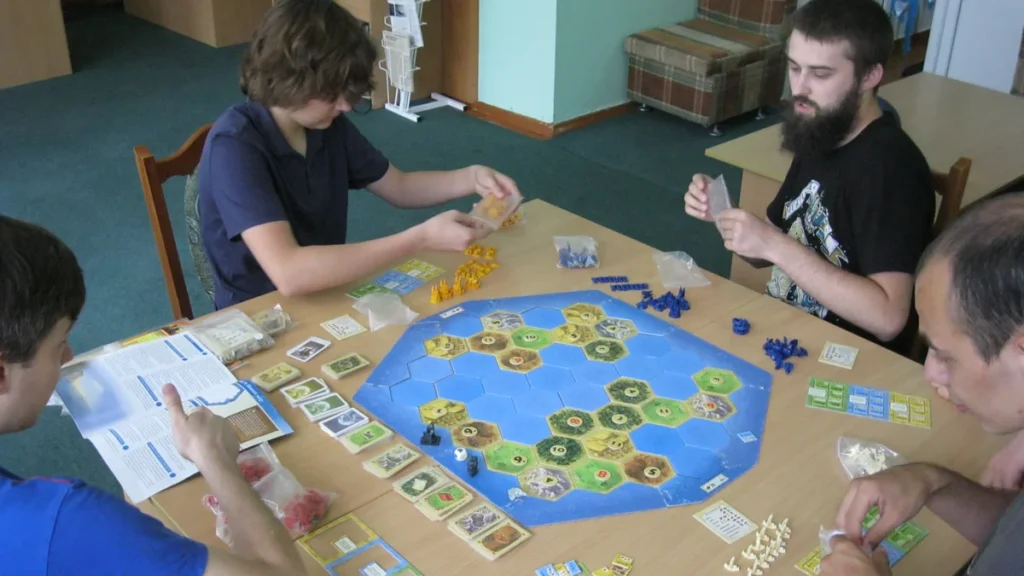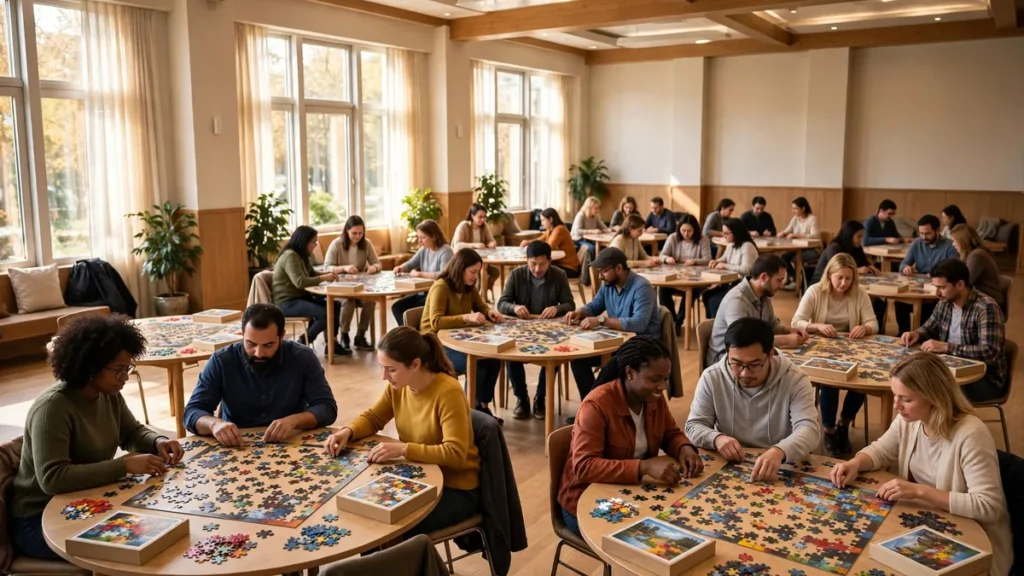
Finding the best puzzle games for 135 players starts with an honest fact: no single puzzle game is designed to seat 135 people around one table at the same time. A jigsaw puzzle, a logic game, or an escape room board game works best with a small group, and that limit is part of what makes puzzle play satisfying. The trick for a group of 135 is not to force everyone into one game, but to run the same puzzle experience across many teams, tables, and rounds at once.
When puzzle games for 135 players are planned well, the whole room still feels like one event. Teams of five or six work on identical puzzles at separate tables, a host runs the same clues for everyone, and a shared scoreboard turns dozens of small games into one clear contest. The room stays noisy in a good way, nobody waits long for a turn, and every player has pieces, clues, or decisions in front of them.
This guide covers the formats that actually work at this scale, the specific puzzle games that suit them, and a practical plan for running the day. It is written for a school event, a company gathering, a community night, or a large family reunion where 135 people need to play together, not just watch a few people play.
Key takeaways
- No single puzzle game seats 135 players, so split the group into teams of five or six and run identical puzzles in parallel.
- Use one puzzle format per round, the same materials at every table, and a visible timer so every team plays under the same conditions.
- Jigsaw races, puzzle hunts, escape room challenges, logic puzzles, and digital puzzle rounds cover the widest range of ages and abilities.
- Score by completed puzzles, correct answers, and time, and keep the scoreboard simple enough for everyone in the room to follow.
- Plan the room first: enough tables, clear walkways, spare puzzle sets, and a host who can explain each round in under two minutes.

The Honest Starting Point for 135 Players
A puzzle game is at its best when every player can reach the pieces, read the clues, and talk to the rest of the team without shouting. That is why most puzzle games are built for two to six players. At 135 players, the game itself does not change, but the organisation around it has to. The event becomes a set of parallel games with a shared start, shared rules, and shared scoring.
This approach also solves the biggest problem with large groups: waiting. If 135 people share one puzzle, most of them are watching. If they are split into 27 teams of five, or 23 teams of six with a few smaller teams, everyone is playing from the first minute. The exact split depends on the room and the puzzle, but teams of five or six are the sweet spot for puzzle work, because the group is large enough to share ideas and small enough that nobody disappears into the crowd.
How to Split 135 Players Into Puzzle Teams
Start by deciding the team size before choosing the puzzles. Five players per team gives 27 teams, which is easy to score and easy to seat. Six players per team gives 22 teams of six and one team of three, which is less tidy but works when tables seat six. Either way, keep the teams as even as possible so no team has a clear advantage from numbers alone.
Give every team a number, a table, and a captain. The captain collects the puzzle, checks the pieces, and reports the finish time to the scorekeeper. That one role removes most of the confusion in a large room, because the host only needs to talk to 27 captains instead of 135 players.
Tables, Space, and Materials
Each team needs a table large enough for its puzzle, plus space for clue cards, answer sheets, and drinks. A standard six-seat table works for a 500-piece jigsaw or a spread of puzzle cards. Leave a clear walkway between tables so the host and the scorekeeper can move without disturbing a team that is deep in a puzzle.
Buy or borrow identical puzzle sets. If one team gets an easier jigsaw than another, the results mean nothing, and the losing teams will notice. Order the same puzzle for every table, and keep two spare sets in case a box is short on pieces or a table damages a card. Count the pieces in advance when you can, and keep a lost-piece box at the host table.
Rotation and Rounds
Run the event in rounds of 20 to 30 minutes. Three or four rounds fill an afternoon without exhausting anyone, and each round can use a different puzzle format. A team that is slow at jigsaws may be fast at logic puzzles, so changing the format keeps the contest open until the last round.
Do not move teams between tables if you can avoid it. Moving 135 people takes ten minutes and breaks concentration. Instead, move the puzzles: the host team collects one set and hands out the next while teams stay seated. If a round needs teams to move, such as a puzzle hunt around the building, run it as a single round and keep the other rounds seated.
Best Puzzle Games for 135 Players
The games below are chosen because they scale. Each one works as a parallel game, with every team playing the same puzzle at the same time, and each one rewards a different kind of thinking. Use three or four of them across your rounds, and keep the rules for each round on one printed sheet per table.
| Puzzle format | Best for | Round length | What each team needs |
|---|---|---|---|
| Jigsaw race | Teamwork and patience | 25 minutes | One identical 500-piece puzzle |
| Puzzle hunt | Movement and clues | 30 minutes | Clue sheets and a route map |
| Escape room challenge | Logic under pressure | 25 minutes | Lock box, clues, and a timer |
| Logic and riddle round | Thinking and wordplay | 20 minutes | Printed puzzle sheets |
| Digital puzzle round | Speed and variety | 20 minutes | One phone or tablet per team |
Jigsaw Races
A jigsaw race is the simplest large-group puzzle format and one of the most reliable. Every team gets the same 500-piece puzzle, the host starts the timer, and the first team to finish wins the round. A 500-piece puzzle suits a 25-minute round for a team of five or six, while a 1,000-piece puzzle is better for a longer session or a team that already puzzles together.
Choose a puzzle picture with clear colour blocks and distinct areas, such as a landscape, a city scene, or a bright pattern. A picture that is mostly sky or mostly one colour will frustrate teams and slow the round for no good reason. Sort the edge pieces first, then work by colour, and let each player own one section of the picture so the team is not reaching over the same pieces.
Score a jigsaw round by finished puzzles first, then by the number of pieces placed when time runs out. Count the placed pieces quickly by comparing each board with the box picture, or ask teams to count their own remaining pieces and report the number. Honest counting matters, so have a scorekeeper spot-check two or three tables each round.
Puzzle Hunts
A puzzle hunt turns the whole venue into the game. Each team gets a set of clues, and each clue leads to a location, an object, or a person in the building. At each stop, the team solves a short puzzle to earn the next clue. The hunt works for 135 players because teams spread out, so no single spot gets crowded.
Design the hunt with at least eight stops and two different routes, so teams are not all following each other. Stagger the starts by two minutes per team, and use clues that need observation rather than running: a number hidden in a display, a word formed from letters on a noticeboard, or a riddle whose answer is a room name. Keep every stop indoors or in one safe outdoor area, and brief the teams on the boundaries before they set off.
Finish the hunt in one room, where the final puzzle brings all the collected answers together. A short final puzzle, such as a code word formed from the first letters of each answer, gives the hunt a clear ending and lets the host announce the results while everyone is back in the same space.
Escape Room Challenges
Escape room play scales well when each team gets the same tabletop challenge. A lock box with a three-digit code, a set of clue cards, and a short story is enough: the team solves the clues, finds the code, and opens the box before the timer ends. The format creates the same pressure as a real escape room, without needing 27 separate rooms.
Build the challenge from four or five linked clues. The first clue should be easy, so every team gets a quick win and understands the pattern. The middle clues should need two players working together, such as one reading a code while another checks a chart. The final clue should bring the earlier answers together, so a team that rushes ahead still has to go back and use what it found.
If your group enjoys this format, look at escape room board games for ready-made versions that work at a table. Many of them include the story, the clues, and the timer in the box, which saves the organiser from building a challenge from scratch. Choose one game and buy the same version for every table, so the contest stays fair.
Logic and Riddle Rounds
A logic and riddle round is the cheapest format to run and one of the easiest to score. Each team gets a printed sheet with ten puzzles: a mix of logic grids, number puzzles, word puzzles, and short riddles. Teams work through the sheet together, write their answers on one answer card, and hand it in when time ends. The host reads the answers aloud, and teams mark their own sheets.
Mix easy, medium, and hard puzzles on every sheet. Three easy puzzles give every team a good start, five medium puzzles decide most of the round, and two hard puzzles separate the top teams. Avoid puzzles that depend on one person knowing a single fact, and avoid puzzles with more than one reasonable answer, because arguments about the answer will slow the scoring. Teams that enjoy the wordplay side of the round can warm up with word games for adults before the event.
Digital Puzzle Rounds
A digital round uses one phone or tablet per team, with every team playing the same puzzle app or web puzzle at the same time. The format suits a venue with good Wi-Fi, and it adds variety after two seated rounds. Choose a puzzle that works offline if the venue connection is uncertain, and test it on the exact device the teams will use.
Pick puzzles with clear levels and a visible score, such as a timed word puzzle, a picture puzzle, or a logic game with ten levels. Avoid games with adverts between levels, because adverts waste the round and distract teams. Set the round to 20 minutes, and ask teams to record their level or score on the answer card when time ends.
For ideas that work on a phone, the range of puzzle apps for adults is a useful starting point, because those apps are built for solo play and adapt well to a team taking turns. Let one player hold the device and the rest of the team call out answers, and rotate the holder every five minutes so everyone gets a turn.
Running a Puzzle Tournament for 135 Players
A tournament format gives the day a shape. Three rounds of different puzzle types, plus a short final for the top teams, fill about two hours including breaks. The final can be a single puzzle that the top six teams solve on a stage or at front tables while the rest of the room watches and plays along on a printed copy.
Keep the points simple. Award 10 points for first place in a round, 8 for second, 6 for third, and then 5, 4, 3, 2, and 1 for the next places, with every other team earning 1 point for finishing the round. A team that wins one round and finishes mid-table in the others can still win the day, which keeps the contest open and the room interested.
Scoring, Fairness, and Tie-Breaks
Fairness is the part of a large puzzle event that organisers most often underestimate. With 27 teams, a small advantage in materials, time, or instructions can decide a round, so the host should check the same things at every table. Start every round with the same words, start the timer only when every team has its materials, and end the round with the same call.
Decide the tie-break before the event, not after a tie happens. A good tie-break is a single puzzle that the tied teams solve head to head, or the fastest time in the jigsaw round, or the highest score in the logic round. Write the tie-break on the team sheet so every captain knows it in advance, and use the same tie-break for every round.
Planning the Room, the Time, and the Budget
Book a room that seats 135 people at tables, not in rows. A community hall, a school hall, or a large function room works well, and a room with a stage or a raised area helps the host be seen. Visit the room before the event, count the tables and chairs, and check the lighting over each table, because a puzzle is hard to solve in a dim corner.
Plan the timetable with breaks built in. A two-hour event might run as a ten-minute welcome, a 25-minute jigsaw round, a ten-minute break, a 25-minute escape room round, a ten-minute break, a 20-minute logic round, and a fifteen-minute final and prize-giving. Teams need time to stretch, talk, and reset, and the host needs time to collect one set of materials and hand out the next.
Checklist for Puzzle Games for 135 Players
Use this checklist in the week before the event, and tick each item off as it is done. It covers the decisions that cause the most trouble on the day, and it is short enough to run through in one planning meeting.
- Teams are set at five or six players, with a named captain and a table number for every team.
- Identical puzzle sets are ordered for every table, plus two spare sets for damaged or incomplete boxes.
- The room is booked with enough tables and chairs, clear walkways, and a microphone and visible timer for the host.
- Each round has a printed rules sheet, an answer card, and a tie-break rule that every captain knows in advance.
- The scoreboard and score sheet are ready, with a scorekeeper and a second person to check the totals.
- Breaks, refreshments, and prizes are planned, and the final round has a clear ending for the whole room.
Frequently Asked Questions
Can one puzzle game really seat 135 players?
No. No single puzzle game is built for 135 players at one table. The working answer is to split the group into teams of five or six, give every team the same puzzle, and run the game in parallel with a shared timer and a shared scoreboard.
How many teams will 135 players make?
At five players per team, 135 players make 27 teams. At six players per team, they make 22 teams of six and one team of three, so most organisers choose five per team for a tidy split, or add a few helpers to fill the smaller team.
What is the best puzzle format for a large group?
A jigsaw race is the best starting format, because it is easy to explain, easy to score, and every team plays at the same time. Add a logic round and an escape room round to cover different skills, and keep each round to 20 or 30 minutes.
How long should a puzzle event for 135 players last?
Two hours is a good length for three rounds plus a final and prize-giving. Shorter events feel rushed at this size, and longer events tire players who are concentrating hard. Build in two short breaks, and keep the welcome under ten minutes.
What if some players have never solved puzzles before?
Mix the teams so every team has at least one confident puzzler, start each round with an easy first step, and choose puzzles with clear pictures and plain wording. A team that finishes its first puzzle, even a small one, will play the next round with far more confidence.
Do we need a prize for every team?
No. A prize for the winning team and a smaller prize for the runners-up is enough, and a certificate or a puzzle book for every team is a kind gesture rather than a requirement. The shared experience is the main reward, so spend the budget on good puzzles first.
The Bottom Line
The best puzzle games for 135 players are not one giant game, but a well-run set of parallel games: teams of five or six, identical puzzles at every table, rounds of 20 to 30 minutes, and a simple scoreboard that everyone can follow. Choose a jigsaw race, a puzzle hunt, an escape room challenge, and a logic round, and you will have an event where all 135 players are solving, not watching. Plan the room, test the puzzles, and brief the captains, and the size of the group becomes the best part of the day.