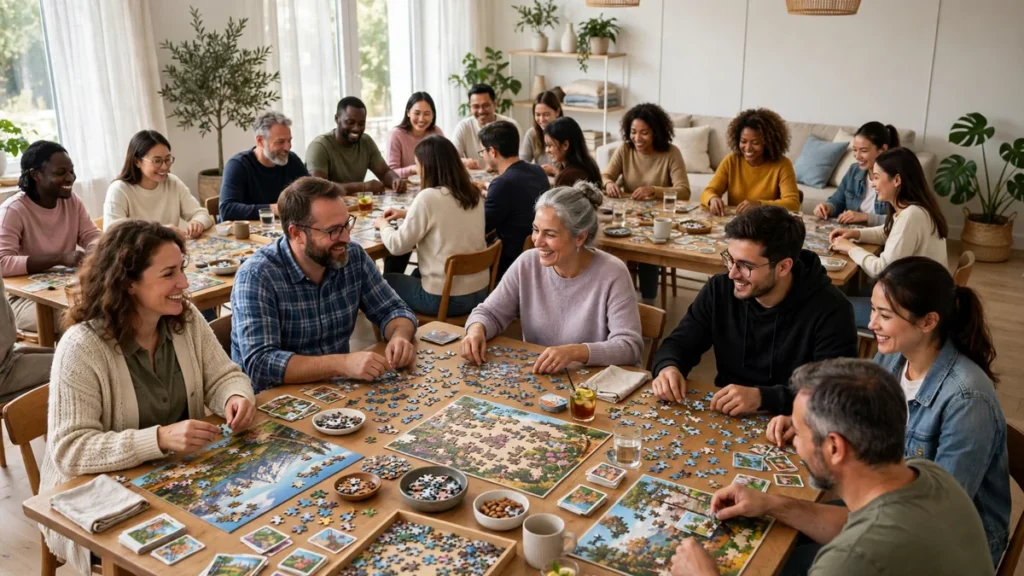
Finding the best dice games for 64 players is a different challenge from picking a game for four. With 64 people in the room, nobody can sit around one table and wait for a single turn to come back to them. The best dice games for 64 players solve that problem by splitting the crowd into tables, teams, or simultaneous rounds, so everyone is rolling, scoring, or cheering at the same time.
A group of 64 usually means a school event, a company party, a church social, a reunion, or a community fundraiser. The players will range from children to grandparents, and most will not know the rules before they arrive. That is why the strongest choices here use ordinary six-sided dice, rules explained in under two minutes, and scoring anyone can follow on a simple sheet.
This guide ranks the games that scale to 64 players, explains how to run each one, and gives you the practical details: how many dice and score sheets you need and how long a round takes.
Key takeaways
- Split 64 players into 8 tables of 8 or 16 teams of 4 so everyone rolls at the same time instead of waiting in one long line.
- Bunco, Farkle, and Yahtzee-style tournaments are the most reliable choices because their rules are simple and their scoring is easy to track.
- Plan on at least 5 dice per player, plus printed score sheets, pencils, and a visible leaderboard for the whole room.
- Keep rounds short, around 15 to 20 minutes, and rotate players between tables so everyone meets new opponents.
- Choose games with no elimination in the early rounds so all 64 players stay involved until the final.

How Dice Games Work With 64 Players
The first decision is the format, and it matters more than which game you pick. A single table cannot hold 64 players, so every successful large-group dice night uses parallel tables, team play, or a station rotation. Parallel tables are the simplest option. Set up eight tables with eight players each, run the same game at every table, and compare scores across the room at the end of each round.
Team play works well with limited tables or mixed ages: divide the 64 players into 16 teams of four, give each team one set of dice and one score sheet, and let teammates take turns rolling while the rest advise and keep score. Station rotation is the liveliest format: set up four or five games at different stations, give each group 15 minutes per station, and rotate everyone through, collecting points at every stop.
What You Need for 64 Players
Count your supplies carefully before the night begins: a shortfall of dice or score sheets mid-round will stall eight tables at once. For most games here, plan on five dice per player, about 320 for the full group, although shared sets at each table reduce that number. Buy dice in bulk bags, and choose a mix of colours so each table can tell its dice apart.
You will also need printed score sheets, one per player per round plus spares, and pencils rather than pens, because scores change and mistakes happen. A large whiteboard or projected spreadsheet makes the leaderboard visible to the whole room, and a bell or whistle signals the end of a round. Assign one host per two tables so questions are answered quickly.
Best Dice Games for 64 Players Compared
| Game | Players per table | Round length | Difficulty | Best for |
|---|---|---|---|---|
| Bunco | 4 | 15 minutes | Very easy | Large social events |
| Farkle | 4 to 6 | 20 minutes | Easy | Risk and reward play |
| Yahtzee tournament | 4 to 6 | 20 minutes | Easy | Classic family play |
| Liar’s Dice | 5 to 10 | 15 minutes | Easy | Bluffing and laughs |
| Ten Thousand | 4 to 8 | 20 minutes | Easy | Push-your-luck scoring |
| Dice Bingo | 8 to 16 | 15 minutes | Very easy | Mixed ages |
| Left Center Right | 6 to 12 | 15 minutes | Very easy | Fast party rounds |
| Pig relay | 4 | 10 minutes | Very easy | Young children |
| Qwixx | 2 to 5 | 20 minutes | Easy | Quick thinking |
| Ship, Captain, Crew | 4 to 8 | 10 minutes | Very easy | Short filler rounds |
The 10 Best Dice Games for 64 Players
1. Bunco
Bunco is the classic large-group dice game, practically designed for a room of 64 players. Each table seats four players in two partnerships, and every table plays the same target number at the same time. When a table finishes its round, the winners move up and the losers move down, so players constantly meet new partners and opponents.
The rules are simple. Players roll three dice and try to match the target number for the round, scoring one point per matching die and five points for three of a kind. A Bunco, three dice showing the target number, scores 21 points and ends the round at that table with a ring of the bell. For 64 players, set up 16 tables of four, with three dice per player, a bell at the head table, and a score sheet each. A full game of six rounds takes about 90 minutes.
2. Farkle
Farkle is a push-your-luck game that creates real tension at every table. On a turn, a player rolls six dice and sets aside scoring dice, then decides whether to bank the points or roll the remaining dice again for more. Rolling with no scoring dice is a Farkle, and the player loses all the points from that turn.
With 64 players, run Farkle as a parallel tournament at tables of four to six. Each table plays to 10,000 points, which takes about 20 minutes, and the table winners advance to a final. Keep a printed scoring card at every seat: ones are worth 100, fives are worth 50, three of a kind is worth 100 times the face value, and a straight or three pairs earns a bonus.
3. Yahtzee Tournament
A Yahtzee tournament is the safest pick on this list, because almost everyone will already know the game or learn it in one round. Each player rolls five dice up to three times per turn, trying to fill thirteen categories on the score sheet, from ones through sixes, three of a kind, a full house, straights, and the famous Yahtzee of five matching dice.
For 64 players, run Yahtzee at tables of four to six, each playing a full game of about 20 to 30 minutes. Table winners advance to a semi-final, and the semi-final winners meet at a final table. For a shorter event, play a half game with seven categories, which takes about 15 minutes. A similar large-group format works well in the best dice games for 63 players guide, which uses the same table-based tournament structure.
4. Liar’s Dice
Liar’s Dice is the loudest and funniest game on this list, and the best choice when your main goal is laughter rather than careful scoring. Each player starts with five dice hidden under a cup, looks at them in secret, and bids on how many dice of a certain value are showing across the whole table. The next player must raise the bid or call the previous player a liar, and then everyone reveals their dice.
At tables of five to ten players, a game takes about 15 minutes, and the bluffing is the whole point. The game needs almost no equipment, five dice and a cup per player, which makes it easy to run at eight tables at once. For 64 players, run short rounds rather than one long game, with each table winner advancing and the losers joining a new table. It is also an excellent icebreaker, because it forces players to talk and joke from the very first roll.
5. Ten Thousand
Ten Thousand, also known as Zilch, is a close cousin of Farkle, with slightly richer scoring and longer rounds. Players roll six dice and score for ones, fives, three of a kind, straights, and pairs, banking points when they stop or risking them by rolling again. The target of 10,000 points gives the game a clear finish line.
The game suits tables of four to eight players, so eight tables hold the full group of 64 comfortably. A game to 10,000 points takes about 20 minutes, and the scoring is simple enough for children aged ten and up to follow with a printed reference card. It is a good middle-of-the-evening game, best played after the group has warmed up with something simpler.
6. Dice Bingo
Dice Bingo is the easiest game on this list to explain, and the best choice when your 64 players include very young children or adults who have never played a dice game before. Each player gets a bingo card, the host rolls two dice and calls out the total, and players mark the matching number. The first to complete a row, a column, or a full card calls out Bingo and wins.
Dice Bingo needs no tables at all. All 64 players can sit in rows facing the host, each with a card and a marker, and everyone plays at the same time. A round takes about 10 to 15 minutes, and you can play five or six rounds in an hour with different winning patterns: a straight line, four corners, an X shape, or a full card. Print the cards in advance in several layouts so no two players share the same card.
7. Left Center Right
Left Center Right, usually just called LCR, is a fast party game using three special dice marked with L, C, R, and dots. Each player starts with three chips, rolls, and passes chips left, centre, or right according to the dice. Players with no chips are out until someone rolls in their direction, and the last player holding chips wins the pot. A round takes 10 to 15 minutes and the rules take thirty seconds to explain.
With 64 players, run LCR at tables of six to twelve, with each table playing its own game and the table winners meeting for a final. The game uses tokens or chips instead of points, which gives the evening variety. LCR is at its best as a short, high-energy game between longer ones: too simple to carry a whole evening, but perfect for a ten-minute burst of laughter after a serious round of Yahtzee or Farkle.
8. Pig Relay
Pig is the simplest dice game ever made, and the relay version turns it into a team race for 64 players. A player rolls one die and adds the result to their turn total, but rolling a one wipes out the turn total and ends the turn. The first to reach 100 points wins. The relay version splits the room into teams of four, and teammates take turns rolling, adding their scores to a shared team total.
Each team of four plays its own race to 100 points, and the fastest teams advance to a semi-final. A single game takes about 10 minutes, so you can run three or four rounds in under an hour, and the game is simple enough for children as young as six to play without help. All you need is one die per team and a score sheet, which makes Pig the cheapest game on this list to run. The same team relay idea also works for the party formats in the best party games for 62 players guide, where teams rotate through short, fast rounds.
9. Qwixx
Qwixx is a modern roll-and-write game that has become a favourite for large groups because everyone plays on every turn. Two dice are rolled in the middle of the table, and every player may use the total, while the active player may also combine one white die with one coloured die. Players cross off numbers on their own score sheet, trying to complete rows from left to right, and the game ends when two rows are locked or four penalty boxes are filled.
Qwixx scales so well because there is no waiting. In most dice games, you watch while other players take their turns, but in Qwixx you make a decision on every single roll. That constant involvement keeps all 64 players focused. A game takes about 20 minutes, and the score sheets are small and easy to print in bulk. If table space is limited, play in the team format, with each team of four sharing one score sheet.
10. Ship, Captain, Crew
Ship, Captain, Crew is a quick game of five dice that makes a perfect filler between longer games. Players roll all five dice up to three times, trying to roll a six for the ship, a five for the captain, and a four for the crew, in that order. Once all three are secured, the remaining two dice are added together for the player’s score, and the highest score wins the round.
A round takes about 10 minutes, needs only five dice per table, and is easy enough to learn in a single demonstration. For 64 players, run it at tables of four to eight, with each table winner advancing to a final. It is also a useful backup game: if a table finishes a long game early, the host can start a round to fill the gap while the other tables catch up.
How to Run a 64-Player Dice Night
Good hosting matters as much as good games. Start with a short welcome that explains the format, the rotation, and the prizes, kept under five minutes so people start playing quickly. Demonstrate the first game at the front of the room with a large set of dice, so everyone can see the rules in action.
Keep rounds to 15 or 20 minutes and use a bell or timer everyone can hear to signal the end. When the bell rings, stop play immediately, because fairness across tables depends on everyone playing for the same amount of time. Collect the score sheets, update the leaderboard, and announce the top three scores before the next round begins. Plan small prizes for the overall winner, the best team, and the most Buncos, and end the evening with a final round that brings the table winners together while the whole room watches.
64-Player Dice Night Checklist
- Count the dice: at least five per player, sorted by colour, with spares for lost dice.
- Print score sheets for every game, one per player per round, plus at least 20 spare sheets.
- Set up eight to sixteen tables with clear numbers, chairs for 64 players, and a host for every two tables.
- Prepare a visible leaderboard on a whiteboard or a projected screen and update it after every round.
- Bring a bell, a timer, pencils, and printed rules cards for each table so questions are answered fast.
- Plan small prizes for the overall winner, the best team, and fun awards like the most Buncos.
Frequently Asked Questions
Can 64 players really play dice games together?
Yes, as long as you split the group into tables or teams. Eight tables of eight players, or sixteen teams of four, let everyone play at the same time. Parallel tables, team play, and station rotation are the three formats that make it work, and all the games on this list suit at least one of them.
How many dice do I need for 64 players?
Plan on about five dice per player, roughly 320 dice for the full group, although shared sets at each table reduce the number you actually need. Bunco uses three dice per player, Farkle and Ten Thousand use six dice per table, and Liar’s Dice uses five dice per player. Buying dice in bulk bags is far cheaper than buying small packs.
What is the best dice game for a mixed-age group of 64?
Bunco is the best choice for a mixed-age group, because its rules take one minute to explain and it keeps players moving between tables. Dice Bingo is best if the group includes very young children, and Yahtzee is best if many adults already know the game. For a wide age range, start with Dice Bingo, then move to Bunco.
How long does a 64-player dice night take?
A full evening takes about two to three hours, including the welcome, four to six rounds, and the final. Each round lasts 15 to 20 minutes, with five minutes between rounds for score collection and rotation. A shorter event of 90 minutes works well with three rounds and one final.
Do I need to buy special dice for these games?
No. Almost every game on this list uses ordinary six-sided dice, which are cheap and easy to buy in bulk. The only exception is Left Center Right, which uses three special dice marked L, C, and R, but a set costs very little and can be reused for years. Everything else on this list works with the standard dice you can find in any toy shop or online.
What if some players have never played a dice game before?
Start with the simplest games, demonstrate the first round at the front of the room, and place experienced players at every table to help newcomers. Printed rules cards at each table answer most questions, and team formats let beginners contribute without playing alone. Most players learn Bunco, Dice Bingo, or Pig within a single round. If your group is close in size to this one, the best dice games for 62 players guide uses the same beginner-friendly approach for a slightly smaller crowd.
The Bottom Line
The best dice games for 64 players keep everyone rolling at the same time, and Bunco, Farkle, and Yahtzee lead this list because they combine simple rules with real excitement. Split the room into tables or teams, keep rounds short, use a visible leaderboard, and start with the easiest game so every player builds confidence. With enough dice, printed score sheets, and a clear rotation plan, 64 players can share one lively, memorable dice night.