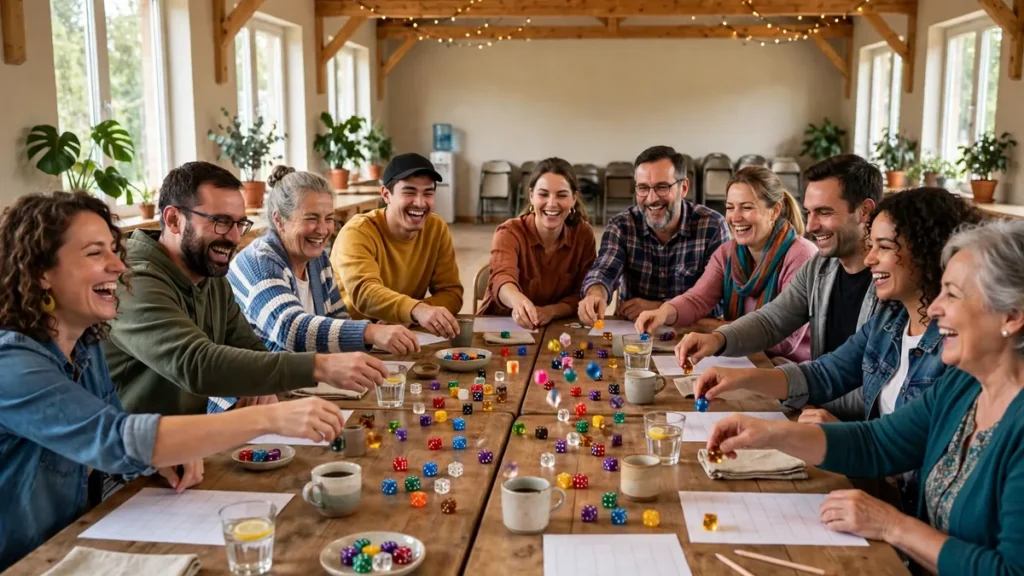
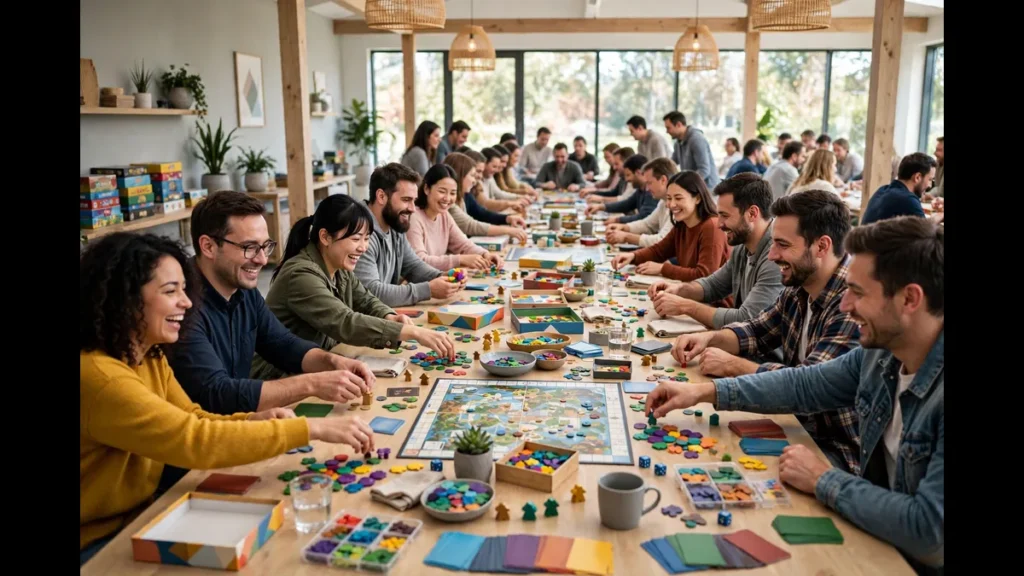
Finding the best puzzle games for 46 players sounds like a logistical headache, but it is actually one of the most rewarding ways to run a large group event. Forty-six people is too many for a single board game and too few to disappear into a crowd, which makes it the perfect size for team-based puzzle play. Split into squads of five or six, every player gets a real job to do, every team can compete head to head, and the room fills with the kind of focused, noisy energy that only a good puzzle can create.
The trick is choosing games that scale. A single 1,000-piece jigsaw will not engage 46 people, but eight jigsaws running at once will. A lone crossword is a quiet solo activity, yet a crossword relay with teams racing the clock becomes a spectator sport. The best puzzle games for 46 players share three qualities: they divide cleanly into parallel teams, they give every player something to contribute, and they produce a clear winner without leaving anyone idle for long.
This guide covers the formats that actually work at this scale, from giant jigsaw races and puzzle hunts to escape-room style challenges and logic puzzle stations. You will find a comparison table to help you pick the right format for your time, space and budget, a six-point checklist for running the night smoothly, and answers to the questions organisers ask most often. Whether you are planning a corporate team day, a school event, a family reunion or a community game night, these are the puzzle games that keep 46 players engaged from the first clue to the final reveal.
Key takeaways
- Split 46 players into eight teams of five or six so every player has a real role and no one waits around.
- Giant jigsaw races, puzzle hunts and escape-room style challenges scale best because teams play in parallel.
- Rotate teams through puzzle stations every 15 to 20 minutes to keep energy high and prevent bottlenecks.
- Use a simple points system with bonus points for speed, accuracy and teamwork so every round matters.
- Plan one puzzle per team plus a shared finale, and test every puzzle yourself before the event starts.

Why Puzzle Games Work So Well for 46 Players
Puzzle games suit large groups because they reward different kinds of thinking at the same time. In a 46-player event, you will have visual thinkers, word lovers, logic fans and pattern spotters in the same room. A well-chosen puzzle night gives each of them a moment to shine, and teams that mix these strengths usually beat teams built around a single skill. That variety is what makes puzzle games fairer and more fun than trivia nights, where the same two or three know-it-alls tend to dominate every round.
Puzzles also keep the noise and movement at a comfortable level. Forty-six people playing a shouting party game can overwhelm a hall, while 46 people hunched over puzzles create a focused buzz that still feels social. Players talk, point, trade pieces and argue good-naturedly over clues, but the room never becomes chaotic. That makes puzzle games a strong choice for venues with neighbours, mixed age groups, or players who prefer thinking to performing.
Finally, puzzle games are easy to scale up or down. If two players drop out at the last minute, you simply rebalance the teams. If the event runs long, you can drop a station. If it runs short, you can add a bonus round. Few other game formats give an organiser that much flexibility on the day itself.
How to Organise 46 Players Into Puzzle Teams
Good organisation matters more than the puzzles themselves. Eight teams of five or six players is the sweet spot for 46 people: teams are small enough that everyone participates, large enough to split tasks, and numerous enough to make the competition feel real. Avoid teams of ten or more, because quieter players will drift to the edges and stop contributing.
Mix the Teams Deliberately
Do not let friends cluster into a single super-team. Mix ages, experience levels and puzzle strengths so every team has a word person, a visual person and a logic person. If you know your players, seed each team with at least one confident puzzle solver and one newcomer. Mixed teams also spark better conversation, which is half the point of a group puzzle night.
Use Stations, Not a Single Table
Set up six to eight puzzle stations around the room and rotate teams through them every 15 to 20 minutes. Stations stop the faster teams from finishing early and sitting bored, and they stop slower teams from feeling stuck on one puzzle for an hour. Each station should hold a different puzzle type so teams face a fresh challenge at every stop.
Keep Score Simple and Visible
Give each station a maximum score and award bonus points for finishing early or solving without hints. Put the leaderboard on a whiteboard or a projected screen where everyone can see it. Visible scores keep the competitive tension alive between rotations and give trailing teams a clear target to chase.
The Best Puzzle Games for 46 Players
These formats have all been tested with groups of this size. They work indoors or outdoors, with modest budgets, and with players of mixed ages and abilities.
1. Giant Jigsaw Race
Give each team the same 500-piece jigsaw and race to finish first. With eight teams, you need eight identical puzzles, which sounds expensive until you realise you can buy them in bulk or borrow from a puzzle library. The race format turns a quiet hobby into a thrilling contest, and the shared image gives every team the same fair challenge. For extra drama, hide one piece from each box and make teams earn it by answering a riddle. If your group enjoys the competitive side of tabletop play, the best board games for 45 players offer more ideas for large-group tabletop contests.
2. Puzzle Hunt and Scavenger Race
A puzzle hunt sends teams around a venue or neighbourhood solving a chain of clues, each answer leading to the next location. For 46 players, design eight parallel clue chains with different starting points so teams do not bunch up behind each other. Include a mix of word puzzles, number puzzles, visual riddles and physical challenges, and finish with a shared final puzzle that all teams solve together in the main hall. Puzzle hunts are the best choice when you have outdoor space or a large building to explore.
3. Escape Room Style Team Challenge
Recreate an escape room by giving each team a locked box, a set of clues and a 45-minute countdown. Teams must solve logic puzzles, crack codes and find hidden keys to open their box before time runs out. You can run all eight teams in the same room with identical boxes, which keeps costs low and makes the event easy to supervise. This format works brilliantly for corporate team days because it forces communication, delegation and calm thinking under pressure.
4. Logic Puzzle Relay
In a logic puzzle relay, each team member solves one puzzle before tagging the next player, like a running relay with brains instead of legs. Mix Sudoku grids, logic grid puzzles, nonograms and pattern sequences so different players face different challenges. The relay format is ideal when your 46 players have mixed abilities, because a team can place its strongest logic solver on the hardest leg and its fastest starter on the opening leg.
5. Crossword and Word Puzzle Tournament
Print a large crossword for each team and race to complete it, with bonus points for finishing without hints. Add a word search, an anagram challenge and a cryptic clue round to keep the word lovers happy. Word puzzles are cheap to prepare, easy to score, and work well as a quieter station between more physical rounds. The format also scales beautifully: the same crossword works for a team of five or a team of six without any adjustment.
6. Tangram and Spatial Puzzle Stations
Tangrams, pentominoes, tower puzzles and 3D brain teasers make excellent hands-on stations. Players who struggle with words often excel at spatial puzzles, so these stations balance the competition and give visual thinkers their moment. Buy a set of wooden tangram tiles for each station and challenge teams to complete a series of silhouette cards against the clock. The tactile, fiddly nature of these puzzles also makes them a hit with younger players.
7. Murder Mystery Puzzle Night
Combine a puzzle hunt with a murder mystery by giving each team a case file full of coded messages, suspect statements and hidden clues. Teams must identify the culprit, the weapon and the motive before the final reveal. With 46 players, assign each team a different suspect to investigate and let them trade information between teams, which creates a lively market of clues and theories. This format suits evening events and works well with themed food and costumes.
8. Puzzle Olympics
A puzzle Olympics runs six to eight short events back to back: a Rubik’s cube relay, a speed jigsaw sprint, a memory matching challenge, a code-breaking race, a spot-the-difference contest and a building-block challenge. Each event lasts 10 minutes and teams earn medals for first, second and third place. The variety keeps energy high, and the short rounds mean no team is ever stuck on a puzzle they hate for long. If you want to broaden the night beyond puzzles, the best party games for 45 players include fast, high-energy options that pair well with a puzzle Olympics.
9. Giant Sudoku and Number Puzzle Battle
Project a giant Sudoku grid onto a wall and let teams take turns filling in numbers, with points for correct entries and penalties for mistakes. Add Kakuro, KenKen and magic square rounds to keep the number lovers engaged. Number puzzles are easy to verify, hard to argue about, and simple to scale: a single projected grid can entertain all 46 players at once, which makes this format a great shared finale after the station rounds.
10. Collaborative Mega Puzzle Finale
End the night with all 46 players working on one enormous puzzle together, such as a 3,000-piece jigsaw or a giant floor puzzle. Split the puzzle into sections, assign one section to each team, and bring the sections together for the final reveal. The collaborative finale turns rivals into teammates for the last 20 minutes and gives everyone a shared achievement to celebrate. It is also a wonderful photo moment, so keep a camera ready for the finished puzzle.
Comparison Table: Puzzle Games for 46 Players
| Game | Best For | Time Needed | Cost | Space |
|---|---|---|---|---|
| Giant Jigsaw Race | Relaxed, social groups | 45 to 60 minutes | Medium | Large tables |
| Puzzle Hunt | Active, adventurous groups | 60 to 90 minutes | Low | Venue or outdoors |
| Escape Room Challenge | Corporate team days | 45 minutes | Medium | One large room |
| Logic Puzzle Relay | Mixed ability groups | 30 to 45 minutes | Low | Tables |
| Crossword Tournament | Word lovers, quieter groups | 30 minutes | Very low | Tables |
| Tangram Stations | Families, visual thinkers | 15 to 20 minutes per station | Low | Small tables |
| Murder Mystery Night | Evening social events | 90 to 120 minutes | Medium | One large room |
| Puzzle Olympics | High-energy groups | 60 to 90 minutes | Medium | Large hall |
| Giant Sudoku Battle | Shared finale | 20 to 30 minutes | Very low | Projector and wall |
| Collaborative Mega Puzzle | Closing celebration | 20 to 30 minutes | Medium | Large floor or tables |
Checklist: Running a 46-Player Puzzle Night
- Test every puzzle yourself. Solve each puzzle in advance, time yourself, and confirm the answers are correct. A puzzle with a wrong answer will frustrate 46 people at once.
- Prepare one puzzle set per team. Eight teams need eight identical sets, plus one spare set for the inevitable lost piece or torn clue sheet.
- Brief the teams clearly. Explain the rules, the scoring and the rotation schedule before the first puzzle starts, and print the schedule on every table.
- Appoint a station host. Each station needs one person to hand out puzzles, check answers and award points, so recruit at least six helpers or rotate the hosting duty among teams.
- Plan the timing with buffers. Allow five minutes between rotations for moving, scoring and settling, and keep a short bonus puzzle ready in case a round finishes early.
- Finish with a shared moment. End with a collaborative puzzle, a leaderboard reveal and a small prize for the winners so the night closes on a high note for all 46 players.
Frequently Asked Questions
How do you split 46 players into puzzle teams?
Eight teams of five or six players work best. Mix ages, strengths and experience levels deliberately, and make sure each team has at least one confident solver and one newcomer. Avoid teams larger than six, because quieter players stop contributing when a team gets too big.
What is the best puzzle game for a group of 46?
A puzzle hunt or an escape room style challenge works best for most groups, because both formats run all teams in parallel and keep every player involved. For a quieter evening, a giant jigsaw race or a crossword tournament is a better fit. The right choice depends on your space, your budget and how active your players want to be.
How long should a 46-player puzzle event last?
Plan for two to three hours including introductions, rotations and the finale. Shorter events feel rushed at this scale, while events longer than three hours test the concentration of even keen puzzlers. Build in a break halfway through with food and drinks.
How much does it cost to run puzzle games for 46 players?
A basic night using printed puzzles and borrowed jigsaws can cost under fifty dollars. A polished event with eight identical jigsaw sets, locked boxes, printed case files and prizes usually costs between one hundred and three hundred dollars, depending on what you already own.
Can children and adults play together in a 46-player puzzle night?
Yes, and mixed-age teams often do very well. Children are surprisingly strong at visual puzzles, tangrams and pattern spotting, while adults tend to lead on word and logic puzzles. Choose stations that cover both strengths, and keep the difficulty moderate so no age group feels left out.
What if some players have never done puzzles before?
Start with an easy warm-up puzzle that every team can finish, and place at least one experienced solver on each team. Avoid cryptic or specialist puzzles in the early rounds, and offer hints at a small points cost so beginners can keep moving instead of getting stuck. If you are planning a series of large-group game nights, the best puzzle games for 44 players follow the same format and work well as a practice run for a slightly smaller crowd.
The Bottom Line
The best puzzle games for 46 players are the ones that give every person a job, every team a fair chance, and every round a clear result. Split into eight mixed teams, rotate through stations, keep the scoring simple and visible, and close with a puzzle everyone solves together. Do that, and 46 players will leave your event already asking when the next puzzle night is.