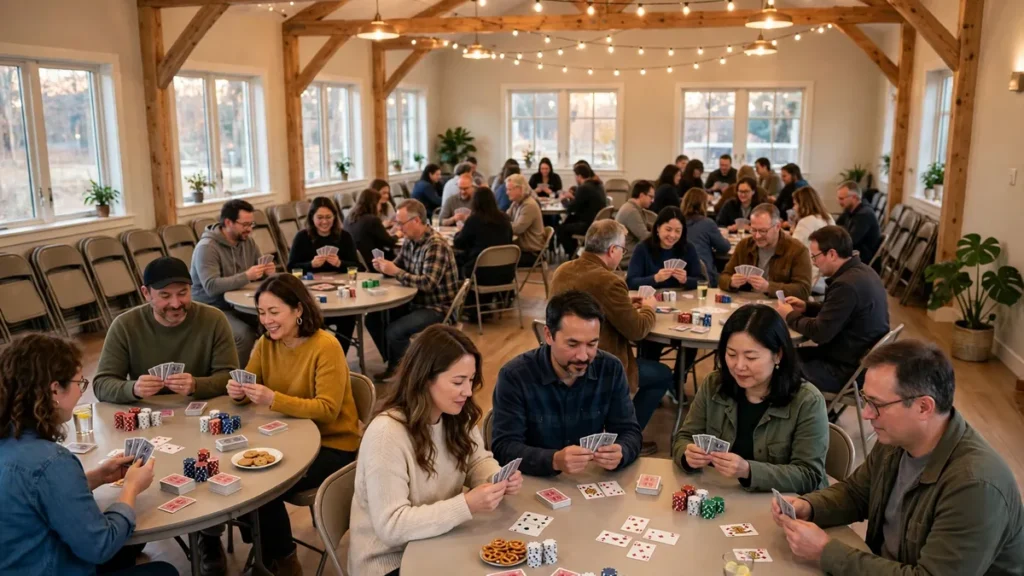
Finding the best dice games for 47 players is a very different challenge from choosing a game for a family of four. With 47 people in the room, a single table will not work, a single set of dice will not be enough, and a game that takes two hours will lose half the room before the first round ends. The best dice games for 47 players are the ones that scale: they split naturally into tables, they keep everyone rolling at the same time, and they give every player a reason to stay involved even when it is not their turn.
A group of 47 is large enough to feel like a party, a school event, or a community night, yet small enough to organise well with a little planning. The trick is to stop thinking of 47 as one giant game and start thinking of it as six or seven small games running side by side, linked by a shared scoreboard, a shared timer, and a shared finish. When the structure is right, a dice night for 47 players can feel fast, noisy, and fair, and nobody spends the evening watching from the sidelines.
This guide brings together the strongest options for a group this size, explains exactly how to set each one up for 47 players, and shows how to run the whole evening without chaos.
Key takeaways
- Split 47 players into six or seven tables of six to eight players, and link the tables with one shared scoreboard and one timer.
- Choose games where everyone rolls at the same time, or where turns last under a minute, so nobody waits long between rolls.
- Use team and relay formats for games that were designed for fewer players, and rotate players between tables after each round.
- Bring at least one set of five dice per table, plus spare dice, printed score sheets, pencils, and a visible clock or timer.
- Keep rounds short, explain only one new rule at a time, and finish with a simple final round that brings all 47 players together.

Why 47 Players Changes the Game
A dice game that works beautifully for four people can fall apart with 47. The most common problem is waiting time: if each player takes thirty seconds and there are 47 turns in a round, a single round takes more than twenty minutes, and most players will have stopped paying attention long before their turn arrives. The second problem is space and noise, because forty-seven people need room to sit, roll, talk, and move between tables, and a game that needs silence or a single shared board will struggle in that setting.
The best dice games for 47 players solve these problems at once. They use parallel play, so several small games happen at the same time instead of one long queue. They use short turns, so the action keeps moving. They avoid early elimination, or they give eliminated players a new role, such as scorekeeper or referee. They also use simple scoring, so a host can add up results from six tables in a few minutes.
How to Set Up a Dice Night for 47 Players
Start with the room. You need enough tables for six or seven groups of six to eight players. Seven tables of seven players gives you 49 seats, which leaves two spare seats for the host and a helper. Six tables of eight players gives you 48 seats, which also works. Use dice trays or shallow boxes in the middle of each table to stop dice from rolling onto the floor.
Next, sort the equipment. Each table needs at least five dice, and ten dice per table is better. Buy dice in bulk in different colours, and give each table its own colour so stray dice are easy to return. Each table also needs printed score sheets, pencils, a dice cup or small tray, and a simple written copy of the rules. Plan three rounds of twenty to twenty-five minutes, with a five-minute break between rounds for rotation and scoring, and finish with a ten-minute final round that brings everyone together.
The Best Dice Games for 47 Players
The games below are ordered from the easiest to set up to the ones that need a little more preparation. You do not need to play all of them in one evening. Pick three, play one per round, and you will have a full and varied night.
1. Bunco
Bunco is the classic large-group dice game, and it is the natural first choice for 47 players. Players roll three dice and try to roll the number of the current round: ones in round one, twos in round two, and so on up to sixes in round six. Each matching die scores one point, three matching dice score five points, and three dice showing the target number score twenty-one points and end the round at once. Set up six tables of eight players, playing as two teams of four per table, with the head table setting the pace. After each round, the winning team stays put and the losing team moves to the next table, so players constantly meet new opponents.
2. Farkle Tournament
Farkle, also known as Ten Thousand in some versions, is a push-your-luck game that scales beautifully into a tournament. Each player rolls six dice, sets aside scoring dice, and decides whether to bank the points or roll again and risk losing them all. A single one scores one hundred points, a single five scores fifty, three of a kind scores a multiple of one hundred, and a straight or three pairs score fifteen hundred. A roll with no scoring dice is a Farkle, and the player scores nothing for that turn. For 47 players, seat six to eight players per table, play to five thousand points at each table, and record each table winner. After twenty minutes, stop all tables, rotate players to new tables, and add the two round scores together for the final result.
3. Dice Bingo
Dice Bingo is one of the simplest games on this list, and it is the best option when you need all 47 players doing the same thing at the same time. Each player gets a bingo card with a grid of numbers, and the host rolls two dice in front of the whole room. Players mark the number rolled if it appears on their card, and the first player to complete a row, column, or full card calls out and wins that round. Print a different card for every player, using a five-by-five grid with numbers from two to twelve in different positions. Play three short rounds: a single line, two lines, and a full card.
4. Yahtzee Relay
Yahtzee is a familiar favourite, but a standard game for 47 players would take far too long in one group, so the relay format solves that problem. Each player rolls five dice up to three times per turn, trying to fill categories such as three of a kind, full house, small straight, large straight, Yahtzee, and chance, and the player with the highest total wins. Set up seven tables of six or seven players, give each table one score sheet per player plus five dice and a cup, and play a shortened game of seven turns instead of thirteen. Set a strict two-minute limit per turn so the round finishes in about twenty minutes, add up the scores at each table, rotate players, play a second shortened round, and add the two table totals together.
5. Left Center Right
Left Center Right, often shortened to LCR, is a fast, noisy game that needs only three special dice and a handful of tokens per player. Each die shows the letters L, C, R, or a dot. On a turn, a player rolls three dice and passes one token to the left for each L, one to the right for each R, one to the centre for each C, and keeps the rest. The last player with tokens wins, and a full game takes ten to fifteen minutes. For 47 players, run LCR at each table with six to eight players and fifteen tokens per player, using small counters, coins, or wrapped sweets. Start all tables at the same time, and when a table finishes, the winner records their name and the table starts a new game at once. After twenty minutes, the players with the most table wins go through to a final table.
6. Pig Relay
Pig is a simple push-your-luck game with a single die, and the relay version turns it into a team race that suits 47 players perfectly. A player rolls a die repeatedly, adding the total to their turn score, and can stop at any time to bank the points. If they roll a one, they lose all the points from that turn and play passes on. The first player to one hundred points wins, and the rules take less than a minute to explain. To play Pig Relay, divide the room into six teams of seven or eight players, with each team at its own table. One player rolls at a time while teammates watch and advise, and when a player rolls a one or decides to bank, the die passes to the next player on the same team. The first team to reach five hundred points wins the round.
7. Tenzi Race
Tenzi is a speed dice game in which each player rolls ten dice as fast as possible, trying to get all ten to show the same number. Players roll, set aside matching dice, and roll the rest again until all ten match. The first player to finish calls out Tenzi and wins. A single round takes two to five minutes, which makes Tenzi one of the fastest games in this guide. Give every player ten dice of their own colour, a small tray or dice cup, and a clear starting signal. Record the first three finishers at each table, awarding three points for first place, two for second, and one for third, and play five short rounds in twenty minutes. Add the points together, rotate players after the third round, and the player with the most points at the end wins.
8. Liar’s Dice Teams
Liar’s Dice is a bluffing game that becomes much more fun in teams, and the team version scales well to 47 players. Each player starts with five dice and a cup, rolls them in secret, and bids on how many dice of a certain number are showing across the whole table. The next player must raise the bid or challenge it, and the loser of a challenge loses a die. The last player with dice remaining wins the table. For 47 players, play in teams of two at each table, so each table has three or four teams. Each team shares five dice and makes joint bids, which means newcomers can learn from a partner and nobody has to bluff alone. Play a timed round of twenty minutes, record how many dice each team has left, rotate teams, play a second round, and add the remaining dice together.
Comparison Table: Which Game Fits Your Group?
Use this table to choose quickly: new groups should start with Dice Bingo or Pig Relay, lively groups with Bunco, Tenzi, or LCR, and strategic groups with Farkle, Yahtzee Relay, or Liar’s Dice Teams.
| Game | Players per table | Time per round | Difficulty | Dice needed | Best for |
|---|---|---|---|---|---|
| Bunco | 8 | 20 minutes | Easy | 3 per player | Large parties, mixed ages |
| Farkle Tournament | 6 to 8 | 20 minutes | Medium | 6 per table | Strategy and risk taking |
| Dice Bingo | All 47 together | 15 minutes | Easy | 2 for the room | Warm-ups and calm rounds |
| Yahtzee Relay | 6 to 7 | 20 minutes | Medium | 5 per table | Familiar favourites |
| Left Center Right | 6 to 8 | 10 to 15 minutes | Easy | 3 per table | Fast, light fun |
| Pig Relay | 7 to 8 per team | 15 minutes | Easy | 1 per table | Young players, low equipment |
| Tenzi Race | 6 to 8 | 20 minutes for 5 rounds | Easy | 10 per player | High energy and speed |
| Liar’s Dice Teams | 6 to 8 | 20 minutes | Medium | 5 per team | Bluffing and social play |
A Sample Evening Plan for 47 Players
A simple three-round plan works for most groups. Start with Dice Bingo for fifteen minutes as a warm-up, so late arrivals can join without missing the main game. Move to Bunco for twenty-five minutes as the main game, because it is social, easy, and sets the tone for the evening. Take a five-minute break, then play Farkle Tournament for twenty-five minutes, which adds strategy after the warm-up. Finish with a ten-minute Tenzi Race final, and announce the winners while the energy is still high. Hosts planning a series of nights will find the best dice games for 46 players useful when the group is one player smaller.
Checklist: Running a Dice Night for 47 Players
- Set out six or seven tables with six to eight seats each, plus a central scoreboard that everyone can see.
- Pack at least five dice per table, plus spare dice, dice cups or trays, printed score sheets, and pencils.
- Print one copy of the rules for each game at each table, and keep a visible timer or clock in the room.
- Choose a scorekeeper at each table for every round, and rotate the role so nobody writes all evening.
- Plan three rounds of twenty to twenty-five minutes, with five-minute breaks for rotation, scoring, and refreshments.
- Prepare small prizes for table winners, overall winners, and light-hearted awards such as the most Bunco rolls or the best comeback.
Common Mistakes to Avoid
The most common mistake is trying to play one game with all 47 players in a single group. A single-group game will be slow, quiet players will disappear, and the host will spend the evening managing turns instead of enjoying the game. Split the group, run parallel tables, and bring everyone together only for short whole-room rounds. The second mistake is choosing a game with complicated rules. If the rules need a long explanation, players will forget them by the second round, and the host will spend the evening answering the same question at every table. The same table sizes work at nearby group sizes, as the best dice games for 45 players show.
Frequently Asked Questions
How many dice do I need for 47 players?
You need at least thirty-five dice for a basic night, with five dice at each of seven tables, but fifty to seventy dice is more comfortable.
How long does a dice night for 47 players take?
A good dice night takes about ninety minutes to two hours, including breaks. Plan three rounds of twenty to twenty-five minutes, with five-minute breaks between rounds, plus ten minutes at the start for welcome and rules and ten minutes at the end for a final round and prizes. A shorter night of sixty minutes works with two rounds and a quick final.
What is the best game to start with for 47 players?
Bunco is the best game to start with, because it was designed for large groups, it moves players between tables, and its rules take less than two minutes to explain. Dice Bingo is the best warm-up if you want all 47 players doing the same thing at the same time while late arrivals settle in.
Can children play dice games with 47 players?
Yes, children can play, and the best choices are Dice Bingo, Pig Relay, and Tenzi, because the rules are simple and the turns are short. Pair younger children with an adult in Farkle, Yahtzee Relay, and Liar’s Dice Teams, so they can help with rolling and scoring without managing the full rules alone.
How do I keep score fairly across six or seven tables?
Use the same score sheet at every table, the same time limit at every table, and the same target score at every table. Choose a scorekeeper at each table, ask the helper to check the sheets during the break, and record the table winners on one central scoreboard that everyone can see.
What if I do not have enough tables or dice for 47 players?
Choose games that need the least equipment. Dice Bingo needs only two dice for the whole room, and Pig Relay needs one die per table. Use the floor with trays or shallow boxes for rolling if tables are short, borrow dice from players, and run the evening in two sessions of about twenty-four players each if space is very tight. The same low-equipment approach works for nearby group sizes, and the best dice games for 44 players include further ideas for running a full evening when tables and dice are limited.
The Bottom Line
The best dice games for 47 players are Bunco, Farkle Tournament, Dice Bingo, Yahtzee Relay, Left Center Right, Pig Relay, Tenzi Race, and Liar’s Dice Teams, because each one scales to six or seven tables, keeps turns short, and gives every player a real part in the evening. Split the room into tables of six to eight, link the tables with a shared scoreboard and timer, rotate players between rounds, and finish with a short whole-room final that everyone can join. With that structure, 47 players stops being a problem to manage and becomes the reason the night works: more tables, more laughter, and more chances for someone to roll the perfect score at exactly the right moment.