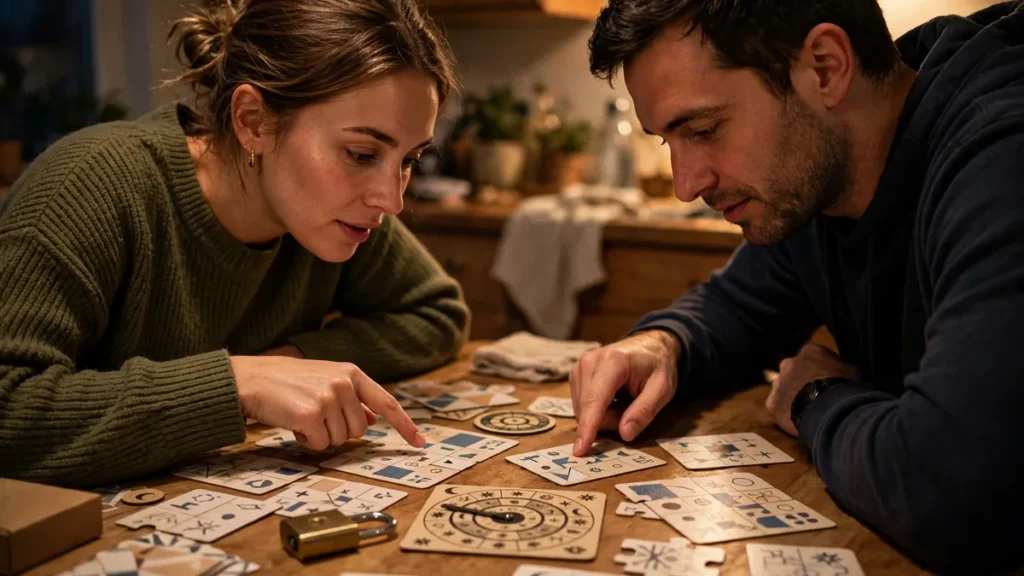
Picture a table full of people, a stack of cards in the middle, and someone reading out a question that makes half the room groan and the other half grin. The whole contest hangs on what people happen to remember. That scene, in all its forms, is a trivia game.
A trivia game is a game where players compete by answering questions about facts they already know, or half-know: places, history, science, sport, music, food, films, animals, books, and famous people. Players score points for correct answers, and whoever finishes with the most points wins.
Key takeaways
- A trivia game is a contest built on fact questions, with points for right answers and a winner.
- Every version shares the same core: questions, players, scoring, and rounds that build toward a result.
- Trivia games come as board games, card games, pub quizzes, television shows, phone apps, and games you make up yourself.
- A trivia game is not the same as a quiz in general, a trivia night, or a word game.
What a trivia game actually is
Strip away the box, the buzzers, and the theme music, and a trivia game is a simple deal: the game asks something, the players try to remember the answer, and correct answers earn points.
Each question points at a single fact with a definite answer, something that was true before anyone asked. Which ocean borders California? A player either knows it, works it out from something related, or takes a guess. The answer can be checked, so there is no debate afterwards. That is what makes trivia fair: knowledge, not opinion, decides the score.
The second ingredient is the contest itself. A trivia game always has a winner, or at least a ranking. That is what separates it from simply asking questions for fun around a dinner table. Points, rounds, and a final tally turn a chat into a game.
The third ingredient is breadth. Trivia games roam across topics instead of staying in one lane: a single round might jump from a capital city to a pop song to a chemical element. No single expert can dominate, because the next question may land in someone else’s patch. Breadth keeps the table level.
The parts every trivia game shares
- A question set. Somebody has put together a bank of questions, usually sorted by topic and difficulty: on cards in a boxed game, in a database in an app, in a notebook in a home-made game.
- A way to ask. A host reads them aloud, a card is flipped over, a screen displays the question, or a buzzer decides who answers first. The method sets the mood.
- Players or teams. Trivia works solo, in pairs, and in teams of any size, though teams of three to six tend to work best. In a team, knowledge pools: one person remembers the decade, another remembers the singer.
- Scoring. Usually one point per correct answer, sometimes with bonuses for harder questions, streaks, or speed. What matters is that it is clear before play starts.
- Structure. Questions are grouped into rounds, often ten at a time, and rounds into a game that ends with a declared winner. A team that trails early still has rounds ahead to catch up.
- An answer key. Somebody, or something, knows the right answers and settles disputes: printed on the card, built into the app, or held by the host.
The main formats of trivia games
Board trivia games
The classic boxed game is probably what most people picture first. Players move pieces around a board by answering questions, often collecting a token per topic mastered. A good answer moves you forward, a wrong one stalls you. If building your own appeals to you, our guide to making a trivia board game walks through the process, from the board layout to writing fair questions.
Card trivia games
Card versions drop the board and keep only the questions. Players draw a card, answer, and keep or pass the card depending on the rules. They are smaller, cheaper, and quicker than board games, and they travel well: a pack of cards fits in a bag, a board does not. They suit short sessions and holidays, though the questions have to carry the fun.
Pub and bar quizzes
The pub quiz is trivia as a social event. Teams sit at tables, a host reads the questions over a microphone, answers are written on sheets, and scores are announced between rounds. The game is the same shape as a home game, but the setting changes everything: the crowd, the noise, the regulars, the small prize at the end.
Television trivia games
Television turned trivia into a spectator sport. Contestants answer under lights, against a clock, with an audience watching, and the home viewer plays along from the sofa. The format adds pressure that a living room never has: the buzzers, the timer, the money at stake.
Phone and app trivia games
Apps took trivia solo and made it instant. You open the app, answer a question, and find out at once whether you were right. Some are single-player, with daily questions and streaks that keep you coming back. Others are live, with thousands of players answering the same questions at the same time. The format suits spare minutes: a commute, a queue, a coffee break. The trade-off is the social side: an app cannot recreate the argument at the table over whether the answer was really 1969.
Home-made and no-equipment games
The oldest format needs no box at all. One person writes twenty questions on a sheet of paper, reads them aloud, and keeps score with a pencil. Families have played this way for generations, on car journeys, at holiday tables, and in classrooms. It costs nothing and can be tuned exactly to the people playing.

A short history of the trivia game
Radio quiz shows in the 1930s and 1940s were the first mass version of trivia: contestants answered general knowledge questions live on air, and listeners played along at home. Television carried the idea further in the 1950s and 1960s, with quiz shows becoming prime-time fixtures. The most famous, a long-running American show built around answers given as questions, first aired in 1964 and is still running today.
The boxed board game arrived later, and it arrived by accident. Two Canadian journalists invented the best-known trivia board game over a drink in 1979, after discovering that pieces were missing from a game they wanted to play. Built around six categories of questions and coloured wedges collected for each category, it was released in the early 1980s and became a phenomenon.
Pub quizzes grew through the 1970s and 1980s, above all in Britain. Then the internet and the smartphone made trivia instant and personal. A 2013 mobile game built around head-to-head trivia duels became a global hit, and live phone quiz apps in the late 2010s briefly drew millions of players to a single nightly game. Today all the formats exist side by side.
Trivia game vs quiz: what is the difference?
Trivia game and quiz sound like the same thing, but they are not. A quiz is the bigger category: any test of knowledge with questions and answers is a quiz, from a school exam to a personality quiz to a driving theory test. A trivia game is one kind of quiz, the kind where the questions are about general facts, the mood is playful, and the point is fun rather than assessment.
The distinction shows up in the stakes. A quiz can matter: pass or fail, a grade, a licence, a job. A trivia game almost never matters beyond the evening. Quiz questions can also ask you to explain, analyse, or work something out, while a trivia question asks you to recall a fact. Every trivia game is a quiz, but not every quiz is a trivia game: a spelling test and a maths exam are quizzes, but neither is built around roaming general knowledge played for fun.
Trivia game vs trivia night: the game and the evening
This pair confuses people because they overlap so often. A trivia night is an evening event built around quiz questions, played in teams, with a host and a score. A trivia game is the thing being played: the night is the occasion, the game the activity at its centre.
The difference becomes clear when you look at what each one needs. A trivia night needs a venue, a time, teams, a host, and usually food and drink. Take those away and there is no night. A trivia game needs only the questions, the players, and a way to score: you can play one on a sofa, on a train, or in a garden, with no venue and no host in sight. Our guide to what a trivia night is describes the evening from a first-timer’s point of view.
Trivia game vs word game: facts against language
The other common mix-up is with word games. Both are played around tables, both suit mixed groups, and both reward a quick mind. But they draw on different stores: trivia on stored facts about the outside world, places, people, dates, and discoveries; word games on your command of language itself, spelling, vocabulary, and the way letters fit together.
In trivia, a question has one right answer, and knowing it is the whole skill. Who painted the ceiling of the Sistine Chapel? There is one answer, and either it comes to you or it does not. In a word game, the board usually offers many routes, and spotting an unusual one can beat playing the safe one. Trivia rewards recall; word games reward pattern-spotting, vocabulary, and imagination. Trivia is mostly skill; word games often add luck through the letters you draw.
What makes a good trivia game?
Not all trivia games are equal, and the difference rarely comes down to the box or the app design. Balance comes first: a good game mixes easy, medium, and hard questions within every round. Easy ones early on let everyone score and settle in; harder ones later separate the teams without humiliating anyone.
Variety comes second. A good game roams across topics and varies the way questions are asked: a fact question, then a picture, then a song, then a list to order. That rhythm keeps players alert, and it means different kinds of knowledge count. The player who knows music gets their round, and so does the player who knows geography.
Fairness comes third. Good questions have one clear answer, use plain language, and avoid vague words that invite arguments. If you want the building blocks, our guide to what a trivia question is breaks down the anatomy of a single question, from its topic and difficulty to what makes it feel fair.
Pacing comes fourth, and it is the one beginners forget. A good game keeps the gap between questions short: players should spend their time thinking, not waiting. The best games keep a steady beat: ask, think, answer, score, next question.
A few questions to try right now
The fastest way to understand a trivia game is to play a tiny one. Here are four fresh questions, each about a single fact.
- Which bird is the only one that can fly backwards?
- What is the main ingredient in guacamole?
- Which planet is known for its wide, bright rings?
- In which city would you find the Eiffel Tower?
Answers: the hummingbird; avocado; Saturn; Paris. If you knew three or four, you would have done well in a real round. A trivia game is not an exam: it is a way to find out what you remember, and to enjoy the remembering.
Frequently asked questions
Is a trivia game the same as a quiz game?
Almost, but not quite. A quiz game is the wider category, covering any game built on questions and answers. A trivia game is the kind that uses general knowledge facts and is played for fun. In everyday speech the two are used interchangeably.
How many players do you need for a trivia game?
One is enough for an app or a solo card game, but two or more is better. Teams of three to six work best, because knowledge pools across the team and nobody carries the whole round alone. Very large teams can work in a pub quiz, though hosts often cap team size to keep the contest fair.
The bottom line
A trivia game is a contest built on fact questions, played for points, and won by whoever remembers the most. It comes in many forms, from a board on a living-room floor to an app on a phone, but the deal never changes: a question, a memory, and a score. It is not an exam, not a word game, and not quite a trivia night.