The Night Is Won Before Anyone Arrives
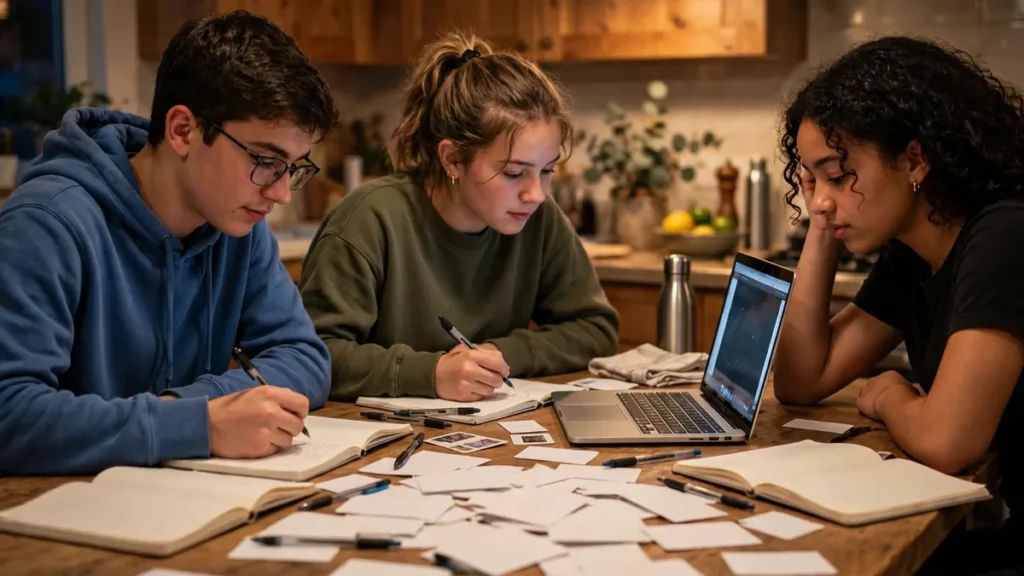
Every smooth trivia night for teenagers has a secret, and it is not a brilliant quizmaster or a lucky set of questions. It is a notebook, filled in weeks earlier, with the date, the guest list, the room, the questions, the teams, the prizes, and the food all settled long before the doorbell rings. The evening itself is the easy part. The real work happens at a kitchen table, in short sittings, while there is still time to change a bad date or rewrite a weak round.
Planning and hosting are two separate jobs. Hosting is what happens with a full room: reading the questions, keeping the pace, and handing out prizes. Planning is everything before that. This guide covers the planning only. Once you split the two jobs apart, each one gets simpler, because every planning decision has its own deadline and nothing is left to the final evening. When the planning is done, the hosting half is covered in our guide to running a trivia night for teens.
Fix the Date in Week One
Nothing else can move until the date is fixed, so settle it first. Offer two or three options in the group chat and let people vote, instead of announcing a date and hoping it suits everyone. Friday evenings work well for school groups, because the week is finished and nobody has homework hanging over them. Saturday afternoons suit younger teens, who fade fast after nine. Check the school calendar as well as your own diary: exam weeks, school trips, big sports fixtures, and the weekends around major holidays can wipe out a third of your guest list overnight.
Let the Guest List Shape the Night
Twelve to sixteen guests is a comfortable size for a first night: enough for four teams, small enough that you still know every name. Fewer than eight can feel thin if two people cancel, and more than twenty needs a hall and a second adult to help. If your list keeps growing past twenty, cap it and keep a short waiting list. A room where everyone fits comfortably beats a room packed to the walls, and guests remember comfort long after they forget the questions.
Choose the Room and Book It Early
The room is the one choice you cannot fix on the night, so make it in week one or two. A living room suits up to about sixteen guests if you move the furniture into small clusters, with a table per team. A church hall, community room, or school classroom suits a bigger group, but popular rooms get booked weeks ahead. Ask about the cost, the key, the heating, the toilets, and whether food is allowed. A free room that bans snacks is a worse choice than a cheap room that lets you bring your own.
Build the Question Bank in Short Sittings
The question bank is the biggest job in the whole plan, so split it across several short sittings in weeks two and three. Fifty to sixty questions across five or six rounds is about right for a two-hour night. Fewer than forty and the evening feels thin; more than seventy and you will be cutting rounds while guests wait, which is the worst time to edit. Sketch the rounds first as themes, then fill them in: a music round, a food round, a films round, a local round about the school and the town, and one wild-card round built from the topics your guests suggested. Rounds built from what the guests genuinely know will always beat rounds lifted from a quiz book.
Verify every answer yourself, then get a second person to check the answer key. One wrong answer on the key can spark a dispute no host wants to referee in front of twenty teenagers, and a question with two fair answers is worse than one nobody knows. Drop anything that depends on a trick, anything that singles out one guest for laughs, and anything you cannot confirm in under a minute. Then write five spare questions and keep them aside. Spares settle ties, fill a round that runs short, and rescue you when a question turns out to have a second correct answer. A bank with spares is a bank that cannot be caught out.
Work Out the Scoring Before the Night
Decide how the night is scored before the night, not during it. The simplest system is also the best: one point per right answer, added up after each round, with the running totals where every team can see them. Draw up the scoring sheet now, with a row per round and a column per team, and print two copies. If the scoring lives only in the host’s head, teams will argue about it, however fair it is. A system written on a sheet, shown to every team at the start, is trusted without a word.
Sort the Teams on Paper, Days Ahead
Decide the teams at home, days ahead, not in the doorway as guests arrive. The worst scene in party planning is a teenager left over while the whole room watches, so never let the group pick sides where everyone can see. Make the groups yourself, or at least settle the rules you will use, and jot the lists on your planning card. Four players per team hits the balance for teenagers: enough minds for the hard questions, few enough that everyone must contribute. Three works; six means somebody always ends up scrolling while the loudest two do everything.
Make a folded name card for every team ahead of time, and let each team pick its name from three options you offer, or vote on one when they arrive. A small prize for the cleverest team name means every team banks a win before a single question is read. Sort the seating while you are still planning, too: each team needs its own table or corner, spaced so teams cannot overhear each other, and every player needs a clear view of the host. Put the youngest team nearest the front, where the questions are easiest to hear. For a different take on the same team thinking, see our guide to hosting a game night for teens.

Put the Budget and Prizes on One Page
Write the budget down before you spend anything, on a single page, in week two. List every cost: the room, the prizes, the food and drink, the printing, the pens, and the decorations. For a night of sixteen guests at home, the spending stays modest: a small sum for prizes, a similar sum for snacks and drinks, and almost nothing for decorations if you raid the cupboards first. Shop once, from one list, with no surprise spending on the day. If the cost is shared, agree the split now, while everyone is calm, and note who pays for what.
Buy the prizes a fortnight ahead, and wrap them early. Prizes cause planners more worry than anything else, and they deserve the least of it. Teenagers care far more about picking than about price: a spread of small wrapped prizes they can choose from feels like a lucky dip, while one dear prize for the winners feels like a raffle most of them lose. Plan three kinds of prize. The winning team gets a small gift card each, or a box of treats to divide up. Then add prizes that ignore the score entirely: cleverest team name, silliest wrong answer, kindest team. And every guest takes home a little something, even if it is only a sweet treat. Grouping the prizes by type, a week before the night, avoids a last-minute hunt through the bags.
Plan the Food Around the Allergies
Start with the allergy answers from the invitations, because the snack table is built from those, not from a guess. Copy every allergy and dietary need onto one card and keep it with the shopping list, so it is in front of you whenever you buy or cook. Keep the table simple: crisps, fruit, biscuits, and a jug of squash beside a few sparkling options. Label each dish with a small card, so a guest scanning the table can tell at a glance what is safe for them. A guest who cannot eat anything on the table will remember that longer than they remember the questions.
Serve a small snack on arrival, and save the main spread for the break in the middle. Food lands exactly when the energy dips, and it gives teams something to do with their hands while the scores are added up. If money is tight, ask each team to bring one snack to share, and say so on the invitation, so nobody is caught out. Time any delivery for the break, not the start, and write the order time on your running-order card. A pizza that turns up during a round is a distraction; a pizza that turns up at the break is a reward. Keep the food table away from the answer sheets, and put it where nobody must cross a team to reach it.
Rehearse Once, Then Write the Backups
The step planners skip most often is a short dry run the day before. Sit down with the question sheets, answer key, and a stopwatch, and read the opening round out loud to an empty room. Clock it. A round that needs fifteen minutes to read and mark will need twenty once teenagers are in the room, so you will know to drop three questions now rather than mid-evening. Read each question twice during the dry run, exactly as you will on the night, and listen for the ones that sound muddled when spoken. A question that looks tidy on paper and comes out tangled aloud is a question to rewrite.
Test the marking as well. Score a pretend sheet and total the points, using the real score sheet. If the adding-up feels slow, simplify the system now, while there is still time. Then walk through the running-order card from start to finish: arrivals, team names, the warm-up round that carries no score, the rounds in order, the break, the final round, the prizes, and the finish time. Any step that makes you hesitate will make you hesitate on the night, so fix it now. A dry run is not a performance. It is how you catch the three small problems that are still cheap to fix.
Finally, jot a short list of fallbacks at the bottom of your running-order sheet. A tie is settled by one spare question where the closest number wins. A late arrival waits for the next round instead of joining mid-round. If the speaker dies, read louder and pull the teams closer. If two guests cancel on the day, merge the smallest team rather than running a team of two. If half the group falls ill, fall back to the spare date you chose in week one, and tell the group in advance that it exists. A fallback written in advance feels like good planning. The same choice made in a panic feels like a disaster.
Your Six-Week Countdown
Six weeks out, fix the date, book the room, and send the invitations with the reply deadline. Five weeks out, chase the replies and lock the guest list. Four weeks out, sort the teams, set the budget, and buy the prizes. Three weeks out, build the question bank in short sittings, verify every answer twice, and draw up the scoring system and the kit list. Two weeks out, confirm the numbers, print the sheets, and test the tech in the room. One week out, wrap the prizes, fold the name cards, and put the folder together. The day before, run the dry run and set the room up. On the day, arrive early, lay everything out, and let the plan do the work. If you would rather fill the evening with ready-made games instead of a quiz, our list of the best party games for teens has plenty to pick from.
Questions Before You Start Planning
How far ahead should I start planning? Six weeks is comfortable: a week to settle the date and the room, two weeks to build the question bank, and the rest to confirm numbers, buy prizes, and rehearse. Three weeks is the minimum, and anything less means cutting corners on the questions, which is the one job that cannot be rushed.
How many questions do I need? Fifty to sixty across five or six rounds, plus five spares. Fewer than forty and the night feels thin; more than seventy and you will be cutting rounds while guests are waiting.
A good teen trivia night is decided at a kitchen table, weeks before anyone arrives. Pick the date, know your guests, book the room, build the questions, sort the teams, buy the prizes, test the tech, rehearse once, and write the backup plans. Do that, and the night itself almost runs itself.