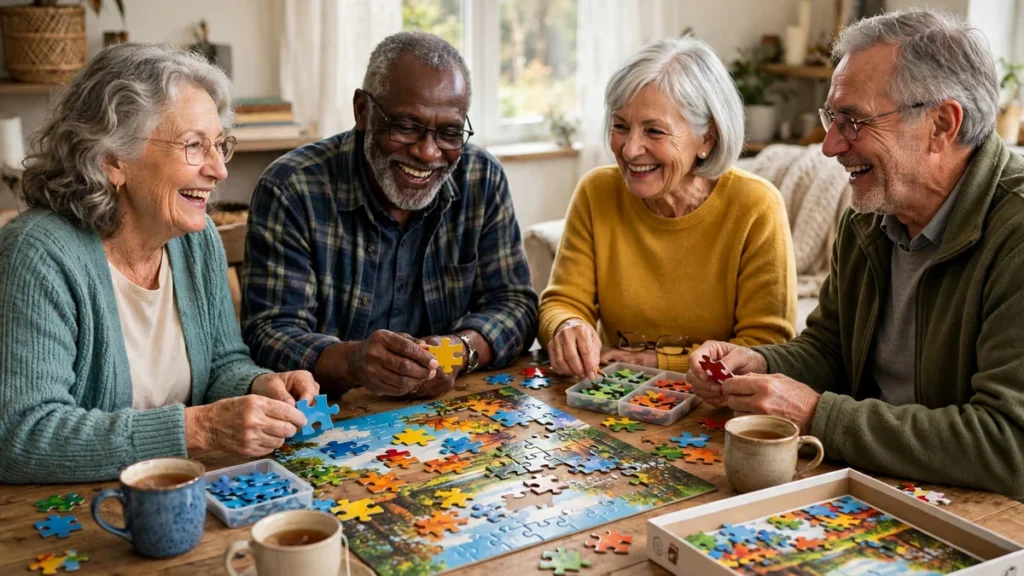
Picture a Tuesday afternoon in a front room with the curtains pulled back. Four neighbours sit around a table where a jigsaw of a harbour is slowly coming together: one sorts the blue pieces, one guards the box lid, one finds the corners. Nobody is in a hurry. The kettle is on, the light is good, and by half past three the harbour sky will be finished.
The trick is to plan for the guests you actually have: a lifetime of words and patience, but eyes that tire sooner, hands that prefer a chunky piece, and knees that dislike a low chair. Build the afternoon around those realities and the puzzles will take care of the rest.
Key Takeaways
- Meet in daylight, keep the whole visit near two hours, and put a proper tea break in the middle.
- Pick large pieces, large print, and familiar puzzle types, with a gentler option on every table.
- Puzzle in pairs or threes so nobody works alone and nobody sits watching.
- Comfort first: bright light, steady chairs, a table that does not wobble.
- Keep score out of it, so finishing together counts for more than finishing first.
- Fix the next date before anyone leaves.
What Older Players Bring to the Table
A crossword clue about a singer from the sixties or a town on the coast is not a test for these guests; it is a memory they are glad to meet again. Decades of reading and working leave older solvers with a deep store of words and facts, and puzzles let that store earn its keep. A jigsaw rewards the person who notices a piece belongs to a rooftop, not the person with the quickest fingers.
Puzzles are unusually forgiving: no hand to lose, no turn that passes while you pour tea, no moment when a player is knocked out and left watching. A guest can pause, chat, and return to the same puzzle exactly where they left it. A puzzle also gives a shy guest something to do with their hands: a newcomer can sit down, pick up a piece, and belong within a minute.
When to Meet, and How Long to Stay
Daylight is your friend: once the light goes, the roads feel less welcoming and the walk home feels longer. A start between one and three suits most groups: the midday meal is done, and hours of daylight remain when the boxes are packed away.
Two hours from the first knock to the last goodbye is a good length, with a tea break dividing it in two. State the finishing time when you invite people, and honour it. A fixed weekday is worth more than a clever date: the first Tuesday of the month becomes a fixture people can plan around.
Puzzles to Put on the Table
Start with a jigsaw, because it is the most sociable puzzle there is. Choose one of 300 to 500 pieces, with big pieces and a bright, busy picture — a garden, a market, a seafront. A thousand tiny pieces will beat the room before the tea break, and a picture of a plain sky will do the same. Before anyone arrives, pull the edge pieces into a bowl and set out shallow trays for sorting by colour.
Word puzzles live or die by print size. Buy crossword and word-search books printed large for older solvers, and print your own in at least 16-point type with roomy spacing. A soft pencil beats a pen, because a wrong answer can be rubbed out without a fuss. Large-print Sudoku belongs on the same table, along with a page of anagrams for the gaps between longer puzzles. Our round-up of the top puzzle games for seniors is a useful place to start before you buy.
Give quiet thinkers a logic puzzle: a gentle Sudoku or a short grid puzzle with a handful of clues suits the guest who thinks before speaking. A puzzle a pair can crack in ten minutes is right; one that eats forty will drain the table. Save riddles for the second half, when everyone is relaxed: read them aloud to the whole room, ten at most, with fair, everyday answers. Trivia lands best when questions come from the guests’ own lives — songs they danced to, food they grew up with.

Making the Table Comfortable
Comfort decides whether the puzzles get played, so sort it before you worry about decorations. Play in the brightest corner of the room, close to a window, and add a lamp above the table for the hours when the daylight thins. Take care nobody sits facing straight into a bright window, where glare hides the pieces. Pick chairs with arms, so guests can push themselves up, and a firm seat high enough for feet to reach the floor. Leave room behind each chair for a walking frame, and keep the route to the bathroom free of bags and cables.
A plain, light-coloured matte cloth helps pale pieces stand out, and a non-slip mat stops the board sliding when someone leans across it. Keep a magnifying glass or two within reach. Hearing aids catch background noise before voices, so keep music off, and seat guests who hear less well where they can watch faces. When you read a riddle aloud, stand where everyone can see you and read it twice.
A Shape for the Afternoon
An afternoon without a shape drifts: one person starts a crossword, another watches, and half the room is still finding a seat when the tea goes cold. Have tea already poured and a puzzle already open when the first guest arrives, so early arrivals have something to do instead of sitting and waiting. Greet each guest by name and point out the bathroom before anyone has to ask.
Open with a warm-up everyone can finish — a short word search or a five-clue mini crossword — for an early win. Then settle into the main puzzling in pairs or threes, each group with a different puzzle, swapping at its own pace. The swap is the point: the guest who struggled with the crossword may spot the jigsaw corner everyone else missed. Our general guide to hosting a puzzle night covers stations and rotations in more detail.
Break properly for tea, clearing the tables so the room can talk. Twenty minutes is about right: long enough for a second cup. Finish together: gather the room for a short riddle round, collect answers together, and celebrate the funniest wrong answer as warmly as the right ones. End with the jigsaw, inviting everyone to place one last piece.
Small Groups, No Scoreboard
Pairs and threes are the heart of the afternoon: two can share a crossword without crowding, three is enough for a jigsaw without anyone idle. Five or six leaves the shyest guest with nothing to do; eight splits into side chats. Mix groups on purpose: a confident solver beside a hesitant one, and a newcomer beside someone who knows the room.
Give each person a role — one reads clues aloud, one writes answers, one sorts pieces — so every guest has a reason to be at the table beyond being the cleverest there. Leave ranking out of it: a points race pushes the slowest pair into silence. Hand out small, silly prizes at the end instead — the best team name, the most patient solver, the pair who laughed the most.
Tea, Cake, and Clean Fingers
Have the kettle on before anyone arrives, offer tea, coffee, and water, and keep a jug on every table so nobody has to ask for a drink. Use sturdy mugs with large handles, set on a side table rather than among the pieces, where a spill can ruin an afternoon’s work. Food should be easy to eat with one hand and kind to fingers going straight back to the puzzle: small sandwiches, cake, biscuits, and soft fruit work; sticky buns and anything greasy do not.
Ask about allergies with the invitation, and label anything sugar-free or gluten-free. Keep the main food on its own table, away from the puzzles, so people stand and stretch between rounds and crumbs stay out of the trays. Put a small plate of biscuits on each puzzle table too, for guests who cannot easily stand.
Invites and Getting There
Invite by phone or on paper, a week ahead; a group message will miss half the guests. Give the day, start and finish times, address, and a single sentence about the afternoon: puzzles, tea, and good company. A call the day before beats any reminder card: it lets a guest mention a sore knee, an allergy, or a worry about the journey privately.
Sort out travel in the invitation itself: say who can drive and match drivers with riders, and name the bus route and nearest stop in plain words. For many older guests the journey is the real barrier, not the puzzles. If you meet in a hall, check the way in — steps, ramps, handrails — and say what you found, so nobody wonders whether they can manage the entrance. Keep the list small for a first afternoon: six to eight people, counting yourself, is about right.
If a Guest Finds It Hard
Some guests will arrive with failing memory, weak eyesight, shaky hands, or a hearing aid that whistles in a crowd. None of that should keep them from the table. Offer easier roles before anyone asks: sorting pieces by colour, reading clues aloud, holding the box lid. Every job at the table is a real job.
Never correct a wrong answer where the room can hear it, and never finish someone else’s puzzle for them. A gentle “shall we try another clue and come back to that one?” keeps things moving without embarrassing anyone. If a guest grows confused or upset, walk with them to the kitchen for tea and bring them back when ready. Keep the material kind: choose questions that bring back good memories — songs they danced to, food their mothers cooked — not ones that only test a fact.
Turning One Afternoon into a Habit
One puzzle afternoon is a pleasant day out; a monthly one is a fixture people build their week around. Fix the next date before anyone leaves the first one: write it on a card, hand it to every guest, and say it aloud twice. Build small traditions — a swap box for finished puzzle books, a notebook for the best riddle of the month — and let guests shape what comes next. If you are weighing a quiet puzzle afternoon against a livelier games evening, our look at whether puzzle nights are better than game nights sets out the difference plainly.
Your Puzzle Night Checklist
- Large-piece jigsaw, 300 to 500 pieces, with a bright picture and the edges pre-sorted.
- Large-print crossword, word-search, and Sudoku books, soft pencils, rubbers.
- Sorting trays or shallow bowls, a non-slip mat, and a magnifying glass or two.
- Ten riddles to read aloud, answers checked together.
- Chairs with arms, a bright table near a window, and a clear path to the bathroom.
- Tea, coffee, water, cake, and finger food — with allergies asked about in advance.
- Invitations by phone or paper a week ahead, and a reminder call the day before.
- Rides arranged, step-free access checked, and the finish time kept.
Frequently Asked Questions
How long should a puzzle night for seniors last?
About two hours from arrival to goodbye, with a tea break in the middle and roughly ninety minutes of puzzling inside that span. Shorter feels rushed; longer and the room tires, attention wanders, and the final puzzle drags.
What is the best time of day for a senior puzzle night?
Early afternoon, starting between one and three, when minds are rested and the light is kind. Weekdays often suit regular groups better than weekends.
Which puzzles work best for older players?
Large-piece jigsaws, large-print crosswords and word searches, gentle Sudoku, simple logic grids, memory pairs, and riddles read aloud — print and pieces that are easy to see and hold, rewarding a lifetime of knowledge rather than speed.
How many guests should I invite?
Six to eight people, counting yourself. Work in pairs or threes, and split into two tables rather than squeezing more than eight around one.
The Bottom Line
A puzzle night for seniors asks little and gives a great deal back: a bright room, a steady table, puzzles older eyes and hands can enjoy, hot tea, and an afternoon that ends on time. The puzzles matter, but they are not the point. The point is the room itself — neighbours leaning over the same picture, a quiet guest finding their voice over a crossword clue, and a finished jigsaw everyone can admire before going home.


