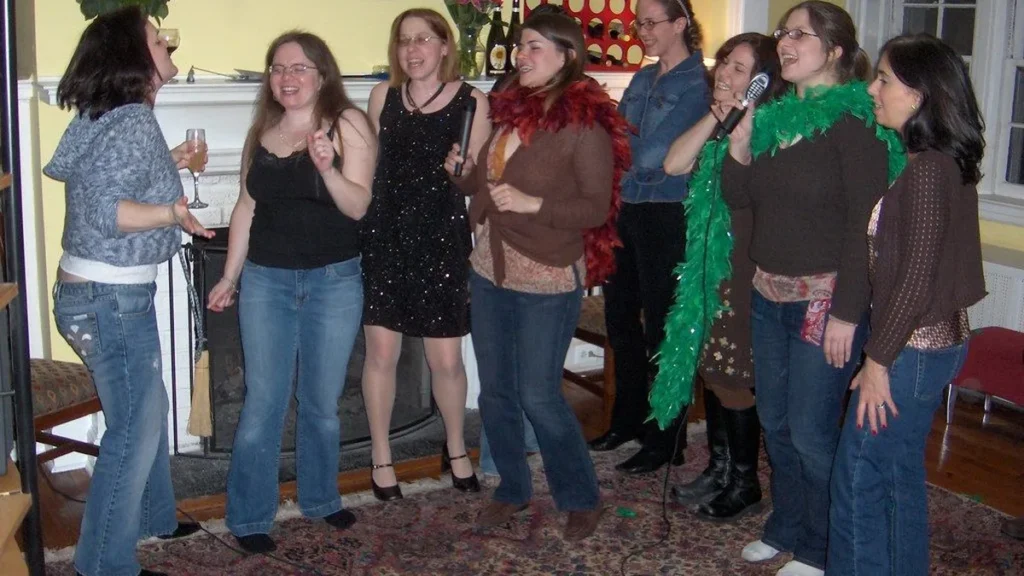
A karaoke night for adults is a strange kind of party. Everyone says they want one, and then half the guests spend the first hour insisting they cannot sing, will not sing, and only came for the snacks. Then somebody grabs the microphone, misses a note in spectacular fashion, and the whole room relaxes. That is the whole secret: the night works when singing feels like a shared joke rather than a performance, and the host is the person who proves that first.

Pick the Shape of the Night First
Before you buy anything or send a single message, decide what kind of night this is. A living-room night for eight friends is a different animal from a rented karaoke room for twenty colleagues, and both are different from booking a table at a karaoke bar and letting the venue do the work.
A living-room night is the cheapest and the most personal. You control the playlist, the drinks, and the finish time, and nobody has to shout over strangers. It suits birthdays, leaving parties, and groups of friends who already know each other well enough to be silly together. The trade-off is that you are the sound engineer, the DJ, and the host all at once, so keep the group small enough that you can actually enjoy it yourself.
A rented private room splits the difference. The machine, the microphones, and the song catalogue are already in place, and you bring the guests and the energy. This is the best choice for work groups and larger birthdays, because the room itself gives people permission to let loose. Book for an hour longer than you think you need, since the first half hour always disappears into arrivals and drinks. A bar night needs the least planning and gives you the least control: you join the queue and wait your turn between strangers. Pick a weeknight, when the list is shorter. Whatever shape you choose, put a start time and an end time on the invitation, because adults have babysitters, early mornings, and trains to catch.
Build a Guest List That Will Actually Sing
The guest list is the single biggest predictor of how the night goes, and the rule is simple: invite people who like each other, not people who can sing. A room full of brilliant singers who barely know each other will be polite and stiff. A room full of old friends who sing badly will be unforgettable.
Aim for eight to fourteen people at home, and up to twenty in a rented room. Fewer than six and the night feels thin, because every singer is on stage too often and the audience is too small to build any momentum. More than fourteen at home and the queue gets long, the room gets crowded, and the quieter guests quietly stop expecting a turn.
The Gear That Actually Matters
You do not need professional equipment, but you do need three things working properly: a way to play the songs with the words on screen, a speaker loud enough for a room full of people, and a microphone that does not sound like a toy. If any one of those fails, the night stalls while somebody fiddles with cables.
Microphones are where cheap gear shows. A toy microphone with a built-in echo will make every singer sound worse and feel sillier than they already fear. A basic wireless microphone, or a wired one with a long enough cable, is a far better buy, and two microphones are better still, because duets start instantly and handovers take seconds. Keep spare batteries beside the speaker. Do a full test run the day before: play three songs from start to finish, sing along to one of them, and check that the words stay in time with the music. Save the songs in advance rather than relying on the Wi-Fi holding up.

Arrange the Room So Singing Feels Natural
Clear a spot for performing and make it obvious. Push the furniture back, leave an open patch of floor near the screen, and set the seats in a loose half-circle facing it. A rug under that patch helps more than you would think: it marks the territory, it softens the sound, and it gives a nervous singer somewhere to stand that is not the middle of an empty floor.
Build a Song List Grown-Ups Will Fight Over
The song list is where adult karaoke nights are won or lost, and the mistake most hosts make is building a list of their own favourites. Your guests grew up in different decades, danced to different songs, and have wildly different ideas of what counts as a classic. A good list covers the room, not just the host.
Some songs are karaoke gold for a reason. Big anthems like “Don’t Stop Believin'”, “Livin’ on a Prayer”, and “Dancing Queen” work because the chorus does the heavy lifting and the audience becomes part of the performance. Power ballads work for the confident singers who want a moment, and they work best one at a time, spaced out through the night, rather than stacked back to back. Novelty songs are best used sparingly: one gloriously silly number in the middle of the evening lands perfectly, but three in a row makes the night feel like a joke at its own expense. Keep most songs under four minutes, because a five-minute epic means everyone else waits while one person works through a verse nobody knows.
Duets deserve their own section of the list. Songs built for two voices, from “Summer Nights” to “Ain’t No Mountain High Enough”, are the easiest way to get a reluctant guest singing, because nobody is alone on stage and the pressure halves. Keep a short list of duet suggestions visible, and when a shy guest hesitates, offer them a duet with a confident friend rather than a solo. Our list of puns for singers is a good icebreaker to read out between songs when the room needs a laugh.
Keep the Evening Moving
The first twenty minutes matter more than the rest of the night put together, because that is when the room decides whether singing is something people do here or something people watch one brave soul do. Open with a group song. Pick something every guest knows, stand up yourself, and sing the first verse badly and happily. A host who sings first, and sings imperfectly, does more for the night than any amount of encouragement. It proves the standard is fun, not talent, and it gives the nervous guests permission to be ordinary. Follow the opener with your most confident guest, then a duet, so the room sees three different kinds of singing in the first fifteen minutes.
Keep the turns moving. A singer who finishes should hand the microphone straight to the next person, and the next song should start within a minute. Long gaps between songs are where karaoke nights die, because the room fills the silence with conversation and the singing becomes an interruption rather than the point. Have the next singer chosen and ready before the current song ends. The same pacing sense applies to any party format, and our guide to creating a trivia night uses a similar rhythm of rounds and breaks if you want a second format for another evening. Plan one proper break in the middle, around ninety minutes in: food, fresh drinks, and ten minutes of conversation give voices a rest. Do not let it drift past fifteen minutes, or the second half will need warming up all over again.
Food and Drink for a Night of Singing
Singing is hungry, thirsty work, and a karaoke night with no food turns into a karaoke night with a headache. The rule is finger food that can be eaten standing up, in one hand, without a plate. Anything that needs a knife and fork, or that drips, will end up on the sofa, the song list, or somebody’s best shirt.
Shy Singers, Mic Hogs, and Other Real Problems
Every adult karaoke night has at least one person who will not sing, one person who will not stop singing, and one person who sings the same song every time. The host job is to handle all three without making anyone feel managed.
The reluctant singer needs an invitation, not a push. Offer them a duet, offer them the chorus of a group song, or offer them a job that puts them near the stage, like choosing the next group number. Many people who refuse at eight o’clock will sing at ten, once they have watched their friends survive it and realised the room is kind. Never call someone out by name in front of the room, never make a joke about their refusal, and never let the group chant their name. A person who is pressured into singing will remember the pressure, not the song, and they will not come next time.
Twists That Keep Grown-Ups in the Game
Once the room is warm, a few twists keep the second half from feeling like a repeat of the first. Duet roulette works brilliantly with adults: write the names of the willing singers on slips of paper, draw two at a time, and let the pair pick a duet from the list. It mixes up the usual pairings, it gives the quiet guests a partner, and it produces the kind of unexpected pairing people remember. Decade rounds work too: announce that the next four songs must all come from the eighties, or that the next round is nineties only, and watch the room argue happily about what counts.
Noise, Neighbours, and Knowing When to Stop
Karaoke is loud, and adults live in houses with neighbours, sleeping children upstairs, and thin walls. Think about the noise before the night starts, not after somebody knocks on the door. Warn the neighbours in advance, especially if you share a wall or live in a flat. A short, friendly word the day before, with a finish time, turns a potential complaint into a shrug, and sometimes into an invitation. Keep the windows closed, keep the speaker away from shared walls, and keep the bass down, because bass travels through walls far further than voices do.
Set a finish time and keep it. Three hours of singing is about right for most groups: long enough for everyone to sing twice, short enough that the last songs still have energy in them. End with a group finale, something big and familiar that everyone can join, and then stop. A night that ends on a high note, with people still laughing, is a night people want to repeat. A night that drags on until the last two singers are performing to an empty room is a night people quietly decide not to repeat. Plan the clean-up before the night starts, too: put a bin bag by the door, stack the glasses on one tray, and leave the microphone and the speaker where they are until the morning.
Frequently Asked Questions
How many people should I invite? Eight to fourteen at home is the sweet spot. Fewer than six feels thin, and more than fourteen means a long queue and a crowded room.
What if nobody wants to sing first? Sing first yourself, badly and happily, then open with a group song. A host who goes first proves the standard is fun, not talent, and the room follows.
What songs work best for adults? Big choruses everyone knows, a spread of decades, and plenty of duets. Keep most songs under four minutes so the queue keeps moving.
The Last Word
An adult karaoke night is not a contest to find the strongest voice in the room. It is about giving a group of grown-ups permission to be silly together for one evening, to sing the songs they loved at seventeen, and to cheer each other on for trying. Keep the list wide, keep the turns fair, keep the volume kind to the neighbours, and sing the first song yourself. Do that, and your guests will be asking about the next one while they are still putting their coats on. For a different kind of evening with the same host-first, everyone-gets-a-turn rhythm, see our board game night hosting guide.