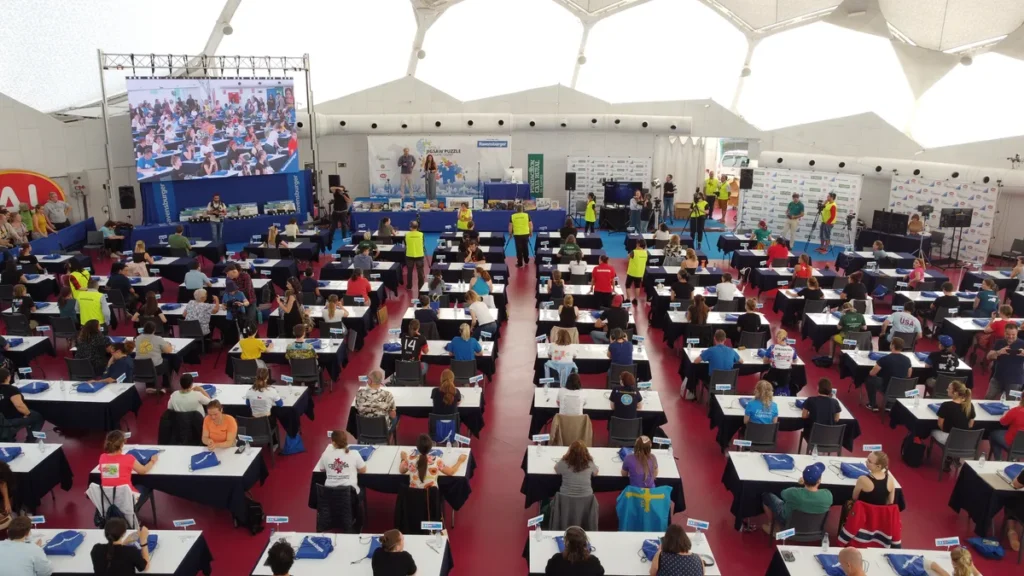
Five hundred and three players is a crowd, not a class. It is a whole school hall, a company away day, or a festival field full of people who all need something to do at the same time. A single sheet passed down a row will not work, and a game that needs everyone to hear one quiet voice will fall apart in the first five minutes. Word games can work at this size, but only when they are built for it: short rounds, clear rules, teams that run themselves, and scoring that a handful of judges can actually keep up with.
The trick is to stop thinking of 503 players as one huge group and start thinking of them as many small teams playing the same game in parallel. Seventy-one teams of seven gives you 497 players, plus a host and five roaming judges, which brings the total to 503. Each team needs a captain, a score sheet, and a pencil, and the clues and answer sheets can be printed once and copied for every table.
This guide gives you nine word games that have never appeared in this series before, along with a running order, a scoring plan, and a checklist for the day. If you want to see how the format has grown, the word games for 501 players used the same team structure with a different set of nine games, and the same principles apply here. Every game below works with printed sheets and a loudspeaker, and none of them needs a screen, an app, or a single piece of specialist equipment.
Key takeaways
- Split 503 players into 71 teams of seven, plus a host and five roaming judges.
- Run nine short games in parallel, with every team playing every game at the same time.
- Use printed answer sheets and a single score sheet per team so judging stays simple.
- Mix quick word-building rounds with slower writing and thinking rounds to keep energy up.
- Keep rounds to ten minutes or less, and announce the running scores after every third game.

How 503 Players Break Into Teams
Teams of seven are the sweet spot for a group this large. A team of seven is big enough that nobody sits idle, and small enough that everyone can hear each other across a table. Smaller teams mean more teams to manage, and larger teams mean quieter players disappear into the crowd. With 71 teams, you need 71 tables or marked floor spaces, and you need the room laid out in clear rows so the judges can walk the aisles without squeezing past chairs.
Give every team a number, a captain, and a coloured score sheet. The captain reads the clues aloud, collects the answers, and hands the sheet to a judge at the end of each round. The colour matters more than it sounds: when a judge sees a yellow sheet, they know at once which zone it came from, and a lost sheet can be returned to the right table in seconds.
The 9 Word Games at a Glance
Each game below takes about ten minutes, and every team plays every game at the same time. The table gives you the shape of the day at a glance, so you can see the balance before you read the detail. Quick rounds sit next to slower ones, and writing rounds sit next to talking rounds.
| Game | What teams do | Time |
|---|---|---|
| Polyptoton Play | Build sentences from one word root | 10 minutes |
| Ellipsis Echo | Fill in the words left out | 10 minutes |
| Epanorthosis Edit | Correct a sentence mid-flow | 10 minutes |
| Circumlocution Circuit | Describe a thing without naming it | 10 minutes |
| Troponym Trek | Sort verbs by how the action is done | 10 minutes |
| Consonance Call | Spot repeated consonant sounds | 10 minutes |
| Tricolon Tally | Build three-part parallel phrases | 10 minutes |
| Apophasis Act | Mention a thing by saying you will not | 10 minutes |
| Anacoluthon Switch | Finish a sentence that changes course | 10 minutes |
The 9 Games
These nine games all turn on how words are built, bent, and put together. They reward players who listen closely and think about language, not players who have memorised long lists of words. Read each one through once, then run them in the order given.
1. Polyptoton Play
Polyptoton is the trick of using the same word root in different forms in one sentence. The host gives each team a root word, such as sing, and the team must write a sentence that uses as many forms of that root as they can: singer, sings, sung, song. A team might write, “The singer sings a song, and the song is sung beautifully.”
Score one point for each correct form of the root, and a bonus point for the best sentence in the room. Roots that work well include teach, play, write, and move. Keep the sentences short, because a long sentence with one repeated root is worth less than a short sentence that packs in four forms.
2. Ellipsis Echo
Ellipsis is the art of leaving words out when the meaning is still clear. The host reads a sentence with a gap, and each team must write down the missing words. “Mara brought the pens, and Tom the paper” is missing the word brought the second time, and the sentence still makes perfect sense.
Give each team ten gapped sentences, and score one point for each missing word or phrase they restore correctly. The gaps should be fair: the missing words must be the only words that fit. Read the full sentence aloud after each round, so teams can hear what was left out and why it still worked.
3. Epanorthosis Edit
Epanorthosis is the habit of correcting yourself in the middle of a sentence, and turning the correction into something better. The host gives each team a plain sentence, such as “It was a good day”, and the team must rewrite it with a correction built in: “It was a good day, no, a great day.”
Score one point for each sentence that corrects itself cleanly, and a bonus point for the funniest correction in the room. The correction must change the meaning for the better, not just repeat the same word. Teams that swap in a stronger word, a bigger number, or a bolder claim will do best here.
4. Circumlocution Circuit
Circumlocution means talking around a thing instead of naming it. One player from each team draws a simple word, such as key, and must describe it in as many words as possible without saying the word itself: “the small metal thing you use to open a locked door.” The rest of the team has thirty seconds to guess it.
Score two points for each correct guess, and take one point away if the describer says the word itself. The best describers use shape, use, and place, and they avoid the obvious clues that give the answer away in the first five seconds. Keep the words simple, because a hard word makes the round drag.
5. Troponym Trek
A troponym is a verb that says how another verb is done. Stroll is a way of walking, whisper is a way of speaking, and march is a way of walking in step. The host gives each team a plain verb, such as walk, and the team must list as many troponyms of it as they can in two minutes.
Score one point for each correct troponym, and take a point away for a verb that is not a way of doing the plain verb. Walk can give you stroll, march, stride, amble, and shuffle. Speak can give you whisper, shout, murmur, and mumble. The judge needs a short list of accepted answers, so agree the list before the round starts.
6. Consonance Call
Consonance is the repetition of consonant sounds, usually at the ends of words. The host reads a short phrase, such as “odds and ends” or “pitter patter”, and each team must name the consonant sound that repeats. In “odds and ends”, the d sound repeats; in “pitter patter”, the t sound repeats.
Give each team ten phrases, and score one point for each repeated sound they name correctly. The phrases should be short and familiar, so the game tests listening rather than vocabulary. Read each phrase twice, slowly, and give teams ten seconds to agree on an answer before moving on.
7. Tricolon Tally
A tricolon is a phrase built in three parallel parts. “I came, I saw, I conquered” is the classic example, and it works because the three parts match in shape and grow in force. The host gives each team a topic, such as a good breakfast, and the team must write a tricolon about it: “Fresh bread, strong coffee, and a quiet morning.”
Score one point for each tricolon with three matching parts, and a bonus point for the best one in the room. The three parts must be the same kind of thing: three nouns, three verbs, or three short clauses. A team that writes two parts, or three parts that do not match, scores nothing for that round.
8. Apophasis Act
Apophasis is the trick of mentioning something by saying you will not mention it. “I will not mention his lateness” mentions his lateness, and everyone in the room hears it. The host gives each team a topic, such as the weather, and the team must write a sentence that brings the topic up while claiming to leave it alone.
Score one point for each sentence that names its topic by denying it, and a bonus point for the slyest one in the room. The denial must be clear: “I am not going to talk about the rain” works, while a sentence that never hints at the rain does not. This game rewards teams that enjoy a little mischief with words.
9. Anacoluthon Switch
Anacoluthon is a sentence that starts in one direction and finishes in another. The host reads the opening of a sentence, such as “The man who arrived early”, and each team must finish it in a way that breaks the grammar on purpose: “The man who arrived early, he left before lunch.”
Score one point for each finish that changes course cleanly, and a bonus point for the funniest one in the room. The break must be clear: the sentence should start with one structure and end with another. Teams that simply finish the sentence normally score nothing, because the whole point is the switch.
How to Run the Whole Day
Start with the quickest games, Polyptoton Play and Ellipsis Echo, while the room is still settling. Teams need something to do in the first ten minutes, and a short writing round gives the judges time to check that every table has its sheets. Announce each round from the stage, and use a whistle or a bell to mark the start and the end, because a voice alone will not carry across a hall of 503 people.
After the third game, pause for five minutes and announce the running scores. The word games for 499 players used the same pause after every third game, and it works because teams can see where they stand without losing the flow of the day. Keep the pause short, hand out fresh sheets, and start the next round on time.
Scoring That Stays Fair
One point per correct answer is the rule for most rounds, with bonus points only for the best sentence or the funniest correction in the room. The judges should agree the bonus winners together, and they should announce the reason out loud, so the room can hear why one answer beat the rest. A bonus that feels secret will cause more argument than a bonus that feels earned.
Disputes are settled by the host, not by the roaming judges, and the host’s word is final. The word games for 497 players used the same rule, and it kept the day moving when two teams disagreed over a single point. Write the disputed answer on the board, give the host thirty seconds, and move on to the next round.
Your Checklist for the Day
Work through this list the night before, and tick each item off as it is done. A missing item on the day is much harder to fix than a missing item the night before.
- Print 71 answer sheets for each game, plus spares, and sort them by game and colour.
- Number 71 tables or floor spaces, and mark clear aisles for the five roaming judges.
- Test the loudspeaker and the whistle from the back of the hall before anyone arrives.
- Brief the host and the five judges on the rules, the bonus points, and the dispute rule.
- Prepare the clue sheets, the accepted answer lists, and a master score sheet.
- Set out pencils, spares, and water for every table before the first team sits down.
Frequently Asked Questions
How do you split 503 players into teams?
Make 71 teams of seven, which gives you 497 players, then add a host and five roaming judges to reach 503. Keep teams at seven where you can, because smaller teams are easier to manage and larger teams leave quieter players out of the game.
How long does the whole day take?
The nine games take about ninety minutes, with a five-minute pause after every third game and ten minutes for the final scores. Plan for two hours from the first round to the last announcement, including the time it takes 503 people to find their tables.
What equipment do we need?
You need printed answer sheets, pencils, a loudspeaker, a whistle or a bell, and a master score sheet. No screens, apps, or specialist equipment are needed, and every game in this guide works with paper alone.
Can children play alongside adults?
Yes, and mixed teams often do well, because children spot sounds and patterns that adults miss. Put at least one confident reader on each team, and keep the clues short enough for younger players to follow.
How do you stop one strong team from winning every round?
Mix quick rounds with slower ones, and use bonus points for the best sentence rather than the most answers. A team that is fast at listing verbs may be slow at writing a good tricolon, and the balance keeps the day open.
What happens if a team disputes a score?
The host settles it, and the host’s word is final. Write the disputed answer on the board, give the host thirty seconds to decide, and move on to the next round so the day does not stall.
The Bottom Line
Five hundred and three players is a big day, but it is a simple one: 71 teams of seven, nine short games, one point per answer, and a host who keeps the clock. Run the games in order, announce the scores after every third game, and let the words do the work.