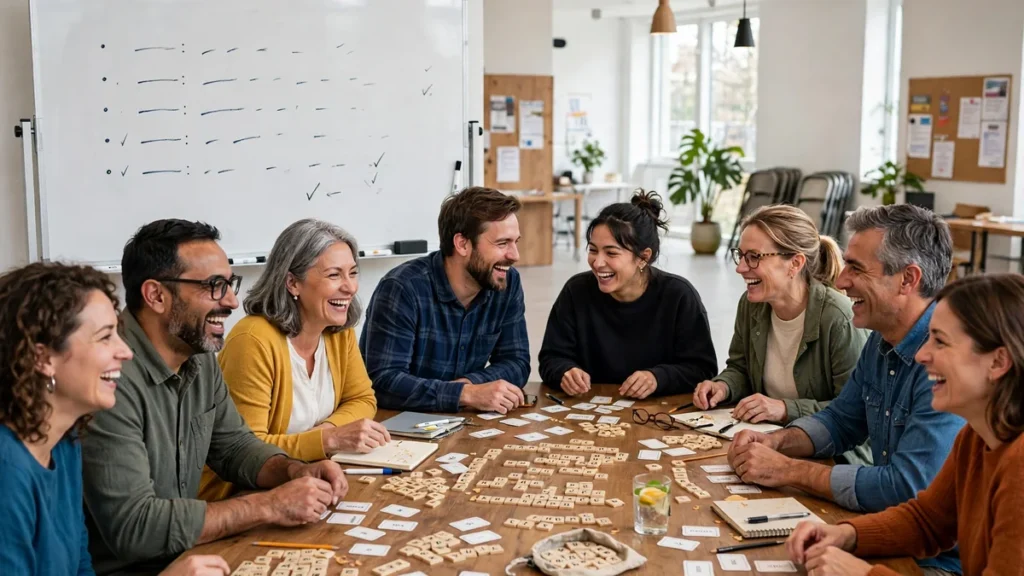
Finding the best trivia games for 60 players is a different challenge from picking a game for a quiet night with four friends. Sixty people is too many for a single table and too few to fill a stadium, so the format matters as much as the questions. The games that work best keep everyone involved at the same time, move quickly between rounds, and make scoring simple.
A group of 60 players usually means a corporate event, a school fundraiser, a family reunion, or a community night. The best trivia games for 60 players handle that scale by organising people into teams of five or six, running rounds of ten to fifteen minutes, and using a host or a screen so every table hears the same question at the same moment. When the structure is right, a crowd this size becomes an advantage: more teams, more rivalry, and a final round that feels like an event.
This guide covers the ten formats that work best for exactly 60 players, compares them side by side, and explains how to run the night from the first question to the final score. Every option below scales cleanly to ten teams, needs no specialist equipment beyond what most venues already have, and keeps the whole room playing.
Key takeaways
- Split 60 players into ten teams of six for the best balance of discussion and speed.
- Pick formats where every team answers every question at the same time, so nobody sits out a round.
- Keep rounds to ten questions and ten to fifteen minutes to hold the room’s attention.
- Use one host, one microphone, and one screen so every table hears the same question at the same moment.
- Score on paper or with a simple app, and announce the standings after every round.

How to Choose the Best Trivia Games for 60 Players
Sixty players changes the maths of a trivia night. A game that works beautifully for eight people can fall apart for sixty if only one person answers at a time or if scoring takes longer than playing. Before choosing a format, check four things: does everyone play at once, can ten teams be scored in under two minutes, does it work in a noisy room, and does it stay fun for two hours.
Team size is the first decision. Teams of six give every table enough combined knowledge to answer most questions while keeping discussion quick. Teams of five work well too, giving you twelve teams, but twelve score sheets take longer to mark. Teams larger than eight slow everything down. Ten teams of six is the sweet spot for 60 players.
Sound and sightlines come next. Every player needs to hear the question and see the screen, so a microphone is not optional at this size. A projector or a large television at the front works, and printed question sheets on each table are a useful backup if the venue has no screen.
What Makes a Trivia Game Work at This Scale
The strongest formats share three traits. First, they are simultaneous: all ten teams answer the same question at the same time, usually by writing the answer down. Second, they are quick to score, with one point per correct answer and no complicated bonus maths. Third, they mix question types, so a team weak on history can still win points on music, pictures, or sport. Plan five or six rounds of ten questions, including at least one picture round and one music round, because a change of style every ten minutes resets the energy and gives trailing teams a fresh start.
Equipment You Need Before the Night
Most of the games below need only a microphone, a screen or printed sheets, pens, and answer sheets. A buzzer set adds excitement for head-to-head rounds, but it is not essential, and a full set for ten teams can be expensive. A simple alternative is to have teams raise a coloured card. Keep the kit list short and test the sound before guests arrive, because a host nobody can hear will lose the room in five minutes.
The 10 Best Trivia Games for 60 Players
The ten formats below are ranked by how well they handle exactly 60 players, how easy they are to run, and how much fun they create in a full room. Most hosts combine two or three across the night.
1. Classic Team Pub Quiz
The classic pub quiz is the most reliable of all the best trivia games for 60 players. Ten teams of six sit at their tables, the host reads out ten questions per round, and each team writes its answers on a sheet swapped with a neighbouring table for marking. Five or six rounds cover general knowledge, history, geography, sport, science, and food and drink, and the whole night runs for about two hours including breaks. There is no app to set up, no device that can fail, and no player left waiting for a turn. The swap-and-mark system means scoring ten sheets takes about two minutes. If you are running a trivia night for 60 players for the first time, start here.
2. Picture Round Trivia
A picture round shows ten images on the screen and asks teams to identify each one: famous landmarks, film stills, flags, album covers, or close-up photos of everyday objects. Picture rounds are ideal for large groups because the question is visual, so a loud room does not matter, and teams can discuss quietly while they look at the screen. They also level the playing field, since visual memory is a different skill from recalling facts. Run the picture round as one of your middle rounds, when energy dips after the opening excitement, and print the images as a backup sheet in case the projector fails.
3. Music Round Trivia
A music round plays short clips of ten songs and asks teams to name the artist, the title, or both. Few rounds create as much noise and laughter, because a familiar opening bar makes a whole table light up at once. For 60 players, keep clips to ten or fifteen seconds each, and choose songs that span several decades so every age group in the room has a fair chance. Test the speakers before the night and keep the volume high enough to reach the back tables. Award one point for the artist and one for the title, giving twenty points for the round, so a trailing team can genuinely catch up.
4. Speed Round Trivia
A speed round gives teams sixty seconds to answer as many quick questions as they can, with the host firing questions one after another and teams writing answers in a numbered list. This format works brilliantly for 60 players because it compresses a lot of questions into a short burst and rewards quick thinking over deep discussion. Keep speed round questions short and unambiguous: capital cities, colours, numbers, and simple facts. Twenty questions in five minutes is a good target, and the round works best near the end of the night when teams are warmed up. Mark it immediately and announce the scores before the final round.
5. Buzzer Trivia
Buzzer trivia turns the night into a game show. Two teams face off at a time, the host reads a question, and the first team to hit the buzzer answers. With 60 players, run buzzer rounds as a tournament: ten teams play five head-to-head matches, the winners advance, and the final is played in front of the whole room. The crowd effect is enormous, because the forty players not currently playing become an audience that cheers every correct answer. The trade-off is time, so use it for one round only, ideally as the finale. If you do not own a buzzer set, a hand-raise or a coloured card works as a substitute.
6. Trivia Bingo
Trivia bingo gives every player their own bingo card printed with answers instead of numbers. The host reads out questions, and players mark the matching answer on their card. The first player to complete a row or a full house calls it out and wins. This format is one of the best trivia games for 60 players because it solves the biggest problem of a large group: every single person plays individually, not just the loudest voice at each table. Prepare cards in advance, either from a bingo generator or by hand for a themed night. One game takes about fifteen minutes, so it fits neatly as a mid-evening change of pace between team rounds.
7. Themed Trivia Night
A themed night builds every round around one subject: films, sport, the 1980s, geography, or a single television series. Themed trivia works well for 60 players when the group shares an interest, such as a company team, a school community, or a fan club, because a shared theme makes the room feel like one crowd rather than ten separate tables. It also makes preparation easier, since the host researches one topic deeply instead of six shallowly. Choose a theme broad enough for sixty questions, and mix styles within it: a picture round of film posters, a music round of theme tunes, and a general knowledge round about the subject. For groups that want more than just questions on the night, hosts often combine a themed quiz with the kind of large-group ideas found in guides to party games for 59 players.
8. App-Based Trivia
App-based trivia runs the whole game on players’ phones, with questions appearing on a shared screen and teams submitting answers through the app. For 60 players this removes the marking burden entirely, since scores are calculated instantly and the leaderboard updates live. The real-time standings create a constant sense of competition, and the host can see which questions were hardest and adjust the difficulty on the fly. The risks are practical rather than creative. The venue needs reliable Wi-Fi, every player needs a charged phone, and the host must know the app well enough to recover quickly if it crashes. Test the app with friends before the night, and keep a paper backup round ready.
9. Tabletop Trivia Card Game
A tabletop trivia card game gives each table its own deck of question cards, and teams play against each other at their own pace. This format suits 60 players when the evening is social rather than competitive, because teams can chat, eat, and play without waiting for a host to read the next question. Each table works through its deck, scores its own answers, and the best score across the room wins at the end of the night. Choose a deck with at least two hundred questions so no table runs out, and pick a difficulty that suits the group. The host’s role becomes a roaming one: checking scores, settling disputes, and announcing the leaders every twenty minutes.
10. Wager Round Trivia
A wager round ends the night with a single high-stakes question. Every team writes down how many of its points it is willing to risk, then hears the question, writes its answer, and either doubles its wager or loses it. With 60 players and ten teams, the final leaderboard can change completely in one question, which makes the last five minutes of the night the most exciting of all. Keep the wager question genuinely hard but fair, and give teams two minutes to discuss it. Announce the wagers before revealing the answer, so the room can react to which teams went all in. A team that trailed all night can still win.
Comparison Table
Use this table to pick the right mix for your night.
| Game | Teams | Time per Round | Equipment Needed | Best For |
|---|---|---|---|---|
| Classic Team Pub Quiz | 10 teams of 6 | 15 minutes | Microphone, answer sheets | First-time hosts |
| Picture Round Trivia | 10 teams of 6 | 12 minutes | Projector or screen | Visual thinkers |
| Music Round Trivia | 10 teams of 6 | 12 minutes | Speakers, playlist | High-energy nights |
| Speed Round Trivia | 10 teams of 6 | 5 minutes | Microphone, timer | Late-night excitement |
| Buzzer Trivia | 2 teams at a time | 20 minutes | Buzzer set, microphone | Game-show finale |
| Trivia Bingo | 60 individual players | 15 minutes | Printed bingo cards | Everyone playing at once |
| Themed Trivia Night | 10 teams of 6 | 15 minutes | Microphone, screen | Groups with a shared interest |
| App-Based Trivia | 10 teams of 6 | 10 minutes | Wi-Fi, phones, screen | Corporate events |
| Tabletop Trivia Card Game | 10 tables of 6 | 30 minutes | Question card decks | Relaxed social evenings |
| Wager Round Trivia | 10 teams of 6 | 10 minutes | Microphone, answer sheets | Dramatic finale |
How to Run a Trivia Night for 60 Players
A good trivia night for 60 players is planned in advance and run with a clear timetable. Arrive early, test the sound, lay out the answer sheets, and write the running order on a card the host can keep in a pocket. Plan for two hours of play plus two ten-minute breaks. Read each question twice, give teams about thirty seconds to answer, and move on even if a table asks for more time, because one slow table delays the other nine. Announce the top three teams and the bottom team after every round.
Your Trivia Night Checklist
- Book a venue with room for ten tables of six, plus space for the host and a screen everyone can see.
- Test the microphone, speakers, and projector before the first guest arrives, and keep spare pens and answer sheets on every table.
- Split 60 players into ten teams of six as they arrive, mixing groups so no single table is stacked with experts.
- Prepare six rounds of ten questions, including one picture round and one music round.
- Set up a simple scoring system, one point per correct answer, and announce the standings after every round.
- Buy prizes for the winning team, the best team name, and the last-placed team, so every table has something to aim for.
Setting Up the Room
Round tables seat six comfortably and let everyone see each other, which makes discussion faster than long rows of chairs. Space the tables so the host can walk between them, and put the screen high enough that the back tables can read it. Seat teams as they arrive rather than letting friends cluster into one super-team. Hand each arriving guest a coloured wristband or a table number, which mixes the room without anyone feeling managed.
Scoring, Prizes, and Fair Play
Simple scoring wins at this size. One point per correct answer, no half points, and a single bonus point for a perfect round is all you need. Marking by swapping sheets between neighbouring tables is fast and transparent. Keep a running total on a whiteboard or a slide so every team can see where it stands. Prizes do not need to be expensive: a small trophy, a box of chocolates, or a voucher for the winning team is enough, and a prize for the best team name gives a creative team something to win even if it finishes last. If your group enjoys a broader mix of large-group games, the closest comparison for planning a full evening is a guide to trivia games for 59 players, which uses the same ten-team structure with one fewer player. On fair play, state the rule at the start: phones stay face down during questions and can be used during breaks.
Frequently Asked Questions
How many teams should 60 players be split into?
Ten teams of six is the best split for 60 players. Teams of six have enough combined knowledge to answer most questions while keeping discussion quick. Twelve teams of five also works, but marking twelve sheets takes longer.
How long does a trivia night for 60 players take?
Plan for two to two and a half hours, including breaks. Six rounds of ten questions take about ninety minutes of play, and two ten-minute breaks bring the total to roughly two hours.
What equipment do I need for 60 players?
You need a microphone, a screen or projector, pens, and printed answer sheets. Speakers are essential for a music round; a buzzer set is useful for a finale but not required. For an app-based night, you also need reliable Wi-Fi and a charged phone for every player.
Can I run a trivia night for 60 players without a host?
You can, but it works better with one. A tabletop card game format lets ten tables play at their own pace with no host, and an app-based game can run itself once it is set up. A live host still adds energy, keeps the pace, and settles disputes.
What prizes work best for a 60-player trivia night?
Small prizes work best: a trophy or a voucher for the winning team, a prize for the best team name, and a joke prize for the last-placed team. Food and drink prizes are popular because the winning team can share them.
How do I stop players from looking up answers on their phones?
State the rule clearly at the start and ask teams to keep phones face down during questions. Swap-and-mark scoring makes cheating easy to spot, since a team with suspiciously perfect answers will be noticed by the table marking its sheet.
The Bottom Line
The best trivia games for 60 players let all ten teams play at the same time, score quickly, and mix question styles so every table has a round it can win. Start with a classic pub quiz, add a picture round and a music round for variety, and finish with a wager round that lets any team steal the win. With ten teams of six, one microphone, and a clear running order, sixty players stop being a logistical problem and become the reason the night is so loud and so competitive. For a similar crowd with a different game style, hosts often plan the evening alongside puzzle games for 60 players, which use the same team sizes and room layout.