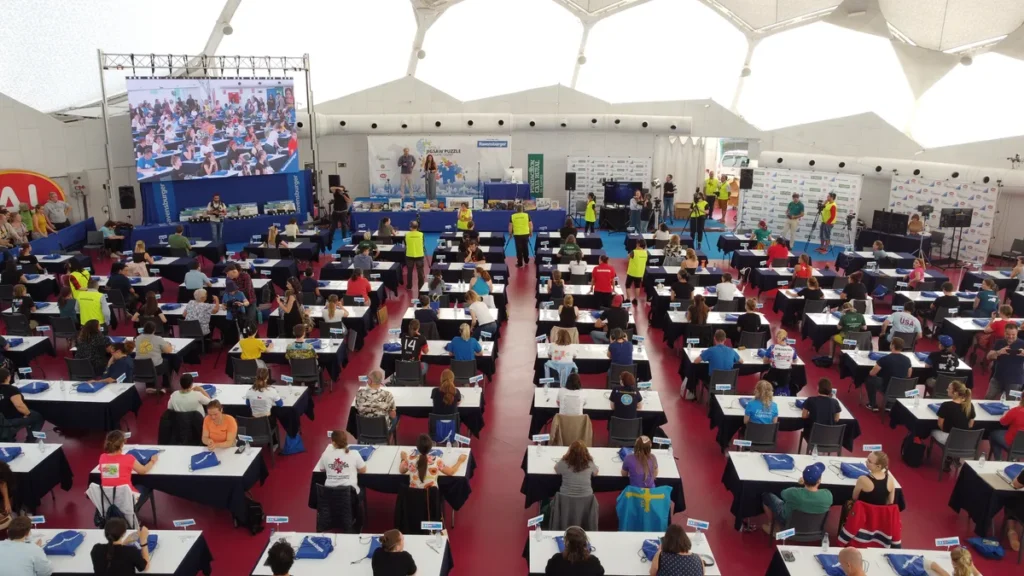
The best trivia games for 381 players are the ones that treat a giant crowd as a system, not as a single room full of people shouting answers at once. When 381 people gather for one trivia night, the game only works if every person has a clear job, a clear team, and a clear way to answer. The format matters far more than the questions. A brilliant question set will still fail if half the room cannot hear the host, cannot see the scoreboard, or cannot reach a buzzer in time.
Think of 381 as a range, not as a fixed headcount. The same plan in this guide works for a room of three friends, a hall of 60, a school of 200, and a full house of 381. The method that scales the game is simple: split players into teams, split teams across stations or divisions, and run the night as a tournament with a shared final. With 127 teams of three, or 63 teams of six plus a three person host crew, the maths stays tidy at every size. The host crew runs scoring, the stations run the rounds, and the final brings everyone back together for one shared finish.
This guide covers the ten formats that hold up best at this scale, the team sizes that keep every player involved, the station and tournament layouts that prevent bottlenecks, and the buzzer and scoring systems that keep a giant game fair. It also includes a comparison table, a night of checklist, and answers to the questions that organisers ask most often when the guest list climbs past 300. Use it to plan a school quiz night, a company social, a charity fundraiser, or a community festival where the whole town turns up to play.
Key takeaways
- Frame 381 as a range from 3 to 381 players, and scale with teams, stations, and divisions rather than one giant room.
- Teams of three to six keep every player active; teams larger than eight leave quiet players with nothing to do.
- Stations and divisions let hundreds of players answer at the same time, while a shared final keeps the night together.
- Buzzers work best in small head to head matches, while written answer sheets work best for the full crowd at once.
- Plan one host, one scorekeeper per division, and one buzzer or answer station per eight teams, then rehearse the final round before the doors open.

Why 381 Players Changes the Game
A trivia night for 12 people is a conversation. A trivia night for 381 people is an event, and events need structure. The questions can stay the same, but everything around them has to change. Sound, sightlines, scoring, and timing all become jobs in their own right. When the plan covers those four jobs, the night feels smooth. When the plan ignores them, the night feels chaotic even when the questions are excellent.
The Range Idea
The number 381 sounds extreme, yet the planning starts from the same place as any smaller game. Start with the smallest unit that works, which is a team of three. Three people can cover different strengths: one knows sport, one knows music, one knows history. From there, the numbers grow in clean steps. Three teams make a table group of nine. Nine table groups make a division of 81. Add more divisions and the total climbs toward 381 without changing the experience for any single player. Every player still sits in a team of three to six, still answers the same rounds, and still hears the same host.
That range thinking also protects the organiser when the final headcount shifts. If 40 people cancel, the night still works, because the plan was never built for exactly 381. It was built for any number between 3 and 381. If 20 extra people arrive, they join as new teams of three or four, and the divisions absorb them. The guide below uses 381 as the top of the range, with 127 teams of three as the cleanest layout, and 63 teams of six plus a three person host crew as the most social layout.
What Breaks at Scale
Four things break first when a trivia crowd grows past 100 players. The first is sound. A single speaker at the front cannot reach the back of a hall built for 381 people, so the host needs a proper public address system and at least two speakers placed halfway down the room. The second is scoring. Collecting 127 paper answer sheets between rounds takes far longer than reading the next question, so scoring has to run in parallel with play, with one scorekeeper per division.
How to Scale Trivia for Hundreds of Players
Scaling trivia is a logistics problem with a simple answer: divide the crowd, then reunite it. Divide players into teams, divide teams into divisions or stations, and divide the night into rounds that suit each division size. Then bring everyone together for a final round that decides the winner in front of the whole room. The sections below explain the three scaling methods in detail, with the numbers that work at 381 players.
Teams of Three to Six
Teams of three to six are the sweet spot for large trivia. A team of three is fast and focused, with every member needed on every question. A team of six is social and broad, with enough different knowledge to cover most categories. A team of eight or more sounds fun, yet it usually leaves two or three people watching rather than playing. At 381 players, 127 teams of three give the most even contest, while 63 teams of six give the liveliest room. Either layout works, so choose based on the mood of the event rather than the maths.
Stations That Run in Parallel
Stations are the best way to let 381 players play at the same time without waiting. Set up six to nine stations around the hall, each with its own theme, its own question set, and its own volunteer. Teams rotate from station to station in a fixed order, spending ten minutes at each one. A music station, a picture station, a sport station, a science station, a food station, and a general knowledge station give a full evening in about an hour of rotation time.
Tournaments With Divisions
Divisions also make the schedule honest. Three divisions of 127 players need three hosts, three scorekeepers, and three sets of questions, yet each division only needs to handle about 42 teams. That is a manageable number for one host. The best trivia games for 379 players use the same division idea, and the lesson carries over directly: when the crowd is huge, run several small games at once instead of one giant game that nobody can follow.
The 10 Best Trivia Games for 381 Players
The ten formats below are ranked by how well they scale, how much every player gets to play, and how simple they are to run. The table gives a quick comparison, and the sections that follow explain the top five in detail. Every format here has been chosen because it works with teams, stations, or divisions, and because it keeps the whole room involved rather than a handful of fast buzzers.
| Game | Best team size | Needs buzzers | Works at 381 | Best for |
|---|---|---|---|---|
| Classic written rounds | 3 to 6 | No | Excellent | Full crowd play |
| Buzzer head to head | 3 to 4 | Yes | Final only | Drama and finals |
| Station rotation quiz | 3 to 5 | No | Excellent | Festivals and fairs |
| Picture round circuit | 3 to 6 | No | Excellent | Mixed ages |
| Music round relay | 4 to 6 | No | Very good | Social nights |
| Speed round sprint | 3 to 4 | Optional | Good | Energy bursts |
| Category knockout | 3 to 5 | Yes | Good | Competitive nights |
| Trivia bingo | 1 to 4 | No | Very good | Casual crowds |
| Team versus team league | 4 to 6 | Optional | Good | Weekly leagues |
| Grand final showdown | 3 to 4 | Yes | Final only | Closing the night |
Three Formats That Work Best at This Scale
Classic Written Rounds
Written rounds are the backbone of any giant trivia night. The host reads ten questions, every team writes its answers on a sheet, and the sheets go to the scorekeepers while the next round begins. Nobody waits for a buzzer, nobody misses a question because another team answered first, and every team has the same chance on every question. At 381 players, written rounds are the only format that lets all 127 teams play every question at the same time.
Buzzer Head to Head
Buzzer games are the most exciting format in trivia, and the least practical for 381 players at once. One buzzer set serves two teams, so a full buzzer tournament for 127 teams would need 63 sets and a whole day. The smart move is to save buzzers for the final, where six finalists play head to head on a stage while the rest of the room watches, cheers, and plays along on paper. The finalists get the drama, and the audience still gets to test itself against every question.
Station Rotation Quiz
The station rotation quiz turns a hall into a small festival. Each station has a theme and a volunteer, and teams move around the room in a fixed order. A team might start at the music station, move to the picture station, then to sport, science, food, and general knowledge. Ten minutes per station keeps the pace brisk, and a bell signals every move. By the end of the circuit, every team has played every theme, and nobody has sat still for an hour listening to one voice.
Stations suit mixed crowds because each station can match its difficulty to its theme. The picture station can use famous faces and places that everyone recognises, while the science station can stretch keen players. Score each station out of ten, and add the station scores together for the final total. The best trivia games for 378 players show how the same rotation idea works with a slightly smaller crowd, and the only change at 381 is one more team per station or one more station on the circuit.
Running the Night for 381 Players
Running a trivia night for 381 players is a team job. One host cannot do it alone, however good the host may be. The minimum crew is one host, three division scorekeepers, one buzzer operator for the final, and one floater who solves problems, finds lost teams, and fetches spare pens. Add one volunteer per station if the night uses a station circuit. Brief the whole crew 30 minutes before the doors open, walk the room together, and agree on the signals for moving, scoring, and starting the final.
A Schedule That Fits the Crowd
A realistic schedule for 381 players runs about two and a half hours from the first question to the trophy. Doors open 30 minutes early so that teams can find tables, collect answer sheets, and settle in. Round one runs for 20 minutes, round two for 20 minutes, and then a 15 minute break lets the scorekeepers catch up and the bar or kitchen serve the room. Round three and round four take 40 minutes together, the picture round closes during the break, and the grand final takes 20 minutes on the main stage. Prize giving takes ten minutes, and the whole night ends before the energy fades.
Keep the schedule visible. Put a printed running order on the wall near the entrance, and have the host announce the time of the next break before each round begins. Players who know when the break comes will stay focused through the round, while players who have no idea when the night ends will start checking the time. The guide on how to run a pub quiz covers the same timing logic for a smaller room, and the only change at 381 players is more time for scoring and more time for teams to move between stations.
Scoring and Buzzers Without Chaos
Fair scoring at this scale needs a system, not goodwill. Give each division its own scoreboard, updated after every round, and place the scoreboards where the room can see them. Use a simple points system: one point per correct answer, with bonus points only in the final. Avoid complicated half points and tiebreak rules in the early rounds, because they slow the marking and confuse the room. Save the tiebreak for the final, where a single sudden death question can decide the winner in front of everyone.
Buzzers need the same discipline. Keep the buzzer sets on the main stage, not on the tables, so that only the finalists touch them. Assign one volunteer to watch the buzzers, call the first press, and reset the set after each question. If a buzzer fails mid final, pause the game, swap the set, and replay the question. The audience will accept a short pause for a fair result, yet it will not accept a final decided by faulty hardware. Keep a spare buzzer set at the scoring table, with fresh batteries fitted before the night begins.
Checklist for the Night
Use this checklist in the week before the event, and again on the day itself. Every item here prevents a problem that has spoiled real trivia nights for large crowds. Tick each item off with the crew, and keep the list at the scoring table so that nothing gets missed in the rush before the doors open.
- Book a hall with seating for 381 players, a stage for the final, and a public address system with speakers halfway down the room.
- Print 127 answer sheets per round, plus spares, and a team list with a number for every team.
- Prepare three question sets, one per division, with ten questions per round and a printed answer key for each scorekeeper.
- Test every buzzer set, fit fresh batteries, and keep one spare set at the scoring table.
- Brief the host, the three division scorekeepers, the buzzer operator, and the station volunteers 30 minutes before doors open.
- Set the final scoreboard where the whole room can see it, and rehearse the grand final with the crew before the first team arrives.
Frequently Asked Questions
Can 381 players really play one trivia game together?
Yes, if the game is built as teams, stations, and divisions with a shared final. No single format lets 381 people answer one buzzer at the same time, yet written rounds, station circuits, and divisions let every player answer every question. The final brings the top teams together on stage, so the whole room shares one ending even though the early rounds ran in parallel.
What is the best team size for 381 players?
Teams of three to six work best. A team of three keeps every member involved, while a team of six brings broader knowledge to the table. At 381 players, 127 teams of three give the most even contest, and 63 teams of six give the most social room. Avoid teams larger than eight, because quiet players end up with nothing to do and the team slows down on every question.
How many buzzers does a 381 player game need?
The main game needs none, because written rounds and stations serve the full crowd better than buzzers. The grand final needs one buzzer set for the finalists, plus one spare set at the scoring table. If the budget allows, eight sets can run a side knockout bracket during the station rounds, yet the main event should never depend on buzzer hardware.
How long should a trivia night for 381 players last?
Plan for about two and a half hours from the first question to the trophy, with doors opening 30 minutes early. Four written rounds of 20 minutes, a 15 minute break, and a 20 minute grand final fit that window. Longer nights lose the back of the room, while shorter nights feel rushed when 127 teams need time to settle, answer, and hand in sheets.
How do you score 127 teams without long delays?
Split scoring by division, with one scorekeeper per division marking while the next round runs. Use one point per correct answer, mark sheets in pairs, and update a visible scoreboard after each round. Collect answer sheets at the end of each round rather than at the end of the night, so that marking never piles up into one giant job.
What prizes work for a crowd of 381 players?
A trophy for the winning team, medals or small prizes for the runners up, and a fun prize for the best team name cover the night well. Add a raffle or a spot prize for a random team number, so that teams at the bottom of the table still have a reason to stay until the end. Keep prizes modest and the focus on the game, because the best reward at a giant trivia night is the shared experience of playing together.
Bottom Line
The best trivia games for 381 players succeed because they respect the size of the crowd instead of fighting it. Teams of three to six keep every player involved, stations and divisions let hundreds of players answer at the same time, written rounds keep the contest fair, and a buzzer final on stage gives the night a shared ending. Plan the sound, the scoring, and the schedule with the same care as the questions, brief the crew before the doors open, and rehearse the final. Do that, and 381 players will leave talking about the night, the questions, and the team that lifted the trophy.