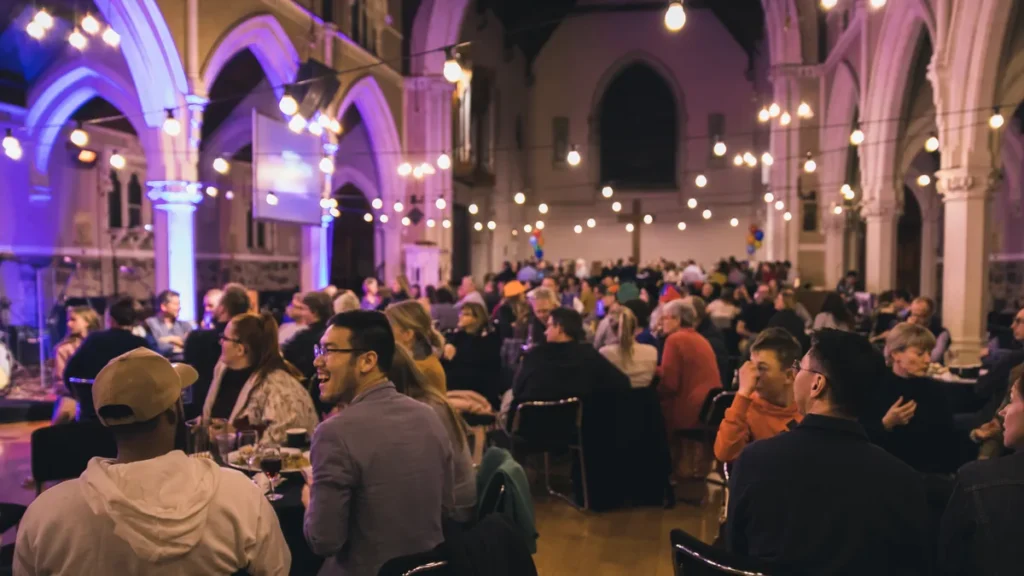
Trivia games for 380 players sound impossible until you see one work. Three hundred and eighty people is not a game night. It is a whole school year group, a company conference, a charity gala, or a village festival that happens to be playing a quiz. Most trivia games are built for one table of four to eight friends, so the idea of stretching the same format across hundreds of players feels like it should fall apart. It does not have to. The trick is to stop thinking of 380 players as one giant team and start thinking of them as many small teams playing the same game at the same time.
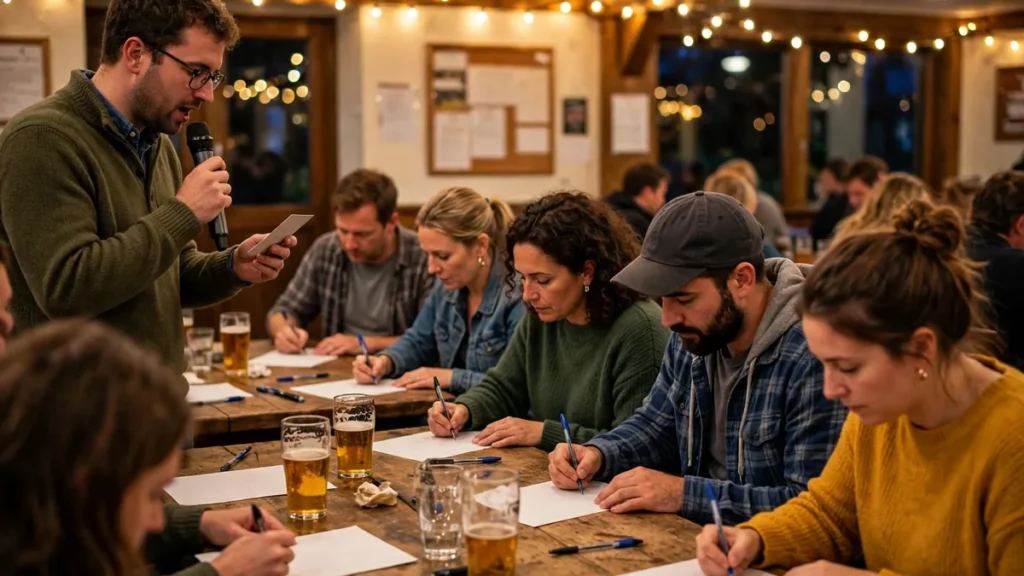
The format that makes trivia games for 380 players work is simple on paper and satisfying in the room: small teams of four to six, seated at tables or stations, all answering the same questions on the same clock, with scores flowing to one shared scoreboard. Nobody waits for a turn. Nobody sits out a round. Every table argues over the same question at the same moment, and the room fills with the low roar of 380 people thinking out loud together. That shared timing is what turns dozens of separate tables into one event.
This guide explains exactly how to run trivia at that scale. You will find ten game formats that hold up with 380 players, a comparison table to help you choose, a setup plan for the room, the hosts, and the scoring, a game-day checklist, and answers to the questions every large-group host asks before the night begins. Whether your crowd is three people at a kitchen table or 380 in a hall, the same principles apply, and the range from 3 to 380 is the whole point: the game scales by adding teams and stations, not by changing the rules.
Key takeaways
- Trivia for 380 players works as many small teams of four to six playing the same questions at the same time, not as one giant team.
- Teams, stations, and a tournament bracket are the three scaling methods; pick the one that fits your room, your time, and your crowd.
- Keep rounds short, questions clear, and scoring visible on one shared scoreboard so every table stays in the game.
- Picture rounds, music rounds, and general knowledge rounds scale best because every table can answer at once.
- Plan one host, one scorer per zone, and a rehearsed timetable, and the night runs itself once the first question lands.

Why 380 Players Changes the Game
A quiz for eight people and a quiz for 380 people are the same game with different logistics. The questions do not change. The laughter does not change. What changes is everything around the questions: the room, the sound, the scoring, and the way answers travel from a table to the scoreboard. Get those right and the quiz feels intimate even in a hall full of strangers. Get them wrong and the night drags, tables lose track of the score, and the back of the room stops listening.
The 3-to-380 Range
Think of trivia as a game with a range of 3 to 380 players, and the format as a dial you turn as the crowd grows. With three players, one team answers together at one table. With thirty, you have five or six teams and one host. With 380, you have roughly sixty to ninety teams, and the host becomes more of a broadcaster than a conversationalist. The questions stay the same at every size. Only the delivery changes.
What Breaks First at Scale
Sound breaks first. In a small room, a host with a strong voice is enough. In a hall of 380, the back tables hear a murmur and guess at the questions. A proper speaker system, a microphone that does not cut out, and a screen showing every question in writing are not luxuries at this scale. They are the game itself. If half the room cannot hear or read a question, half the room is not playing.
The Team-and-Station Format That Makes It Work
The team-and-station format is the engine of large trivia. Teams sit at tables. Each table is a station in the sense that it has its own answer sheet, its own pen, and its own small world of debate. The host runs the same round for every station at once. Nothing moves between rounds except the scoreboard. This is the format behind the best large quizzes, from school halls to corporate conferences, and it is the reason 380 players can feel like one game instead of sixty separate ones.
Team Size That Actually Works
Four to six players per team is the sweet spot. Three works, but a team of three can stall on a question nobody knows. Seven or eight still works, but the quieter players start to disappear and one confident voice takes over. With 380 players, four to six per team gives you roughly 65 to 95 teams, which sounds like a lot until you realise the host only ever deals with teams, never with individuals.
One Shared Scoreboard
Every table should be able to see the score at all times. A projected scoreboard, updated after each round, turns a quiz into a competition. Without it, teams play in the dark, and the night feels like a classroom exercise. With it, a team in twentieth place can see the gap to tenth and decide to take a risk on the wager round. That visible ladder is what keeps the back tables playing hard in round eight.
7 Trivia Games for 380 Players
Not every trivia format survives contact with 380 players. A buzzer game built for two teams needs a tournament bracket. A board game built for six needs a station version. The seven formats below are the ones that hold up, because they let every team play every round, they need little equipment per table, and they keep the host in control of the clock. Pick three or four for a single night rather than trying to run all seven.
1. General Knowledge Mega-Quiz
The classic, and still the best starting point. Eight rounds of ten questions, covering history, geography, science, sport, food, music, film, and the world around us. Every team answers every question, so nobody is ever eliminated and nobody waits. The mega-quiz is the format that the trivia games for 379 players guide uses as its backbone, and the same structure carries 380 players without a single change. Vary the difficulty within each round: three easy, four medium, three hard, so every team scores something and no team sweeps everything.
2. The Pub Quiz Classic
Five or six rounds, an answer sheet per team, a picture round in the middle, and a host who reads the questions twice. The pub quiz classic works at 380 players because it was designed for a noisy room: written questions on screen, spoken questions from the host, and a marking break with music. The difference at scale is only the marking, which happens in zones while the host runs a bonus round. It is the most forgiving format in this list, and the best choice for a first large quiz.
3. Picture Rounds
Show a picture, ask a question about it. Famous faces, flags, landmarks, album covers, film stills, or close-ups of everyday objects. Picture rounds scale beautifully because a screen can show the same image to 380 people at once, and every table works it out together. Print the pictures on the answer sheet too, as a backup for tables with a bad view. Ten pictures, one point each, and a bonus point for the team that names all ten. Picture rounds are also the easiest round to write badly, so test every image on a small group first and throw out any picture that is a guess rather than a question.
4. Music Rounds
Play ten seconds of a song and ask for the artist, the title, or the year. Music rounds are the loudest, happiest part of a big quiz, and they work because the whole hall hears the same clip at the same moment. Choose songs the crowd will know, mix decades and genres, and keep the clips short so the round moves fast. A music round also doubles as the interval: play the clips, let the teams argue, and mark the previous round while the room is still buzzing. For a full guide to the hosting side of the night, the how to run a pub quiz guide covers microphones, timing, and marking in detail.
5. Buzzer Tournament Bracket
Two teams, one buzzer each, fastest finger answers. With 380 players, run it as a tournament: teams qualify through the written rounds, and the top eight go into a knockout bracket on stage while the rest of the hall watches and plays along on their sheets. The bracket gives the night a finale that a written quiz cannot match, and the audience becomes part of the game by shouting answers from their tables. Keep the bracket short: quarter-finals of five questions, a semi-final, and a final. The stage final should take fifteen minutes, not an hour.
6. Speed Rounds
Twenty questions, sixty seconds per question, no conferring time beyond a quick whisper. Speed rounds are the energy spike of a big quiz. They favour quick recall over deep debate, which suits a hall of 380 because the room never goes quiet for too long. Run a speed round after the interval, when attention dips, and watch the hall wake up. Keep the questions short and the answers shorter: one word, one name, one number. A speed round with long questions is not a speed round.
7. The Final Wager Round
One question, one wager. Teams bet some or all of their points before hearing the question, then answer together. The wager round is the ending every large quiz needs, because it lets a team in fifth place win the night and lets the leaders feel real pressure. Announce the wager round early so teams can plan for it, and make the question hard but fair: something the best team has a real chance of knowing, not a trick. The trivia games for 378 players guide uses the same closing round, and it works for the same reason at 380: the quiz is decided by the players, on the last question, in front of the whole hall.
Which Format Fits Your Night?
| Format | Best for | Equipment per table | Host effort |
|---|---|---|---|
| General knowledge mega-quiz | Any crowd, any venue | Answer sheet and pen | Medium |
| Pub quiz classic | First-time large quizzes | Answer sheet and pen | Low |
| Picture rounds | Halls with a big screen | Printed picture sheet | Low |
| Music rounds | Evening events, mixed ages | Nothing extra | Medium |
| Buzzer tournament bracket | A dramatic finale | Buzzers for finalists only | High |
| Speed rounds | After the interval | Answer sheet and pen | Low |
| Final wager round | Closing any quiz | Wager slip | Low |
Setting Up Your 380-Player Night
Room Layout
Seat teams at round tables of six where you can, and leave a clear aisle down the middle of the room for the host, the scorers, and the runners. Round tables let every player see the screen without turning around, and they keep team debate inside the table instead of spilling across the room. If the venue only has long banquet tables, seat teams in blocks of six with a gap between blocks, and mark each block with a team number card so scorers can find it fast.
Hosts and Scorers
One host runs the night. Not two, not a committee. One voice, one pace, one set of decisions. The host reads the questions, keeps the clock, and talks to the room. Everything else is done by other people: a scorer per zone, a scoreboard operator, a timekeeper, and a floater who solves problems. Give each of those people a written job card with their zone, their timing, and the name of the person they report to.
Brief the host on the crowd. A host who knows the event is a school fundraiser will joke differently from a host who knows it is a company conference. Give the host the team names, the cause, the prize, and the one fact about the night that matters most, and let them use it. A host who reads questions like a train timetable will lose a hall of 380. A host who talks to the room like a person will keep it.
Game-Day Checklist
- Sound and screen checked from the back row, with a spare microphone and a spare cable in the room.
- Answer sheets printed for every team plus twenty spares, with pens on every table before the doors open.
- Team number cards on every table, and a zone map for every scorer showing their ten tables.
- Scoreboard tested with a dummy round, and the top-five format agreed with the host before the first question.
- Volunteers briefed with written job cards, including who collects sheets, who marks, and who posts scores.
- Prizes, team-name slips, and wager slips ready at the host table, with the final question sealed until the wager round.
Frequently Asked Questions
Can trivia really work for 380 players?
Yes, and it works well, because trivia scales by adding teams rather than by changing the game. With teams of four to six, 380 players become roughly 65 to 95 teams, and every team answers the same questions at the same time. The host, the sound system, and the scoring need to be planned for the size of the room, but the questions and the fun are the same as a quiz for eight people.
How many teams should 380 players form?
Aim for 65 to 95 teams of four to six players each. Cap team size at six so every player gets a voice, and split larger groups rather than letting one table hold ten people. Mixed teams score more steadily across the night than teams of specialists, so mix ages, departments, or year groups where you can.
How long does a 380-player quiz take?
Plan for about two and a half hours from the first question to the last prize. That covers eight rounds of ten questions at roughly fifteen minutes each, a twenty-minute interval, and time for the welcome and the prizes. A shorter night of five rounds fits into about ninety minutes, which suits a school evening or a lunch event.
What equipment do I need for 380 players?
A microphone and speakers that reach the back of the hall, a screen every table can see, printed answer sheets and pens, team number cards, and a projected scoreboard. That is the core kit. Buzzers are only needed for a stage final, and digital answer forms are optional: paper is more reliable when 380 phones share one venue network.
How do I stop cheating at a quiz this big?
Keep it light and practical. Ask teams to put phones away during rounds, run a phone-free round if the crowd agrees, and use questions that reward thinking rather than searching: picture rounds, music rounds, and questions with a twist are hard to search quickly. The real answer is culture: a host who treats the quiz as fun, and a crowd that wants to win fairly, will police itself better than any rule.
What is the best prize for a 380-player quiz?
A prize the whole winning team can share, plus smaller prizes for the best team name and the most improved team. A shared meal, a hamper, or a trophy the team keeps for a year all work better than cash, which is hard to split six ways. Announce all the prizes at the start so every team has something to play for, not just the leaders.
Bottom Line
Trivia games for 380 players work when you treat 380 as a range, not a wall. Start with small teams, run the same questions for every table at the same time, and let teams, stations, and a tournament bracket do the scaling for you. Keep the rounds short, the questions clear, and the scoreboard visible, and a hall of strangers will feel like a room full of friends by the third round. Plan the room, brief the volunteers, rehearse the handoffs, and the night will run itself. The quiz is the same game you already know. It just has more people laughing at it.