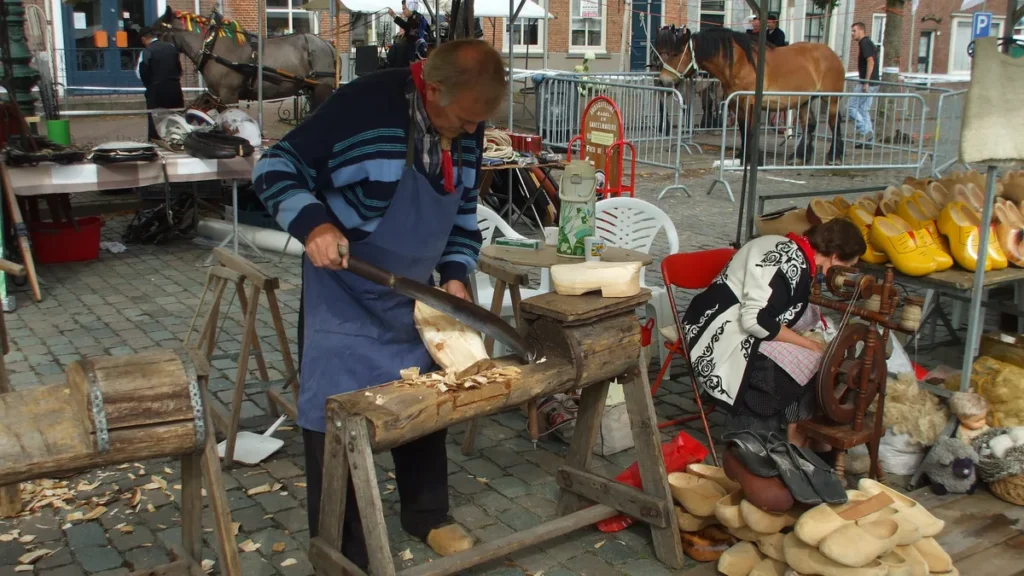
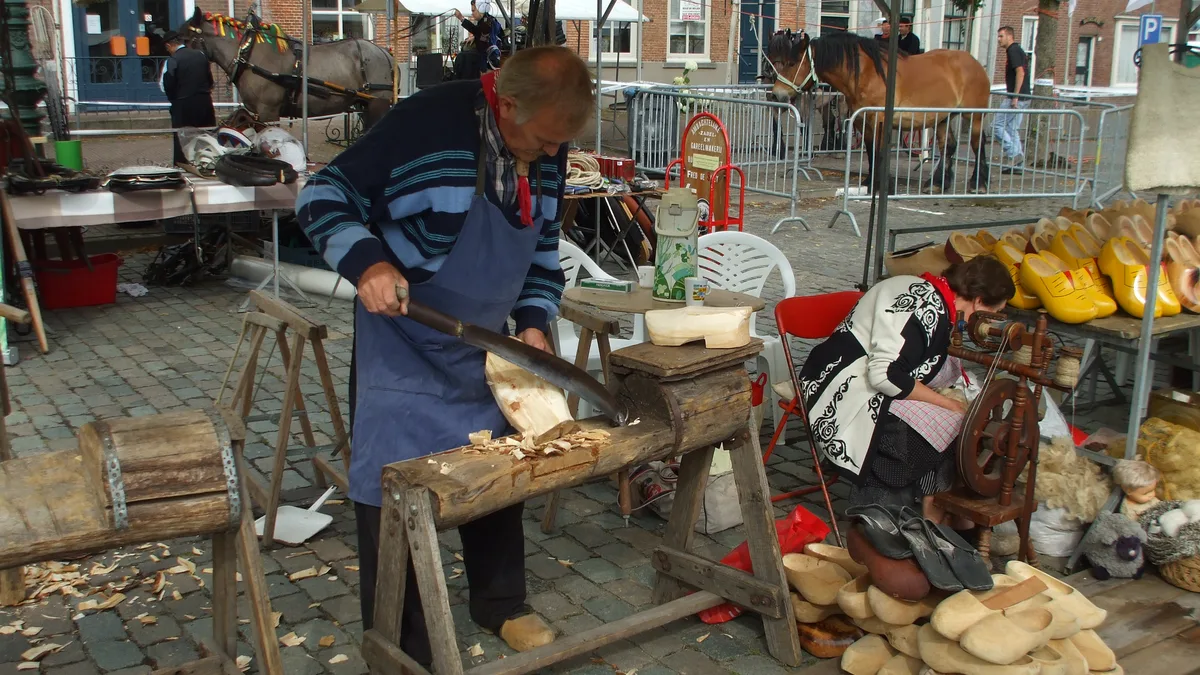
In a small village workshop, a clog maker turns plain wood and leather into footwear that can outlast its owner. The wooden base is shaped by hand, the leather top is cut and fitted over it, and every clog leaves the workshop with the maker’s initials on it. That workshop gives this day its theme: nine short puzzle races, each one built around a single part of a clog or a single implement from the maker’s shelf.
Five hundred and fifty-five players is a large crowd for one day, so the day is built around movement. Players divide into small groups, and each group works through the nine races in turn, spending about ten minutes at each one. No group waits long, no race needs more than a few ordinary items, and every race ends with a clear tally that the organiser can read at a glance. The clog-maker theme ties the whole day together without making any race hard to explain: each race has one job, one clog bit, and one way to earn its tally.
This plan suits a fete, a school fair, a community day, or any large gathering where people of mixed ages want to play together. Younger players can join every race, older players will enjoy the craft detail, and nobody needs to know anything about clog making before they start. The instructions below give you the order of the day, the nine races, a short checklist, and answers to the questions organisers ask most often.
Key takeaways
- 555 players take part in nine clog-maker puzzle races, all held in an old village clog-maker’s workshop.
- Each race lasts about ten minutes, and groups move from one work area to the next so nobody waits long.
- Every race uses one clog bit, such as the vamp, the instep, or the welt, and one simple job.
- Tallies are kept on paper, one tally per group per race, and the leading group is the one with the highest total at the end.
- Nobody needs to know anything about clog making before they start, and all nine races run with ordinary paper, pencils, wood, and leather strips.
How 555 Players Fit Into One Day
The simplest way to run a day for 555 players is to divide them into groups of five. That gives 111 groups, and each group needs a starting area. Nine races cannot hold 111 groups at once, so each race area holds several groups at the same time, working side by side on separate copies of the same job. Ten minutes per race, with two minutes to reach the next area, gives a full round of nine races in about one hour and fifty minutes.
Run the round twice, once in the morning and once in the afternoon, with a midday pause for food and rest. The morning round lets every group learn the races; the afternoon round lets them chase a better tally. Add the two tallies together for the final total. If the morning runs late, leave out the afternoon repeat of the two longest races and keep the rest. The plan below still works with a single round if time is short: one round, nine races, and a final tally at the end of the day.
Keep one organiser at each area, plus two floaters who carry extra paper and pencils and help any group that falls behind. The organisers do not need craft skills. Each race below tells the organiser exactly what to hand out, what to look out for, and how to work out the tally, so a volunteer can run any area after a two-minute briefing.
The Nine Races
Each race below names its clog bit first, then the job, then the tally.
1. Clog Vamp Count Race
The vamp is the front of the leather top, the part that covers the toes and rises over the front of the foot. In this race, each group gets a tray of mixed vamp pieces in three lengths: short, middle, and long. The job is to count how many of each length are in the tray, and to write the three tallies on the group sheet. The pieces look alike at first glance, so groups must put them out in three rows and count each row twice.
The organiser checks the three tallies against the answer sheet and awards one tally for each correct row, so a group can earn up to three. A group that rushes and guesses will usually miss the middle row, where short and long pieces hide among the others.
2. Clog Instep Measure Race
The instep is the raised middle of the leather top, where the foot bends. In this race, each group gets five instep strips and a marked ruler, and the job is to measure each strip to the nearest half centimetre and write the five lengths in order from shortest to longest. The strips differ by only a little, so groups must measure with care and agree on each reading before they write it down.
The organiser awards one tally for each strip in its correct position in the order, so a group can earn up to five.
3. Clog Gouge Cut Race
A gouge is a curved cutting implement the maker uses to clear the inside of the wooden base. In this race, each group gets a sheet showing nine gouge cuts drawn as curved lines, and the job is to work out which three cuts are the odd ones out: two that curve the wrong way and one that is too deep. The sheet also shows a plain clog base, and groups must point to where each odd cut would fall on the base.
The organiser awards one tally for each odd cut found, up to three. Groups should run a finger along each curve and ask whether it suits the shape of the base or fights against it.
4. Clog Adze Shape Race
An adze is a broad cutting implement the maker swings to shape the outside of the wooden base. In this race, each group gets nine outline shapes of clog bases, and the job is to choose the three that match the maker’s pattern and to put aside the six that do not. The wrong shapes are close: one is too wide at the toe, one is too slim at the back, one is too long, and the rest have small faults in the curve of the side.
The organiser awards one tally for each correct shape kept, up to three. Groups should hold each outline up against the pattern and look at the toe first, then the back, then the side.
5. Clog Quarter Sort Race
The quarter is the side panel of the leather top, running from the vamp to the back of the clog. In this race, each group gets a pile of quarter panels in four colours of leather: tan, dark brown, black, and natural. The job is to sort the pile into four colour groups and then count each group, writing the four tallies on the group sheet. The colours are close in dim light, so groups should sort near a window or under a bright lamp.
The organiser awards one tally for each colour group counted correctly, up to four. The dark brown and black panels cause the most mistakes, so groups should check those two piles twice.

6. Clog Welt Order Race
The welt is the slim strip of leather that runs around the base of the top, joining the leather to the wood. In this race, each group gets eight welt strips of different lengths, and the job is to put them in order from longest to shortest. The strips differ by small amounts, so groups must compare them side by side and rearrange them until the order is right.
The organiser awards one tally for each strip in its correct position, up to eight, which makes this the richest race of the day.
7. Clog Cleat Check Race
A cleat is a small grip fixed under the wooden base to keep the clog from slipping on wet ground. In this race, each group gets a sheet showing twelve clog bases, each drawn with its cleats, and the job is to find the four bases where a cleat is missing or fitted wrongly. The drawings are small, so groups must look at each base in turn and put a pencil cross beside the faulty ones.
The organiser awards one tally for each faulty base found, up to four, and takes one tally away for each good base wrongly marked, so guessing is worse than leaving a base unmarked.
8. Clog Rand Match Race
The rand is a thin strip that fills the join between the leather top and the wooden base, keeping draughts and dust out of the clog. In this race, each group gets six rand strips and six small clog drawings, and the job is to match each strip to the drawing whose join it fits. The strips differ in length and in thickness, and each drawing needs one strip only.
The organiser awards one tally for each correct pairing, up to six. Groups should measure each strip against the drawings before they commit, because two strips look the same length but differ in thickness.
9. Clog Toe Length Race
The toe is the front of the clog, and its length decides how the clog feels on the foot. In this race, each group gets nine toe outlines drawn on a single sheet, and the job is to measure each toe from the very front to the line where the vamp begins, then write the nine lengths in order from shortest to longest. The outlines are close in length, so groups must measure with the ruler flat and read to the nearest half centimetre.
The organiser awards one tally for each toe in its correct position in the order, up to nine, which makes this the longest race of the day and a fitting final. Groups should measure each toe twice and write the lengths on scrap paper before they try to order them.
The Stations
Give each race its own work area, with the race name written large beside it and a copy of the instructions beside it. The areas can sit in a hall, outdoors, or out on the grass, as long as groups can get between them without crossing each other. Put the quiet races, such as the gouge and adze races, away from the lively ones, such as the vamp and quarter races, so careful groups are not disturbed. The old-globe workshop in our puzzle games for 551 players uses the same nine-area layout, with one race at each area.
Each area needs a table or a flat surface, the race materials, pencils, and a tally sheet for the organiser. Keep extra materials close by so the organiser can replace a lost strip or a torn sheet without leaving the area.
Running the Tournament
Start the day with a short welcome that explains the theme, the nine races, and the tally. Show one clog, point out the vamp, the instep, the quarter, the welt, the rand, and the toe, and let players look at it closely if you have an extra one. Then send each group to its starting area and start the clock. The soap-boiler’s workshop day in our puzzle games for 552 players runs on the same rotation, with nine short races and a shared tally.
Call time clearly at each area, and give groups two minutes to reach the next area. If a group finishes early, the organiser can let them check their work, but they must not start the next race until the call.
The Day at a Glance
The table below sums up the nine races, the clog bit each one uses, the job, and the highest tally a group can earn. The sailmaker’s loft in our puzzle games for 550 players keeps the same day shape, with morning races, a midday pause, and afternoon races. Use the table when you brief your organisers, and leave a copy at the main desk so players can see what is coming next.
| Race | Clog bit | The job | Highest tally |
|---|---|---|---|
| 1. Clog Vamp Count Race | Vamp | Count vamp pieces by length | 3 |
| 2. Clog Instep Measure Race | Instep | Measure instep strips and order them | 5 |
| 3. Clog Gouge Cut Race | Gouge | Find the three odd gouge cuts | 3 |
| 4. Clog Adze Shape Race | Adze | Keep the three shapes that match the pattern | 3 |
| 5. Clog Quarter Sort Race | Quarter | Sort quarter panels by colour and count them | 4 |
| 6. Clog Welt Order Race | Welt | Put welt strips longest to shortest | 8 |
| 7. Clog Cleat Check Race | Cleat | Find the four faulty clog bases | 4 |
| 8. Clog Rand Match Race | Rand | Pair each rand strip with its drawing | 6 |
| 9. Clog Toe Length Race | Toe | Measure toes and order them by length | 9 |
Your Clog-Maker’s Workshop Checklist
- Print 111 group tally sheets, nine rows each, plus extra sheets for mistakes.
- Cut the vamp pieces, instep strips, quarter panels, welt strips, and rand strips before the day starts, and keep each pile separate.
- Draw or print the gouge, adze, cleat, and toe sheets, with one answer sheet per area for the organiser.
- Put out nine work areas with the race names on show, pencils, rulers, and a small tray for spares at each one.
- Brief every organiser for two minutes on their race, the tally, and the time call.
- Put two floaters on the rota with extra paper, pencils, and rulers, and a main desk for adding tallies.
Frequently Asked Questions
How long does the full day take?
A full day with two rounds takes about four hours, including the midday pause. One round of nine races takes about one hour and fifty minutes, with ten minutes per race and two minutes to get between areas. If you run a single round, allow two hours from the welcome to the final tally.
What if we have fewer than 555 players?
With fewer than 100 players, you can run one group per area at a time and keep the same ten-minute rhythm.
Do players need to know anything about clogs?
No. Every race explains its own clog bit in plain words, and the welcome shows a real clog so players can see the vamp, the instep, the quarter, the welt, the rand, and the toe. Players who have never seen a clog before do just as well as players who have.
What materials do we need?
Paper, pencils, rulers, leather strips, lengths of wood, and printed sheets for the gouge, adze, cleat, and toe races. You do not need real clogs, though one extra clog for the welcome helps players picture the parts. All the race materials can be cut from paper and cardboard if leather and wood are hard to find.
How do we keep 555 players busy without long waits?
Groups of five move together, each area holds several groups at once, and every race lasts ten minutes. The two-minute gap between areas gives organisers time to reset the materials. The floaters help any area that falls behind, so no group waits more than a few minutes at any point in the day.
Can we run this indoors on a wet day?
Yes. All nine races need only a flat surface, good light, and room to arrange pieces in rows. A hall with nine tables works well, and the quarter race benefits from bright light so the leather colours stay clear. Outdoors, open ground works just as well when the ground is dry.
The Bottom Line
An old village clog-maker’s workshop gives 555 players a day that is easy to run and easy to enjoy. Nine short races, each built around one part of a clog, keep every group busy, and the shared tally keeps the day honest.


