Four hundred and forty-six players, nine puzzle stations, and one hall that has to stay calm while everybody in it is thinking hard. That is the whole challenge of a 446-player puzzle day, and it is entirely solvable. The crowd only feels unmanageable when everyone tries to do the same puzzle at the same time, in the same place, with the same set of pieces. Split the players into small teams and the puzzles into stations, and the hall stops feeling crowded.
The number 446 divides into 88 teams of five and one team of six, which is 89 teams in total, and that small unevenness never matters once play starts, because the single team of six simply gets one extra step in each puzzle to balance the extra pair of hands. This plan needs no screens, no apps, and no special venue. A school hall, a community centre, or a large function room will do, as long as it holds nine stations with room for teams to move between them.
The nine formats below are all fresh for this series, and every one of them is built on words. Teams decode picture puzzles, act out phrases without speaking, sketch clues against the clock, guess letters one at a time, rhyme their way down a list, race letter tiles into place, spell under pressure, match words to their meanings, and sort out sound-alike words that mean different things. A team that is slow at one station can still shine at the next, because each format rewards a different kind of word skill. Nobody needs to be good at everything, and nobody is stuck doing the same kind of thinking all day.
Key Takeaways
- Split 446 players into 89 teams, 88 teams of five and one team of six, and run them in four flights of 22, 22, 22, and 23 teams.
- Run nine stations at once, one puzzle format per station, with every team playing every format.
- Give each round 12 minutes of play and three minutes to move, so nine rounds fit into about two and a quarter hours per flight.
- Score every round out of ten, with a small speed bonus, so a slow start never ends a team’s day.
- Print everything the night before and brief nine helpers, one per station.
How a 446-Player Puzzle Day Works
With 89 teams in total, the day runs in four flights of 22, 22, 22, and 23 teams, one in the morning, one around midday, one in the afternoon, and one in the early evening, and each flight follows exactly the same rotation. Inside a flight, two or three teams share a station in each round, and each team gets its own puzzle set, so teams race the clock and each other rather than waiting for a turn. A short welcome at the start of each flight explains the rotation, the scoring, and the one rule that matters most: when the bell rings, stop writing and move.
Each round lasts 12 minutes, and the changeover lasts three minutes, so nine rounds take two hours and fifteen minutes. Add a fifteen-minute welcome, a ten-minute break, and fifteen minutes for results, and each flight fits comfortably into three hours. The station helper at each table explains the rules in under a minute, starts the clock, and records the score when the round ends. Helpers keep a spare set at every station, because a lost tile or a torn sheet should never stop a round. The same team-and-station shape worked well in the puzzle games for 445 players plan, where the flight system kept a very large crowd moving without queues, and the only real change here is the set of nine formats, which are all new.
Inside each team, small jobs keep everyone involved. Every team needs a captain, a scorekeeper, and a timekeeper, and those jobs should rotate between rounds so nobody is stuck writing answers all day. The captain collects the puzzle sheet and hands in the answer sheet, the scorekeeper records the points the judge awards, and the timekeeper watches the clock and calls out the last two minutes. Three smaller rooms work just as well as one big hall, with three stations in each room, as long as every team can see the big clock and hear the bell. Put the noisy formats at one end of the hall and the quiet paper formats at the other, so the spelling and definition tables stay calm while the charade and pictionary races build up a cheer.
The 9 Puzzle Formats at a Glance
Use this table to plan the day at a glance. Every round below runs for 12 minutes, is scored out of ten, and uses printed sheets and simple pieces you can prepare in advance.
| Format | What Teams Do | Main Skill | Round Time |
|---|---|---|---|
| Rebus Puzzle Race | Decode picture clues that read as common phrases | Wordplay and lateral thinking | 12 minutes |
| Charade Puzzle Race | Act out words and phrases without speaking a word | Acting and quick guessing | 12 minutes |
| Pictionary Puzzle Race | Sketch clues on a notepad while teammates shout guesses | Drawing and visual thinking | 12 minutes |
| Hangman Relay | Guess letters in turn to reveal a hidden word before the drawing is complete | Spelling and deduction | 12 minutes |
| Rhyming Word Race | Build a chain of rhyming words, each one leading to the next | Sound patterns and vocabulary | 12 minutes |
| Letter Tile Race | Arrange letter tiles into words against the clock | Word building and speed | 12 minutes |
| Spelling Puzzle Race | Spell spoken words correctly, with harder words worth more points | Spelling and listening | 12 minutes |
| Definition Match Race | Match words to their correct definitions from a shuffled set | Vocabulary and meaning | 12 minutes |
| Homophone Puzzle Race | Choose the right spelling for sound-alike words in each sentence | Spelling and careful reading | 12 minutes |
The Nine Races
Each format below is a complete race in its own right, with its own set of sheets, its own scoring, and its own way of rewarding a different kind of word skill. Read each one through before the day, print the packs the night before, and let the helpers run their own stations. If your group loves wordplay of every kind, the word games for 443 players plan shows the same station shape applied to a full day of pure word games.
1. Rebus Puzzle Race
Each team gets a sheet of ten rebus puzzles, where pictures, letters, and positions combine to make a common phrase. A picture of an eye followed by the word heart and the letter U reads as I love you, and a word written inside another word might read as something in something. Teams work through the sheet together, and the best teams split it up, with one player taking the picture clues, another taking the position clues, and a third checking every answer before it is written down.
2. Charade Puzzle Race
Each team gets a deck of phrase cards, and one player at a time stands up to act out a card while the rest of the team guesses. No speaking, no pointing at objects in the room, and no spelling words in the air. The actor may show how many words the phrase has, and may act out each word in turn, but the moment a sound slips out, the card is lost and the next one comes up.
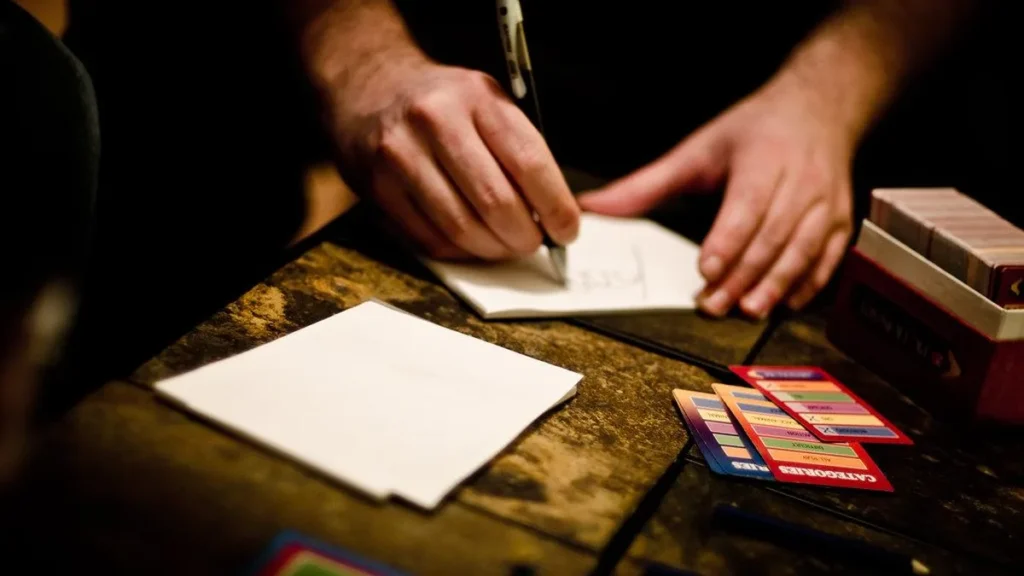
3. Pictionary Puzzle Race
Each team gets a stack of notepads, a set of pens, and a deck of word cards. One player draws the word on the card while the rest of the team shouts out guesses, and the drawer may not write letters or numbers, may not speak, and may not nod at a correct guess until the helper confirms it. The drawing does not need to be good, and in fact the roughest sketches often get guessed fastest, because a simple drawing leaves less to argue about.
4. Hangman Relay
Each team gets a small whiteboard, a marker, and a list of hidden words that only the helper can see. The helper draws the blank spaces for the first word, and the team calls out letters one at a time, in relay order, so every player must take a turn before anyone can guess twice. A correct letter fills every matching space, a wrong letter adds one part to the hanging figure, and the word is won if the team completes it before the figure is finished.
5. Rhyming Word Race
Each team gets a starting word and a sheet of blank lines, and the job is to build the longest chain of rhyming words they can before the clock runs out. The first word might be light, and the chain could run through night, right, bright, flight, and sight, with each new word earning a point. A word that does not rhyme breaks the chain, and the team must start a fresh chain from the last good word, so careful listening matters as much as a big vocabulary.
6. Letter Tile Race
Each team gets a bag of letter tiles and a set of word cards showing target words of different lengths. The job is to pick the right tiles out of the bag and lay them in order to spell each target word, racing the clock and the teams at the next table. Short words are worth one point, medium words are worth two, and the long words are worth three, so a team must decide whether to chase the big words or bank the quick ones.
7. Spelling Puzzle Race
Each team gets a set of answer sheets and a pencil, and the helper reads out words one at a time, using each word in a short sentence so the team knows which meaning is meant. The team writes the word down together, and the helper collects the sheet after every five words to mark it before reading the next five. Easy words are worth one point, medium words are worth two, and the hard words are worth three, so the score can swing late in the round.
8. Definition Match Race
Each team gets two shuffled sets of cards, one set with words and one set with definitions, and the job is to pair every word with the definition that belongs to it. The words should be a mix of familiar and unfamiliar, from everyday words with a surprising second meaning to unusual words that most players have never met. A team that matches by guessing will finish fast and score badly, while a team that reads every definition carefully will finish slower and score far better.
9. Homophone Puzzle Race
Each team gets a sheet of sentences with a blank in each one, and a word bank of homophones, words that sound the same but are spelled differently and mean different things. The job is to choose the right spelling for each sentence, so that their goes in the sentence about belonging, there goes in the sentence about place, and they are goes in the sentence about people doing something. Every blank has exactly one correct answer, and the team must agree on each one before moving on.
Planning Checklist
- Print nine station packs the night before, one per format, plus two spare sets for every station.
- Brief nine helpers, one per station, and walk each of them through their format, their scoring, and their spare set.
- Mark the rotation loop with numbered signs on every table, so teams can find their next station without asking.
- Set out a big clock where every team can see it, and test the bell or whistle from the far end of the hall.
- Prepare one scorecard per team, with nine rows for the nine rounds and space for the flight total.
- Pack extra pens, pencils, notepads, and letter tiles, because the small things are always the first to run out.
Scoring That Keeps Everyone in It
Every round is scored out of ten, with one or two bonus points for speed or a perfect set, and the flight winner is the team with the highest total after nine rounds. The ten-point cap matters, because it means a team that scores badly in the first round can still catch up, and a team that starts fast cannot run away with the day. Post the running totals where everyone can see them after the fourth round and again after the seventh, so teams know where they stand and which stations they still need to win.
Ties are broken by the fastest total time across the nine rounds, which the helpers record on the scorecards as each round ends. If two teams are still tied after that, the tie is broken by the highest single-round score, and if they are tied on that too, both teams share the prize. The same ten-point round and speed bonus shape worked well in the puzzle games for 444 players plan, where the scoring kept every flight close right up to the final round.
Frequently Asked Questions
How many helpers do we need for 446 players?
Nine helpers, one per station, plus one floater who covers breaks, hands out spare sets, and answers questions from teams between rounds. The floater is the most important helper of the day, because a station helper who has to leave their table to fetch a spare set leaves their station unguarded. Brief all ten helpers together the night before, and give each of them a printed sheet with their format, their scoring, and the rotation order.
What if a team has six players instead of five?
Only one team in the whole day has six players, and that team simply gets one extra step in each puzzle, such as one extra rebus to solve, one extra word to spell, or one extra card to match. The extra step balances the extra pair of hands, and in practice the difference is so small that nobody notices it after the first round. Do not split the team of six or move a player to another team, because a team that has practised together should stay together.
Do teams need to be good at spelling to enjoy the day?
No, because only two of the nine stations are really about spelling, and the other seven reward acting, drawing, guessing, rhyming, and matching meanings. A team that struggles with spelling can still win the charade race, the pictionary race, and the rebus race, and the ten-point cap means a weak round never ends their day. The mix is deliberate, so that every player finds at least two stations where they are the strongest member of their team.
Can we run this in three smaller rooms instead of one hall?
Yes, with three stations in each room, as long as every team can see a clock and hear the bell from wherever they are playing. Put the noisy formats in one room, the quiet paper formats in another, and the mixed formats in the third, so the spelling tables stay calm while the charade and pictionary rooms build up a cheer. Send the floater between the rooms on a fixed route, and keep the scorecards in one place so the totals can be added up without chasing teams around the building.
What happens if a team finishes a station early?
The team waits at the station and may not start the next puzzle until the bell rings, because an early start would give them extra time that other teams do not get. Helpers should have a short bonus puzzle ready for early finishers, such as a single rebus or a quick rhyme chain, which earns a small bonus point and keeps the team busy. The bonus puzzle is optional, and a team that prefers to rest and talk is welcome to do that too, as long as they stay at their station.
How do we break a tie at the end of the day?
Ties are broken by the fastest total time across the nine rounds, which the helpers record on the scorecards as each round ends. If two teams are still tied after that, the tie is broken by the highest single-round score, and if they are tied on that too, both teams share the prize. Announce the tiebreak rules at the welcome, so nobody is surprised by them at the results, and read the top three teams aloud before announcing the winner.
The Bottom Line
A 446-player puzzle day works when the planning is done the night before and the day itself is left to the rotation. Split the crowd into 89 small teams, give them nine word-play stations to move through, score every round out of ten, and let the bell do the organising. The formats are all fresh, the skills are all different, and every team gets a station where it can shine.
Print the packs, brief the helpers, and trust the plan. By the last round the hall will be loud, the scorecards will be close, and the teams will be arguing about homophones on the way out of the door, which is exactly how a puzzle day should end.