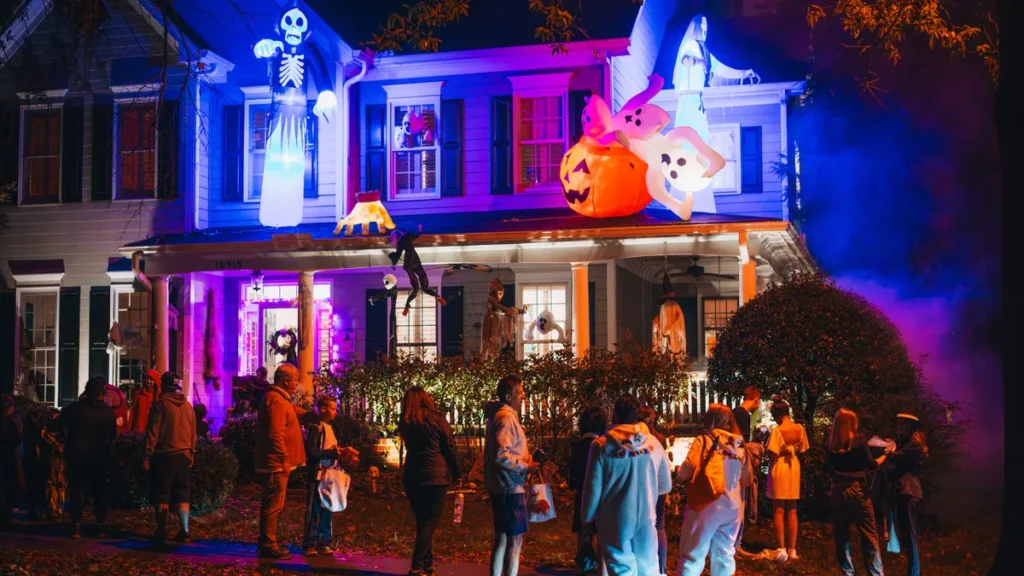
Once the guest list is entirely grown-ups, Halloween stops being a night you supervise and becomes a night you get to enjoy. No bedtime to protect, no question to soften for small ears, no winding down by nine. An adults-only night leans into all of that: horror and true crime, cocktails instead of squash, costumes people commit to, and a scoreboard the room cares about. The gap between a good one and a great one is rarely what happens on the night. It is the planning in the weeks before.
Here is the plan, in the order you should tackle it.
Who is coming, and how many
Settle the guest list before you do anything else, because every later decision hangs off it. Sixteen to twenty-four people is the sweet spot for a grown-ups’ quiz. Below a dozen, one cancellation unbalances the evening. Past two dozen, you need a bigger space and a second pair of hands on the scores.
Mix the room on purpose. Couples, single friends, and colleagues all bring different strengths, and a night works best when those strengths are spread around. Put a horror obsessive, a film buff, a music fan, and a true-crime listener on each team. Friendship groups sitting together by default hands the evening to the group that already quizzes together.
Say plainly in the invitation that this one is adults only. One short line does it: grown-ups only this year, leave the little monsters at home. When someone asks about a teenager, the honest answer is that the material assumes adults: horror with real scares, true crime, and jokes for people who pay rent. Ask for replies a week ahead. A firm headcount builds fair teams; guessing is how you get a table of three against six.
Four weeks, four jobs
Spread the work over a month. In week one, lock in the date, the room, and the guest list, then send the invitations. The Saturday nearest 31 October pulls the biggest crowd, since fancy dress is already out. Reserve the space now, while choices remain.
Week two is for the shape of the evening. Decide the rounds, the reader, the scorekeeper, and who looks after drinks. Sketch the round list before writing a single question: horror films, true crime, soundtracks, urban legends, and a picture round fill a night between them. If two people host, agree in advance who takes which rounds; improvising that split is how questions get skipped.
Week three is question week. Fifty questions in five rounds is the right size: enough to split the teams, short enough that the room stays sharp. Check every answer twice, then try the set on a friend who never watches horror. If they can answer around a third, the difficulty is right for a mixed crowd. Order food and drink the same week, and confirm numbers with anyone yet to reply.
Week four is for the small stuff: printed answer sheets, a visible scoreboard, a charged speaker, prizes bought and wrapped, and the costume contest categories decided. Set the room the day before if you can, so that on the night, reading the questions is your only real job.
Home, bar, or hired room
A living room suits about sixteen people and starts to strain past twenty. Each team wants a table, a sightline to the host, and room to spread out. Shift the furniture, borrow a folding table, and sit in the farthest seat and check that a normal speaking voice carries to the back.
A pub back room is the other strong choice, and it takes drinks off your plate entirely. Plenty of pubs lend a quiet room on a weeknight to a group buying drinks all evening, and a bar already has the seating, lighting, and sound a quiz needs. Ask about a minimum spend, bringing your own decorations and prizes, and the closing time. A screen or projector in the room turns a picture round from a chore into a highlight.
Wherever you land, sort out the journey home before the first glass is poured. Put taxi numbers and the last bus on the invitation, and make sure two people stay sober enough to drive.
Five rounds built for grown-ups
This is where an adults’ night earns its billing. A horror-film round can move past the famous titles into details only real fans know: a director’s first film, a line the room misquotes, the scene that launched a franchise. Build questions around films people have genuinely watched, and let the points go to the person who loves horror.
True crime usually becomes the round everyone talks about on the way home. Stick to cases the room knows from documentaries and podcasts, and ask about the detail that stuck in everyone’s memory, not the date of a trial. The strongest read like puzzles: the clue everyone missed, the alibi that collapsed, the slip that unravelled it. Never build a question from a victim’s suffering, and never ask the room to laugh at a real crime.
Give the non-horror fans rounds of their own: soundtracks and Halloween songs for the music lovers, and a picture round of famous masks and monsters that sparks arguments at every table. An audio round is the loudest ten minutes of the night: two seconds of a scream, a creaking door, or a theme tune, and the room shouts the film. If a lighter round would help, a ready-made bank of funny Halloween trivia questions and answers covers one for you, and a sillier round in the middle keeps the mood up between the darker ones.
Ten questions a round, five rounds, fifty points. Inside each round, aim for three easy ones, five in the middle, and two that only the strongest table will land. Open every round with one the whole room can answer, so each team banks points early.
Food and drink that keep the game moving
Two signature drinks are plenty, both made in jugs. A blackberry and gin punch and a spiced rum cider cover most tastes, and each one can be mixed alcohol-free in a second jug for drivers and non-drinkers. Put the recipe on a card beside the jug so guests serve themselves and the host stays at the front. Keep one rule: no shots while the quiz runs, and the strongest bottles only appear once the scores are in.
Feed people food they can hold in one hand, because the other hand is holding a pen. Chilli in small cups, a cheese board, sausage rolls, roasted pumpkin seeds, and brownies will vanish faster than anything needing cutlery. Serve food at its own table, away from the answer sheets, and open it during the break.
That break, after round three, is the hinge of the evening: fifteen minutes, scores on show, food out, and the room stretches, argues about the answers so far, and returns ready for the second half. If you order food in, have it arrive for the break, so it is hot when people are hungry.
Costumes and the contest
A costume turns a quiz into a party, so plan it in. Mention fancy dress in the invitation, suggest ideas at different levels of effort, and announce the categories early: best costume, best group, scariest, and funniest. Four categories give four kinds of guest a reason to try.

Let the room judge by cheering. After the last round, bring the finalists forward, let everyone cheer for each one, and hand the prize to the loudest reception. It takes five minutes and involves the whole room. Keep it generous: the contest should reward the effort people made, not embarrass anyone for the effort they skipped.
Comfort deserves a mention in the invitation, too. Guests sit for two or three hours, and a costume nobody can sit in will be abandoned by round two. A gentle line covers it: fancy dress welcome, chairs unforgiving. Set aside a corner with good light and a plain wall for photographs.
A wager and a steal
Keep the backbone simple: a point for every right answer, and accept any wording that is clearly correct. A generous host with borderline answers keeps the room warm.
Then add a single twist. Before the last round, let each team risk between one and five of the points it has already banked. Get most of the final ten right and the risk pays double; get them wrong and those points are gone. It keeps the bottom team interested to the end and gives the top team something to lose. Explain the wager before the first round, never at the moment it matters, so nobody feels caught out.
A steal is the other trick worth having, used for one round only. When a team misses, the first table to call the right answer takes the point, and the host decides who called first. Ten minutes of it is the loudest fun of the night. For a tie at the top, have one decider nobody can prepare for, such as guessing the sweets in a jar. The host calls it, and the night moves on.
Where to draw the line
Grown-ups can take a proper scare, but scary and gory are different things, and the host decides where one ends. Creepy, atmospheric, and unsettling are all fair game. Graphic descriptions of violence are not, and neither are questions built to disgust the room. A ghost round can raise hairs without a single detail that makes anyone set their glass down.
Ask about phobias on the invitation, rather than discovering them mid-round. Spiders, clowns, and realistic gore are the usual ones, and swapping one or two questions once you know is easy. Never put one guest on the spot in front of everyone, and never turn somebody’s fear into a question. If a round falls flat, soften the next one and lean on the sillier material. A good night bends to the room it has.
Prizes worth winning
Grown-up prizes need not be expensive, but they should be things adults genuinely want: a decent bottle, a horror film on disc, a streaming voucher, a box of good chocolate. The winners take the main prize, the best costume takes something smaller, and the bottom team takes something silly, so nobody goes home empty-handed. A wooden spoon tied with a ribbon has closed more quiz nights in laughter than any trophy. Keep it short: winners, prizes, one photograph.
Running the room on the night
Start at eight: twenty minutes for arrivals and team names, then a short welcome covering the rules and the wager. Three rounds before the break, two after, scores shared at halfway, and the costume contest and prizes closing around eleven. That is roughly ninety minutes of play inside a three-hour evening, with time for a last drink before home. For more on the host’s job once the room is full, our companion guide to hosting a Halloween trivia night covers the evening from the host’s side.
Marking stays fast when teams check each other’s sheets while you read the answers aloud. Give the right answer first, add background only when it is genuinely interesting, and keep moving. One disputed answer should never become a five-minute argument.
The morning after
Share the photographs the next morning, thank everyone, and note which rounds landed and which ones flopped while the night is fresh. File the answer sheets, the score sheet, and the running order, because next year you begin with a setup that already works and spend your time on better questions. If you are building the wider party around the quiz, our guide to planning a Halloween party with games covers the games, the food, and the shape of the evening.
Frequently asked questions
How many people do you need for an adults’ Halloween trivia night?
Sixteen to twenty-four is the sweet spot: four to six teams of four, with enough kinds of knowledge in the room that every round is a real contest. Fewer than twelve feels thin; more than twenty-four wants a bigger room.
How long does the whole evening run?
Plan on three hours, first drink to final prize. Five rounds of ten take around ninety minutes once marking is counted, and arrivals, the break, and the costume contest fill the rest. Eight o’clock to eleven suits a grown-up crowd.
What makes it adults-only rather than family friendly?
The material does. Horror with real scares, true crime, and jokes written for grown-ups are the difference, along with drinks, a later finish, and a costume contest the room judges itself. The planning is the same shape, but nothing in the rounds needs softening.
Plan it like a party, run it like a quiz, and let the room do the rest. The best nights are the ones where the host did the thinking weeks ago, so everyone, host included, gets to play.