Four hundred and thirty-five players in one puzzle day sounds like a recipe for chaos. It is not, as long as nobody tries to seat them all at one table or hand them all the same puzzle at the same time. The day works when the crowd is split into small teams, the puzzles are split into stations, and every team knows exactly where to be and what to do next.
This plan divides 435 players into 87 teams of five. The teams run in three flights of 29, and each flight rotates through nine stations in nine rounds. Every station hosts three or four teams at a time, so nobody queues, nobody waits for a turn, and every team plays every format before the day ends.
The nine formats below are all fresh for this series. Each one uses a different skill, from knot untangling and cup stacking to word hunts and pipe laying, so a team that is slow at one station can still shine at the next.
Key takeaways
- Split 435 players into 87 teams of five and run them in three flights of 29 teams.
- Use nine stations and nine rounds, with three or four teams sharing each station per round.
- Give every format a different skill, so no single strength decides the whole day.
- Score each round out of ten and add a small speed bonus, so late rounds still matter.
- Print one pack per team per station, and keep a spare pack at every station.
How a 435-Player Puzzle Day Works
Start with the arithmetic, because the whole day hangs on it. Four hundred and thirty-five players divide neatly into 87 teams of five, and 87 divides neatly into three flights of 29 teams. Each flight takes about three and a half hours, which means a morning flight, a midday flight, and an afternoon flight fit into a single day with room for lunch and a grand final.
Inside each flight, the 29 teams rotate through nine stations in nine rounds of twenty minutes. Three or four teams share a station in each round, and each team gets its own puzzle set, so teams race the clock and each other rather than waiting for a turn. A five-minute changeover between rounds gives teams time to walk to the next station and helpers time to reset the sets.
The format of the day is close to the approach used in the 433-player plan, where the same flight system kept a very large crowd moving without queues. The difference here is the set of nine formats, which are all new, and the scoring, which is simpler so that helpers can run it without a spreadsheet.
One hall can hold a whole flight if it has room for nine station tables plus walking space, but three smaller rooms work just as well, with three stations in each. Put the noisy formats, such as Jenga and cup stacking, at one end, and the quiet paper formats, such as word search and Hangman, at the other. A single announcer with a loud voice or a small speaker system calls the start and end of every round.
The 9 Puzzle Formats
Every format below is a race against the clock and against the other teams at the station. A team scores points for a finished puzzle, and a small bonus for finishing first. The table gives the quick picture, and the sections that follow explain how each format plays.
| Format | Main skill | Round length | What a team needs |
|---|---|---|---|
| Rope Knot Untangle Race | Untangling | 20 minutes | Knotted ropes and rings |
| Mosaic Tile Copy Race | Colour matching | 20 minutes | Coloured tiles and pattern cards |
| Cup Stack Pattern Race | Speed and steadiness | 20 minutes | Plastic cups and pattern cards |
| Jenga Block Pull Race | Steady hands | 20 minutes | Jenga block sets |
| Hangman Letter Guess Race | Word guessing | 20 minutes | Phrase boards and markers |
| String Peg Picture Race | Pattern winding | 20 minutes | Pegboards, string, and pattern cards |
| Word Search Grid Race | Word spotting | 20 minutes | Printed word grids and pens |
| Battleship Grid Hunt Race | Search and deduction | 20 minutes | Printed grids and pens |
| Pipe Connection Race | Path building | 20 minutes | Printed pipe grids and pens |
1. Rope Knot Untangle Race
Each team gets a length of rope tied into a series of tight knots, with a small ring trapped in the middle of the tangle. The team must work the knots loose, one by one, until the ring slides free. The first team to hold up the freed ring wins the round, and a team that cuts the rope or forces a knot tighter is out of that round.
Knot untangling rewards patience more than strength, which makes it a fine opener for teams of mixed ages. The trick is to loosen each knot before trying to pull it apart, and to work from the outside of the tangle inward. Let one player hold the rope steady while another works the knot.
2. Mosaic Tile Copy Race
Each team gets a tray of small coloured square tiles and a pattern card showing a picture made of coloured squares, such as a fish, a flower, or a star. The team must copy the picture exactly, square by square, onto its own blank grid. The first team to show a finished copy that matches the card wins the round.
Mosaic copying is a calm, careful change of pace after a hands-on round. It rewards teams that sort their tiles by colour before they start and check each row against the card as they go. Let one player read the card aloud, row by row, while the others place the tiles.
3. Cup Stack Pattern Race
Each team gets a set of plastic cups and a pattern card showing a pyramid, such as six cups on the bottom row, then five, then four, down to one on top. The team must build the pyramid, then collapse it back into a single neat stack. The first team to finish both the build and the collapse wins the round, and a pyramid that falls before it is finished must be rebuilt from the start.
Cup stacking looks easy, and that is exactly why it works in a race. The fastest teams build from the bottom row upward with smooth, even movements, and they practise the collapse once before the round starts. Let the steadiest hands build while the others count the rows aloud.
4. Jenga Block Pull Race
Each team gets a fully built Jenga tower on its table. Players take turns pulling one block from the tower and placing it on top, and the team scores a point for every block it moves safely. The round ends for a team when its tower falls, and the team keeps the points it has already scored. The team with the most points when time runs out wins the round.
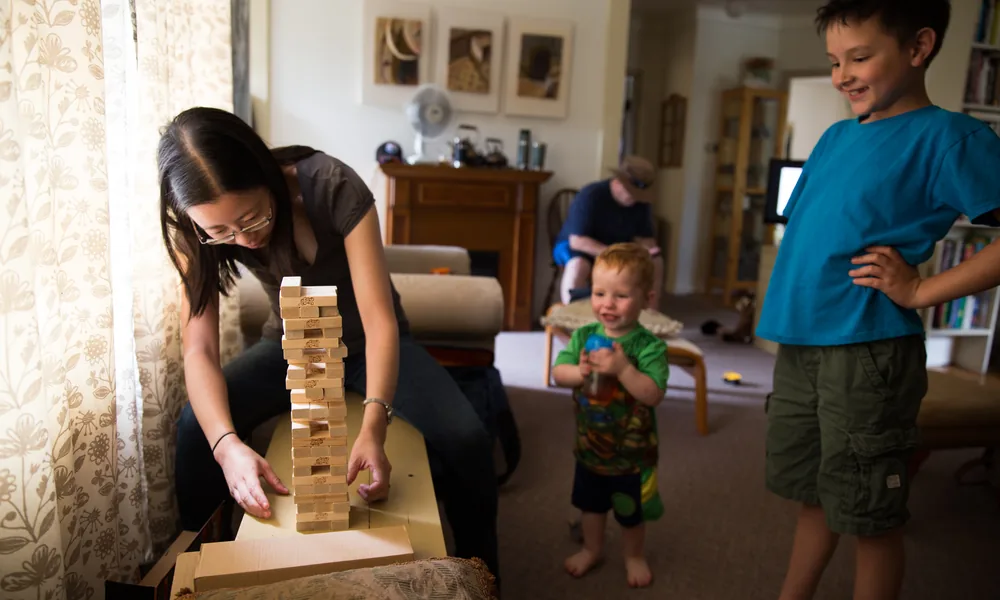
Jenga is the tensest station of the day, and the crowd around the table proves it. The skill is choosing the right block: test a block with a gentle tap first, pull only the ones that slide freely, and leave the tight ones alone. The photo below shows a family game in full swing, with one player easing a block out while the others watch the tower.
5. Hangman Letter Guess Race
Each team gets a hidden phrase shown as blank lines on a board, one blank for each letter. Teams take turns guessing a letter, and every correct guess fills in all of its places on the board. A wrong guess adds one part to a drawn figure, and a team that completes the figure before solving the phrase is out of the round. The first team to call out the full phrase correctly wins.
Hangman suits teams that like to think out loud. Start with vowels and the most common letters, and guess the phrase as soon as enough letters show, rather than spending guesses on rare letters. Let one player track the letters already guessed so the team never wastes a turn repeating one.
6. String Peg Picture Race
Each team gets a pegboard, coloured string, and a pattern card showing a simple picture, such as a star, a house, or a sailboat. The team must wind the string around the pegs to copy the picture, following the lines on the card. The first team to show a finished picture that matches the card wins the round, and a picture with a missing line must be fixed before it counts.
String peg pictures suit teams that work well with their hands. Anchor the outline of the picture first, then fill in the inner lines, and keep the string pulled tight so the shape holds. Let one player hold the tension on the string while another winds it around the pegs.
7. Word Search Grid Race
Each team gets the same printed word search grid and a list of twelve hidden words. Teams circle each word they find, and the first team to find all twelve wins the round. A circled word must be spelled correctly and run in a straight line, and the helper checks the winning grid against an answer key before the points are given.
Word search is the most even format in the whole day, because sharp eyes matter more than puzzle experience. Split the list among the team, with each player hunting for two or three words, and call out found words loudly so nobody hunts for the same word twice. The list should mix short words and long words, so the round is not decided by a single lucky spot.
8. Battleship Grid Hunt Race
Each team gets two printed grids: one showing its own hidden fleet and one for tracking shots at the opposing fleet. Teams call out grid squares in turn, marking hits and misses, and the first team to sink the whole opposing fleet wins. A team that fires at random will lose to a team that hunts in a pattern and tightens the search after every hit.
Battleship brings a head-to-head contest into a day that is otherwise a race against the clock, which makes it a crowd favourite. The skill is search discipline: spread the first shots across the grid, and once a hit lands, test the squares around it before moving on. Keep the fleets small, with five ships each, so a round finishes inside twenty minutes.
9. Pipe Connection Race
Each team gets a printed grid covered in pipe pieces, with a tap at one edge and a tank at the other. Teams draw lines to rotate and join the pipes into one unbroken path from the tap to the tank, and the first team to show a complete working path wins. A path with a gap, a dead end, or a leak at a joint does not count.
Pipe connection is a fine closing format because it mixes planning with a clear visual payoff: when the path is done, the whole team can see the water route at a glance. Work backwards from the tank as well as forwards from the tap, and mark the pieces that cannot be part of the route before drawing anything. The station helper checks the path with a finger trace, which takes only a few seconds.
Scoring and Timing
Keep the scoring simple enough for a helper to run with a pen and a score sheet. Each round is worth ten points: ten for the first team to finish correctly, eight for second, six for third, and four for every team that finishes inside the time limit. Teams that do not finish still earn one point for trying, so nobody leaves a station with nothing.
Add a small speed bonus of two points for the fastest finish at each station across the whole flight. That bonus keeps the later rounds tense, because a team in second place overall can still catch up with a fast finish. At the end of each flight, the three highest-scoring teams go through to a grand final, where they play one short round of each of the three quickest formats.
The timetable for one flight is nine rounds of twenty minutes, eight changeovers of five minutes, and a fifteen-minute briefing at the start, which comes to about three and a half hours. Run the three flights back to back with a thirty-minute reset between them, and the whole day, including the grand final, fits into a long but comfortable schedule. A similar points system kept the day fair in the 432-player tournament setup, where the same ten-point rounds stopped one strong station from deciding everything.
Stations, Materials and Helpers
Each station needs one helper, one table, and enough sets for four teams, which means four Jenga sets, four cup sets, four knotted ropes, and so on per station. Paper formats are the cheapest to run: print one pack per team per station, plus a spare pack at every station for mistakes and spills. Buy the reusable sets, such as Jenga sets, cups, ropes, and pegboards, once and keep them for the next event.
Helpers do three jobs and nothing else: hand out the sets, check finished puzzles against the answer key, and write the scores on the station sheet. Brief every helper before the first flight, and give each one a one-page sheet with the rules of their format, the answer key, and the scoring table. A helper who has to make up a ruling on the spot will slow the whole station down.
Put the score sheets on a single board near the entrance, and update them at the end of every round. Players love watching the board change, and it saves the announcer from repeating the standings. The station plan follows the same layout ideas as the 431-player step-by-step plan, with quiet paper stations kept away from the noisy cup stacking and Jenga stations so that concentration and celebration do not clash.
Checklist
- Confirm the venue, the nine station tables, and the walking routes between them a week before the day.
- Print one pack per team per station, plus a spare pack and an answer key at every station.
- Brief all nine station helpers on their format, the answer key, and the ten-point scoring table.
- Prepare the team lists, with 87 teams of five sorted into three flights of 29 teams.
- Test the announcer system and the clocks, and put a large visible timer at each station.
- Set up the scoreboard near the entrance and appoint one person to update it after every round.
Frequently Asked Questions
How many teams will 435 players make?
Four hundred and thirty-five players make 87 teams of five. If a team is short a player on the day, let it play with four, because a team of four can still finish every format. Do not merge two short teams into one team of six, since a six-player team would have an unfair edge at the hands-on stations.
Do teams need to be good at every format?
No, and that is the point of using nine different formats. A team that is weak at word hunts may be strong at cup stacking or Jenga, and the ten-point scoring means a good finish at any station is worth the same. Teams should play to their strengths and let different players lead at different stations.
Can we run this plan with fewer than 435 players?
Yes. The plan scales down cleanly: with 300 players, make 60 teams of five and run two flights of 30 teams instead of three flights of 29. The nine stations, the twenty-minute rounds, and the scoring all stay exactly the same, so the only change is the number of flights.
What if a team finishes a round early?
Early finishers stay at their station and wait for the changeover call. Give them a bonus round at the cup stacking station or a spare word search at the paper stations, so they stay busy without disturbing the teams still playing. Do not let teams wander to the next station early, because that crowds the station and distracts the teams there.
What materials do we need to buy?
Buy four Jenga sets, four cup-stacking sets, four rope-and-peg kits, and four mosaic tile sets per station, and print the paper formats in bulk. Pens, score sheets, answer keys, and a visible timer at each station cover the rest. Most of the reusable sets will last for many events, so the cost drops sharply after the first day.
Can younger players join in?
Yes, if each team mixes ages rather than grouping all the youngest players together. Cup stacking, Jenga, and word search suit younger players well, while Hangman and Battleship suit older ones, so a mixed team can share the work across the nine stations. Keep the teams at five players so that younger players always have an older teammate beside them.
Bottom Line
Running puzzle games for 435 players comes down to three decisions: 87 teams of five, three flights of 29, and nine fresh formats that test different skills. Get those three right, print the packs, brief the helpers, and the day will run on time from the first round to the grand final.