
Finding the best puzzle games for 41 players takes more planning than picking a game off a shelf. Forty-one is an awkward number for most party games, which are usually built for four, six, or eight people, and a single puzzle shared by 41 people would leave most of the group standing around watching. The trick is to choose puzzle games that scale through teams, stations, and relays, so every player has a job to do from the first minute to the last.
The best puzzle games for 41 players turn a big crowd into an advantage. Split the group into six or seven teams, give each team its own puzzle to solve, and suddenly you have a race, a leaderboard, and a room full of people shouting out ideas. Puzzle games also suit mixed groups because they reward different strengths: pattern spotting, wordplay, logic, memory, and steady hands all matter, so nobody is left out for not being the fastest talker in the room.
This guide covers ten puzzle games that genuinely work for 41 players, with team sizes, timings, and setup notes for each one. Every game here has been chosen because it scales cleanly to a group of this size without expensive equipment or complicated rules, and each one can be run in a living room, a community hall, a classroom, or an office event space.
Key takeaways
- Split 41 players into six or seven teams of six or seven for the best balance of teamwork and participation.
- Relay and station formats work far better than a single shared puzzle, because everyone stays involved.
- Mix puzzle types across the night so word lovers, logic fans, and hands-on builders all get a game they enjoy.
- Keep rounds short, around 15 to 20 minutes, and rotate teams between stations to hold energy high.
- Prepare answer sheets, timers, and a simple points system before the night starts so the games run smoothly.
How to Organize Puzzle Games for 41 Players
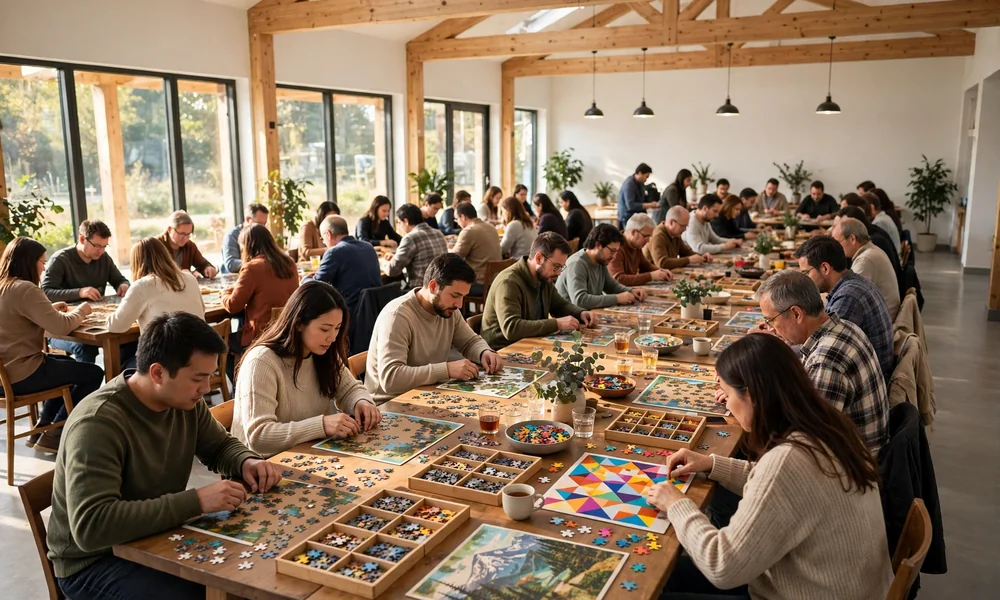
A group of 41 players needs structure before it needs games. Without teams and a schedule, a puzzle night with this many people drifts into small clusters doing their own thing while others check their phones. A little planning at the start makes the whole evening feel like one shared event instead of several separate ones happening in the same room.
Start by dividing the group into teams. Six teams of seven leaves one team short by one player if you count strictly, so the cleanest split is five teams of six and two teams of five, or six teams of six plus one team of five. Give each team a name, a table, and a captain who collects answer sheets and keeps the team on schedule. Puzzle-themed team names, such as the Crosswords or the Cubers, add a little fun at no cost.
Next, decide between a race format and a station format. In a race, every team works on the same puzzle at the same time and the first to finish wins. In a station format, teams rotate through different puzzle stations every 15 minutes and earn points at each one. Stations suit 41 players better because they keep every team busy even if one team finishes early, and they let you mix puzzle types across the night. If you are planning a full evening of group games, pairing puzzle rounds with the best board games for 41 players gives you a strong lineup that covers both quiet thinking games and livelier table games.
Setting Up the Room
Seven tables is the right number for seven teams, with enough space between them that teams cannot easily copy each other. Each table needs a flat surface large enough for a jigsaw puzzle or a puzzle board, plus pens, paper, and a timer. Put a central scoring table or whiteboard where everyone can see the running totals, because a visible leaderboard keeps competitive energy high all evening.
Puzzle solving needs good light, especially for jigsaws and small-print crosswords, so choose a bright room or add a lamp to each table. Keep background music low enough that teams can talk through clues without shouting.
Scoring and Timing
Keep scoring simple. Award ten points for a first-place finish in a round, seven for second, five for third, and three points for every team that completes the puzzle within the time limit. Bonus points for the fastest individual solve or the most creative team name keep things light. A single host with a stopwatch and a score sheet can run the whole night, though a second helper makes station rotations much smoother.
Plan for rounds of 15 to 20 minutes with five-minute breaks between them. That pace fits six rounds into about two and a half hours, including a welcome and a final scores announcement, and a team that struggles with one puzzle type is never stuck for long.
The 10 Best Puzzle Games for 41 Players
These ten games were picked because they scale to 41 players, need little specialist equipment, and suit a wide range of ages and abilities. Each entry explains how the game works with a large group, how long a round takes, and what you need to set it up.
1. Jigsaw Puzzle Relay Race
The jigsaw relay is the simplest large-group puzzle game and one of the most exciting. Each team gets an identical jigsaw puzzle, usually 500 pieces, and races to complete it. The twist that makes it work for 41 players is the relay rule: only two team members may work on the puzzle at a time, and they swap out every three minutes. That keeps all seven players involved and stops one fast puzzler from doing the whole thing alone.
A 500-piece puzzle takes a team of seven around 45 to 60 minutes in relay format, which makes it a good anchor game for the evening rather than a quick round. Buy identical puzzles so the race is fair, and choose images with clear sections of colour so teams can sort pieces by area.
2. Team Escape Room Challenge
Escape room games translate surprisingly well to a group of 41 when each team gets its own set of puzzles. Instead of renting a venue, build a tabletop escape game: a locked box, a series of clue envelopes, and a final combination that opens the box. Each clue solved leads to the next, and the team that opens its box first wins the round.
You can buy printable escape room kits online or build your own with padlocks, combination locks, and handwritten clues. A good tabletop escape round needs four or five puzzles in a chain: a word clue, a number code, a pattern puzzle, and a final riddle that gives the combination. Budget about 30 minutes per round and prepare one identical kit per team.
3. Puzzle Hunt Trail
A puzzle hunt sends teams around a venue, or around a house and garden, following a trail of clues. Each station hides a puzzle, and solving it reveals the location of the next station. The first team to complete the trail and solve the final puzzle wins. This format suits 41 players because teams spread out, so the room never feels crowded.
Design six or seven stations, one per team to start at, and stagger the starting points so teams do not bunch up. Stations can use riddles, rebuses, word ladders, map coordinates, or simple ciphers. Keep each station puzzle solvable in three to five minutes so the trail keeps moving, and make the final puzzle a satisfying team effort, such as a large crossword or a code that opens a prize box.
Puzzle hunts also work outdoors, which makes them a strong choice for summer parties and school events. Pair the hunt with the best party games for 41 players for the later, louder part of the night.
4. Crossword Race
Crossword races are cheap, easy to run, and ideal for a big group. Give each team the same crossword, printed large, and set a 15-minute timer. Teams work together, calling out answers and filling in the grid, and the team with the most correct answers when time runs out takes the round.
Choose a themed crossword that matches your group, such as general knowledge, movies, or music, and make sure the difficulty suits a mixed audience. A good target is a puzzle that a strong team finishes in about 12 minutes, leaving room for a close race.
5. Sudoku Relay
Sudoku is a natural team puzzle because it rewards patience and pattern spotting rather than speed alone. In a relay, each team gets the same Sudoku grid on a large sheet. Players take turns placing one number at a time, checking with their team before each move, and the first team to complete the grid correctly wins.
Use a medium-difficulty puzzle for the main round. Easy grids end too quickly and hard grids stall the game, but a medium puzzle gives every team a genuine chance and takes about 15 minutes in relay format.
6. Tangram Team Challenge
Tangrams are seven-piece geometric puzzles that have been played for centuries, and they make an excellent hands-on team game. Each team gets a tangram set and a series of silhouette cards showing shapes to build, from animals to houses to boats. Teams race to complete each silhouette, earning points for every shape finished within the time limit.
Tangram pieces are cheap, durable, and easy to share, and one set per team is all you need. The puzzles are silent and visual, which makes tangrams a good choice for groups that include players who are less confident with words or numbers.
7. Rubik’s Cube Relay
A Rubik’s Cube relay sounds like a game for experts, but with the right rules it works for complete beginners too. Each team gets a cube, and players take turns making a set number of moves, passing the cube along the line. The team that solves one face first wins the round, and nobody needs to know how to solve a whole cube.
For a friendlier version, use pattern cubes or cubes with pictures instead of colours, and set the goal as matching a single face rather than solving the entire cube. Both versions need only one cube per team and take about ten minutes.
8. Mystery Lockbox Challenge
The lockbox challenge gives each team a box secured with three or four small padlocks, each opened by solving a puzzle. One lock opens with a word code, another with a number code, and a third with a pattern or colour sequence. Inside the box is a final puzzle or a small prize, and the first team to open its box wins.
This game is similar to the escape room challenge but simpler to prepare, because each lock is an independent puzzle rather than part of a long chain. Teams can split up and work on different locks at the same time, so all seven players stay busy. Budget about 20 minutes per round.
9. Puzzle Trivia Relay
Puzzle trivia combines quiz questions with puzzle solving, and it is one of the best formats for a group of 41 because it uses two different skills at once. Each team answers a trivia question to earn a puzzle piece, clue, or letter, and the team that collects enough pieces to complete a puzzle first wins the round. Wrong answers cost time, so teams have to balance speed against accuracy.
Build the round around six trivia questions and a six-piece puzzle, such as a word revealed letter by letter. The host reads each question, teams write down their answers, and correct answers earn the next piece.
This format keeps both trivia fans and puzzle fans engaged in the same game. If your group enjoys quiz rounds, the best trivia games for 41 players offer more formats in the same style.
10. Giant Collaborative Puzzle
Not every puzzle game for 41 players needs to be a competition. A giant collaborative puzzle, such as a 1,000-piece jigsaw or a large floor puzzle, gives the whole group a shared goal. Set it up on a big table or on the floor, and let players drift in and out, adding pieces whenever they like between the competitive rounds.
The collaborative puzzle works as the social heart of the evening. It gives quieter players something to do without the pressure of a timer, it gives teams a place to chat between rounds, and it produces a finished picture by the end of the night. Choose an image that suits the occasion and photograph it at the end as a keepsake.
Best Puzzle Games for 41 Players Compared
A good evening usually combines one long anchor game, such as the jigsaw relay, with three or four short rounds from different rows of this table.
| Game | Team Size | Round Length | Setup Needed | Best For |
|---|---|---|---|---|
| Jigsaw Puzzle Relay Race | 6 to 7 | 45 to 60 minutes | Identical 500-piece puzzles | Opening anchor game |
| Team Escape Room Challenge | 6 to 7 | 30 minutes | Clue kits and lockboxes | Most memorable round |
| Puzzle Hunt Trail | 6 to 7 | 30 to 45 minutes | Printed clue stations | Outdoor and active groups |
| Crossword Race | 6 to 7 | 15 minutes | Printed crosswords | Word lovers |
| Sudoku Relay | 6 to 7 | 15 minutes | Large printed grids | Calm, focused round |
| Tangram Team Challenge | 6 to 7 | 15 minutes | Tangram sets and cards | Hands-on visual puzzlers |
| Rubik’s Cube Relay | 6 to 7 | 10 minutes | One cube per team | Fast late-night energy |
| Mystery Lockbox Challenge | 6 to 7 | 20 minutes | Boxes and padlocks | Teams that like prizes |
| Puzzle Trivia Relay | 6 to 7 | 20 minutes | Questions and puzzle pieces | Mixed trivia and puzzle fans |
| Giant Collaborative Puzzle | Whole group | All evening | 1,000-piece puzzle | Social centrepiece |
Checklist for Your Puzzle Game Night
Run through this checklist the day before your event so nothing is left to the last minute.
- Divide 41 players into six or seven named teams and prepare a score sheet and a visible leaderboard.
- Buy or print identical puzzles, grids, and clue kits for every team so no team has an unfair advantage.
- Test every puzzle yourself first, and time a practice round, so you know each game fits its slot.
- Set up seven tables with good lighting, pens, paper, timers, and sorting trays before guests arrive.
- Prepare a simple points system and a small prize for the winning team, plus a shared prize for the collaborative puzzle.
- Keep spare puzzles and a backup quiz round ready in case a game finishes early or a puzzle proves too hard.
Frequently Asked Questions
What is the best puzzle game for 41 players?
The jigsaw puzzle relay race is the best all-round choice for 41 players because it is easy to explain, uses identical puzzles for fairness, and keeps every team member involved through the relay rule. For a more varied evening, combine it with an escape room challenge and a puzzle trivia relay.
How do you split 41 players into teams?
Split 41 players into six teams of six and one team of five, or five teams of six and two teams of five. Either split keeps teams small enough that everyone can contribute and large enough to cover different puzzle skills. Keep the same teams all evening so rivalries and teamwork build across rounds.
How long does a puzzle game night for 41 players take?
Plan for two and a half to three hours. That allows a welcome, six rounds of 15 to 20 minutes each, short breaks between rounds, and a final scores announcement. A single game, such as a jigsaw relay, takes 45 to 60 minutes on its own, so treat that as the anchor.
What equipment do I need for puzzle games with 41 players?
You need seven tables, good lighting, pens, paper, timers, and one set of puzzle materials per team. Most games on this list need only printed puzzles or inexpensive items such as tangram sets, Rubik’s Cubes, and combination padlocks. A whiteboard or large sheet of paper for the leaderboard is the only extra item worth preparing.
Can children and adults play puzzle games together?
Yes, puzzle games suit mixed-age groups well because different games reward different strengths. Children often spot visual patterns quickly in tangrams and jigsaws, while adults tend to do well on crosswords and trivia. Mixed-age teams work best, so seat children and adults together rather than splitting the group by age.
What if some players have never done puzzles before?
Start with the easiest game on the list, such as the tangram challenge or the giant collaborative puzzle, so new players learn by doing without pressure. Explain each game in under a minute, demonstrate the first move, and keep the first round short. Most beginners are solving confidently within ten minutes, and the team format means experienced players can guide them.
The Bottom Line
The best puzzle games for 41 players are the ones that turn a big crowd into teams, give every player a role, and mix puzzle types so the whole evening stays fresh. Start with a jigsaw relay to anchor the night, add an escape room challenge and a puzzle hunt for excitement, and fill the gaps with quick rounds such as crosswords, Sudoku, and tangrams. With seven tables, a simple points system, and puzzles prepared in advance, 41 players is not a problem to manage but the perfect size for a puzzle night nobody forgets.


