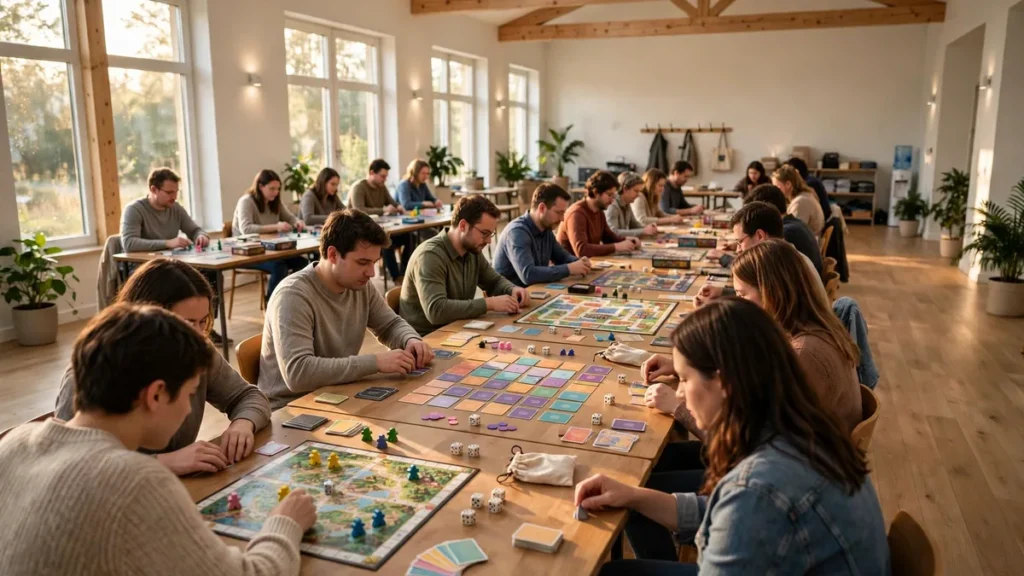
Finding the best board games for 41 players takes a different kind of thinking than picking a game for a family of four. No boxed board game on the shelf seats 41 people around one table, and any list that pretends otherwise is selling you a fantasy. A group of 41 is a small event, not a game night, and the games that work for it are the ones that scale through teams, parallel tables, or whole-room play where everyone is involved at the same time.
The good news is that a group this size can be more fun than a small one, provided you plan the structure before anyone sits down. With 41 players you have enough people for proper teams, real tournaments, and loud, shared moments that small groups never get. The trick is choosing games where nobody waits twenty minutes for a turn, where the rules take under five minutes to explain, and where a newcomer can contribute within seconds.
This guide does exactly that. Every game below genuinely works for 41 people through a team format, multiple copies, or a whole-room setup, and each entry explains precisely how to run it at that scale. You will also find a comparison table, a ready-made schedule, and a short checklist so nothing is left to chance.
Key takeaways
- No single boxed game seats 41 players, so the best board games for 41 players are the ones that scale through teams, multiple copies, or whole-room play.
- Split 41 players into five or six tables of seven or eight, or into two big teams, and keep every table playing the same game at the same time.
- Choose games with rules that take less than five minutes to explain and turns that take seconds, not minutes.
- Team word games, social deduction games, and party drawing games scale far better than long strategy games at this size.
- Plan a rotation and a short tournament bracket in advance, and finish the night with one whole-room game that brings all 41 players together.

Why 41 Players Changes the Way You Pick a Board Game
Most board games are designed for two to six players. With six people, everyone can see the board, hear the rules, and take a turn every minute or two. With 41 people, none of that is true. One table cannot hold 41 players, one board cannot be seen by 41 pairs of eyes, and a game with two-minute turns would take nearly ninety minutes to complete a single round. The format has to change before the game choice makes sense.
The first decision is structural. Most hosts use six tables: five tables of seven and one table of six, or five tables of eight with one floater who helps run the event. Another option is two big teams of twenty and twenty-one, which works beautifully for word games and quiz games but poorly for anything with a physical board. The game you pick has to match the structure you choose, and this guide explains the setup for every recommendation.
Speed matters more than depth at this scale. A game that takes ninety minutes with four players will take far longer with forty-one, and attention will drift long before it ends. The best board games for 41 players keep each round short and give every player something to do even when it is not their turn. If your group is one person smaller, our guide to the best board games for 40 players covers nearly the same setup, and the same principles apply here with one extra seat to fill.
How to Run Board Games for 41 Players
Running a 41-player game night is mostly logistics, and getting the logistics right is what turns a chaotic evening into a great one. Decide the shape of the night before you choose the games: three rounds of table games followed by one whole-room finale, with short breaks between rounds so people can stretch, refill drinks, and swap tables.
Split Into Tables of Seven or Eight
Six tables of seven or eight players is the most practical layout for 41 people. Each table gets its own copy of the game, its own score sheet, and a table captain who knows the rules well enough to teach them in a few minutes. The captain does not need to be an expert, just someone who has played the game once before and can keep the pace moving. Rotate the tables between rounds so people meet new opponents, and keep a simple leaderboard on a whiteboard so the competition feels real.
Use Team Formats Wherever Possible
Team games are the secret weapon for large groups. In a team word game, twenty people can shout suggestions at once, and every one of them is playing even though only one person is giving the clue. In a team drawing game, the whole team argues over what the sketch means, which is half the fun. Teams also solve mixed experience levels, because a beginner can sit beside a confident player and learn by watching for a round before taking the lead.
Rotate and Keep a Tournament Bracket
Rotation keeps the evening fresh and stops one table from becoming a closed clique. After each round, move the top two scorers from each table up a table and the bottom two down. At the end of the night, the players at the top table play a short final while everyone else watches, cheers, and plays a relaxed whole-room game. This gives the night a climax without forcing 41 people to sit through a long final they are not part of.
The Best Board Games for 41 Players
The games below are ranked by how well they scale, how quickly they can be taught, and how much fun they create at a big table. Every one works for 41 players through teams, multiple copies, or whole-room play, and the setup notes explain how many copies you need. The same team logic behind the best board games for 39 players applies here, with room for two extra players across your tables.
| Game | Players per copy | How it scales to 41 | Playing time | Best for |
|---|---|---|---|---|
| Codenames | 2 to 8 or more | Teams, or several copies at once | 15 minutes | Wordplay teams |
| Two Rooms and a Boom | 6 to 30 | Two parallel games | 15 minutes | Whole-room energy |
| One Night Ultimate Werewolf | 3 to 10 | Five tables at once | 10 minutes | Social deduction |
| Telestrations | 4 to 8 | Six copies, one per table | 30 minutes | Drawing and laughs |
| Wavelength | 2 to 12 | Teams of ten or more | 20 to 40 minutes | Party discussion |
| Wits and Wagers | 3 to 7 | Team betting, several copies | 25 minutes | Trivia with a twist |
| Monikers | 4 to 20 | Two big teams | 30 to 60 minutes | Shouting and guessing |
| Just One | 3 to 7 | Cooperative, several copies | 20 minutes | Relaxed cooperation |
| Dixit | 3 to 6 | Team judging, several copies | 30 minutes | Creative storytelling |
| Green Team Wins | 3 to 12 | Teams of twenty | 20 minutes | Quick party rounds |
1. Codenames
Codenames is the single best board game for 41 players. The base game is designed for two teams, but the teams can be any size, so a group of 41 can play as two teams of twenty and twenty-one with one spymaster per side. The spymaster gives a one-word clue linked to several words on the table, the team debates, and everyone is involved in every guess. For a livelier night, split into five tables of eight and run five simultaneous games, then bring the table winners together for a final. The rules take three minutes to teach, a game takes fifteen minutes, and it works for every age and experience level.
2. Two Rooms and a Boom
Two Rooms and a Boom is built for large groups and feels like a live-action social deduction game. Players are split between two rooms, each with a secret role, and they have five minutes to find out who belongs where before the rooms swap members. The base game supports up to 30 players, so for 41 you run two parallel games of about twenty players each and compare results afterwards. It needs a confident host and a timer, but the energy it creates is unmatched, and it is the best whole-room opener because everyone is moving, talking, and playing at the same time.
3. One Night Ultimate Werewolf
One Night Ultimate Werewolf compresses the classic werewolf game into a single ten-minute round, which makes it perfect for 41 players. Each copy supports up to ten players, so five copies cover five tables of eight, and every table plays at the same time. A free companion app handles the night phase with spoken instructions, so nobody has to memorise the order of roles. Because a round takes only ten minutes, tables can play three or four rounds in a session and rotate players after each one. It is the best choice when your group loves bluffing and debate.
4. Telestrations
Telestrations is the party game version of the telephone game mixed with drawing, and it is ideal for a big group because it is almost impossible to play badly. Each player draws a word, passes the sketch on, and the next player writes what they think it shows, with results that get funnier at every step. A standard box covers eight players, so six copies cover all 41 players across six tables. At the end of each round, every table shares its funniest sketchbook with the room. Buy the twelve-player party pack if you can find it, since it reduces the number of copies you need.
5. Wavelength
Wavelength is a guessing game built around a single dial, a target, and a spectrum such as hot versus cold or underrated versus overrated. One player gives a clue, the team debates where the target sits, and points are scored by accuracy. The box supports up to twelve players, but the team format means a table of eight works perfectly, and you can run five copies at once or play one giant game with two teams of twenty. It takes two minutes to teach and rewards conversation over knowledge, so nobody feels left out.
6. Wits and Wagers
Wits and Wagers turns trivia into a betting game, which removes the usual problem where one expert dominates every question. Every player writes a numerical guess, the guesses are ranked, and everyone bets on which answer is closest. That means a player who knows nothing can still win by betting wisely, and the whole table stays involved on every question. A copy supports up to seven players, so run it in teams of two or three at each table, or buy a few extra copies and run six tables at once. It is the best pick for a mixed group where some people love quizzes and others dread them.
7. Monikers
Monikers is a team guessing game played in three rounds with the same set of cards, and it scales beautifully to 41 players. Split the group into two teams of twenty and twenty-one, or into several smaller teams across tables, and let each team take turns describing, miming, and finally giving one-word clues for the same cards. The shared cards mean the jokes build across rounds, and by the third round the room is shouting single words that only the teams understand. A round takes about thirty minutes with a big team, so choose cards with names and references your players will actually know.
8. Just One
Just One is a gentle cooperative word game where everyone writes a one-word clue for a mystery word, duplicate clues are removed, and one player has to guess from what remains. It is the calmest game on this list, which makes it a good choice for the second half of the evening when the energy dips. A copy supports up to seven players, so run six copies across six tables and let each table compare scores at the end. Because it is cooperative, there is no elimination and no loser, which suits family gatherings and work events. The rules take one minute to explain, and a game takes about twenty minutes.
9. Dixit
Dixit is a storytelling game with beautiful illustrated cards, where one player gives a clue for a card and everyone else tries to match it. It is quieter than the party games on this list, but it creates the most memorable moments, because the clues reveal how differently people think. A box supports up to six players, so run it with two teams per table or buy several copies and an expansion to stretch the player count. It works best where players are comfortable being creative, and it is a strong choice for a group that prefers imagination over competition.
10. Green Team Wins
Green Team Wins is a fast party game where every player answers a question, and points go to the team whose answers match the majority. The box supports up to twelve players, but the format works with two teams of twenty, since everyone answers at the same time and the reveal takes seconds. It is the quickest game on this list, with a full round taking about twenty minutes, and it is the best closer for the night because it needs no setup, no table space, and no elimination. Play it as the whole-room finale with all 41 players together.
A Sample Schedule for a 41-Player Game Night
A good schedule is worth more than a good game, because it keeps 41 people moving instead of waiting. Start with a whole-room game so nobody stands around while tables are sorted out. Two Rooms and a Boom or Green Team Wins both work as openers, taking fifteen to twenty minutes and getting the whole room talking. After the opener, split into six tables for two rounds of table games, with a ten-minute break between rounds for drinks and table swaps.
For the table rounds, let each table choose between two games so players have some say in what they play. Codenames and One Night Ultimate Werewolf are a strong pairing for the first round, and Telestrations and Wavelength work well for the second. Keep each round to thirty minutes, with table captains keeping score on a simple sheet. Finish the night with one whole-room game, and if you want a lighter ending, pick something from our roundup of the best party games for 39 players, which scales to 41 with the same team structure. Hand out a small prize to the winning table, and keep the whole evening under three hours.
Checklist Before Game Night
- Count your copies: make sure you have enough boxes to cover six tables, and borrow extras a week in advance.
- Appoint six table captains who know the rules and can teach each game in under five minutes.
- Print score sheets, bring a whiteboard for the leaderboard, and set a timer that the whole room can hear.
- Arrange six tables with seven or eight chairs each, plus a clear open space for the whole-room opener and finale.
- Prepare name badges or team colours so players can find their table quickly after each break.
- Plan snacks and drinks that can be eaten between rounds, not during play, so cards and boards stay clean.
Frequently Asked Questions
Can one board game really seat 41 players?
No single boxed board game seats 41 players around one table. The games on this list work for 41 people because they use teams, multiple copies, or whole-room formats. Plan for six tables or two big teams, and the group size becomes an advantage instead of a problem.
How many copies of a game do I need for 41 players?
It depends on the game. For a game that supports eight players per copy, such as Telestrations, you need six copies. For a team game such as Codenames, one copy can serve two teams of twenty, although several copies make for a better tournament. Check the player count per copy in the table above before you buy.
What is the best board game for 41 players at a work event?
Codenames is the safest choice for a work event because it is cooperative within teams, takes minutes to learn, and involves everyone at once. Just One is the best backup if you want something calmer, and Green Team Wins is the best whole-room closer because nobody is put on the spot alone.
How long should a 41-player game night last?
Plan for about three hours, including breaks. A fifteen-minute opener, two thirty-minute table rounds, a ten-minute break, and a twenty-minute finale fills the evening without exhausting anyone. Longer nights work only if you add a proper meal break in the middle.
What if some players have never played board games before?
Start with the simplest games on this list, such as Just One, Green Team Wins, or Codenames, and let beginners sit beside experienced players in team games. Avoid long strategy games entirely, since their rules take too long to teach and their turns are too slow for this size of group.
Do I need a host for 41 players?
Yes, one confident host makes a real difference. The host explains the schedule, keeps the timer, announces the leaderboard, and runs the whole-room games, while table captains handle the rules at each table.
The Bottom Line
The best board games for 41 players are the ones that turn a big group into an advantage: team word games like Codenames, whole-room games like Two Rooms and a Boom, and fast party games like One Night Ultimate Werewolf, Telestrations, and Green Team Wins. Split the group into six tables or two big teams, pick games with five-minute rules and short turns, and keep the evening to about three hours. Do that, and 41 players will feel like the perfect number, not a problem to solve.


