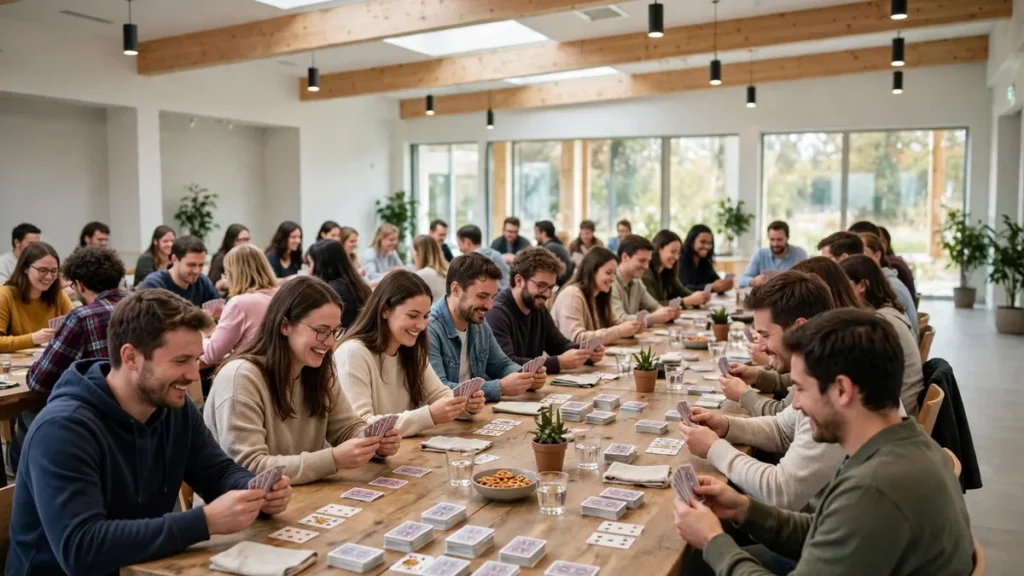
Finding the best dice games for 42 players sounds like a puzzle in itself, but it is one of the most rewarding party challenges you can take on. Forty-two people is a big crowd, far too many for a single table, yet dice games are almost uniquely suited to groups this size because they are fast, simple to learn, and easy to run in parallel across several tables at once. With the right format, every guest stays involved and the whole room shares the same energy.
The best dice games for 42 players work because they scale. Instead of squeezing everyone around one table, you split the group into smaller tables of six or seven, run the same game at every table, and then bring everyone together for a shared final round or a tournament-style leaderboard. The dice do the heavy lifting: they keep turns short, they make every roll exciting, and they need almost no explanation, which matters when you are briefing four dozen people at once.
This guide covers the games that genuinely work at this scale, how to set up your room and supplies, and how to keep 42 players moving without chaos. Every game below plays well in parallel, uses cheap supplies, and keeps the focus on fun rather than complicated rules.
Key takeaways
- Split 42 players into six tables of seven or seven tables of six, and run the same dice game at every table.
- Choose games with short turns and simple rules, such as Bunco, Farkle, Tenzi, and Left Center Right.
- Use a tournament or rotation format so tables mix and a room-wide winner can be crowned at the end.
- Buy dice in bulk and prepare one identical kit per table, including score sheets, pencils, and a dice cup.
- Appoint one host and one table captain per table to keep scores honest and the pace brisk.

Why Dice Games Work So Well for 42 Players
Dice games have three qualities that make them ideal for very large groups. First, they are quick. Most dice turns take only a few seconds, so even with seven people at a table, nobody sits idle for long. Second, they are easy to teach. A new player can understand Bunco or Farkle in under a minute, which means you can brief 42 people in one short announcement instead of running a long tutorial. Third, they are cheap to scale. A bag of dice costs very little, and every table needs the same small kit, so adding more players costs almost nothing.
A board game built for four players does not stretch to 42 people without many copies, complex rules, and long turns. Dice games avoid all of that, and when dozens of dice roll at once, the whole room buzzes with excitement.
Dice games are also flexible: quiet table competitions, loud team relays, or a structured tournament with a final. Luck plays a big part, so players of all ages and experience levels can compete together, and nobody needs to be an expert to win a round.
How to Set Up Dice Games for 42 Players
Good setup turns a fun idea into a smooth event. With 42 players, you need a clear plan before the first die is rolled, and most of it comes down to tables, kits, and a simple schedule.
Arrange Six or Seven Tables
Divide your 42 players into six tables of seven or seven tables of six. Seven tables of six is usually the better choice, because six players per table keeps turns moving quickly and gives everyone enough elbow room. The same layout works for slightly smaller crowds too, as our guide to the best dice games for 40 players shows. Place the tables with space between them so hosts can walk around, and put a numbered card on each table so players can find their seats and rotate easily.
If you are playing a tournament, keep the same table groups for the first two or three rounds, then rotate players so they meet new opponents. Rotation keeps the night social and stops one table from becoming too competitive or too quiet.
Prepare One Kit Per Table
Every table needs an identical kit: a shared pool of 12 to 15 dice, one or two dice cups, printed score sheets, pencils, and a copy of the rules. Prepare the kits in advance and place one on each table before guests arrive. Identical kits keep the games fair and stop arguments about missing dice or different rules.
Buy dice in bulk packs rather than single sets. A pack of 100 dice is inexpensive and gives you spares for the dice that inevitably roll under a sofa. Brightly coloured dice also help, because they are easier to spot on the floor and they look great in photos.
Appoint a Host and Table Captains
Choose one overall host who explains the rules, keeps time, and announces rotations and results. Then pick one table captain per table to hand out score sheets, settle small disputes, and report the table winner at the end of each round. Captains make a huge difference, because the host cannot be at seven tables at once.
Plan a Simple Schedule
A good schedule is ten minutes for welcome and rules, three 20-minute rounds at the tables, a short break, and a 20-minute final with the table winners. That fills about 90 minutes. Keep rounds timed, because timed rounds stop one slow table from holding up the whole room.
The Best Dice Games for 42 Players
The games below are ranked by how well they scale, how easy they are to teach, and how much fun they create in a large room. You can run one game all night, or play a different game each round and crown an overall champion based on total points.
1. Bunco
Bunco is the classic large-group dice game, and it is the first choice for 42 players. Players sit in groups, roll three dice, and try to match the target number for the round. The game moves fast, the rules take one minute to explain, and it was designed for exactly this kind of multi-table party. With 42 players, run Bunco at every table with the same target numbers, then compare scores across tables after each round.
Bunco also has a built-in social element, because players move tables between rounds and meet new people. If you only pick one game for your night, make it Bunco.
2. Farkle
Farkle is a push-your-luck game where players roll six dice, bank scoring combinations, and decide whether to risk another roll. It is easy to learn, but the risk decision gives it real tension, and the scores swing wildly, which keeps every table lively. For 42 players, run Farkle as a timed table competition: the highest score at each table after 20 minutes advances to the final.
Print a small scoring chart for every table, because new players will need to check which combinations score. Once players have played two or three turns, they rarely need the chart again.
3. Tenzi
Tenzi is a speed game: each player rolls ten dice as fast as possible, trying to get all ten to show the same number. It is loud, frantic, and hilarious with a big group, and it works brilliantly as a relay. At each table, players race individually, and the fastest time wins the round. For a room-wide twist, run a Tenzi relay where each table fields its fastest roller in a final race while the whole room cheers.
Tenzi needs ten dice per player, so it uses more dice than the other games here, though bulk packs make it affordable. Keep spares at every table, because Tenzi dice scatter everywhere.
4. Left Center Right
Left Center Right, often called LCR, is a game of pure chance played with three dice and a handful of tokens. Players pass tokens left, right, or to the centre based on their rolls, and the last player holding tokens wins. A round takes only a few minutes, which makes it perfect as a warm-up or a filler between longer games.
With 42 players, run LCR at each table with the same starting tokens, and let each table winner take a small prize. The game needs almost no skill, so it is a great equaliser when your group mixes ages and experience levels.
5. Yahtzee Tournament
Yahtzee is a familiar favourite, and it adapts well to large groups as a tournament. Each table plays a standard game with shared score sheets, and the top scorer at each table moves on to a championship table for the final. The mix of luck and choice keeps players engaged, and most guests already know the rules, which saves teaching time.
Use one score sheet per player and one set of five dice per table. A full game takes about 30 minutes, so Yahtzee works best as the main event, and its familiar name helps new players feel comfortable joining in.
6. Dice Bingo
In Dice Bingo, each player has a card printed with numbers, and a host rolls two dice for the room. Players mark the matching total, and the first to complete a row or a full card wins. Because one host rolls for everyone, Dice Bingo unites all 42 players in a single shared game.
Prepare the bingo cards in advance, one per player, with different number layouts so that several people do not win at once. Dice Bingo is an excellent choice for the final game of the night, because everyone plays at the same time and the room erupts when someone calls bingo.
7. Liar’s Dice
Liar’s Dice, also known as Perudo, is a bluffing game where each player shakes a cup of five dice, peeks at their own roll, and bids on how many of a certain number are showing across the table. It is social, sneaky, and full of laughter, and it rewards bold bluffs as much as good guesses. With 42 players, run it at each table with six players, and let table winners face off in a final.
This game suits groups who enjoy talking and teasing each other, and it works best with adults and older teenagers. Run one practice round first, because the bidding takes a try to click.
8. Pig
Pig is the simplest game on this list, and sometimes the simplest game is the right one. Players roll a single die, add the result to their turn total, and choose whether to roll again or bank their points. Roll a one, and the turn total is lost. That single decision creates real tension, and games finish quickly, so Pig is ideal for a fast round or for younger players.
For 42 players, Pig works as a quick table tournament with a target score of 100, and it is a good backup game when a table finishes early.
9. Seven Eleven Doubles
Seven Eleven Doubles is a fast party game where players roll two dice and pass a cup around the table, trying to avoid being the player holding the cup when a seven, eleven, or double is rolled. It is noisy, quick, and very funny, and it works well as an icebreaker before the main games begin. The rules take seconds to explain, and the game needs only two dice and a cup per table.
Because rounds are so short, use it in ten-minute bursts rather than as a full-length game. It wakes a room up and gets everyone laughing, which is exactly what you want at the start of a big night.
10. Roll and Write Games
Roll and write games such as Qwixx and a dice-based version of Bingo use shared dice rolls that every player records on their own sheet. That shared-roll structure scales beautifully, because one person can roll for an entire table, or even for the whole room. These games are calm and thoughtful, which makes them a good contrast to the louder games on this list, and they suit players who prefer strategy over shouting.
Print one sheet per player and provide pencils at every table. Roll and write games are a smart choice for mixed-age groups, because they are easy to follow and nobody is eliminated early. If you want to mix dice play with board games at your event, the best board games for 41 players pair well with these dice games and use the same table layout.
Comparison Table: Best Dice Games for 42 Players
Use this table to pick the right game for your group. The best choice depends on how much time you have, how competitive your guests are, and whether you want a loud party or a calmer evening.
| Game | Players per table | Time per round | Difficulty | Best for |
|---|---|---|---|---|
| Bunco | 4 to 6 | 20 minutes | Very easy | Large parties and mixed groups |
| Farkle | 2 to 6 | 20 minutes | Easy | Risk takers and score chasers |
| Tenzi | 2 to 6 | 5 minutes | Very easy | High-energy relays and finals |
| Left Center Right | 3 to 8 | 10 minutes | Very easy | Warm-ups and family groups |
| Yahtzee | 2 to 6 | 30 minutes | Easy | A familiar main event |
| Dice Bingo | Unlimited | 15 minutes | Very easy | Whole-room finales |
| Liar’s Dice | 3 to 6 | 20 minutes | Medium | Bluffing and social play |
| Pig | 2 to 6 | 10 minutes | Very easy | Quick rounds and younger players |
| Seven Eleven Doubles | 4 to 8 | 10 minutes | Very easy | Icebreakers and loud fun |
| Roll and Write | 2 to 8 | 20 minutes | Easy | Calm, thoughtful play |
Tips for Running a Smooth 42-Player Game Night
The games matter, but the hosting matters just as much. A few practical habits will keep 42 players happy and prevent the small problems that can slow a big night down.
Start on time and explain the first game once, clearly, to the whole room. Demonstrate one turn at a front table so everyone can see how it works, because players copy what they see faster than they follow spoken rules.
Keep score sheets simple and collect them at the end of each round. Captains should add up their table scores and hand the sheet to the host, who records the leaders on a visible board. A visible leaderboard builds excitement and gives the night a sense of progress.
Have a plan for ties. Decide in advance whether tied players share a prize, roll off with a single die, or play a sudden-death round of Tenzi. Announcing the tie-break rule before the night starts prevents arguments at the end.
Finally, remember that the goal is fun, not perfection. Some tables will finish early, some scores will be disputed, and someone will drop dice on the floor. Keep the mood light, keep the rounds moving, and your 42 players will remember the laughter far more than the final scores.
Checklist: Hosting Dice Games for 42 Players
- Book a room with space for seven tables of six, with room to walk between them.
- Buy dice in bulk, at least 100 dice, plus spare dice cups and small bowls.
- Prepare one identical kit per table with dice, cups, score sheets, pencils, and rules.
- Print score sheets and bingo cards in advance, one set per player.
- Appoint a host and one table captain for each of the seven tables.
- Plan a 90-minute schedule with timed rounds, a break, and a room-wide final.
Frequently Asked Questions
Can you really play dice games with 42 players?
Yes. Split the group into tables of six or seven and run the same game at every table, either as separate table competitions or as a tournament with a shared final. Games such as Bunco, Farkle, and Dice Bingo were made for this format.
What is the best dice game for 42 players?
Bunco is the best all-round choice, because it was designed for multi-table parties, takes one minute to teach, and includes table rotation so players meet new people. The same approach scales down smoothly, and the best dice games for 39 players follow the same format. For a faster and louder night, add Tenzi relays. For a calm final that involves everyone at once, finish with Dice Bingo.
How many dice do you need for 42 players?
Plan on at least 100 dice, plus spares for dice that roll away. Tenzi needs ten dice per player, so budget extra if Tenzi is on your schedule. Bulk packs are the cheapest way to cover a group this size.
How do you keep 42 players organised during a game night?
Use numbered tables, a single host who announces rounds and rotations, and one captain per table who handles scores and questions. Timed rounds are essential: when every round ends at the same time, no table holds up the room, and the host can keep the night on schedule.
Are dice games good for mixed ages?
Yes, dice games are excellent for mixed-age groups, because most of them rely on luck and simple choices rather than knowledge or experience. Games such as Left Center Right, Pig, and Dice Bingo work for children and adults together, while Liar’s Dice and Farkle give older players more to think about.
What prizes work well for a 42-player dice night?
Small, fun prizes work best: a trophy or medal for the overall winner, gift cards for table winners, and a silly prize for the lowest score. Make sure every table winner gets recognised, not just the final champion.
The Bottom Line
The best dice games for 42 players are simple to teach, quick to play, and easy to run across seven tables at once. Bunco leads the list, Farkle and Tenzi bring energy, Left Center Right and Pig keep things simple, and Dice Bingo unites the whole room for a memorable final. Split your group into tables of six, prepare identical kits, appoint captains, and keep your rounds timed, and 42 players will feel like a celebration rather than a crowd.