
Memory is one of those skills that quietly shapes almost everything a teenager does. It helps with exams, with learning a new language, with remembering a friend’s birthday, with following a recipe, and with keeping track of the dozen small things that fill a school day. The good news is that memory is not a fixed talent you either have or you do not. It is a skill, and like any skill, it gets stronger with practice — especially when that practice feels like play rather than homework.
That is exactly where memory games come in. The best memory games for teens are fun enough to play voluntarily, challenging enough to stretch recall and focus, and flexible enough to fit into a ten-minute break, a family game night, or a long car ride. They work because they turn remembering into a game with rules, stakes, and a satisfying win, instead of a chore with a test at the end. A teenager who would never sit down to memorise a list of words will happily play three rounds of a matching game to beat a sibling’s score.
In this guide, we have rounded up the best memory games for teens in 2027, from classic card-matching games and verbal chain games to clever apps, board games, and brain-training challenges. Every pick is teen-friendly, easy to learn, and genuinely good at building the different kinds of memory that matter: short-term recall, working memory, visual memory, and long-term retention. Whether you are a teen looking for a fun challenge, a parent hunting for a screen-free activity, or a teacher planning a classroom warm-up, you will find a game here that fits.
Key takeaways
- Memory games build short-term recall, working memory, visual memory, and focus — skills that help with school, sports, music, and everyday life.
- The best games for teens mix challenge with fun: classic matching games, sequence games, verbal chain games, and smart apps all work.
- Just 10 to 15 minutes of memory play a day is enough to notice a real difference in concentration and recall.
- Pair memory games with other brain games, like the best Sudoku puzzles for teens, to train different kinds of thinking at once.
- Start easy, raise the difficulty gradually, and play with friends or family — social play makes memory practice stick.
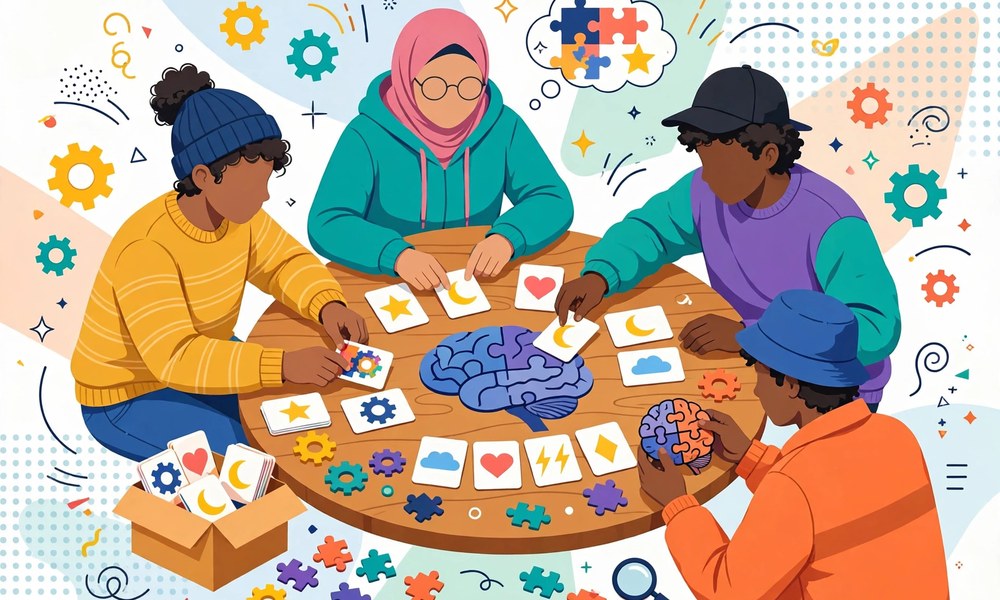
What Makes a Great Memory Game for Teens?
Not every game that claims to train your brain actually does. A great memory game for teens has a few things in common. First, it has a clear memory challenge at its heart: you must remember something — a card’s position, a sequence of sounds, a list of items, a pattern — and use that memory to win. If you can win by luck alone, it is not really a memory game.
Second, it scales. A good game is easy to start and hard to master. The first round should feel doable, but the tenth round should still make you think. Games that let you add more cards, speed up the sequence, or shorten the viewing time keep teens engaged long after the novelty wears off. Third, it is genuinely fun. The best memory games have a satisfying rhythm, a bit of friendly competition, and moments of surprise — the flip of a card you were sure about, the sequence that suddenly gets one step longer.
Finally, a great teen memory game fits real life. It should work in short bursts between homework and dinner, need little or no setup, and be playable alone or with others. The games in this guide tick all of those boxes, and most of them cost little or nothing to start.
How We Picked These Games
We looked for games that are popular with teenagers, easy to learn in under five minutes, and proven to challenge memory in a meaningful way. We favoured games with replay value — ones you can play a hundred times without it feeling the same — and games that work for different strengths, because some teens have brilliant visual memory while others remember sounds or words best. We also made sure the list mixes free and low-cost options, screen-free and app-based games, and solo and group play, so there is something here for every teen and every situation.
Each game below includes what it trains, how to play, who it suits best, and tips to make it harder as you improve. Use the comparison table to find your match quickly, then read the full reviews to pick your favourites.
Best Memory Games for Teens at a Glance
| Game | Best For | Players | Cost | Memory Skill |
|---|---|---|---|---|
| Concentration (Memory Match) | Classic visual recall | 1–4 | Free | Visual and spatial memory |
| Simon | Sequence recall | 1–4 | Low cost | Auditory and sequential memory |
| I Went to the Market | Group fun, verbal memory | 3–10 | Free | Verbal and working memory |
| Kim’s Game | Observation and detail | 2–8 | Free | Visual detail memory |
| Memory Palace Challenge | Long lists and study | 1+ | Free | Long-term recall |
| Dual N-Back | Serious brain training | 1 | Free apps | Working memory |
| Sequence Board Game | Strategy plus memory | 2–12 | Board game | Spatial and strategic memory |
| Memory Bingo | Fast, fun recall | 2–6 | Low cost | Visual and pattern memory |
| Spot the Difference Memory | Sharp observation | 1–2 | Free | Visual detail memory |
| Card Pairs (Pelmanism) | Quick rounds anywhere | 1–4 | Free | Visual and spatial memory |
| Brain-Training Apps | Daily practice | 1 | Free to try | Working and visual memory |
| Trivia Memory Quiz | Facts and recall | 2–8 | Free | Long-term and factual memory |
1. Concentration (Memory Match)
Concentration is the original memory game, and it is still one of the best. A set of cards is shuffled and laid face down in a grid. Players take turns flipping two cards, trying to find a matching pair. If they match, the player keeps the pair and goes again. If they do not, the cards are flipped back and the next player tries. The winner is the player with the most pairs at the end.
What makes Concentration so effective is that it trains visual and spatial memory at the same time. You are not just remembering what you saw — you are remembering where you saw it. After a few rounds, strong players build a mental map of the whole grid, tracking cards they saw three turns ago. That is exactly the kind of memory that helps with exams, where you need to recall not just a fact but where you read it.
Start with 12 pairs for a quick game, then work up to 24 or more. Use picture cards, word cards, or even matching pairs of maths facts and answers to turn it into a study tool. Play it with a timer for solo practice, or head-to-head with a friend for real competition. It is free, portable, and endlessly replayable — the perfect first memory game for any teen.
2. Simon
Simon is the classic electronic sequence game, and it is pure memory in its simplest form. The device lights up coloured panels and plays tones in a sequence. You repeat the sequence exactly. Each round adds one more step, and the sequence gets longer and longer until someone makes a mistake. It sounds simple, and the first few rounds are — then round eight arrives and your brain starts to sweat.
Simon trains auditory and sequential memory, which is a different skill from the visual memory used in card games. Remembering a sequence of sounds and colours in order is close to what you do when you memorise a phone number, a piece of music, or the steps of a dance routine. It also builds focus, because one moment of distraction breaks the chain.
Modern versions exist as apps and handheld devices, and you can even play Simon-style games with friends by clapping rhythms or tapping patterns on a table. Try playing at double speed once the normal pace feels easy, or add a rule where you must repeat the sequence backwards. That twist turns a familiar game into a serious brain workout.
3. I Went to the Market
I Went to the Market is a verbal chain game that is as funny as it is challenging, and it needs no equipment at all. The first player says, “I went to the market and I bought…” followed by one item, such as apples. The next player repeats the whole list and adds their own item. Each player must recite the full list in order before adding something new. The first person to forget an item or get the order wrong is out, or the group simply starts a new round.
This game is brilliant for working memory, because you have to hold a growing list in your head while also thinking of a new item to add. It also rewards creative, memorable choices: a player who adds “a purple elephant” is much easier to remember than one who adds “bread.” That is a real memory technique in disguise — vivid, unusual images stick in the mind far better than ordinary ones.
Play it in the car, at lunch, or as a classroom warm-up. Try themed rounds — items you would find in a kitchen, things that start with the letter B, or things you would pack for a space trip — to make it harder and funnier. Ten players and a list of twenty items is a genuine test of focus, and the laughter when someone confidently recites the wrong item is half the fun.
4. Kim’s Game
Kim’s Game is named after a character in Rudyard Kipling’s novel Kim, and it has been used to train observation and memory for over a century. The setup is simple: place 15 to 20 small objects on a tray — a key, a coin, a pen, a rubber band, a button, and so on. Let everyone study the tray for one minute, then cover it. Players write down as many objects as they can remember. The player who remembers the most wins.
What makes Kim’s Game special is that it trains attention to detail. It is not enough to remember “there was a coin” — strong players remember the coin was next to the red button, under the pen. That kind of detailed visual memory is useful everywhere, from noticing what has changed in a room to remembering the layout of a diagram in a textbook.
Make it harder by shortening the viewing time to 30 seconds, adding more objects, or asking players to remember the exact position of each item. You can also play a variation where one object is secretly removed while the tray is covered, and players must spot what is missing. That version trains change detection, a skill that sharpens with every round.
5. Memory Palace Challenge
The Memory Palace, also called the Method of Loci, is the technique used by memory champions to memorise hundreds of items in order, and it works surprisingly well as a game. Pick a place you know well — your house, your school, your route to the shops. Imagine walking through it room by room, and place one item you need to remember in each spot: a giant apple on the sofa, a singing fish in the bath, a pile of books on the stairs. To recall the list, you simply walk through the palace in your mind and collect the items.
As a game, one player reads out a list of 15 or 20 random words while the others build a memory palace in their heads. After a minute, everyone writes down as many words as they can in order. The results are usually astonishing: teens who could barely remember seven words by repetition can often recall fifteen or more using a palace. That is because the technique turns abstract words into vivid pictures tied to familiar places, giving the brain two hooks — visual and spatial — instead of one.
Memory palaces are also genuinely useful for school. Use one to memorise the order of historical events, the steps of a science process, or vocabulary for a language test. Once a teen has built their first palace, they have a tool they can use for life, not just a game they played once.
6. Dual N-Back
Dual N-Back is the most science-backed game on this list, and also the hardest. You watch a grid and listen to letters at the same time. You must press a button whenever the square appears in the same position as it did N steps ago, and whenever the letter matches the one from N steps ago. At N equals 1, it is easy. At N equals 2 or 3, it is a serious workout for working memory — the mental workspace where you hold and juggle information while you use it.
Research has linked Dual N-Back training with improvements in working memory and fluid reasoning, which is why it appears in so many brain-training apps. It is not a party game, and it will not feel fun in the same way as a card game, but for a teen who likes a challenge and wants measurable progress, it is unmatched. Many free apps offer it, with difficulty that rises automatically as you improve.
Start at N equals 1 and do short sessions of 10 to 15 minutes. Expect it to feel hard — that is the point. Track your level over a few weeks and you will see real progress, which is motivating in itself. Pair it with lighter games so your daily brain training stays balanced and enjoyable.
7. Sequence Board Game
Sequence is a board game that mixes memory, strategy, and luck, and it is a favourite for family game nights. Players place chips on a board based on the cards in their hand, trying to form a row of five chips in a sequence. To win, you must remember which cards have been played, which spaces your opponents are targeting, and where your own chips sit on a crowded board.
The memory demand in Sequence is subtle but real. You are tracking the board state, remembering your opponents’ patterns, and planning several moves ahead — all while new cards change the picture every turn. That combination of memory and strategy is excellent training for games like chess, for planning essays, and for any task where you must hold a plan in mind while new information arrives.
Sequence works with two to twelve players, so it scales from a quiet game for two to a noisy team game for a crowd. Play in teams of two for a social version, or play the classic free-for-all for maximum competition. Either way, it is one of the most replayable games on this list.
8. Memory Bingo
Memory Bingo takes the familiar bingo format and adds a recall twist. Instead of numbers being called at random, players must remember which items or pictures have already appeared, or match a called item to its position on their card from memory. Some versions use picture cards that are shown briefly and then hidden, so players must remember where each picture sits.
The game is fast, noisy, and very teen-friendly, especially in a group. It trains pattern memory and quick visual scanning, because you must check your card, remember what you have seen, and react before someone else shouts bingo. It is also easy to customise: make cards with vocabulary words for a language class, science terms for revision, or favourite films and songs for a party.
Print your own cards or use a bingo app, and play short rounds of five minutes so everyone gets several games in one session. Add a rule where the winner must recall the order the items were called in to claim the prize, and a simple party game becomes a genuine memory challenge.
9. Spot the Difference Memory
Spot the Difference is usually played with two pictures side by side, but the memory version is much harder and much better training. Look at the first picture for 30 seconds, then look away while it is hidden. Now study the second picture and find everything that has changed — without being able to compare them directly. You are relying entirely on your visual memory of the first image.
This game trains detailed visual memory and attention. Strong players do not just glance at a picture; they scan it systematically, noting colours, positions, and small details. That habit transfers to real life: reading a map, checking your work for errors, or noticing a detail in a science diagram that everyone else missed.
You can play with printed puzzles, apps, or even real rooms: study a room for a minute, step out while a friend changes five small things, then come back and spot them all. The real-room version is a favourite at sleepovers and youth groups, and it gets harder the more familiar the room is, because your brain fills in what it expects to see instead of what is actually there.
10. Card Pairs (Pelmanism)
Pelmanism is the classic pairs game played with a standard deck of cards, and it is the fastest memory game to set up anywhere. Shuffle a deck, lay out a grid of cards face down, and take turns flipping two cards to find matching values. Match a pair and keep it; miss and flip them back. The player with the most pairs wins.
Because it uses an ordinary deck of cards, Pelmanism is the game you can play anywhere: at school, on a train, at a campsite, or while waiting for food at a restaurant. It trains the same visual and spatial memory as Concentration, but with the added challenge of a full 52-card deck and cards that look similar at a glance. Telling a seven of hearts from a seven of diamonds after a quick flip is harder than it sounds.
For a harder version, use only part of the deck at first, then add cards as you improve. Try a speed version where each player has 60 seconds to find as many pairs as possible, or a team version where partners take turns and must remember cards their teammate saw. Small twists keep this old favourite fresh for years.
11. Brain-Training Apps
Brain-training apps bundle dozens of small memory games into one place, with daily challenges, streaks, and progress charts that keep teens coming back. The best apps include games for remembering sequences, matching patterns, recalling words and numbers, and spotting changes — all in short sessions of five to ten minutes. Many are free to try, with optional upgrades for extra games.
The strength of apps is consistency. A phone reminder, a daily streak, and a score that climbs a little each week turn memory practice into a habit, the same way a step counter turns walking into a game. For teens who like measurable progress and friendly competition, leaderboards and challenges against friends add real motivation.
Choose an app that varies its games rather than repeating the same one, and treat it as one part of a balanced routine rather than the whole routine. Apps are at their best when combined with physical games and puzzles — for example, warming up with an app in the morning and playing a card game with family in the evening. And if you enjoy word-based brain training, the best word games for teens make a great companion to memory apps, training vocabulary and verbal recall alongside visual memory.
12. Trivia Memory Quiz
A trivia memory quiz turns remembering facts into a game, and it is one of the most social games on this list. One player reads a question — the capital of Australia, the year the first moon landing happened, the name of a character in a popular series — and the others race to answer from memory. No phones, no looking things up, just what you already know.
Trivia trains long-term and factual memory, the kind you build over years of reading, watching, and learning. It also rewards curiosity: teens who play trivia regularly start noticing and remembering facts in everyday life, because they know a random detail might win them a point next Friday. It is also wonderfully flexible — write your own questions about music, sport, films, history, or school subjects.
Play in teams for a party, head-to-head for a duel, or solo with a quiz app for daily practice. Mix easy questions with hard ones so everyone gets moments to shine, and keep a running score across weeks to build a friendly rivalry. Trivia is proof that memory is not just about cards and sequences — it is about everything you have ever learned.
How Memory Games Help at School
The memory skills these games build show up directly in schoolwork. Visual memory helps with diagrams, maps, and geometry. Verbal memory helps with vocabulary, speeches, and language learning. Working memory helps with mental maths, where you must hold numbers in your head while you work on them. Sequential memory helps with processes: the steps of an experiment, the order of historical events, the plot of a novel.
Teachers often use memory games as warm-ups because they wake up the brain before a lesson. A five-minute round of Kim’s Game or I Went to the Market gets students focused and ready to learn in a way that a worksheet rarely does. If you are a student, try playing a memory game for ten minutes before a study session — many teens find they concentrate better afterwards.
Memory games also help with exam technique. Techniques like the memory palace and vivid association, which you practise in games, are the same techniques memory champions use to memorise huge amounts of information. Learn them through play and they feel natural when you need them for revision.
Memory Games vs Other Brain Games
Memory games are one family in a bigger world of brain games, and they work best alongside the others. Logic puzzles train reasoning, word games train vocabulary and verbal fluency, and number puzzles train calculation and pattern spotting. A teen who plays only memory games will build a strong memory but miss out on other skills, while a teen who mixes game types builds a more balanced brain.
A good weekly mix might look like this: memory matching on Monday, a number puzzle on Tuesday, a word game on Wednesday, and a trivia quiz with friends on Friday. That variety keeps things fresh and trains different mental muscles. If you like number puzzles, the best crossword puzzles for teens are a great next step after memory games, combining word recall with pattern recognition in a satisfying daily challenge.
Tips to Improve Your Memory While You Play
Playing memory games regularly will improve your memory on its own, but a few techniques make the gains much bigger. First, use association: link what you need to remember to something vivid, funny, or familiar. A card with a picture of a cat becomes “the cat sitting on my laptop,” not just “a cat.” Second, use chunking: break long lists or sequences into small groups of three or four, which are much easier to hold in mind than a single long string.
Third, say it out loud. Speaking a sequence or a list engages your auditory memory as well as your visual memory, giving you two ways to recall it. Fourth, space your practice: playing for ten minutes every day beats playing for two hours once a week. Memory strengthens between sessions, while you sleep, so regular short practice is the most efficient way to improve.
Finally, get enough sleep and stay active. Memory consolidation happens during sleep, and exercise improves blood flow to the brain. No game can replace those basics, but games plus good sleep and movement are a powerful combination.
Choosing the Right Memory Game for You
If you are playing alone, start with Concentration, Dual N-Back, or a brain-training app. If you are playing with friends, I Went to the Market, trivia quizzes, and Sequence are hard to beat. If you want a screen-free evening, card games, Kim’s Game, and Spot the Difference are perfect. If you are studying for exams, the Memory Palace Challenge and trivia quizzes give you the most direct help.
Age and experience matter too. Younger teens and beginners should start with fewer cards, shorter lists, and slower sequences, then raise the difficulty as they improve. Older teens who find the classics easy should try Dual N-Back, memory palaces, and backwards sequences — challenges that stay hard even for strong players.
The most important rule is simple: pick a game you actually enjoy. The best memory game in the world is useless if it sits on a shelf, while a simple game you play every day will transform your memory over time. Try three or four games from this list this week, keep the ones you love, and come back to the rest later.
Checklist: Getting Started With Memory Games
- Pick one solo game and one group game from this list to try this week.
- Play for 10 to 15 minutes a day, at the same time each day, to build a habit.
- Start easy and raise the difficulty only when you win comfortably twice in a row.
- Use memory techniques while you play: vivid associations, chunking, and saying things out loud.
- Track your scores or levels so you can see your progress over a few weeks.
- Mix memory games with other brain games, like word and number puzzles, for balanced training.
Frequently Asked Questions
Do memory games really improve memory?
Yes, regular practice with memory games improves the specific skills you practise, such as visual recall, sequence memory, and working memory, and those gains often transfer to everyday tasks like studying and concentrating. The key is regular, varied practice rather than a single long session.
How long should teens play memory games each day?
Ten to fifteen minutes a day is plenty. Short, regular sessions build memory more effectively than occasional long ones, and they fit easily into a school day. Treat it like exercise: a little every day beats a lot once in a while.
What is the best memory game for a teenager?
It depends on the teen. Concentration and Memory Match are the best all-rounders, Simon is best for sequence memory, I Went to the Market is best for groups, and Dual N-Back is best for serious brain training. Try several and keep the ones you enjoy most.
Can memory games help with exams?
Yes. The techniques used in memory games — vivid association, chunking, and memory palaces — are the same techniques that help with revision. Playing the games builds the skill, and the techniques transfer directly to memorising facts, dates, and vocabulary for exams.
Are memory game apps as good as physical games?
Both have strengths. Apps are convenient, track progress, and offer variety, while physical games add social interaction and hands-on play, which many teens find more engaging. The best routine combines both: apps for daily solo practice and physical games for family and friends.
What age are these memory games suitable for?
All the games in this guide suit teenagers aged 13 to 19, and most work well for younger children and adults too, with the difficulty adjusted. Start with fewer cards, shorter lists, or slower sequences for younger players, and raise the challenge as they improve.
Bottom Line
The best memory games for teens prove that building a sharper memory does not have to feel like work. From the timeless simplicity of Concentration and Pelmanism to the clever challenge of Dual N-Back and the memory palace, there is a game here for every teen, every mood, and every moment — a quiet solo session, a noisy family game night, or a five-minute warm-up before homework.
Start with one game you like, play it for ten minutes a day, and raise the difficulty as you improve. Mix in other brain games to keep things balanced, play with friends whenever you can, and watch your recall, focus, and confidence grow week by week. Your memory is a muscle, and these games are the gym — the only thing left to do is start playing.
Note: Memory games are a fun way to practise recall and focus, but they are not a substitute for professional help if a teenager has ongoing difficulties with memory or learning. If concerns persist, speak to a teacher or a healthcare professional for advice.


