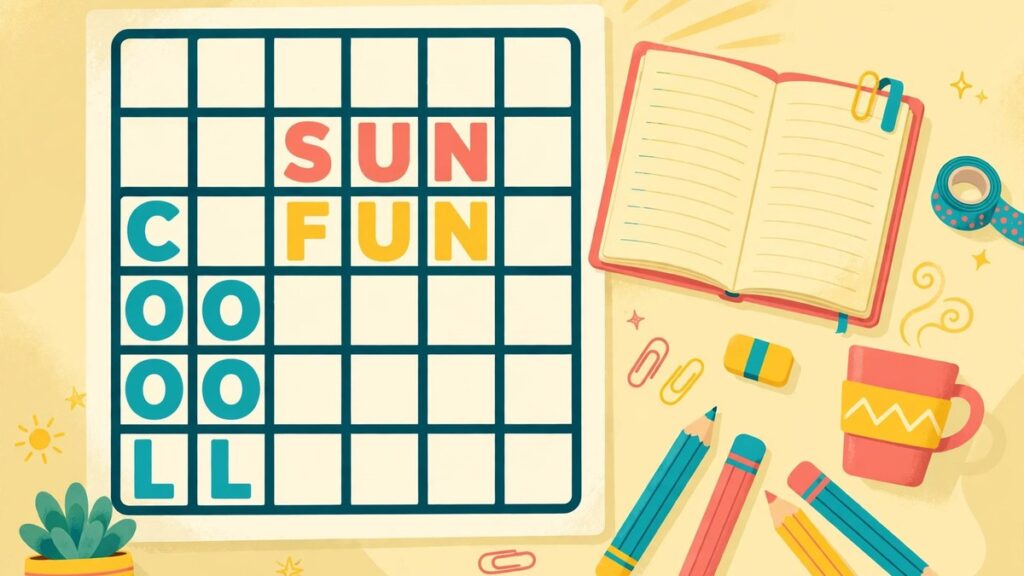
There is a particular kind of quiet that falls over a room when a teenager is truly hooked on a crossword. The phone is face down, the pencil is moving, and a clue that looked impossible two minutes ago suddenly clicks into place. It is not just a puzzle. It is a small, satisfying victory, repeated again and again, and it is one of the few screen-free activities that teenagers will actually choose for themselves once they find the right puzzle.
Crosswords are also quietly brilliant for growing minds. They stretch vocabulary without feeling like homework, they reward general knowledge, lateral thinking and pattern-spotting, and they teach patience in a way that few other games can. A teenager who solves crosswords regularly learns to hold several possibilities in mind at once, to test a guess against the crossing letters, and to let go of a wrong answer without giving up on the whole grid. Those are skills that show up in exams, in essays, in job interviews and in everyday problem-solving.
This guide rounds up the best crossword puzzles for teens in 2027, from gentle starter grids that build confidence to fiendish themed puzzles for seasoned solvers. Whether you are a parent looking for a thoughtful gift, a teacher hunting for classroom material, or a teenager searching for your next obsession, you will find a puzzle here that fits. We have included free and paid options, print and app choices, and plenty of example clues so you can try before you commit.
Key takeaways
- The best crossword puzzles for teens balance challenge and encouragement, with clear clues, fair wordplay and grids that reward persistence rather than punishing beginners.
- Start with easy or themed crosswords, then move up to standard daily puzzles and cryptic crosswords as confidence and vocabulary grow.
- Apps with hints, check buttons and streaks make crosswords more approachable, while print books are ideal for screen-free time, travel and classrooms.
- Solving together, timing yourself, or tackling one clue a day are all proven ways to turn a crossword habit into a lasting hobby.
- Look for puzzles with teen-friendly themes such as music, sport, films, gaming, science and school life, and avoid grids packed with obscure or dated references.
How to Choose the Best Crossword Puzzle for a Teen
Not every crossword is a good crossword for a teenager. A grid designed for a lifelong solver in their sixties will feel very different from one designed for a fifteen-year-old who loves music, gaming and sport. The best teen crosswords use vocabulary a teenager can reasonably be expected to know, or can learn with a little effort, and they sprinkle in modern culture alongside the classics. If every other answer is a 1950s film star or an obscure river in Europe, the puzzle will feel like a test rather than a game.
Difficulty matters too, and it is worth being honest about it. A puzzle that is too easy becomes boring after a week. A puzzle that is too hard becomes a source of frustration and ends up abandoned in a drawer. The sweet spot is a grid where a teenager can solve perhaps half the clues on their own, get another quarter with the help of crossing letters, and learn something from the rest. That ratio keeps motivation high and makes each completed grid feel earned.
Format is the third thing to consider. Some teenagers love the ritual of a printed book and a pencil. Others will only ever solve on a phone, and for them an app with a clean interface, a hint system and a daily streak is the difference between solving and not solving. There is no right answer here. The best crossword is the one a teenager will actually pick up, so match the format to the person, not the other way round.
Comparison Table: Best Crossword Puzzles for Teens at a Glance
| Puzzle | Best For | Format | Difficulty | Price |
|---|---|---|---|---|
| Teen Daily Crossword | Everyday solving | App and print | Easy to medium | Free with paid options |
| Pop Culture Crosswords | Music, film and TV fans | Book and app | Easy to medium | Low cost |
| School Subjects Crosswords | Learning and revision | Print workbook | Easy | Low cost |
| Quick Crosswords for Teens | Short bursts and travel | Book | Easy | Low cost |
| Themed Weekend Crosswords | Longer relaxed solving | Print and online | Medium | Free and paid |
| Science and Nature Crosswords | Curious minds | Book | Medium | Low cost |
| Sports Crosswords | Sports fans | Book and app | Easy to medium | Low cost |
| Music Crosswords | Music lovers | Book | Medium | Low cost |
| Cryptic Crosswords for Beginners | Advanced solvers | Book and app | Hard | Low cost |
| Mini Crosswords | Daily five-minute habit | App | Easy | Free |
1. Teen Daily Crossword
The Teen Daily Crossword is the ideal starting point for most teenagers, and it is the puzzle we recommend first. It arrives every day, it takes around ten to twenty minutes, and it is pitched at exactly the right level: challenging enough to be interesting, gentle enough to finish. The clues are written in plain, modern language, and the answers draw on school, sport, music, films, food and everyday life rather than obscure trivia.
What makes this puzzle work so well is its rhythm. Because a new grid appears daily, solving becomes a habit rather than a one-off activity. Teenagers start to recognise clue patterns, they build a mental bank of common crossword answers, and they get faster week by week. Many solvers keep a streak going for months, and that small daily win becomes a surprisingly powerful motivator. If you are looking for one puzzle to recommend to a teenager who has never solved a crossword before, start here.
Try these example clues from a typical easy daily grid. “Feline friend (3)” is CAT. “Opposite of cold (3)” is HOT. “School subject with numbers (4)” is MATH. “Red fruit that keeps the doctor away (5)” is APPLE. None of these is tricky, but together they teach the most important crossword skill of all: trusting the crossing letters and filling in what you know first.
2. Pop Culture Crosswords
Pop culture crosswords are the secret weapon for reluctant solvers. Instead of asking about history or geography, they ask about the things teenagers actually care about: chart-topping songs, blockbuster films, streaming shows, video games, influencers and internet culture. Suddenly a crossword is not a school exercise. It is a quiz about your own world, and that changes everything.
These puzzles are particularly good for groups. Two or three friends can solve one together, arguing over a film title or a song lyric, and the shared knowledge makes the grid feel collaborative rather than competitive. They are also a great choice for parties, youth groups and long car journeys, where a printed pop culture crossword can keep a whole back seat busy. If a teenager tells you they hate crosswords, hand them a pop culture one before you believe them.
Example clues show the flavour. “Singer of the hit song about a midnight drive (5,5)” might lead to a familiar pop star. “Streaming show about a school for superheroes (4,6)” points to a well-known series. “Video game where you build with blocks (9)” is MINECRAFT. “Film about a friendly neighbourhood spider hero (7,3)” is SPIDERMAN in spirit, though the grid will tell you the exact letter count. The answers feel rewarding because the solver already knows them; the puzzle is simply unlocking them.
3. School Subjects Crosswords
School subjects crosswords turn revision into a game, and teachers have known this for years. A crossword on biology terms, maths vocabulary, historical dates or French verbs forces a student to recall information actively rather than simply re-reading notes, and active recall is one of the most effective ways to learn. The puzzle format also makes gaps in knowledge obvious in a gentle way: an empty square is a prompt to look something up, not a red mark on a test.
These crosswords work best when they are matched to what a teenager is actually studying. A Year 9 science crossword is useful in Year 9 and far less useful two years later. Look for workbooks organised by subject and topic, so a student can pick the chapter they need and solve a grid that reinforces exactly that material. Many teachers now use them as starters, homework or revision games, and students often prefer them to worksheets.
Here are some typical school-themed clues. “The powerhouse of the cell (12)” is MITOCHONDRIA. “A word that describes a noun (9)” is ADJECTIVE. “The capital of France (5)” is PARIS. “Two plus two (4)” is FOUR. “The chemical symbol for water (3)” is H2O, though a grid may spell it out differently. Each answer is a small piece of knowledge, locked in place by the act of solving.
4. Quick Crosswords for Teens
Quick crosswords are short, friendly grids designed to be finished in five to ten minutes. They are perfect for busy teenagers who want a puzzle fix without committing to a full daily crossword, and they are ideal for travel, waiting rooms, lunch breaks and the last ten minutes before bed. Because the grids are smaller, there is less room for obscure answers, and the clues tend to be direct and fair.
The real value of a quick crossword is that it removes the intimidation factor. A full-sized grid can look daunting to a beginner, with its sea of white squares and long answers. A quick crossword looks doable, and doable is what gets a teenager to pick up a pencil. Once they have finished a few quick grids, the bigger puzzles stop looking scary. Think of quick crosswords as training wheels: useful, confidence-building, and easy to outgrow when the time is right.
Example quick clues include “Morning drink (3)” for TEA, “A place to borrow books (7)” for LIBRARY, “Opposite of win (4)” for LOSE, and “A small green vegetable (3)” for PEA. Simple, satisfying and finished before the bus arrives. For teenagers who say they do not have time for puzzles, quick crosswords are the perfect reply.
5. Themed Weekend Crosswords
Themed weekend crosswords are larger, richer puzzles built around a single idea. One week the theme might be space exploration, the next it might be famous inventions, classic novels, world cuisines or Olympic sports. The theme runs through the longest answers, and spotting the connection between them is half the fun. These puzzles reward curiosity and general knowledge, and they often teach the solver something new along the way.
Weekend crosswords are best saved for a relaxed moment: a Sunday morning, a rainy afternoon, or a long train journey. They take longer than a daily puzzle, often thirty to forty-five minutes, and they benefit from a slower, more thoughtful approach. Many families solve them together, with different people tackling different corners of the grid. If your teenager enjoys a challenge and likes learning random facts, a themed weekend crossword is a wonderful gift.
A space-themed example makes the idea clear. “First person to walk on the Moon (9)” is ARMSTRONG. “Planet known as the Red Planet (4)” is MARS. “A star at the centre of our solar system (3)” is SUN. “Vehicle that travels into space (6)” is ROCKET. Once you spot the theme, the remaining answers start to fall into place, and that moment of recognition is one of the great pleasures of crosswords.
6. Science and Nature Crosswords
Science and nature crosswords are made for curious teenagers who love asking how things work. They cover animals, plants, the human body, weather, space, chemistry and the environment, and they turn fascinating facts into puzzle answers. A teenager who loves documentaries or science videos will find these grids feel less like a test and more like a treasure hunt through things they already find interesting.
These puzzles also build scientific vocabulary in a painless way. Words like PHOTOSYNTHESIS, ECOSYSTEM and GRAVITY are much easier to remember when you have wrestled them into a grid than when you have simply copied them from a textbook. For students considering science subjects at a higher level, that vocabulary head start is genuinely useful, and it comes without any of the pressure of formal study.
Try these science clues. “Process by which plants make food using sunlight (14)” is PHOTOSYNTHESIS. “Force that pulls objects towards Earth (7)” is GRAVITY. “The largest mammal in the world (5,5)” is BLUE WHALE. “Gas we breathe in to live (6)” is OXYGEN. “A baby frog (7)” is TADPOLE. Each answer is a fact worth knowing, and each one sticks a little better because you solved for it.
7. Sports Crosswords
Sports crosswords are a natural fit for teenagers who follow football, basketball, tennis, cricket, athletics or any other sport. The clues draw on players, teams, tournaments, rules and records, and for a sports fan the answers are often on the tip of the tongue. That familiarity makes sports crosswords one of the most accessible entry points into puzzle-solving, especially for teenagers who think crosswords are not for them.
These puzzles are also great for building sports knowledge. A young football fan might know their favourite team inside out but learn the name of a historic player or a famous stadium through a crossword. A basketball fan might discover a rule or a record they had never heard of. The grid becomes a way of deepening a passion they already have, which is a far more powerful motivator than any worksheet.
Example sports clues include “Sport played with a bat and ball on a pitch (7)” for CRICKET, “Number of players in a football team on the pitch (6)” for ELEVEN, “Tennis score of zero (4)” for LOVE, “A race run over 42 kilometres (8)” for MARATHON, and “Sport where you score by getting a ball through a hoop (10)” for BASKETBALL. For a sports-mad teenager, these are not hard clues. They are invitations.
8. Music Crosswords
Music crosswords celebrate songs, artists, instruments, genres and lyrics, and they are a delight for teenagers who live with headphones on. Whether the puzzle focuses on pop, rock, hip hop, classical or musical theatre, the clues tap into knowledge that feels personal and current. A teenager who can name every song on an album will find a music crossword far easier, and far more fun, than a general knowledge grid.
Music crosswords also introduce solvers to new artists and eras. A clue about a classic rock band or a jazz legend might send a teenager to a streaming service to hear a song for the first time, and that discovery is part of the joy. Parents and teachers can use music crosswords to bridge generations too, solving a grid together and trading knowledge across decades of music.
Here are some music-themed examples. “Instrument with 88 keys (5)” is PIANO. “A group of musicians (4)” is BAND. “Song that tops the charts (3,4)” might be NUMBER ONE, depending on the grid. “Musical with cats as characters (4)” is CATS. “Singer known as the Queen of Pop (7)” is MADONNA. The answers sing, quite literally, and the puzzle feels like a playlist in grid form.
9. Cryptic Crosswords for Beginners
Cryptic crosswords have a reputation for being impossible, but beginner cryptics are a different beast entirely. They are designed to teach the logic of cryptic clues step by step, with clear wordplay, fair definitions and gentle introductions to anagram indicators, hidden words and reversals. For a teenager who has mastered standard crosswords and wants a bigger challenge, cryptics are the next mountain to climb, and the view from the top is wonderful.
The key to enjoying cryptics is understanding that every clue has two parts: a definition and a piece of wordplay that leads to the same answer. Once that clicks, the puzzle transforms from baffling to brilliant. A clue like “Confused cat is an animal (3,3)” might hide an anagram, while “A pet inside a car (3)” might hide a word inside another word. Learning these tricks feels like learning a secret code, and teenagers love secret codes.
Start with beginner books that explain each clue type and include worked examples. Solve with a friend or a parent at first, talking through each clue out loud. Do not worry about speed; cryptics are about the aha moment, not the stopwatch. After a few weeks of practice, clues that once looked like nonsense will start to make sense, and that is one of the most satisfying feelings in puzzling.
10. Mini Crosswords
Mini crosswords are tiny grids, often just five by five, that can be solved in two or three minutes. They have become hugely popular as a daily habit, especially in apps, because they fit into the smallest gaps in a day: waiting for a bus, standing in a queue, or the first thing in the morning. Despite their size, they are cleverly constructed, and a good mini can be surprisingly tricky.
For teenagers, minis are the perfect low-commitment entry point. There is no large grid to intimidate, no long session required, and the sense of completion comes quickly. Many solvers start with a mini each morning and graduate to a full crossword within weeks. If you want to build a daily puzzle habit with minimal friction, start with minis and let the habit grow from there.
Example mini clues are short and sweet. “A colour of the rainbow (3)” is RED. “A pet that barks (3)” is DOG. “Opposite of day (5)” is NIGHT. “A fruit that is also a colour (6)” is ORANGE. “The first meal of the day (9)” is BREAKFAST. Small grids, big satisfaction, and a habit that sticks.
More Great Crossword Puzzles for Teens
Beyond the ten picks above, there are many more crossword styles worth exploring. Holiday crosswords, with themes for Christmas, Halloween and summer, are fun seasonal treats. Geography crosswords help with maps, capitals and flags. Literature crosswords celebrate books, authors and characters, and they are a lovely companion to a reading habit. History crosswords bring the past to life through names, dates and events. The more a teenager explores, the more they discover which themes suit them best.
Crossword apps deserve a special mention here. The best apps offer a daily puzzle, a hint button, a check feature, a timer and a streak tracker, all in a clean interface that does not distract from the grid. Some apps let you solve with friends, compare times, or compete on a leaderboard. For teenagers who do their puzzle-solving on a phone, a good app can be the difference between a passing interest and a lasting hobby. Look for apps with teen-friendly content and no intrusive adverts.
Print books still have an important place too. A well-made crossword book is a screen-free companion for holidays, long journeys and quiet evenings. It never runs out of battery, it never shows a notification, and it can be shared, swapped and passed on. Many teenagers enjoy the physical act of writing in a grid with a pencil, erasing a wrong answer and trying again. That tactile experience is part of the charm, and it is worth preserving.
Example Crossword Clues With Answers for Teens
If you want to test whether crosswords are right for a teenager in your life, try these clues together. They cover a range of topics and difficulties, and they show how satisfying a crossword answer can be when it clicks. Read the clue, guess the answer, then check it against the letters.
Easy clues: “A yellow fruit monkeys love (6)” is BANANA. “The season after summer (6)” is AUTUMN. “A vehicle with two wheels (4)” is BIKE. “The opposite of up (4)” is DOWN. “A place where you sleep (3)” is BED. “Water that falls from the sky (4)” is RAIN. These are gentle warm-ups that build confidence quickly.
Medium clues: “Capital city of Japan (5)” is TOKYO. “A large body of salt water (5)” is OCEAN. “The study of living things (7)” is BIOLOGY. “A famous detective created by Arthur Conan Doyle (7,6)” is SHERLOCK HOLMES. “The fastest land animal (7)” is CHEETAH. “A book that tells you the meaning of words (10)” is DICTIONARY. These require a little more knowledge, but the answers are all familiar.
Harder clues: “The largest planet in our solar system (7)” is JUPITER. “Author of the Harry Potter books (7)” is ROWLING. “The chemical symbol for gold (2)” is AU. “A triangle with all sides equal (11)” is EQUILATERAL. “The country where the Eiffel Tower stands (6)” is FRANCE. “The process of a caterpillar becoming a butterfly (13)” is METAMORPHOSIS. These are the kind of clues that make a solver feel clever when they get them right.
Fun wordplay clues: “I am tall when I am young and short when I am old. What am I? (6)” is CANDLE, a classic riddle-style clue that works beautifully in a crossword. “What has keys but cannot open a door? (5)” is PIANO. “What gets wetter the more it dries? (5)” is TOWEL. These playful clues remind us that crosswords are games first and tests second, and they are a great bridge for teenagers who love riddles. If your teenager enjoys these, they will also enjoy exploring the best riddles for teens with answers, which use the same kind of lateral thinking in a different format.
How to Get Better at Crosswords
Getting better at crosswords is mostly about practice, but a few strategies help enormously. First, always fill in the answers you know straight away, even if they are scattered across the grid. Those letters will help you solve the crossing clues, and the grid will start to fill itself in. Second, read every clue carefully and pay attention to the number in brackets: it tells you exactly how many letters the answer has, and that is a powerful constraint.
Third, learn the common crossword answers. Certain short words appear again and again because they are useful for filling grids: words like ERA, ALE, ORE, EEL, APE and ION. Once you know them, you will spot them instantly. Fourth, do not be afraid to use a hint or to check a letter. Hints are not cheating; they are learning tools, and every expert solver uses them sometimes. The goal is to finish the grid and enjoy it, not to suffer in silence.
Finally, solve regularly. A crossword a day, even a mini, builds vocabulary and pattern recognition faster than an occasional marathon session. Keep a notebook of interesting words you learn, look up answers you did not know, and celebrate your fastest times. Over weeks and months, you will notice the clues getting easier, the grids filling faster, and your confidence growing. That progress is the real reward.
Crosswords also pair beautifully with other word games. Many teenagers who love crosswords also enjoy brain teasers, and working through the best brain teasers for teens is a great way to sharpen the same skills in a fresh format. Similarly, if you want a broader mix of word-based fun, the best word games for teens offers plenty of ideas for game nights, classrooms and solo play.
Crosswords for Classrooms, Families and Gifts
Teachers can use crosswords in many creative ways. A crossword can introduce a new topic, revise an old one, fill a spare ten minutes, or serve as a fun homework alternative. Because crosswords are self-checking, students get instant feedback: if the crossing letters do not work, something is wrong, and they can fix it themselves. That independence is valuable, and it frees the teacher to help students who need it most.
For families, crosswords are a rare activity that works across ages. A grandparent, a parent and a teenager can all contribute different knowledge to the same grid, and the conversation that follows is often as enjoyable as the puzzle itself. Solving together on a Sunday morning, or competing to finish a daily puzzle fastest, creates small shared rituals that teenagers actually remember fondly.
As gifts, crossword books are thoughtful, affordable and easy to personalise. Choose a theme that matches the teenager’s interests, add a nice pencil, and you have a gift that will be used for weeks. For a birthday or a holiday, a subscription to a crossword app or a set of themed books makes a present that keeps giving long after the wrapping paper is gone.
Checklist: Choosing and Solving Crosswords for Teens
- Match the difficulty to the solver: start easy, build up gradually, and celebrate progress rather than perfection.
- Pick themes the teenager cares about, such as music, sport, gaming, science or pop culture, to keep motivation high.
- Choose the right format: an app for phone lovers, a print book for screen-free time, or both for variety.
- Fill in known answers first, use crossing letters to unlock harder clues, and do not fear hints or checks.
- Solve regularly, even for five minutes a day, to build vocabulary, speed and confidence over time.
- Make it social: solve with friends or family, share interesting clues, and enjoy the conversation that crosswords spark.
Frequently Asked Questions
What age are crossword puzzles for teens suitable for?
Most teen crosswords are suitable for ages 12 to 18, with easier grids working well for younger teens and harder or cryptic grids suiting older teens. The key is matching difficulty and theme to the individual rather than the age on the cover. A twelve-year-old who loves reading may enjoy a harder puzzle, while a seventeen-year-old new to crosswords may prefer a gentle starter grid.
Are crosswords good for teenagers?
Yes, crosswords are excellent for teenagers. They build vocabulary, improve spelling, strengthen general knowledge, encourage lateral thinking and develop patience and persistence. They also offer valuable screen-free time and a sense of achievement that comes from solving a problem through your own effort. Research on word puzzles consistently shows benefits for memory and language skills.
How long does a crossword for teens take to solve?
A mini crossword takes two to five minutes, a quick crossword takes five to ten minutes, a standard daily crossword takes ten to twenty-five minutes, and a larger weekend or themed crossword can take thirty to forty-five minutes. Beginners should allow extra time and not worry about speed. The goal is enjoyment, not a stopwatch record.
What is the best crossword puzzle for a teenager who has never solved one before?
Start with a mini crossword or a quick crossword book with easy, direct clues. Pop culture or sports themes are often the most engaging for beginners because the answers draw on familiar knowledge. Once a teenager has finished a few easy grids, move up to a daily crossword and then to themed or medium puzzles.
Are there free crossword puzzles for teens?
Yes, many free crosswords are available in apps and online, including daily puzzles and mini crosswords. Free options are a great way to try crosswords without spending money, though paid books and app subscriptions often offer better curation, fewer adverts and a wider range of themes. A mix of free daily puzzles and one good print book is an excellent starting point.
How can I help a teenager who gets stuck on a crossword?
Encourage them to fill in what they know, use the crossing letters, and take a break if needed. A fresh look often reveals an answer that was invisible before. Suggest using a hint, checking a single letter, or solving a different corner of the grid. Remind them that getting stuck is normal, even for experienced solvers, and that every grid teaches something new.
Bottom Line
The best crossword puzzles for teens in 2027 are the ones that meet a teenager where they are: fun, fair, modern and just challenging enough to be satisfying. Start with easy daily grids or themed puzzles that match their interests, build a small daily habit, and let confidence grow naturally. Whether they solve on a phone or with a pencil, alone or with friends, teenagers who discover crosswords gain a hobby that entertains, educates and endures. Pick a puzzle from this guide, try a few of the example clues together, and see how quickly a crossword can turn a quiet afternoon into a small triumph.
Note: Crossword difficulty and themes vary by publisher and edition, so check the sample grid or clue list before buying a book or subscribing to an app. Encourage teenagers to solve at their own pace, use hints when needed, and enjoy the process rather than rushing to finish. The best puzzle is always the one they want to pick up again tomorrow.