
Finding the best puzzle games for 268 players sounds like an impossible brief, because almost no puzzle game is designed for 268 people sitting around one table. The best puzzle games for 268 players are not single-box games at all. They are formats that scale: team puzzles, relay rounds, parallel stations, and shared challenges that let hundreds of people play at the same time without anyone waiting around doing nothing. When the format is right, a room of 268 players feels like one big game instead of a crowd watching a few people play.
The trick is to stop thinking about one game and start thinking about one event. A jigsaw race works when 268 players split into teams and each team builds the same puzzle against the clock. A crossword works when every team gets the same grid and the first finished grid wins. An escape-room style challenge works when the same puzzle trail is copied across many tables, so every team faces the same clues at the same moment. The puzzle itself stays familiar. The scale comes from how it is organised, and that is where most large-group game nights succeed or fail.
This guide covers the puzzle games that genuinely work at this size, how to set each one up, and what equipment you need. Every pick below scales cleanly, needs little specialist equipment, and keeps the focus on solving rather than waiting. Use the comparison table to shortlist your format, then follow the setup notes for the games that fit your room and your players.
Key takeaways
- Pick formats that scale, not single-box games: team puzzles, relays, stations, and shared grids work for 268 players.
- Split 268 players into teams of four to eight so everyone has a job and no one is left watching.
- Run the same puzzle for every team at the same time, so results are fair and the finish is genuinely exciting.
- Mix puzzle types across the event: jigsaws, word puzzles, logic grids, and code-breaking keep energy high.
- Plan the room first: tables, timers, answer sheets, and a clear scoring system matter more than the puzzles themselves.
What Makes a Puzzle Game Work for 268 Players
A good large-group puzzle game has three qualities. First, it must split cleanly into parallel copies, so every team plays the same challenge at the same time. Second, it must give every player something to do, because a puzzle that only needs two sharp minds will leave the other 266 people bored. Third, it must have a clear, checkable answer, so scoring is fast and nobody argues about the result.
Team size is the first decision. Teams of four to eight work best for puzzle events. Smaller teams mean more teams to manage, and larger teams mean quieter players get pushed to the edge of the table. With 268 players, teams of six give you about 45 teams, which is a manageable number for one host with a microphone and a printed score sheet. Teams of four give you 67 teams, which is workable if you have helpers, but scoring takes longer. Whatever size you choose, keep it the same for every team, because mixed team sizes make the competition unfair.
The room matters as much as the puzzles. You need enough tables that each team has its own working space, a central area where the host can be seen and heard, and a way to display the timer and the scores. A projector or a large screen helps enormously, because it lets you show the puzzle, the countdown, and the leaderboard to the whole room at once.
The Best Puzzle Games for 268 Players
The games below are ranked by how well they scale, how little equipment they need, and how much fun they create in a large room. You do not need to run all of them. Pick three or four, and you have a full evening of play.
Team Jigsaw Race
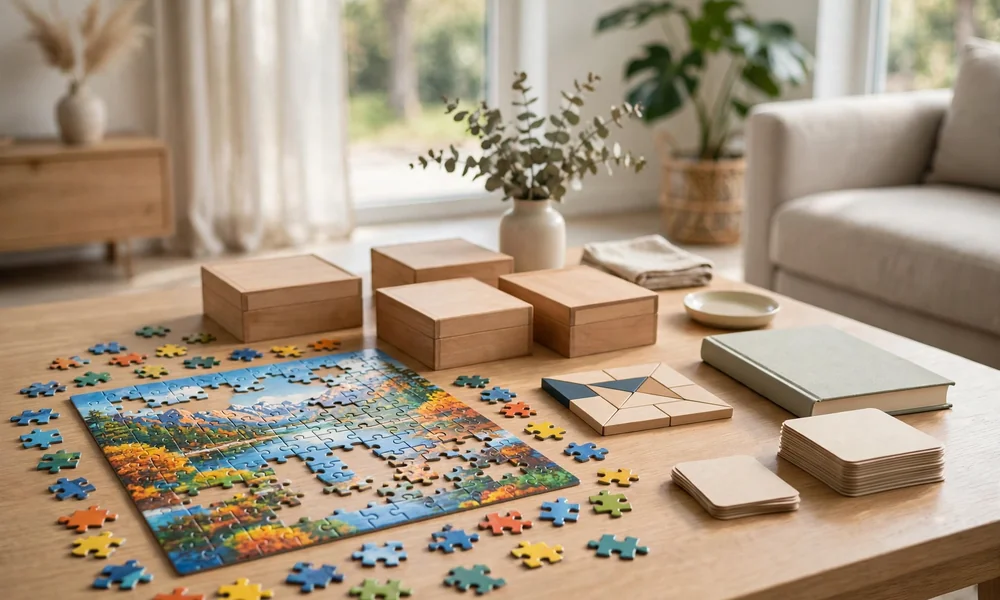
A jigsaw race is the simplest large-group puzzle and often the most satisfying. Every team gets an identical puzzle, usually between 300 and 500 pieces, and the first team to finish wins. With 268 players, you need one puzzle per team, so about 45 identical puzzles for teams of six. A 500-piece puzzle takes a competent team of six around 45 to 60 minutes, which is a good length for a main event.
The format works because everyone can contribute at once. One player sorts edges, another sorts colours, another builds the sky, and the picture comes together as a team. Hand out the puzzles sealed, start every team on the same signal, and use a visible countdown timer to add excitement. If your budget is tight, use 300-piece puzzles instead.
Giant Crossword Challenge
A giant crossword is a strong choice when you want a quieter, thinking-heavy round. Print the same large crossword grid for every team, with clues that mix general knowledge, wordplay, and riddles. The best grids for a large group have 20 to 30 clues and take 20 to 30 minutes to solve.
Crosswords scale well because they cost almost nothing to run: one printed sheet per team, one answer sheet, and a pen. They also suit mixed-age groups, because different players shine on different clues. To avoid arguments about spelling, print the answers in a sealed envelope the host opens at the end, and award points per correct word rather than an all-or-nothing result.
Escape Room Relay
An escape room relay brings the excitement of an escape room to a group far too large for a single locked room. Set up a series of puzzle stations around the hall, each with a different challenge: a coded message, a combination lock, a pattern puzzle, and a hidden-object search. Teams move from station to station in order, and the team that completes all stations fastest wins. Plan for at least eight stations and stagger the start times so teams are not queuing.
The relay works because it turns the whole room into the game. Players move, talk, and think together, and the movement keeps energy high after a seated round. Each station should take three to five minutes, so the full relay runs in about 30 to 40 minutes. Keep each station self-contained, with the answer written on a card the team carries to the next station, so the host can score the event from the completed cards.
Sudoku and Logic Grid Tournament
A Sudoku tournament is ideal when you want a fair, silent, head-to-head competition. Every player gets the same Sudoku grid at the same difficulty, and the fastest correct finishers score points for their team. A standard Sudoku takes a good solver five to ten minutes, so three rounds fit comfortably into half an hour.
The format is fair because everyone faces the same puzzle, and scoring is simple because the answer is either right or wrong. It also works for mixed abilities: run an easier grid for beginners and a harder grid for experienced players, then combine the scores. Logic grids, where players match people to houses, pets, and drinks using clues, work in exactly the same way.
Code-Breaking Challenge
A code-breaking challenge gives 268 players a taste of detective work. Each team receives the same coded message, a short cipher key, and a set of clues that reveal the code step by step. The best codes for a large group are simple ciphers, such as a Caesar shift or a number-to-letter substitution, because they are easy to explain and satisfying to crack. A message of 30 to 50 words takes a team of six about 15 to 20 minutes to decode.
Code-breaking suits large groups because it rewards teamwork. One player works on the cipher, another hunts for patterns, and another guesses likely words from the context. To make the round more exciting, break the code into three parts and release each part on a timer, so teams that fall behind can catch up. The decoded message can be a riddle, a joke, or the location of the next round.
Word Ladder and Anagram Race
A word ladder race is a fast, noisy round that works well between slower puzzles. Give every team the same starting word and the same target word, and challenge them to build a ladder of real words, changing one letter at a time. For example, turning COLD into WARM takes four steps, and the team that finds the shortest ladder wins.
These games are excellent for large groups because they need no equipment beyond printed sheets, take only five to ten minutes, and create a lively atmosphere. They also suit players who find jigsaws and Sudoku intimidating, because word games reward vocabulary and quick thinking rather than patience. Agree the rules before the round starts: only words in a standard dictionary count, names do not count, and the host has the final word on disputes. The best word games for large groups use the same team format, so they pair naturally with this round if you want a word-heavy section in your event.
How to Compare the Best Puzzle Games for 268 Players
Choosing between these games is easier when you compare them side by side. The table below shows the round length, the equipment, and the best moment in your event for each format. Use it to build a schedule that mixes quiet thinking rounds with active rounds.
| Puzzle game | Round length | Equipment needed | Best for |
|---|---|---|---|
| Team jigsaw race | 45 to 60 minutes | One identical puzzle per team | Main event, teamwork |
| Giant crossword challenge | 20 to 30 minutes | Printed grids and pens | Quiet thinking round |
| Escape room relay | 30 to 40 minutes | Eight puzzle stations | Active, high-energy round |
| Sudoku tournament | 25 to 30 minutes | Printed grids, answer key | Fair head-to-head play |
| Code-breaking challenge | 15 to 20 minutes | Coded sheets and cipher keys | Detective-style teamwork |
| Word ladder race | 5 to 10 minutes | Printed word sheets | Fast filler between rounds |
The table shows a useful pattern: the games that need the most equipment, the jigsaw race and the escape room relay, create the strongest memories, while the games that need the least, the crossword and the word ladder, are the easiest to run well. A strong event mixes both kinds, opening with a cheap, simple round while the room settles, then building to the bigger games once everyone is warmed up.
How to Run a 268-Player Puzzle Event
Running a puzzle event for 268 players is mostly a logistics job, and good logistics make the puzzles feel easy. Confirm your numbers a week before the event: with 268 players, plan for 44 teams of six and one team of four, or 67 teams of four if you prefer smaller teams. Print everything a day early, count the sheets twice, and pack a spare set of every puzzle.
On the day, arrive early and lay out the room before the players arrive. Put a number card on every table, stack the puzzle sheets in order, and test the microphone and the timer display. Welcome the players, explain the scoring in one minute, and start with your easiest round, which gives every team an early success and teaches them how the event works. Between rounds, collect the answer sheets quickly, announce the top five teams, and hand out the next round without a long pause.
Scoring should be simple enough that one person can do it with a printed sheet. Award ten points for first place, eight for second, six for third, and one point per team for finishing a round at all. That way, every team stays in the running. If two teams tie at the end, settle it with a single tie-breaker puzzle, such as a five-minute anagram race. The earlier puzzle games guide for large groups follows the same team format, so its scheduling advice works here too if you are planning a series of events rather than a single night.
Choosing the Right Puzzle Format for Your Group
The best format depends on who is playing. A school group will enjoy the jigsaw race and the word ladder, because those games are visual and easy to explain. A corporate group will enjoy the escape room relay and the code-breaking challenge, because those games reward teamwork and communication. A mixed-age family event will enjoy the crossword and the word ladder, because those games let different generations contribute different strengths.
Age range matters more than most hosts expect. Young children need puzzles they can touch and move, such as jigsaws, while older players enjoy logic grids and code-breaking. If your 268 players include a wide range of ages, run the visual games first and the logic games later, so younger players build confidence before the harder rounds arrive.
Budget is the other deciding factor. A full jigsaw race for 45 teams can cost a significant amount if you buy new puzzles, while a crossword, a Sudoku tournament, and a word ladder race together cost almost nothing beyond printing. If your budget is small, spend it on one memorable game, such as the escape room relay, and fill the rest of the evening with printed puzzles. For a quieter evening with fewer players, the best board games for large groups offer a useful comparison, because they show how tabletop games scale in a similar way.
Your 268-Player Puzzle Night Checklist
Use this checklist when you plan your event, and tick each item off as you complete it. It covers the decisions that matter most, in the order you should make them.
- Confirm the player count and divide 268 players into equal teams of four to eight.
- Choose three or four puzzle formats that mix quiet thinking with active play.
- Print one set of puzzle sheets per team, plus a spare set for every round.
- Prepare a simple scoring sheet and a visible leaderboard for the whole room.
- Test the microphone, the timer display, and the seating layout before players arrive.
- Plan a tie-breaker puzzle in advance so a draw at the end is settled in five minutes.
Frequently Asked Questions
Can 268 players really play the same puzzle game at once?
Yes, as long as the game is split into parallel team copies. Every team gets the same puzzle, the same clues, and the same time limit, so all 268 players are solving at the same moment. The key is preparation: print enough copies, set up enough tables, and keep the rules short so the game starts on time.
What team size works best for 268 players?
Teams of six work best for most events, giving you about 45 teams. Teams of four work well when you have helpers to manage scoring, giving you 67 teams. Avoid teams larger than eight, because quieter players stop contributing and the puzzle becomes a job for two or three people.
How long should a 268-player puzzle event last?
Two to three hours is ideal, with three or four rounds and short breaks between them. A single round of 45 to 60 minutes, such as a jigsaw race, plus two shorter rounds of 20 to 30 minutes, fills an evening without tiring the players.
How much does a 268-player puzzle night cost?
It depends on the formats you choose. Printed puzzles such as crosswords, Sudoku, and word ladders cost very little beyond paper and ink. A jigsaw race for 45 teams is the biggest expense, because you need one identical puzzle per team.
What if some teams finish much faster than others?
Plan a bonus puzzle for early finishers, such as an extra anagram sheet or a bonus riddle, so fast teams stay busy while slower teams finish. Never start the next round while half the teams are still working, because that punishes the slower teams.
Do puzzle games work for mixed-age groups of 268 players?
Yes, and they work better than most other party games for mixed ages, because different puzzles reward different strengths. Younger players often shine at jigsaws, while older players shine at crosswords and logic grids. Mixing the formats across the evening gives every age group a round where it can lead.
The Bottom Line
The best puzzle games for 268 players are the ones that turn a huge crowd into teams, give every player a job, and keep the whole room solving the same challenge at the same time. Start with a simple printed round, build to a jigsaw race or an escape room relay, and finish with a fast word game. Plan the room, the teams, and the scoring before you worry about the puzzles themselves, and the evening will run smoothly. With the right format, 268 players is not a problem to solve. It is the reason the night works, because a puzzle solved by a whole room feels bigger than a puzzle solved alone.


