
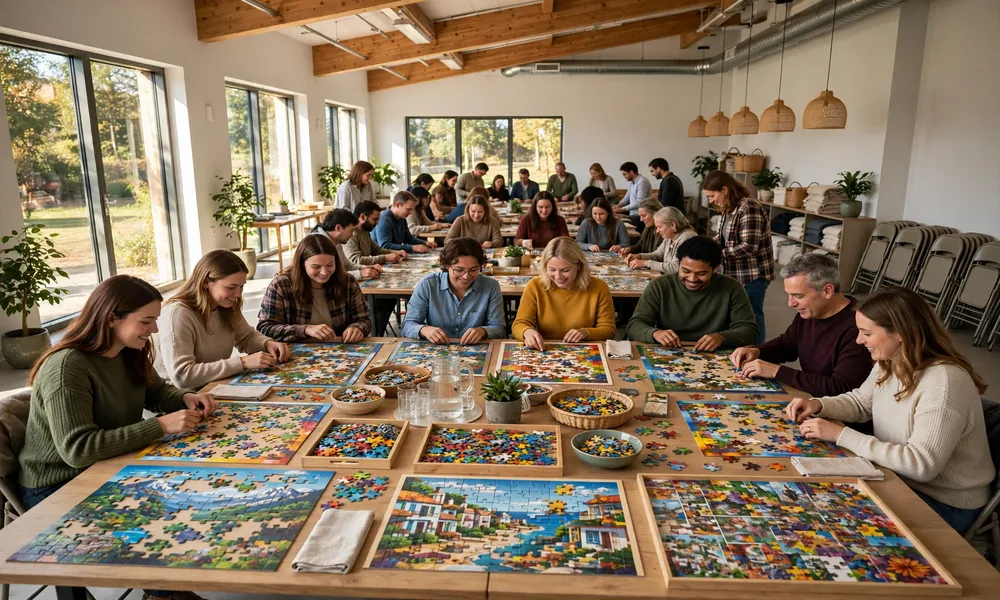
Best puzzle games for 266 players turn an ordinary gathering into a giant shared brain teaser, where hundreds of people solve, guess, and race toward the same answers at the same time. A group this large sounds impossible to organise, yet puzzle games are one of the few formats that scale beautifully, because the solving can happen in small teams while the excitement stays shared across the whole room. Whether the event is a school assembly, a company social, a community festival, or a huge family reunion, the right puzzle format keeps every single player involved instead of leaving most of the crowd watching from the sidelines.
The secret is structure. With 266 players, nobody should wait for a turn or struggle to hear the host. The best formats split the crowd into teams of four to eight, give every team the same puzzle at the same moment, and score results on a big visible leaderboard. Teams talk, argue, laugh, and piece clues together while the host keeps the pace moving with timed rounds and clear instructions. That mix of small-team teamwork and large-group energy is what makes a 266-player puzzle night feel electric rather than chaotic.
This guide covers the eight best puzzle games for 266 players, explains exactly how to run each one at this scale, and includes a comparison table, a setup checklist, and answers to the questions organisers ask most often. Every game here has been chosen because it works with a huge crowd, needs little or no special equipment, and keeps the focus on fun, fair play, and clever thinking.
Key takeaways
- Split 266 players into teams of four to eight so everyone solves actively instead of watching.
- Use timed rounds of five to fifteen minutes and a visible leaderboard to keep the whole room engaged.
- Mix puzzle types across the night, including jigsaws, word puzzles, logic grids, and picture rounds.
- Give every team the same puzzle at the same time so the contest stays fair and easy to score.
- Appoint one host, two or three scorekeepers, and a few floor helpers before the first round begins.
How Puzzle Games Work With 266 Players
Running a puzzle game for 266 players starts with simple maths. Divide the crowd into teams and the event becomes manageable at once. Teams of six give you about forty-four teams, while teams of eight give you about thirty-three. Either size works well, because a team of six to eight is large enough for lively discussion and small enough that quieter players still get heard. Ask each team to pick a name and a captain, and hand the captain a scorecard, a pen, and the first puzzle sheet before the host explains the rules.
The format that works best at this scale is the simultaneous round. Every team receives the same puzzle, the host starts a timer, and all teams work at once. When time runs out, answers are collected or held up, points are awarded, and the leaderboard is updated before the next round begins. This keeps the energy high because nobody is waiting for another team to finish, and it keeps scoring simple because every team faced the same challenge. A typical evening runs for ninety minutes to two hours, with six to eight rounds and a short break in the middle.
Scoring should reward accuracy first and speed second. A common system gives ten points for a correct answer, with up to three bonus points for the fastest correct teams. That way a careful team that solves every puzzle still beats a rushed team that guesses, while the speed bonus keeps the competitive edge sharp. Avoid elimination formats, because a team knocked out in round two will spend the rest of the night bored. Everyone should play every round, and the final standings should stay close enough that the last round still matters.
Best Puzzle Games for 266 Players at a Glance
The table below compares the eight games in this guide so you can pick the right mix for your crowd. Times are per round, and difficulty is judged for an average mixed group of adults and older children.
| Game | Players per Round | Best For | Time per Round | Difficulty |
|---|---|---|---|---|
| Giant Jigsaw Race | All 266 | Hands-on teamwork | 15 minutes | Easy |
| Team Word Puzzle Relay | All 266 | Word lovers | 10 minutes | Medium |
| Logic Grid Challenge | All 266 | Careful thinkers | 12 minutes | Medium |
| Picture Puzzle Round | All 266 | Visual solvers | 8 minutes | Easy |
| Riddle Relay | All 266 | Quick thinking | 10 minutes | Medium |
| Code Breaker Challenge | All 266 | Pattern spotters | 12 minutes | Hard |
| Memory Match Tournament | All 266 | All ages | 8 minutes | Easy |
| Escape Room Puzzle Dash | All 266 | High energy finish | 15 minutes | Hard |
The 8 Best Puzzle Games for 266 Players
Each game below includes how it works, what you need, and the small details that make it run smoothly with a very large group. Run them in the order listed for a natural arc: start gentle, build the challenge, and finish with a high-energy finale. The formats follow the same team structure as the Best Puzzle Games for 265 Players guide, so organisers who ran that event can reuse their table plan and score sheets.
1. Giant Jigsaw Race
The giant jigsaw race is the warmest possible start to a 266-player puzzle night. Give every team the same 100-piece jigsaw and set a fifteen-minute timer. Teams spread their pieces, sort edges from middles, and build together while music plays and the host walks the room. Because jigsaws are visual and hands-on, they suit players of every age and ability, including guests who might feel nervous about word or number puzzles.
Preparation is simple. Buy identical puzzles in bulk, one per team, and check that every box is complete before the night. Number the boxes to match team numbers so nothing gets mixed up, and keep a spare or two in case a piece goes missing. Score by counting completed sections, or award full points to every team that finishes and partial points based on pieces placed. The sight of dozens of teams building the same picture at once is a wonderful opener.
2. Team Word Puzzle Relay
The team word puzzle relay mixes crosswords, anagrams, and word searches into one fast-moving round. Each team receives a sheet with ten short word puzzles and must solve as many as it can in ten minutes. Anagrams work especially well here, because different team members spot different letter patterns, and a word search gives quieter players a calm task while others tackle the harder clues. Keep the vocabulary everyday and familiar so the round tests teamwork rather than obscure knowledge.
Print one sheet per team plus a few spares, and prepare an answer key for the scorekeepers. Award two points per correct puzzle, with a three-point bonus for the first three teams to hand in a perfect sheet. If your crowd loves word games, the Best Word Games for 263 Players collection offers more formats in the same team style, including word ladders and themed vocabulary rounds that slot neatly into a second word round later in the evening.
3. Logic Grid Challenge
The logic grid challenge is the thinking heart of the night. Each team gets a grid puzzle, such as matching five people to five hobbies and five hometowns using a set of written clues. Nobody needs prior knowledge, only patience and careful reading, which makes it one of the fairest games on the list.
Choose a puzzle with eight to twelve clues so it fits comfortably into twelve minutes, and print the grid large enough to read at arm’s length. Give full points for a completely correct grid and half points for a grid with only one error, so teams that nearly solve it still feel rewarded. Because this round is quieter than the others, follow it with something visual or physical next, so the room’s energy lifts again before the break.
4. Picture Puzzle Round
The picture puzzle round uses a projector or large screen, which makes it ideal for a crowd of 266. Show a series of ten images, each hiding something to spot: a close-up of a familiar object, a scene with one detail changed, a rebus made of pictures, or a spot-the-difference pair. Teams write their answers on a shared answer sheet, and the host reveals the solutions one image at a time so the room reacts together.
Keep each image on screen for about forty-five seconds, and number the images clearly so teams can track which answer belongs where. This round needs almost no printing, only a laptop, a projector, and a room dark enough for the screen to be seen from the back. Award one point per correct answer, with a bonus point for the team that spots the trickiest detail first.
5. Riddle Relay
The riddle relay brings quick thinking and laughter into the evening. The host reads ten riddles aloud, one at a time, and teams have sixty seconds to agree on an answer and write it down. Short classic riddles work best, because every team should have a real chance to solve each one, and the best riddles produce a satisfying groan when the answer is revealed. Mix easy riddles with two or three genuinely tricky ones so the scores spread out without frustrating anyone.
Read each riddle twice, slowly, and display it on the screen as well so nobody misses a word because of room noise. Collect answer sheets at the end of the round rather than after each riddle, so teams cannot copy from their neighbours. Two points per correct riddle is a fair rate, and a small prize for the funniest wrong answer adds warmth.
6. Code Breaker Challenge
The code breaker challenge asks teams to crack a simple cipher, such as a letter-shift code, a number-to-letter code, or a symbol substitution puzzle. Give each team the same coded message, usually a funny sentence or the name of a well-known place, plus the key or a worked example so everyone understands the method. Teams then decode the message as quickly as they can, with the first correct teams earning bonus points.
This round rewards pattern spotting and persistence, and it feels wonderfully satisfying when the hidden message suddenly makes sense. Keep the message short, around eight to twelve words, so it fits into twelve minutes even for teams new to codes. Print the code sheet clearly, with large letters and plenty of space for working notes. Award ten points for the correct decoded message and up to five bonus points for speed.
7. Memory Match Tournament
The memory match tournament is the most inclusive game on this list. Each team receives a set of face-down cards, usually pairs of pictures or matching words, and takes turns flipping two cards to find pairs. Because the game is pure memory and luck, children can beat adults, which makes it a favourite at family events. Play it as a timed round where teams find as many pairs as they can in eight minutes, rather than a knockout bracket, so every team stays involved.
Use identical card sets for every team so the contest is fair, and choose clear, colourful pictures that are easy to tell apart. Laminate the cards if you plan to reuse them, and count the pairs carefully at the end of the round. Two points per pair is a simple scoring system, and the team with the most pairs wins the round.
8. Escape Room Puzzle Dash
The escape room puzzle dash is the perfect finale. Each team receives a sealed envelope containing a chain of five short puzzles: a riddle that gives a number, a code that gives a word, a picture clue that gives a location, and so on. Solving each puzzle unlocks the next, and the final answer is a phrase the team captain shouts out or brings to the host. The first teams to finish earn the biggest bonuses, and the whole room counts down the final minute together.
Build the chain carefully so each step is solvable in about three minutes, giving a total of fifteen minutes for the round. Test the full chain on two or three people beforehand to catch any puzzle that is too hard or unclear, because a stuck team in the finale is a frustrated team. Award twenty points for completing the chain, with bonus points for the fastest five teams.
How to Set Up a 266-Player Puzzle Night
Good setup decides whether a 266-player puzzle night feels smooth or stressful. Start with the room. You need tables that seat six to eight, with enough space between them for the host and helpers to walk freely. A stage or raised area at the front helps everyone see the host and the screen, and a sound system with at least two speakers is essential in a room this large. Test the projector, microphone, and timer display before guests arrive, and keep spare batteries, pens, and paper within reach.
Prepare the materials a day ahead. Print one puzzle sheet per team for each written round, plus answer keys for the scorekeepers and a master score sheet for the leaderboard. Pack each team’s materials into a labelled folder or envelope, one per round, so helpers can hand them out quickly without sorting through loose paper. If you are short on preparation time, a trivia-style round can fill a gap nicely, and the Best Trivia Games for 265 Players guide shows how to run question rounds for a crowd of almost the same size, using the same team sizes and scoring system described here.
On the night itself, arrive early and brief your helpers. One host runs the room, two or three scorekeepers collect and mark answer sheets, and four or five floor helpers hand out puzzles and keep the timing on track. Welcome teams as they arrive, point them to their tables, and start with a short practice puzzle so everyone understands the format before the scoring begins.
266-Player Puzzle Night Checklist
Work through this checklist in the week before the event, and tick each item off as it is done.
- Confirm the venue, tables, chairs, projector, screen, and sound system, and test every device the day before.
- Divide 266 players into teams of six to eight, prepare name cards, scorecards, and a numbered table plan.
- Print one puzzle sheet per team for every written round, plus answer keys and a master score sheet.
- Buy or borrow identical jigsaw puzzles and card sets, one per team, and check that every set is complete.
- Brief the host, scorekeepers, and floor helpers on the rules, timing, and scoring for each round.
- Prepare the leaderboard, small prizes for the winning teams, and a short practice puzzle for the opening.
Frequently Asked Questions
These are the questions organisers ask most often when planning a puzzle night for 266 players.
How long does a 266-player puzzle night take?
A full evening usually takes ninety minutes to two hours, including a short break. Six to eight rounds of eight to fifteen minutes each, plus time for scoring and the leaderboard between rounds, fills that time comfortably. If you have less time, run four rounds and skip the break.
What is the best team size for 266 players?
Teams of six to eight work best. Smaller teams mean more teams to manage, while larger teams leave quieter players with nothing to do. Teams of six give you about forty-four teams, and teams of eight give you about thirty-three.
Do we need special equipment for 266 players?
Very little. You need tables and chairs, a projector and screen, a microphone and speakers, printed puzzle sheets, pens, and a timer everyone can see. Jigsaw puzzles and card sets are the only game-specific purchases, and both can be borrowed or reused.
Can children play alongside adults?
Yes, and mixed-age teams often do very well. Jigsaws, picture rounds, and memory games suit younger players, while adults usually lead on logic grids and code breaking. Keep the language simple, avoid obscure references, and let every team member contribute in the rounds that suit them best.
How do we keep scoring fair with so many teams?
Give every team the same puzzle at the same time, use a written answer key, and have two scorekeepers check any disputed answers together. Award points for accuracy first and speed second, and update the leaderboard after every round so teams can see exactly where they stand.
What if two teams finish tied at the top?
Prepare a tie-breaker in advance, such as one extra-hard riddle or a short code to crack. Give the tied teams three minutes to solve it, and award the win to the first correct answer. Announce the tie-breaker rules before the final round so the ending feels fair and exciting rather than rushed.
The Bottom Line
The best puzzle games for 266 players succeed because they turn a huge crowd into dozens of small, buzzing teams working on the same challenge at the same time. Start with a hands-on jigsaw race, mix in word puzzles, logic grids, picture rounds, riddles, codes, and memory games, and finish with an escape room dash that brings the whole room together. Keep the teams small, the rounds timed, and the scoring fair, and 266 players will leave having solved, laughed, and worked together far more than they expected.


