Finding the best party games for 60 players takes more than picking a fun game and hoping it scales. A game that works brilliantly for eight people can fall flat when sixty guests are waiting for a turn, and a game that needs quiet concentration will lose a room this size in minutes. The best party games for 60 players are built around teams, short rounds, and formats where everyone plays at the same time instead of watching from the sidelines.
Sixty players is a big, energetic crowd, and that is actually an advantage. You have enough people for ten teams of six, for head-to-head tournaments, for relay races, and for games where the whole room votes, cheers, or competes at once. The noise, the team spirit, and the friendly rivalry all grow with the size of the group, as long as the format keeps everyone involved and nobody is left standing around for long.
This guide covers the games that genuinely work at this scale, how to organise sixty players without chaos, and the practical details that make the difference between a party people remember and one that drags. Every game below has been chosen because it scales cleanly, needs little or no special equipment, and keeps all sixty guests playing rather than waiting.
Key takeaways
- Split sixty players into ten teams of six so every game runs in parallel and nobody waits long for a turn.
- Choose games where all teams play at the same time, such as trivia, scavenger hunts, and relay rounds, rather than one-player-at-a-time formats.
- Keep each round to five or ten minutes and use a visible scoreboard so the whole room can follow the competition.
- Mix active games, quiet thinking games, and creative games so guests of every age and energy level stay involved.
- Appoint one host and one scorekeeper, and brief team captains before the party starts so the games run themselves.

Why 60 Players Changes Everything
Most party games are designed for six to twelve people. At sixty players, the maths changes completely. A game where each person takes a thirty-second turn would need half an hour just to get through one round, and by then half the room has lost interest. The games that work at this size are the ones that run in parallel, with every team doing the same thing at the same time.
Team size matters more than the game itself. Ten teams of six is the sweet spot for sixty players. Six is small enough that every team member gets a real role, and large enough that a shy guest can contribute without being put on the spot. Teams of ten or more tend to split into talkers and watchers, while teams of three or four mean you need fifteen or twenty teams, which is hard to manage and score. If your guest list is one person short, our guide to party games for 59 players covers almost the same format with one smaller team.
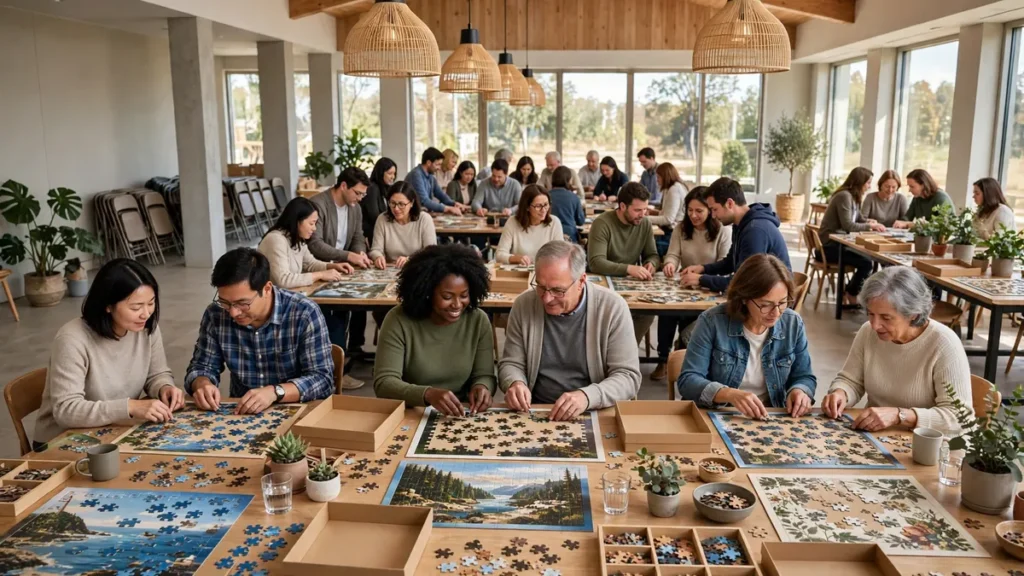
Space matters too. Sixty people need room to move, sit in teams, and gather for announcements. A large hall, a garden, or a community centre works far better than a living room. Arrange tables in a circle or in rows facing the host, leave clear walkways between teams, and keep one open area in the middle for relays and active games.
How to Organise 60 Players Without Chaos
Good organisation is what turns sixty players from a crowd into a competition. Decide the structure before the party, write it down, and share it with your helpers. Guests should always know which team they are on, what game is happening now, and what happens next.
Split Into Teams of Six
Prepare team lists in advance and hand each guest a coloured wristband, sticker, or name badge as they arrive. Colour-coding is faster than reading names aloud and it helps guests find their team table instantly. Choose team captains ahead of time, ideally confident guests who will keep their team organised, collect answer sheets, and cheer their team on. A captain who knows their job in advance is worth more than any amount of equipment.
Use a Points System Everyone Can See
Write scores on a large whiteboard, a flip chart, or a projected screen where the whole room can see them. Update the scores after every round and announce the leaders. A visible scoreboard creates tension, gives teams something to chase, and stops arguments about who is winning. Keep the scoring simple: ten points for first place, eight for second, six for third, and so on, or five points per correct answer in quiz rounds. Simple scoring means the scorekeeper can keep up even during fast games.
Keep Rounds Short and Snappy
No single round should run longer than ten minutes. Short rounds keep energy high, let you fit six or eight games into an evening, and mean that a team that loses one round is straight back in the next. Build in a two-minute break between games for the host to explain the next round and for teams to reset. If a game is going well, you can always add a bonus round, but a game that drags on past fifteen minutes will lose the room no matter how good it is.
The Best Party Games for 60 Players
These twelve games are the strongest choices for a sixty-player party. Each one scales cleanly, works with ten teams of six, and has been selected because every guest plays rather than watches.
1. Giant Trivia Tournament
Trivia is the easiest large-group game to run well, and it works for every age group. Prepare sixty questions across six rounds of ten, covering music, films, food, sport, general knowledge, and a fun round about the host or the occasion. Each team gets an answer sheet, writes down its answers, and hands the sheet in at the end of each round. Trivia needs nothing more than printed sheets, pens, and a host with a microphone, and it is the safest opening game because it gets every team working together within minutes.
2. Charades Relay
Charades works at sixty players when you run it as a relay. Each team sends one player at a time to act out a word or phrase while their team guesses, and the next player goes as soon as the word is guessed or the thirty-second timer runs out. With ten teams acting at the same time, the room fills with laughter and movement. Prepare a stack of prompt cards in advance, mixing easy words for younger players with harder phrases for confident actors. A relay format keeps the pace fast, and because each player only acts for thirty seconds, even shy guests are happy to take a turn.
3. Team Scavenger Hunt
A scavenger hunt is ideal for sixty players because it gets everyone moving and thinking at once. Give each team a list of twenty items to find or photograph within a set area and a thirty-minute time limit. Mix easy items, such as a red pen or a paperclip, with creative challenges, such as a photo of the whole team jumping or a selfie with a stranger wearing a hat. Points are awarded for each item, with bonus points for the most creative photo. Scavenger hunts work indoors or outdoors, and they suit mixed-age groups because different team members can take on different tasks.
4. Bingo Blitz
Bingo scales to any number of players, and sixty is no problem at all. Print a unique bingo card for every guest, using a free bingo card generator so no two cards are the same. Call the numbers over a speaker, and players mark their cards as they go. Offer a small prize for the first line, the first full house, and the most creative shout when someone wins. Bingo is calm, simple, and inclusive, which makes it a perfect game to play after a high-energy round, giving guests a chance to sit down, chat, and catch their breath while still competing.
5. Pictionary Relay
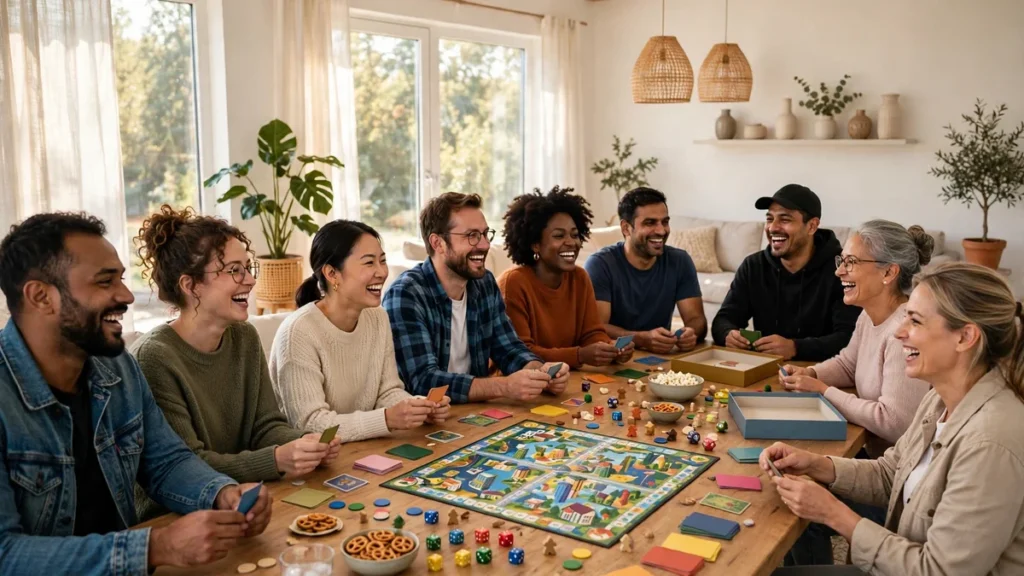
Pictionary works the same way as the charades relay, with drawing instead of acting. Each team has a small whiteboard or a pad of paper, and players take turns drawing a word while their team guesses. Keep each turn to forty-five seconds and use simple words that can be drawn quickly, such as a bicycle, a lighthouse, or a birthday cake. Drawing games are wonderfully funny at this scale because ten teams sketch at once, and the results are often more entertaining than the correct answers. This is also a good moment to remember that quieter, table-based formats have their place too, and our guide to board games for 60 players covers seated games that work when the party moves to tables.
6. Minute to Win It Stations
Set up six stations around the room, each with a sixty-second challenge using household items. Examples include stacking cups, moving biscuits from forehead to mouth, bouncing a ping pong ball into a cup, sorting sweets by colour, balancing a spoon on a nose, and building a tower from playing cards. Teams rotate through the stations, one player attempts each challenge, and points are awarded for every completed task. Stations are brilliant for sixty players because the whole room is active at once, the challenges are short and funny to watch, and guests can cheer on their own team member without disrupting anyone else.
7. Human Bingo
Human bingo, also called find someone who, is a superb icebreaker for a large party where many guests do not know each other. Each guest receives a grid of statements such as has been to another country, can play a musical instrument, or has a pet dog, and must find a different person who matches each square. The first guest to complete a row or a full card wins. Human bingo gets people talking, moving, and laughing within minutes, and it works especially well at the start of a party, before teams are formed.
8. Lip Sync Battle
A lip sync battle turns sixty players into an audience and a set of performers at the same time. Each team prepares a short lip sync performance to a well-known song, complete with props, costumes, and choreography if they wish. Teams perform one at a time while the other nine teams watch, cheer, and vote. Keep each performance to ninety seconds and score on energy, creativity, and audience reaction rather than accuracy. Lip sync battles are loud, joyful, and memorable, and they give confident guests a stage while everyone else enjoys the show.
9. Balloon Pop Relay
Balloon games are cheap, noisy, and perfect for large groups. In a balloon pop relay, each team lines up and players take turns running to a chair, sitting on a balloon to pop it, and running back to tag the next player. The first team to pop all its balloons wins. You can also try balloon keep-up, where each team must keep three balloons in the air for sixty seconds, or balloon modelling races for creative teams. Balloons cost very little, the games need almost no explanation, and the sound of sixty balloons popping guarantees a room full of laughter.
10. Family Feud Style Quiz
A Family Feud style game works beautifully with sixty players because it is built for teams. Prepare survey-style questions such as name something you find in a kitchen or name a popular holiday destination, and award points based on how many people gave each answer. Two teams face off at the front while the other teams watch and play along, or run it as a written round where every team submits its top three answers. The survey format is easy to understand, sparks friendly arguments about the best answers, and suits guests who prefer thinking games to physical ones.
11. Two Truths and a Lie Tournament
Two truths and a lie is a classic icebreaker that becomes a proper competition at sixty players. Each team member writes down two true statements and one lie about themselves, and the other teams must guess which statement is the lie. Award points for every correct guess and bonus points for lies that fool the whole room. The game works because it is personal, surprising, and funny, and it helps guests learn real things about each other. Run it in small team circles first, then bring the best lies to the whole room for a final round.
12. Dance-Off and Freeze Dance
Finish the active part of the party with music. In a dance-off, each team sends its best dancer, or its whole team, to the floor for a thirty-second routine while the room votes. In freeze dance, everyone dances while the music plays and must freeze completely when it stops, with anyone caught moving sitting out. Dance games need nothing more than a speaker and a playlist, they work for every age, and they end the games session on a high note. Keep the music varied, and let the whole room join in for the final dance.
Comparison Table
Use this table to pick the right mix of games for your party.
| Game | Energy Level | Best For | Equipment Needed | Time Per Round |
|---|---|---|---|---|
| Giant Trivia Tournament | Low | Opening the party | Answer sheets, pens, microphone | 10 minutes |
| Charades Relay | High | Energy and laughter | Prompt cards, timer | 10 minutes |
| Team Scavenger Hunt | High | Outdoor or large venues | Item lists, phones for photos | 30 minutes |
| Bingo Blitz | Low | Calm, inclusive rounds | Printed cards, number caller | 15 minutes |
| Pictionary Relay | Medium | Creative teams | Whiteboards, markers, word cards | 10 minutes |
| Minute to Win It Stations | High | Whole-room activity | Cups, balls, household items | 15 minutes |
| Human Bingo | Medium | Icebreaking | Printed grids, pens | 15 minutes |
| Lip Sync Battle | High | Performance and fun | Speaker, playlist, props | 20 minutes |
| Balloon Pop Relay | High | Quick, noisy fun | Balloons, chairs | 5 minutes |
| Family Feud Style Quiz | Low | Thinking teams | Question list, scoreboard | 10 minutes |
| Two Truths and a Lie | Low | Getting to know guests | Paper, pens | 15 minutes |
| Dance-Off and Freeze Dance | High | Closing the party | Speaker, playlist | 10 minutes |
Party Planning Checklist
Run through this checklist the day before the party.
- Confirm the guest list and prepare ten teams of six, with colour-coded wristbands or badges ready at the door.
- Book a venue with enough space for ten team tables, clear walkways, and one open area for active games.
- Prepare all printed materials in advance: trivia answer sheets, bingo cards, scavenger hunt lists, and human bingo grids.
- Test the microphone, speaker, and playlist before guests arrive, and keep spare batteries and a backup speaker nearby.
- Buy prizes for the winning team and small prizes for individual rounds, plus enough balloons, pens, and paper for sixty players.
- Brief your host, scorekeeper, and team captains on the running order, the scoring system, and the time limit for each round.
Frequently Asked Questions
What is the best party game for 60 players?
A giant trivia tournament is the best all-round choice for sixty players because every team plays at the same time, it needs almost no equipment, and it suits every age group. Pair it with one active game, such as a balloon pop relay, and one creative game, such as a lip sync battle, for a balanced evening.
How do you split 60 players into teams?
Split sixty players into ten teams of six. Hand out colour-coded wristbands or badges at the door so guests can find their team table straight away, and appoint one captain per team in advance. Teams of six give every guest a real role without making the team so large that some people stop taking part.
How long should party games for 60 players last?
Plan for about two hours of games in total, made up of six to eight games with rounds of five to fifteen minutes each. Add short breaks between games for the host to explain the next round. Two hours keeps the energy high without tiring guests out, and it leaves time for food, conversation, and dancing afterwards.
What games work for 60 players indoors?
Trivia, bingo, Pictionary relay, charades relay, human bingo, and Family Feud style quizzes all work well indoors because they need only tables, chairs, and a host with a microphone. Minute to Win It stations and balloon games also work indoors if you have one open area for movement. Word-based games are a strong indoor option too, and our guide to word games for 60 players has more ideas for seated play.
What games work for 60 players outdoors?
Scavenger hunts, relay races, balloon pop relays, tug of war, and sack races all work well outdoors because they use the extra space. Outdoor games suit warm weather and large gardens or parks, and they are a good choice when the group includes many children or energetic guests who want to run around.
How much does it cost to run party games for 60 players?
Most games in this guide cost very little. Printed sheets, pens, balloons, and a few small prizes usually come to under fifty pounds or dollars for the whole party. Trivia, charades, human bingo, and two truths and a lie cost almost nothing at all.
The Bottom Line
The best party games for 60 players are team games with short rounds, simple rules, and formats where everyone plays at the same time. Split the room into ten teams of six, mix thinking games with active games, keep a visible scoreboard, and let a confident host keep the pace moving. Do that, and sixty players becomes the best part of the party rather than a problem to solve.