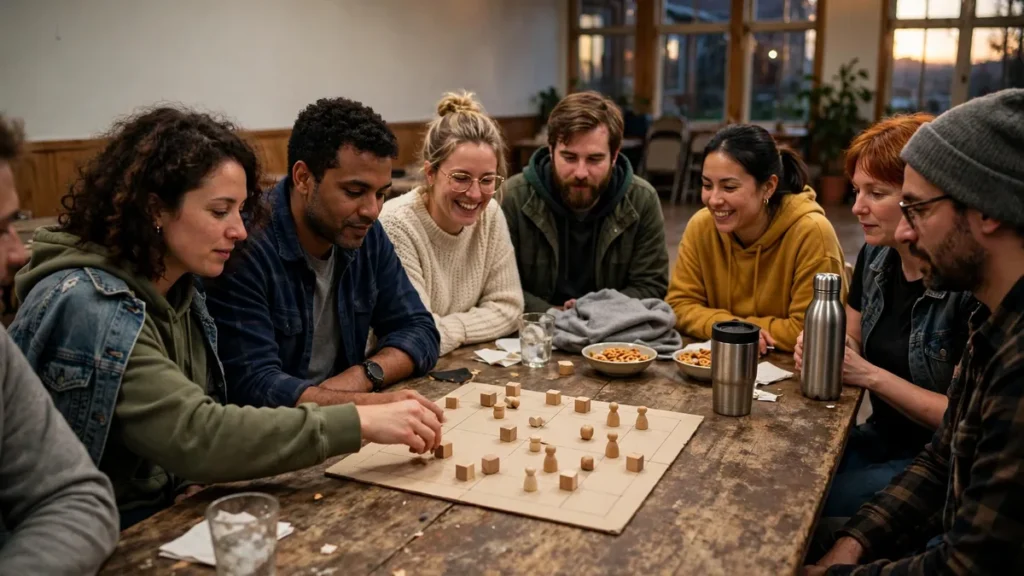
Five hundred and forty-seven players, one old village slater’s yard, and nine dice challenges built around the work of splitting, dressing, and laying slate. That is the whole idea behind these dice games for 547 players: everybody has a piece of slate in hand, everybody rolls, and nobody waits long for a go. The trade gives the day its shape, with waist-high work surfaces, piles of grey slate, and a clear path from one post to the next, so even a crowd this size can keep moving without bunching up.
The slater’s trade works so well for a huge group because the work itself breaks into small, quick jobs. One group splits, another dresses edges, another punches holes, and each job takes less than a minute to learn. If you enjoy workshop themes, the chair-maker’s workshop games in our dice games for 545 players use the same large-group shape, with nine short challenges and a host who keeps the pace even.
Each challenge below runs on ordinary six-sided dice, a pile of sample slates, and a wax crayon for marking. No challenge needs a screen, a speaker, or any special kit beyond what the yard already holds. Split the players into nine groups of sixty, keep seven players back as scorers and runners, and the full 547 are all in play from the opening roll to the closing tally.
Key takeaways
- Nine short dice challenges, each built around one job from a slater’s yard.
- Nine groups of sixty players, plus seven scorers and runners, cover all 547 players.
- Every challenge uses ordinary six-sided dice, sample slates, and a wax crayon.
- Groups rotate from post to post, so nobody queues and nobody sits out.
- Points go on a tally sheet at each post, and the best tally at the close wins the day.

How 547 Players Fit Into One Day
Five hundred and forty-seven is a prime number, so even splits are out of reach, and that is fine. Nine groups of sixty make 540 players, and the remaining seven form the host group: two scorers, two runners, two markers, and one caller who keeps the day on schedule. Each group starts at one of nine posts around the open ground, and a horn call moves every group on to the next post at the same moment. A full round of nine posts takes about ninety minutes, with a short pause in the middle for water and a rest.
The host group does the quiet work that holds a day this size together. Scorers carry the tally sheets from post to post, runners fetch fresh sample slates when a pile runs low, markers check the crayon marks before points are given, and the caller watches the clock so no post overruns. The wheelwright’s workshop games in our dice games for 542 players run on the same host-group idea, and it works just as well here: the players play, and the host group handles everything else.
The rotation order matters as much as the challenges. Groups move in the same direction all day, so no two groups ever meet head-on in a narrow gap between posts. The caller sounds the horn, every group finishes its marking, and then every group walks to the next post together. That shared movement is what keeps 547 players from turning into a crowd: everybody moves at once, everybody arrives together, and no post ever has two groups waiting at its work surface.
The Nine Slater’s Yard Games
Each challenge below names the job, the dice, and the tally. Read the job aloud, roll the dice, and mark the result before the group moves on. The jobs follow the real order of the trade, from splitting a block to fixing a finished slate in place, so the day feels like a walk through a working day rather than nine unrelated dice tasks.
1. Dice Slate Split
A slater splits a thick block along its grain until it falls into thin, even pieces, and this challenge turns that single skilled moment into a dice task. Each player takes a sample piece, rolls two dice, and splits the piece in the mind’s eye along the split the dice suggest: a high roll means a clean split with no waste, a low roll means a ragged edge that needs more work. The player marks the split with a wax crayon and passes the piece along.
Points go to the cleanest splits. A pair of matching dice earns a bonus, because a matched pair means the grain ran true all the way through. The post works best with a fresh pile of sample pieces and a firm work surface, and the host should swap in new pieces whenever the pile drops below a dozen.
2. Dice Slate Dress
Dressing a slate means shaping its edges until they sit neat and true, and this challenge asks each player to dress one edge per roll. Roll one die: the number shows how many strokes of the zax the edge needs, and the player counts the strokes aloud while a partner watches for a steady hand. A roll of six means the edge is dressed in a single smooth pass, and that earns the top tally.
The fun here is in the watching. Partners call out wobbles, and a wobble costs a point, so steady hands matter more than fast ones. Keep the sample pieces small enough to hold in one hand, and keep the zax blunt, since the dressing here is all in the counting and the care, not in real cutting.
3. Dice Slate Hole
Every roofing slate needs holes for its fixings, and this challenge is about placing those holes in exactly the right spots. Each player rolls two dice and marks two holes on a sample slate, one for each die, measuring from the top edge by the number shown. Holes placed too near the edge lose points, because a hole near the edge would crack the slate in real work.
A matched pair earns a bonus, since matching numbers mean matching holes on both sides of the piece. The post needs a clear sample slate to show the safe zone, and the host should check the opening few marks in each group until the players have the spacing right.
4. Dice Slate Stack
Slates leave in neat piles, sorted by size and thickness, and this challenge turns piling into a race against the dice. Each player rolls three dice and piles that many sample pieces onto the group pile, largest at the bottom and smallest at the top. A pile that leans or topples loses its points, so players learn to place each piece with care rather than speed.
The group pile grows fast with sixty players rolling, so the host should clear the pile after every tenth player and start a fresh one. The best piles are the ones that stand straight when the group moves on, and the host gives a bonus to any pile still standing at the horn call.
5. Dice Slate Sort
The trade holds slates of many shades, from pale grey to deep blue-grey, and sorting them by shade is a core part of the work. Each player rolls one die, draws that many sample pieces from a mixed crate, and sorts them into shade piles on the work surface. Pieces placed in the wrong pile cost a point, so players look twice before they place.
This challenge rewards a sharp eye more than a lucky roll. A low roll can still earn a fine tally if every piece lands in the right pile, while a high roll with two mistakes earns little. The host should keep the shade piles clearly marked with sample pieces so nobody has to guess where a shade belongs.
The shade piles need a bright spot, so place this post near the brightest part of the open ground, or under a pale canopy on a dull day. The host can add a variation for older players by mixing in a few pieces with a rust-coloured fleck, which belong in their own small pile and earn a bonus when placed right. Keep the mixed crate full, and have a runner bring fresh pieces whenever the crate drops below twenty, so no group has to wait for stock.

6. Dice Slate Lay
Laying slates means placing each piece so it overlaps the one below and sheds water, and this challenge asks players to lay a short course of slates by the dice. Each player rolls two dice and lays that many sample pieces in a row on the work surface, each overlapping the one before by a finger width. Pieces laid with no overlap lose points, because a gap would let water through.
The course grows along the work surface as the group plays, and the host marks the best stretch with a wax crayon at the close. A matched pair earns a bonus, since matching numbers mean a steady, even course with no sudden jumps in the overlap.
7. Dice Slate Carry
Slates are heavy for their size, and carrying them safely across the open ground is a job in itself. Each player rolls one die and carries that many sample pieces from the pile to the far work surface, holding them flat and steady. A piece dropped on the way loses a point, and a piece carried with both hands flat earns a bonus for safe handling.
This challenge is the liveliest of the nine, since sixty players are on their feet and moving at once. Keep the carrying path short and clear, with no loose pieces underfoot, and have the runners sweep the path between groups so nobody trips on a stray sample.
For a gentler round, the host can let younger players carry two pieces at a time whatever the die shows, and still give the bonus for a steady hold. For a harder round, the host can narrow the carrying path and ask for a slower pace, so every step earns double. Either way, the post stays safe: flat hands, short path, and a runner sweeping the way clear between groups.
8. Dice Slate Count
Before the day’s slates are packed away, somebody has to tally how many of each size are ready, and this challenge turns that tally into a dice task. Each player rolls three dice and tallies that many pieces from the mixed crate, calling out the running total as they go. A player who loses the total and has to start again loses a point, so a steady voice matters as much as quick hands.
The host checks the tally at the close of each group by tallying the same crate a second time. Groups whose two tallies agree earn a bonus, and that simple check teaches the one habit every yard relies on: never trust a single tally when a second one costs only a minute.
9. Dice Slate Nail
The closing challenge fixes the slate in place. Each player rolls two dice and taps that many fixing nails into a soft practice block beside a sample slate, one tap per nail, while a partner watches the aim. A nail driven straight earns a point, a nail driven crooked earns none, and a matched pair earns a bonus for a perfectly even pair of fixings.
Use blunt practice nails and a soft block, and keep real slates away from this post, since the aim here is the tapping rhythm rather than real fixing work. The host calls the closing tally once the ninth group has finished, and the day ends with the best tally taking the honours.
At a Glance
The summary below shows each challenge, the dice it needs, and the tally it rewards, so a host can brief all nine posts in a few minutes.
| Challenge | Dice | What earns the tally | Minutes |
|---|---|---|---|
| Dice Slate Split | Two | Clean splits and matched pairs | 10 |
| Dice Slate Dress | One | Steady strokes and a smooth edge | 10 |
| Dice Slate Hole | Two | Holes placed well inside the safe zone | 10 |
| Dice Slate Stack | Three | Straight piles that stay standing | 10 |
| Dice Slate Sort | One | Pieces in the right shade piles | 10 |
| Dice Slate Lay | Two | Even overlap along the course | 10 |
| Dice Slate Carry | One | Safe carrying with nothing dropped | 10 |
| Dice Slate Count | Three | A tally that agrees on a second check | 10 |
| Dice Slate Nail | Two | Straight nails and even pairs | 10 |
Before the First Whistle
- Mark nine posts around the open ground, each with its own work surface and a clear path between posts.
- Prepare nine crates of sample slates, plus spare piles at the host post for top-ups.
- Hand each post a pair of tally sheets, wax crayons, and enough six-sided dice for sixty players to share in small handfuls.
- Brief the seven-person host group ahead of the players, so scorers, runners, markers, and the caller all know their jobs before the players arrive.
- Walk every group through the safe zone for holes and the flat-carry rule before the opening roll.
- Agree the closing tally rule in advance: best tally takes the honours, and matched pairs earn a bonus at every post.
Frequently Asked Questions
Do we need real roofing slates for these games?
No. Sample slates, reclaimed offcuts, or thick grey pieces cut to slate size all work, and they are safer to handle than full roofing slates. The challenges are about the jobs, not the material, so any flat grey piece that can be marked with a wax crayon will do.
How long does the full day take?
Ninety minutes covers all nine posts at ten minutes each, with a short pause in the middle. Add thirty minutes for briefing at the start and the closing tally at the end, and the whole day fits comfortably into two hours.
What ages suit these games?
Older children and adults get the most from the jobs, since the challenges reward care and a steady hand. Younger players can join in with a partner, sharing the dice and the marking, and the host can drop the bonus rules for a gentler day.
Can a smaller group play these games too?
Yes. The nine challenges work for any size of group: with fewer players, run fewer posts at once, or let each group visit the posts twice and keep only the better tally. The tin-mine games in our dice games for 538 players show the same large-group shape working at a smaller scale, with the same rotation and host-group idea.
What if a piece comes apart during a challenge?
Put it aside in a spare crate and carry on with a fresh piece. Slates are brittle by nature, and a piece that comes apart is not a failure, it is a reminder of why the trade values a careful hand. The host should keep spare pieces at every post so nobody waits for a replacement.
Where can we run the day?
Any open ground with room for nine work surfaces and clear paths between them will do: a village green, a school yard, or a community centre with the furniture pushed back. The slater’s yard is the theme, not a requirement, and the challenges work just as well indoors on long work surfaces.
The Bottom Line
Nine dice challenges, nine groups of sixty, and seven hosts holding the day together: that is all it takes to give 547 players a full day in an old village slater’s yard. The jobs are real, the dice keep every round short, and the tally sheets make the closing honours easy to call. Bring the sample slates, the wax crayons, and the dice, and the yard does the rest.