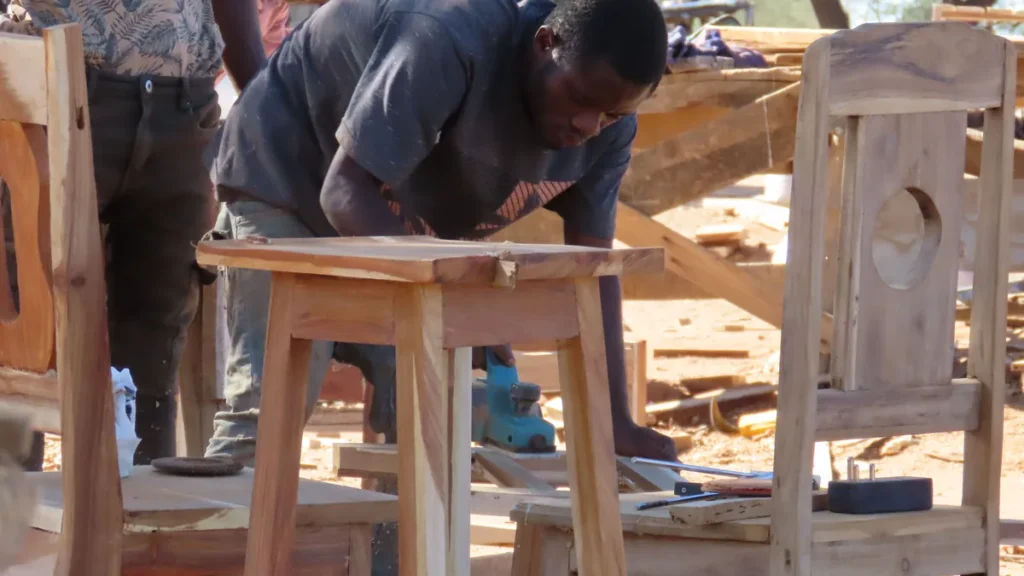
Five hundred and forty-five players sound like a crowd that no single activity could hold, yet a chairmaker’s workshop gives the day a shape that fits everyone. The work of the shop is simple to picture: green wood pared into legs, spindles, rails and rungs, each piece shaped by hand and put together without fuss. Nine dice games below borrow one workshop job each, and every team of five gets a part to play at every post.
The plan is built for scale rather than haste. 109 teams of five spread across nine posts, with twelve teams at most posts and thirteen at the pole lathe post, so all 109 teams play every round. Each round runs for about twelve minutes, then teams move to the next post, so the whole circuit takes under two hours plus a short breather in the middle. Nobody waits long, nobody is left out, and the day ends with happy noise at every post.
All nine games use ordinary six-sided dice and points only, with no money involved and nothing to buy. A team needs three dice, a tally sheet and a pencil, and the caller at each post needs a clear voice and a raised arm to start and stop play. The games below explain the workshop job behind each one, the dice in use, and the small habit that keeps a huge group moving well.
Key takeaways
- 109 teams of five fill nine posts, with twelve teams at most posts and thirteen at the pole lathe post.
- Every game uses ordinary six-sided dice and points only, with no money involved.
- One round lasts about twelve minutes, and nine rounds fill a morning or an afternoon with a short breather in the middle.
- No team needs prior skill: each game explains its workshop job in one short paragraph before play starts.
- Keep the tally visible at each post so every team can see where it stands without asking.

How 545 Players Fit Into One Day
The arithmetic is honest, and it works because the teams are small and the posts are many. Five hundred and forty-five players make 109 teams of five. Eight posts hold twelve teams each and the pole lathe post holds thirteen, which accounts for every team with nobody left over. Each post needs a caller, three dice per team, and a tally sheet, and the whole day needs 327 dice plus a few extra at the tally post for the odd stray die.
Rotation is the part that decides whether a huge day runs well or drags, so keep it dull and visible. After each round the caller raises an arm, every team records its tally, and all teams move one post along in the same direction. A large arrow drawn on a sheet at each post shows the way, and helpers from the tally post walk with any team that looks unsure of the way. The extra team at the pole lathe post moves with the others, so the post with thirteen teams is a different post in each round and no team carries the extra weight all day.
Time the day loosely and the mood stays light. Nine rounds of twelve minutes make just under two hours of play, with a short breather after round five and a few minutes at each end for the opening tally and the final tally. The wood-workshop dice games for 520 players run the same way, with teams moving between posts while the tally stays visible. If a round overruns, shorten the next round by two minutes rather than skipping a post, because every team should meet every workshop job before the day ends.
The Nine Dice Games
Each game below takes its name and its job from the chairmaker’s shop. Read the workshop paragraph aloud at the post, hand out the dice, and let the tally do the talking. Points are the only prize, and the highest tally at a post takes the round.
1. Dice Pole Lathe
The pole lathe is the oldest turning tool in the shop. A long springy pole overhead pulls a cord, a foot bar below works the cord, and a length of green wood spins between two centres while the worker pares it with a blade. The wood moves one way and then the other, and the worker shapes it only while the cord is taut, which is why a pole lathe rewards patience over force.
Each team rolls three dice and keeps the middle value, adding it to the spindle tally. A roll of three matching dice adds a bonus of five points on top of the middle value. Play runs until the caller raises an arm, and the team with the highest tally at the post takes the round. The middle value matters more than the highest, so a team that rolls steadily will often beat a team that always reaches for big numbers.
2. Dice Shave Horse
The shaving horse holds wood steady while the worker pares it with a two-handled blade. The worker sits astride it and works a foot bar that keeps the wood still, leaving both hands free for the blade. The piece is moved a little after each shaping so the shape stays even all the way around.
Each team rolls two dice. When the two values differ, the team adds the gap between them to its tally, so a roll of two and six earns four points. When the two values match, the piece moves in its hold and the team adds nothing for that roll, except that two sixes earn ten points. The gap between the dice is the whole game here, which makes every roll matter even when it earns nothing.
3. Dice Spindle Cut
Spindles are the thin rods that fill the back of a chair between its rails. Each one must match the others in length, or the back will look lopsided and feel wrong against the sitter. The chairmaker pares each spindle to the same length and tests it against the others by eye before it is fitted into the chair.
The caller names a sum from two to twelve. Each team rolls two dice and adds the two values together. A roll that matches the sum exactly earns ten points, a roll one away from the sum earns five points, and any other roll earns nothing. Because the sum changes with each roll, teams keep listening to the caller’s voice, and a team that listens well can outscore a team that merely rolls well.
4. Dice Leg Splay
A chair stands steady because its legs splay outward, spreading the weight over a wider patch of floor. Legs that stand straight up and down look neat and topple easily, while legs with a generous splay hold firm when someone shifts their weight. The chairmaker eyes the splay, aiming for legs that look eager to stand rather than shy of the floor.
Each team rolls two dice, and the gap between the two values is the splay. A roll of two and five gives a splay of three, and the team adds three points to its tally. A splay of five, from a one and a six, earns a bonus of five points on top of the five. Two matching dice give a splay of zero and earn nothing, and the team steadies itself and rolls again with the next round. The wheelwright’s workshop dice games for 542 players use the same team-and-post shape, with a different old craft at each post.
5. Dice Seat Hollow
The seat of a wooden chair is hollowed so it fits the sitter, shallow at the edges and deeper in the middle. The worker hollows it with a rounded blade, working from the middle outward and feeling the depth with a palm. A seat that is too deep feels wrong, and a seat that is too shallow feels hard, so the hollow must be even and gentle.
Each team rolls three dice and adds the lowest value to its hollow tally. A roll in which all three dice show the same value adds the lowest value twice over, so three fours earn eight points rather than four. Play runs until the caller raises an arm, and the team with the highest tally at the post takes the round. Low dice do the best work here, which delights teams that have spent the day reaching for high ones.

6. Dice Back Rail
The back rail crowns the chair, running across the top of the back between the two rear posts. It is bent slowly into shape while the wood is still green, then left to dry in that shape before it is fitted. A rail that is bent too fast will come apart, and a rail that is bent too little will look stiff against the spindles below it.
Each team has a disc on position one of a rail of nine positions. A team rolls one die and advances its disc by that many places. An exact roll onto position nine earns ten points, and the disc starts again at position one. A roll that would carry the disc past position nine earns nothing, and the disc holds its place. The rail rewards exact rolls, so teams greet the humble one as loudly as the six.
7. Dice Stretcher Peg
Stretchers are the low bars between the legs of a chair that stop the legs from splaying under weight. Each stretcher is locked in place with a peg, a short wooden pin that grows slightly with moisture and holds where the stretcher meets the leg. A peg that is too loose will work itself out, and a peg that is driven too hard will damage the leg it was meant to save.
Each team rolls two dice. A sum of exactly seven drives a peg home and earns seven points. A sum above seven earns points equal to the amount over seven, so a sum of ten earns three points. A sum below seven earns nothing, and the team waits for the next roll. Seven is the hardest sum to roll on purpose and the sweetest to see when it arrives, which gives this post its steady hum.
8. Dice Rung Notch
Rungs sit between the legs of a chair at matching heights, and notches show where each rung sits. The chairmaker cuts a notch into each leg at the same height, then fits the rung into the notch and tests the chair by pressing down on the seat. A rung that sits uneven makes the chair unsteady, so the notches must agree with each other before the rung is fitted in.
The caller calls a value from one to six. Each team rolls one die. A roll that matches the called value places a rung and earns six points. A roll one above or one below the called value earns two points, and any other roll earns nothing. The called value changes often, so teams listen for the call before they roll, and the post stays lively from the opening roll to the caller’s raised arm.
9. Dice Arm Bow
The arm of a chair is a bowed length of wood that the sitter’s arm lies along, rising from the back post and running forward to meet the front. It is shaped while the wood is still green, bent slowly into its bow and left to dry in that shape. An arm that is too flat feels hard, and an arm that is bowed too much looks showy against a plain chair.
Each team rolls three dice and adds the highest value to its tally. A roll in which all three dice show different values earns a bonus of three points on top of the highest value. Play runs until the caller raises an arm, and the team with the highest tally at the post takes the round. High dice do the best work here in the end, which suits teams that have waited all day for a high-dice round.
The Nine Games at a Glance
The weaver’s workshop dice games for 543 players show the same team-and-post shape in another old craft, and the overview below gives the dice, the teams and the job for each of the nine games in this article.
| Game | Dice per team | Teams at the post | The job in brief |
|---|---|---|---|
| Dice Pole Lathe | 3 | 13 | Shape a spindle on a foot-powered lathe |
| Dice Shave Horse | 2 | 12 | Pare wood held on the shaving horse |
| Dice Spindle Cut | 2 | 12 | Pare spindles to matching lengths |
| Dice Leg Splay | 2 | 12 | Splay the legs for a steady chair |
| Dice Seat Hollow | 3 | 12 | Hollow the seat for comfort |
| Dice Back Rail | 1 | 12 | Advance a disc along the back rail |
| Dice Stretcher Peg | 2 | 12 | Drive pegs that lock the stretchers |
| Dice Rung Notch | 1 | 12 | Place rungs at matching notches |
| Dice Arm Bow | 3 | 12 | Shape the arm into its bow |
Your 545-Player Checklist
- Dice: 327 ordinary six-sided dice, three per team, plus a few extra at the tally post for the odd stray die.
- Tally sheets and pencils: one sheet per team per round, with the post and the round written at the top.
- Nine posts: nine posts in a hall or outdoors, each with a caller who knows the round, the dice and the tally.
- Start and stop: a raised arm at every post, easy to see from anywhere, so no team needs to hear a call over the noise.
- A visible tally: a tally at each post, updated after every round, so teams can see where they stand.
- A firm finish: a firm finish time and a final tally, with the top three teams named aloud before everyone heads home.
Frequently Asked Questions
Do we need 545 dice?
No. Each team plays with three dice, so 327 dice cover the day, and a few extra dice at the tally post cover the odd stray die. Teams keep their own dice during a round, so play never slows while a team waits for dice.
How long does the day run?
Nine rounds of about twelve minutes make just under two hours of play, plus a short breather in the middle and a few minutes at each end for the opening tally and the final tally. If a round overruns, shorten the next round by two minutes rather than skipping a post.
What if a team has fewer than five players?
A team of four plays the same way with the same three dice. A team of three can join with a nearby team for the day and share one tally sheet, which keeps the arithmetic simple and gives the smaller team extra hands at the post.
Can younger players take part?
Yes. Every game asks for a roll and a small addition, and the caller at each post explains the workshop job in a sentence or two before play starts. Younger players often top the tally at Dice Seat Hollow, where low dice earn the points.
What happens when two teams tie at the top?
The tied teams roll one die each, and the higher roll takes the higher place. If they roll the same value again, they roll once more until one team rolls higher. Keep the tie-break quick and public, so the whole post can see it happen.
Do the games work outdoors?
Yes, outdoors on level ground, as long as each post has a flat surface for the dice and the tally sheets, and the caller can be seen across the post. Dice will wander on a slope, so choose level ground for the day.
The Bottom Line
Five hundred and forty-five players need a day with small teams, many posts and a tally that everyone can see. Nine workshop games give each team a job to learn, a roll to make and a tally to keep, and the chairmaker’s shop gives the whole day a shape that holds together from the opening roll to the final tally. Bring out the dice, raise an arm, and let the workshop do its work.