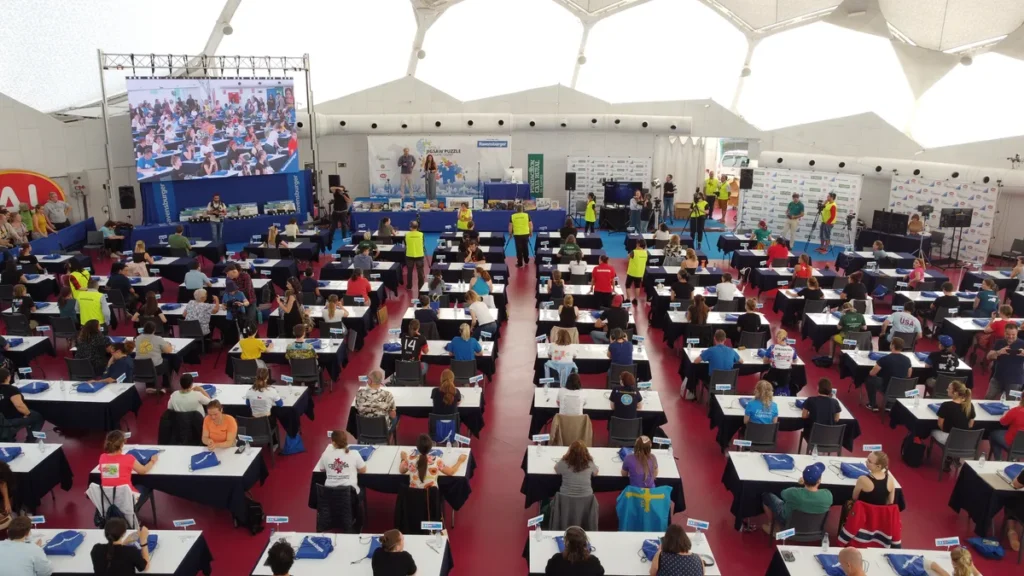
Four hundred and ninety-six players sounds like a crowd no dice game can hold. In practice it is ninety-nine tables of five, or eighty-two tables of six with four spare players helping as scorers, all rolling at the same moment. The secret is not a bigger table or a louder voice. It is a plan that treats the whole room as one camera club, with every table running the same small game at the same time. When the dice land together, the room feels like one game instead of a hundred separate ones.
This guide gives you nine photography games that share one theme, one set of rules for rotating, and one scoring sheet. Each game uses ordinary six-sided dice, a handful of cheap props, and a station card that any volunteer can read in thirty seconds. Nobody needs to learn anything in advance, and nobody sits out a round. The photography theme does the heavy lifting: cameras, darkrooms, portraits, and film are easy to picture, so players understand each game the moment they hear its name.
Every game below fits a table of five or six players and lasts about twelve minutes, with a two-minute rotation between stations. If your group is one player smaller, our guide to dice games for 495 players uses the same table system with a different set of nine games. Keep one floor captain per zone, keep every round to the same length, and keep the scoreboard where everyone can see it. Do that, and 496 players will feel like a party, not a queue.
Key Takeaways
- Split 496 players into tables of five or six, and run the same game at every table at the same time.
- Use nine short photography games, each lasting about twelve minutes, with a two-minute rotation between stations.
- Give every table the same kit: three dice, a station card, a pencil, and one score sheet.
- Appoint one floor captain for every ten tables so questions get answered without stopping the room.
- Score by table totals, not individual rolls, so every player matters and no table falls behind.

The Nine Games at a Glance
Use this table to plan the night at a glance. Every game fits a table of five or six players, and every round is short enough that nobody gets bored. Print one copy per table, or write the nine rows on a whiteboard where the whole room can see them.
| Game | Players per Table | Minutes | You Need |
|---|---|---|---|
| Dice Camera Click | 5-6 | 12 | 3 dice, camera cards |
| Dice Photo Album | 5-6 | 12 | 3 dice, album cards |
| Dice Flashbulb Pop | 5-6 | 10 | 2 dice, flash cards |
| Dice Darkroom Develop | 5-6 | 12 | 3 dice, tray cards |
| Dice Lens Focus | 5-6 | 10 | 2 dice, lens tokens |
| Dice Snapshot Hunt | 5-6 | 12 | 3 dice, hunt cards |
| Dice Portrait Pose | 5-6 | 10 | 2 dice, pose cards |
| Dice Shutter Speed | 5-6 | 12 | 3 dice, shutter cards |
| Dice Film Roll | 5-6 | 15 | 3 dice, film strip |
How to Run the Night
Set up ninety-nine tables of five before anyone arrives, and keep four spare chairs near the scoreboard for the extra players who will act as scorers. Lay out the same kit at every table: three dice, a station card, a pencil, and one score sheet. Number the tables clearly, and place one floor captain in each zone of ten tables so that help is always close by.
Start every station at the same moment with a single clear signal, such as a whistle or a bell. Call time after twelve minutes, allow two minutes for rotation, and start the next station with the same signal. The shared rhythm is what turns a hundred small tables into one event, and it stops faster tables from waiting around while slower tables finish.
If your group is two players smaller, our guide to dice games for 494 players uses the same table system with a different set of nine games. Keep the scoreboard in one place, update it after every round, and read out the top three tables before the final station. A visible scoreboard keeps the room honest and gives every table something to chase.
The 9 Photography Dice Games
All nine games share the same rhythm. Roll, act, score, rotate. The host calls the start, the tables play, and the host calls time. Read each game once, keep the station card on the table, and let the players run the rest themselves.
Dice Camera Click
Each player takes turns being the photographer. Roll three dice and add the total to the number on your camera card. The highest total in the round wins the shot and keeps the card. A roll of three sixes is a perfect exposure, and the table cheers it as a group before play moves on.
After six rounds, the player with the most cards is the table photographer of the day. Ties are settled with a single sudden-death roll, highest number wins, and the loser still gets a round of applause. The game is quick, noisy, and easy to explain, which makes it a strong opener for the night.
Dice Photo Album
Every table gets a set of album cards showing simple scenes, such as a birthday, a beach day, and a snowy street. Players roll two dice and match the total to a page number in the album. The player who completes a full row of three pages first calls out album done and the round ends.
Completed pages score one point each, and a full row scores three bonus points. If two players finish a row on the same roll, both score the bonus and the table moves to the next round together. The album theme keeps the game calm and chatty, so it works well as the second station after the louder opener.
Dice Flashbulb Pop
One player rolls a single die behind a cup while the others guess whether the result is odd or even. A correct guess scores a point, and a wrong guess passes the cup to the next player. A roll of six is a flashbulb pop, and everyone at the table must freeze for five seconds while the roller scores two points.
The freeze is the heart of the game. It breaks up the rolling, makes people laugh, and gives the host a moment to check the room. Play six rounds, then add up the points. The player with the most points is the flash champion, and the table moves on with energy to spare.
Dice Darkroom Develop
Players work together to develop a photograph before the timer runs out. Each roll of three dice moves the picture one step closer to finished: a total of ten or more adds a step, a total under six adds nothing, and a total of exactly twelve adds two steps. The table needs eight steps to finish the print.
If the table finishes the print, every player scores five points. If the timer ends first, the table scores only the steps it completed. The shared goal changes the mood completely, because players start cheering each other’s rolls instead of competing. It is the best team game in the set, and a good mid-evening station.
Dice Lens Focus
Each player holds a lens token and rolls two dice to focus the camera. A pair scores three points, a total of seven scores two points, and anything else scores one point. The catch is that a player may stop rolling at any time and bank the points, or keep rolling and risk losing the round total on a roll of two.
The choice between banking and pushing on is what makes the game tense. Cautious players build steady scores, while bold players sometimes lose everything on a single unlucky roll. Play five rounds and the highest banked total wins. The game teaches itself, and the groans at the table are part of the fun.
Dice Snapshot Hunt
The host hides twelve snapshot cards around each table area before the round begins. Players roll one die and move that many steps around the table, collecting any card they land on. A card with a star is worth three points, a plain card is worth one point, and a blank card is worth nothing but still counts as a find.
After every player has rolled four times, the cards are counted and the points are added up. The player with the most points wins the hunt, and the table resets the cards for the next group. The movement keeps people standing and laughing, so place this station where there is a little extra floor space.
Dice Portrait Pose
One player is the model and the rest are photographers. The model rolls two dice and strikes a pose matching the number: one is a wave, two is a bow, three is a salute, four is a jump, five is a twirl, and six is the player’s own invention. The photographers vote on the best pose by rolling one die each, and the highest vote wins the round.
The model changes every round, so everyone gets a turn in front of the camera. A six is always the highlight, because the invented poses get stranger as the night goes on. Score one point per round won, and after six rounds the player with the most points is the portrait star of the table.
Dice Shutter Speed
This is the fastest game in the set. The host calls a target number between three and eighteen, and players race to roll that exact total with three dice. The first player to hit the target calls out shutter and scores three points. Everyone else scores one point for any roll that lands within one of the target.
Speed matters more than luck here, because the dice never stop moving until someone calls out. Keep the rounds short, about ninety seconds each, and play eight rounds. The game is loud and frantic, so it works best as the final station before the break, when the room needs a burst of energy.
Dice Film Roll
Each table gets a paper film strip with twelve frames. Players take turns rolling three dice and filling in frames equal to the total rolled, up to a maximum of six frames per turn. A roll of three ones is a ruined frame, and the player must cross out one filled frame instead of adding any.
The first table to fill all twelve frames calls out film done, and every player at that table scores ten points. Tables that are still rolling when the round ends score one point per filled frame. The long fifteen-minute round gives the night a calm, satisfying finish, and the filled strips make a nice keepsake to take home.

Host Checklist
Run through this list before the first roll. Every item takes a minute or two, and each one prevents a problem that is much harder to fix once 496 people are playing.
- Count the dice before the doors open, and put three at every table with a few spares at the scoreboard.
- Print one station card and one score sheet per table, and number the tables so rotation is obvious.
- Place one floor captain in each zone of ten tables, and give each captain a whistle or a bell.
- Test the timer and the scoreboard before the first roll, and keep a pencil at every table.
- Keep the rounds to twelve minutes with a two-minute rotation, and start every station with the same signal.
- Read out the top three tables before the final station, and hand out the prizes while the room is still together.
Frequently Asked Questions
How many tables do 496 players need?
Ninety-nine tables of five cover 495 players, and the last player joins as a scorer or floats between tables. Eighty-two tables of six work too, with four spare players helping as scorers. Either way, keep every table playing the same game at the same time.
Do we need special dice for these games?
No. Ordinary six-sided dice are all you need, three per table. The props are simple cards, tokens, and paper strips that you can print at home. Nothing in the set needs a special board, an app, or an expensive kit.
How long does the whole night take?
Nine stations at about twelve minutes each, plus two-minute rotations, come to roughly two hours and ten minutes. Add ten minutes for the welcome and ten minutes for the prizes, and the whole evening fits comfortably inside two and a half hours.
What if a table finishes early?
Give early tables a quick filler roll, such as a single-die high roll for fun, and ask them to tidy their station card for the next group. The shared timer keeps the room together, so no table should wait more than a minute or two.
Can younger players join in?
Yes. Every game uses simple adding and matching, and the station cards explain each step in plain words. Pair younger players with an adult at the table for the first round, and they will be rolling on their own by the second.
What if our group is a different size?
Use the same table system and pick the guide that matches your headcount. If your group is three players smaller, our guide to dice games for 493 players gives you nine different games built for that number, with the same rotation and scoring plan.
The Bottom Line
Four hundred and ninety-six players is a big number, but the plan is a small one. Split the room into tables of five or six, run the same photography game at every table, rotate on a shared timer, and score by table totals. Nine short games, one clear signal, and a visible scoreboard are all it takes.
Print the station cards, count the dice, appoint your floor captains, and let the room roll. The photography theme gives every game a picture worth remembering, and the shared rhythm turns a crowd into a single game night that everyone played together.