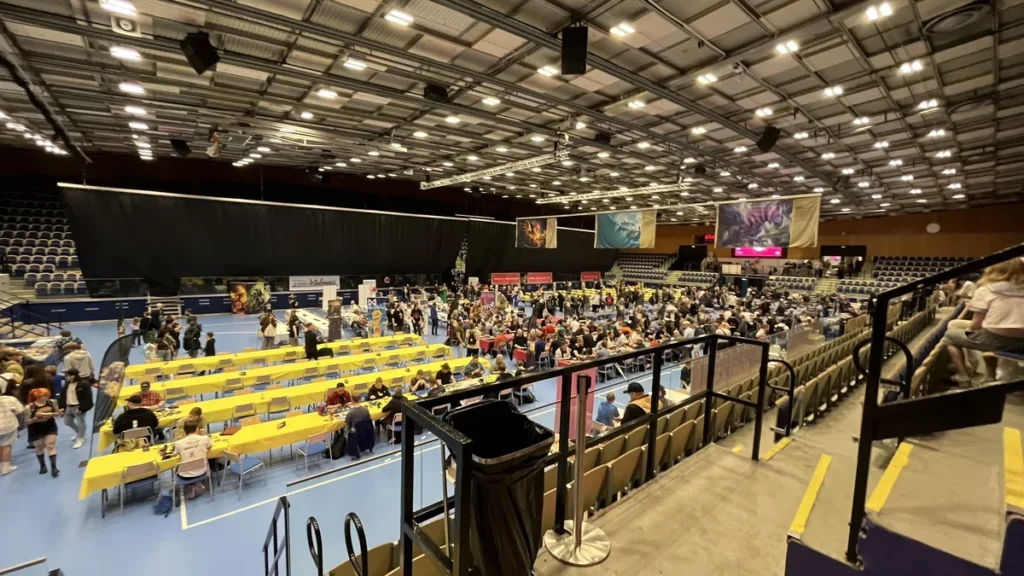
Dice games for 417 players sound impossible until you are the person holding the sign-up sheet for a hall full of people and a crate of dice. No single table seats 417 players, and no single roll can include everyone at once, so the trick is to stop thinking of one game and start thinking of one event built from many small games running at the same time. Dice are cheap, the rules can be taught in under a minute, and the best games break cleanly into tables, teams, and short rounds, which is exactly what a crowd this size needs.
The nine games in this guide were picked for a crowd of 417: five of them turn familiar sports into dice games, so even players who have never touched a polyhedral die can follow along, while the last four use dice in quieter ways that suit mixed ages and mixed energy levels. Each game can be taught from a single printed card, each round lasts only a few minutes, and every result fits on one score sheet. You do not need a games master at every table, and you do not need expensive equipment.
This guide gives you the table plan, dice counts, and round lengths you need to run the night, plus a comparison table, a setup checklist, and answers to the questions every host asks first. Read the scaling plan, pick three or four games, and let the tables rotate between them. With 417 players, the best plan is a simple one, repeated well.
Key takeaways
- Split 417 players into 69 tables of six plus one table of three, and run the same game at every table on one shared clock.
- Choose games anyone can learn in under a minute, so the whole room starts together.
- Sports-themed dice games keep the room loud and competitive, while Dice Solitaire and Dice Chess give quieter tables a break.
- Bring one dice set per table, plus spare dice, score sheets, pens, and a rules card for every game.
- Keep rounds between ten and fifteen minutes, and move table winners to a new table after each round.
How Dice Games Scale to 417 Players
Scaling a dice game to 417 players is a maths problem before it is a games problem. Four hundred and seventeen divides into 69 tables of six, which covers 414 players, plus one table of three for the last three seats. Six is a good table size: everyone can see the dice, nobody waits long for a turn, and a single score sheet stays readable. The table of three simply plays the same game with fewer players, and nobody feels left out.
The second decision is the clock. Every table plays the same game at the same time, and the host calls each round over a microphone or loudspeaker. A round lasts ten to fifteen minutes, then the host calls time and tables record their scores. This shared clock turns 70 separate tables into one event, and it stops fast tables from drifting off while slow tables are still playing. The dice games for 415 players use the same table-and-timer approach, and it works just as well with two more players in the room.
The third decision is the equipment: one dice set per table, plus a spare set for every ten tables, one score sheet and one pencil per table, a rules card for each game, and a visible leaderboard near the host table. Dice cups stop dice bouncing onto the floor, and a tray or shallow box on each table does the same job. Finally, appoint zone captains, one for every eight to ten tables, to answer rules questions, settle disputes, and report scores to the host.
Dice Games for 417 Players at a Glance
Use this table to pick your games at a glance. Every game below needs only standard dice, a score sheet, and a table, and every one works with groups of hundreds of people.
| Game | Dice needed | Players per table | Round length | Best for |
|---|---|---|---|---|
| Dice Hockey | 2 per table | 4 to 6 | 15 minutes | Fast team rivalry |
| Dice Cricket | 2 per table | 4 to 6 | 15 minutes | Big scoring totals |
| Dice Football | 2 per table | 4 to 6 | 15 minutes | American football fans |
| Dice Volleyball | 1 per table | 6 | 10 minutes | Quick loud rallies |
| Dice Rugby | 2 per table | 4 to 6 | 15 minutes | Physical team play |
| Dice Solitaire | 5 per player | 1 to 6 | 10 minutes | Quiet focused tables |
| Dice Memory | 12 per table | 2 to 6 | 10 minutes | Sharp memories |
| Dice Dominoes | 6 per player | 2 to 6 | 15 minutes | Matching and planning |
| Dice Chess | 1 per table | 2 | 20 minutes | Patient strategists |
The 9 Best Dice Games for Huge Groups
Each game below includes the basic rules, the table size that works best, and one tip for running it with dozens of tables at once. Teach one game at a time, let every table play it, and only then move on. If you want a second set of ideas, the dice games for 414 players run on the same shared clock and pair well with this list.
1. Dice Hockey
Dice Hockey turns a table into an ice rink. Draw a simple rink on paper with two goals, and split the table into two teams of two or three. The team with the puck rolls two dice to move it up the ice, and rolling a double means a shot on goal. The defending team then rolls one die: a five or six saves the shot, and anything lower means a goal. First to three goals wins the match.
For 417 players, Dice Hockey is one of the loudest games on this list, because every roll is a pass, a breakaway, or a shot the whole table reacts to. A match lasts about fifteen minutes, and the goalkeeper roll gives the defending team something to do on every attack. Use a bottle cap or a coin as the puck, and let the referee at each table keep the score and settle arguments about which zone the puck is in.
2. Dice Cricket
Dice Cricket plays a full innings with two dice and a score sheet. The batting side sends out one batter at a time, and the batter rolls two dice to score runs equal to the total. Rolling a one on either die means the batter is out, so every roll carries real risk. Each batter keeps rolling until they are out, and the team total is the sum of every batter, with the whole team batting in turn.
For a hall of 417 players, Dice Cricket works because it builds a big, shareable number that tables love to compare. A full innings takes about fifteen minutes with four to six players per table, and the leaderboard quickly fills with team totals. Keep a simple rule card at each table showing that a one means out, and let the non-batting team do the scoring so everyone stays involved between rolls.
3. Dice Football
Dice Football is American football played with two dice and a paper field. The attacking team starts on its own twenty-yard line and has four downs to gain ten yards. On each down, the team rolls two dice and moves the ball forward by the total, so a roll of nine gains nine yards. Roll doubles and the defence makes a tackle for no gain, and four failed downs means the other team takes over.
A touchdown is worth six points, and the first team to two touchdowns wins the game, which takes about fifteen minutes. For 417 players, Dice Football is a strong pick because American football fans already understand downs and yardage, so the game needs almost no teaching. Print a small field on each score sheet, mark the ball with a coin, and let the defending team roll the dice on fourth down to raise the tension.
4. Dice Volleyball
Dice Volleyball is the fastest team game on this list. Split the table into two teams of three, and draw a net line across the middle of the table. The serving team rolls one die: a one or two means the serve hits the net, and anything higher starts the rally. Teams then take turns rolling, and the first team to roll a one loses the rally and gives away the point. First to fifteen points wins the set.
For 417 players, Dice Volleyball works as a quick burst between longer games, because a set lasts only about ten minutes and the whole table plays at once. The single-die rally keeps the pace high, and the sudden loss on a one produces the kind of groan and cheer that carries across the hall. Play best of three sets if a table finishes early, and rotate the server after every five points so everyone gets a turn.
5. Dice Rugby
Dice Rugby turns the table into a rugby pitch with two teams driving the ball toward the try line. The attacking team rolls two dice to carry the ball forward by the total in metres, and the defending team rolls one die after every carry. If the defence rolls a six, they make a tackle and the attack restarts from the same spot, so long drives need a mix of good rolls and good luck. Three tries wins the match.
For a crowd of 417, Dice Rugby suits tables that enjoy a physical, noisy game without needing to leave their seats. A match takes about fifteen minutes, and the tackle roll keeps the defending team alert on every single carry. Draw five zones on the pitch so everyone can see how far the ball has travelled, and let the team that scores a try kick off again so the action never stalls.

6. Dice Solitaire
Dice Solitaire is the quiet game on this list, and every huge event needs one. Each player rolls five dice and tries to arrange them into the best scoring hand, a little like poker with dice: three of a kind, a straight, a full house, or five of a kind. Players roll up to three times, setting aside dice they want to keep, and the best hand at the table wins the round. A round takes about ten minutes.
For 417 players, Dice Solitaire is the game for the tables that want a breather after the shouting matches. Because everyone plays their own hand at the same time, there is no waiting for a turn, and the room stays calm without going silent. Give each player their own five dice and a printed hand-ranking card, and run three rounds so a slow start never decides the table winner.
7. Dice Memory
Dice Memory tests how well a table can remember what it has just seen. Place twelve dice under twelve cups on the table, with the values hidden, and let players take turns lifting two cups. If the two dice show the same number, the player keeps the pair and goes again. If they do not match, the cups go back down and the next player takes a turn. The player with the most pairs at the end wins.
For 417 players, Dice Memory is a brilliant change of pace because it rewards attention rather than luck, and quiet players often beat loud ones. A game takes about ten minutes with two to six players per table, and the hidden dice mean every table plays a different game. Keep the cups opaque so nobody can peek, and reshuffle the dice under the cups between rounds so memory alone decides the winner.
8. Dice Dominoes
Dice Dominoes turns a set of dice into a domino train. Each player starts with six dice, and the first player places one die in the middle of the table to start the train. On your turn, roll one die and place a die from your hand that matches either end of the train, so a train ending in four needs a die showing four. If you cannot match, you pass and pick up a spare die instead. The first player to use all their dice wins.
For a hall of 417, Dice Dominoes suits tables that like planning ahead, because every placement changes what the next player can do. A game takes about fifteen minutes, and the matching rule is simple enough for children and grandparents to play side by side. Use one colour of dice per player so the train stays readable, and keep a spare pool of dice in the middle for players who cannot match.
9. Dice Chess
Dice Chess is normal chess with one twist: a die decides which piece you move. Roll a one and you must move a pawn, two means a knight, three a bishop, four a rook, five a queen, and six means the player chooses any piece. If you cannot move the piece the die demands, you lose your turn, so luck and planning share the board. All other chess rules stay exactly the same, and checkmate still wins the game.
For 417 players, Dice Chess is the slow corner of the evening, and that is its strength. It gives experienced players a game with real depth while the die keeps things fair for beginners, and a single game lasts about twenty minutes. Set up a few chess boards at the side of the hall rather than at every table, and let winners stay on as champions while new challengers take the other seat.
Running the Night: A Host’s Checklist
Use this checklist on the night itself, and tick each item off before the doors open. The dice games for 413 players include a sports-heavy set that pairs well with this list if you want extra options for the night.
- Count the tables and seats before the doors open, and confirm the plan of 69 tables of six plus one table of three.
- Place one dice set, one score sheet, one pencil, and one rules card on every table.
- Put spare dice, score sheets, and pencils in a box at the host table for tables that lose pieces.
- Test the microphone, the timer, and the leaderboard, and make sure the back of the hall can hear the host.
- Brief the zone captains on the rules, the clock, and how to report scores after each round.
- Set out small prizes for table winners, and keep one bigger prize for the overall champions.
Frequently Asked Questions
Can 417 people really play dice games at the same time?
Yes, because nobody plays one giant game. The room splits into 70 tables, every table plays the same game on the same clock, and the host calls each round. The shared timer and the central scoreboard are what turn 70 small games into one event.
How many dice do we need for 417 players?
Plan for one set per table, which means about 70 sets, plus a spare set for every ten tables. Most games on this list need only one or two dice per table, so a bulk box of standard dice covers the whole night for very little money.
What if some players have never played a dice game?
Every game here can be taught in under a minute from a printed rules card, and the sports games need even less teaching because players already know the sport. Start the night with Dice Volleyball or Dice Hockey, which are the easiest to follow from the next table.
How long should the whole evening last?
Allow about two hours for four games, with a short break in the middle. Each round lasts ten to fifteen minutes, and the host needs a few minutes between rounds to collect scores and explain the next game. Four games is enough for every table to find a favourite.
Do we need special dice or boards?
No, standard six-sided dice cover eight of the nine games, and a printed pitch or field on paper covers the rest. Polyhedral dice are only needed if you want to show off a tabletop set, and ordinary dice cups or trays stop dice rolling onto the floor.
What is the best game to start with?
Start with Dice Volleyball, because it is fast, loud, and easy to learn, and the whole table plays at once. Follow it with Dice Hockey or Dice Cricket once the room has warmed up, and save Dice Chess for the side tables where patient players can settle in.
The Bottom Line
Dice games for 417 players work when you stop trying to seat everyone at one table and start running one event across many tables. Split the room into 69 tables of six plus one table of three, put the same game on the same clock everywhere, and let the sports games carry the noise while the quiet games give tired tables a rest. Pick three or four games from this list, print the rules cards, and let the dice do the rest.